
PaintingProGuide is reader-supported. When you buy through links on this page we may earn an affiliate commission at no extra cost to you.
A good palette for mixing colors does one job well: it gives you enough clean space to push two or three paints together without everything bleeding into mud. The shape of that space matters more than the brand name printed on the box.
Flat, open palettes suit thick paints like acrylic and oil, where you drag color with a knife or a loaded brush. Welled trays suit fluid paints like watercolor, gouache and thinned acrylic, where you need walls to stop puddles from running together. Kids and group classes need something cheap, stackable and easy to rinse.
Below you will find six palettes from Amazon, sorted by how well each one handles mixing rather than by price, plus a buying guide that explains wells, surface texture, size and cleanup.
Quick answer: For most painters, the DUGATO 20-Well Plastic Paint Palette 2-Pack is the most practical mixing palette: two large 10 x 13 inch trays with wells of different sizes, so one can stay dirty while you work on the other. If you mix thick acrylic with a knife, pick the flat Tamaki Clear Acrylic Palette 2-Pack. For kids and classrooms, the Hulameda 12-Piece Round Paint Trays give every child their own tray.
Our Top Picks at a Glance
- DUGATO 20-Well Plastic Paint Palette (2-Pack) — Best overall for mixing fluid paint
- Tamaki Clear Acrylic Paint Palette (2-Pack) — Best flat palette for knife and brush blending
- Sweaty Pony 20-Well Large Square Palette — Best single tray for a home studio
- Mr. Pen Round Paint Tray Palettes (4-Pack) — Best budget round palette
- Hulameda 12-Piece Paint Tray Palettes — Best for classrooms and kids
- HYL.LL&RQ 22-Piece Round Paint Palettes — Best bulk pack for parties and workshops
| Product | Best For | Key Spec | Key Strength | Price Tier |
|---|---|---|---|---|
| DUGATO 20-Well Plastic Paint Palette (2-Pack) | overall for mixing fluid paint | Two 10 x 13 in trays, 20 wells each | Mixed well sizes plus a spare tray | $ |
| Tamaki Clear Acrylic Paint Palette (2-Pack) | flat palette for knife and brush blending | 11.8 x 7.9 in rectangular + oval, thumb hole | Open, smooth, see-through surface | $ |
| Sweaty Pony 20-Well Large Square Palette | single tray for a home studio | 13 x 10 in, 20 wells, about 0.35 lb | Variety of well shapes on one tray | $ |
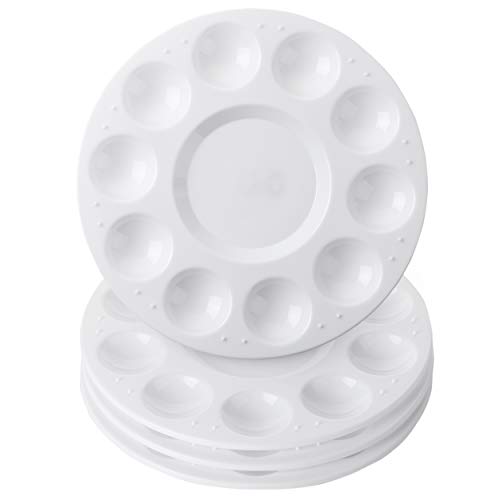
| Mr. Pen Round Paint Tray Palettes (4-Pack) | budget round palette | 6.7 in diameter, 10 wells + center, 0.4 in deep | Central reservoir for a large mix | $ |
| Hulameda 12-Piece Paint Tray Palettes | classrooms and kids | 12 round trays, 6.7 x 6.7 in | One tray per child, stackable | $ |
| HYL.LL&RQ 22-Piece Round Paint Palettes | bulk pack for parties and workshops | 22 trays, 6.6 x 6.6 in, 10 wells + center | Largest quantity in the lineup | $ |
How We Chose
We did not paint on these palettes. Picks are based on the Amazon listing details and specifications checked in October 2026, how well each palette’s format, size and well layout fit color mixing, and how widely each product is reviewed by Amazon buyers.
Mixing is the core use case here, so a palette’s surface layout carried more weight than extras like gift packaging or color options.
- Mixing area: open flat space or enough wells to blend without contamination
- Well depth and variety for fluid paints
- Surface color (white or clear) for judging mixes accurately
- Size versus workspace and portability
- Pack quantity and who it is for (solo artist, family, classroom)
- Ease of cleaning based on material
Best Palettes for Mixing Colors Reviewed
1. DUGATO 20-Well Plastic Paint Palette (2-Pack) — Best overall for mixing fluid paint

This is the palette to start with if you work in watercolor, gouache or acrylic thinned with water. Each 10 x 13 inch tray carries 20 separate wells, which means you can lay out a full set of tube colors along one side and still have a run of empty wells for blending.
The listing describes a smooth, non-stick white plastic surface that wipes or rinses clean. White matters for mixing: you judge a color against the same neutral ground you will usually paint on, so a mix that looks right in the well is less likely to surprise you on paper. Getting two trays in the pack is the real advantage, because you can keep one loaded with dried watercolor and use the other for wet mixes.
Best suited for: Watercolor and gouache painters, students who want a large mixing area, and anyone who likes to keep a dedicated palette per medium.
Key features:
- Two rectangular trays measuring 10 x 13 inches
- 20 wells per tray for separating and mixing colors
- White, non-toxic plastic with a smooth surface
- Lightweight enough to hold or leave flat on a table
Pros:
- Plenty of wells for a full color layout plus mixes
- Second tray doubles your working space or lets you split media
- White ground makes color judgment easier
Cons / limitations:
- Shallow plastic wells do not suit thick impasto acrylic mixed with a knife
- Plastic can stain with strong pigments such as phthalo blue over time
- Large footprint on a small desk
Buying consideration: If you only paint occasionally, one tray may be enough; the Sweaty Pony single-tray version below has the same footprint and well count.
2. Tamaki Clear Acrylic Paint Palette (2-Pack) — Best flat palette for knife and brush blending

Thick paint needs a flat surface, not wells. The Tamaki set gives you two transparent acrylic palettes, one rectangular and one oval, both 11.8 x 7.9 inches with a thumb hole so you can hold them like a traditional artist palette.
Because the sheet is clear, you can slide a white or gray sheet of paper underneath and judge your mixes against whichever value you are painting on. That trick is genuinely useful when you are matching a midtone. The listing notes protective film on both sides that has to be peeled off before use, and the surface is described as smooth with finished edges.
Best suited for: Acrylic painters who mix with a palette knife, plein air painters who hold the palette, and anyone who wants to choose the mixing background color.
Key features:
- Two palettes: one rectangle, one oval, each 11.8 x 7.9 inches
- Transparent acrylic sheet with a thumb hole
- Smooth surface and edges per the listing
- Suitable for acrylic and gouache mixing
Pros:
- Flat open area makes broad, even mixes easy
- Clear sheet lets you change the background value underneath
- Hand-held format works standing at an easel
Cons / limitations:
- No wells, so runny watercolor will spread across the surface
- Acrylic sheet can scratch if scraped hard with a metal knife
- Dried acrylic needs soaking or scraping to remove
Buying consideration: Use a plastic or rounded-edge palette knife on this surface to keep it clear longer, and clean acrylic off before it fully cures.
3. Sweaty Pony 20-Well Large Square Palette — Best single tray for a home studio

If you want one big tray rather than a pair, this 13 x 10 inch palette is slightly larger than A4. Its 20 wells are split into eight squares, four large circles and eight small circles, which is a thoughtful mix: small circles hold tube color, the large circles take bigger washes, and the squares give you room to blend.
At roughly a third of a pound it can be held in one hand or left flat on the table. The listing calls it sturdy, washable and portable enough to go into a backpack.
Best suited for: Students and hobby painters who work at one desk and want different well sizes in a single tray.
Key features:
- 13 x 10 inch footprint
- 20 wells: 8 square, 4 large round, 8 small round
- About 0.35 lb
- Reusable white plastic
Pros:
- Different well sizes for color storage versus mixing
- Light enough to hold
- Fits in a backpack
Cons / limitations:
- Only one tray in the box
- Wells are shallow for big watercolor washes
- Not designed for knife mixing
Buying consideration: Pair it with a small flat palette or a sheet of palette paper if you also mix heavy-body acrylic.
4. Mr. Pen Round Paint Tray Palettes (4-Pack) — Best budget round palette

The classic round tray has stayed popular for a reason. Ten small wells sit around the rim and a larger central reservoir takes the main mix, so you can pull color inward from the edge as you build a blend.
The listing gives the size as 6.7 inches across with wells 0.4 inches deep. That depth is enough to hold watery paint without it spilling between wells. Four trays per pack means you can dedicate one to each painting session or share them.
Best suited for: Beginners, small watercolor or acrylic sessions, and painters who want cheap spare trays.
Key features:
- Pack of four round plastic palettes
- 6.7 inch diameter, 0.4 inch well depth
- 10 wells plus one central reservoir
- Lightweight and easy to rinse
Pros:
- Very low cost per tray
- Central well suits mixing one large batch
- Small enough to hold in one hand
Cons / limitations:
- Limited mixing space for larger paintings
- Thin plastic can flex
- Small wells fill quickly
Buying consideration: Round trays are best for short sessions with a limited palette of colors; for a full spectrum you will want a 20-well tray.
5. Hulameda 12-Piece Paint Tray Palettes — Best for classrooms and kids

Group painting is where palettes get lost, broken or cross-contaminated. A dozen identical round trays solves that: everyone gets their own, they stack for storage, and they rinse fast at a sink.
The listing describes break-proof molded plastic with a smooth surface and a 6.7 inch square footprint. Hulameda also highlights uses beyond painting, such as decorating at parties, which tells you these are designed as general-purpose trays rather than studio palettes.
Best suited for: Teachers, parents, birthday painting parties and art camps.
Key features:
- Twelve plastic paint trays
- About 6.7 x 6.7 inches each
- Stackable for storage
- Break-resistant molded plastic per the listing
Pros:
- Enough trays for a whole table of kids
- Easy to wash and stack
- Light for small hands
Cons / limitations:
- Small mixing area per tray
- Not suited to serious studio work
- Plastic may stain with heavy use
Buying consideration: If you run larger groups, the 22-piece set below lowers the cost per tray further.
6. HYL.LL&RQ 22-Piece Round Paint Palettes — Best bulk pack for parties and workshops

For paint-and-sip events, school workshops or a craft club, this 22-piece pack gives you the same 10-well-plus-reservoir layout as the Mr. Pen trays at a much larger count. Each tray is listed at 6.6 x 6.6 inches.
These trays are about quantity and convenience. They stack, they are light, and losing one or two to dried paint does not matter.
Best suited for: Workshop hosts, teachers with large classes and families who paint often with several kids.
Key features:
- 22 round plastic palettes
- 6.6 x 6.6 inch size
- 10 wells and 1 central reservoir
- Stackable design
Pros:
- Huge quantity for groups
- Familiar round layout
- Disposable-friendly cost per tray
Cons / limitations:
- More trays than a solo painter needs
- Small mixing area per tray
- Lightweight plastic
Buying consideration: Buy this only if you regularly paint with groups; a solo artist gets more from a single large tray.
Wells or Flat? Matching the Palette to Your Paint
The most common reason mixes go muddy is the wrong palette for the medium. Watercolor and gouache are mixed with lots of water, so they need walls. A flat palette lets a wash run straight into the next color.
Acrylic and oil behave differently. Heavy-body paint sits in a mound, and you mix by folding it with a knife or scrubbing it with a brush. Wells get in the way; a flat surface lets you see the whole gradient you are building, from pure color to tint.
Thinned acrylic for pouring or washes sits in the middle. Many painters keep a welled tray for fluid mixes and a flat palette or palette paper for heavier passages.
Buying Guide: How to Choose a Palette for Mixing Colors
Here are the factors that change how a palette performs when you mix, ranked roughly by how much they matter.
Surface type: flat, welled or both
Match the surface to your medium as described above. A 20-well tray covers watercolor, gouache and fluid acrylic. A flat sheet covers acrylic and oil. Painters who use both often own one of each, which costs less than one premium palette.
Number and size of wells
Count the colors you squeeze out on a typical day, then add the same number again for mixes. A 12-color palette user needs about 20 wells to work comfortably, which is why 20-well trays are such a common format. Mixed well sizes help: small wells for storage, large ones for washes.
Surface color
White plastic mimics white paper and canvas, so color reads true. Clear acrylic lets you place a toned sheet beneath it to match a gray or colored ground. Avoid dark or patterned palettes for mixing; they distort value judgment.
Material and staining
Plastic is light and cheap but strong staining pigments, especially phthalos and quinacridones, can leave a tint. That does not affect future mixes much once the surface is clean. Clear acrylic sheet is smoother but can scratch under a steel knife. Porcelain and glass resist staining best but are heavier and fragile.
Size and how you hold it
A 13 x 10 inch tray needs table space. If you paint standing at an easel, a thumb-hole palette around 12 x 8 inches is easier to hold for long periods. For travel, small round trays slip into a bag.
Quantity
Solo painters rarely need more than two palettes. Classrooms and parties benefit from 12 or more identical trays so nobody shares, which keeps colors cleaner and reduces mess.
Keep Learning About Color Mixing
Once your palette is set, practice mixing colors directly on the palette with a limited set of primaries before adding more tubes.
Not sure what to squeeze out? Our guide to which colors to put on a painting palette explains a practical starter layout. If acrylic dries before you finish blending, read about how a wet palette works.
Common Mistakes to Avoid
- Using a welled tray for heavy-body acrylic and fighting the walls while mixing
- Placing colors randomly instead of in a consistent order around the palette
- Mixing every color in the same well and contaminating your clean tones
- Letting acrylic dry on a plastic palette, which makes cleanup much harder
- Judging a mix on a dark or stained surface instead of white or a known value
- Buying a single tiny round tray for a full 12-color palette
FAQs
What type of palette is best for mixing colors?
It depends on your paint. Welled trays with around 20 wells suit watercolor, gouache and fluid acrylic. Flat palettes, like clear acrylic sheets with a thumb hole, suit heavy acrylic and oil because you can mix with a knife.
Is a white or clear palette better for mixing?
White is the default because it matches white paper and canvas. Clear works just as well when you put white paper underneath, and lets you switch to a gray or toned sheet when painting on a toned ground.
How many wells do I need on a mixing palette?
Roughly double the number of colors you use. A 10-color layout works best with 18 to 20 wells so you have empty space for mixes.
Can I use a plastic palette for oil paint?
You can, but oil paint and solvents are harder to clean off plastic and some solvents can soften cheaper plastics. A flat sheet of glass, acrylic or a wooden palette is more common for oil.
How do I stop acrylic from drying on my palette while I mix?
Mist the paint lightly with water, work in smaller amounts, or switch to a wet palette, which keeps acrylic workable for hours or days.
How do I clean dried paint from a plastic palette?
Soak it in warm soapy water so dried acrylic softens and peels. Watercolor and gouache rewet easily and simply rinse off. A soft scraper helps without scratching the plastic.
Final Recommendation
For most painters who mix fluid paint, the DUGATO 2-pack is the strongest all-round choice: large trays, 20 wells each and a spare. If you only want one tray, the Sweaty Pony 20-well palette offers the same footprint with a smart mix of well sizes.
If you mix heavy-body acrylic with a knife, the flat Tamaki clear palettes are the better match. For budgets, the Mr. Pen 4-pack round trays handle short sessions, while the Hulameda 12-piece and 22-piece sets are built for classrooms, kids and parties rather than studio work.




