

PaintingProGuide is reader-supported. When you buy through links on this page we may earn an affiliate commission at no extra cost to you.
The greenest kids’ paint set is often the one that does not end up in the trash half-used. Dried-out pots, cracked lids and tiny single-use containers create more waste than most parents realize. So when choosing the best sustainable paint sets for kids, it pays to look at two questions: what the set is made of, and how long it will actually last in a busy household or classroom.
Only some brands make detailed environmental claims, and we say so plainly below. Alongside those, we include sets whose resealable caps, refill-friendly bottle sizes or long-lasting formats reduce waste in practice. All six picks are washable kids’ paints with non-toxic claims in their Amazon listings.
Quick answer: The most clearly sustainable set here is the Honeysticks Non Toxic Watercolor Paint Set, with 95% natural and plant-based ingredients and a recyclable metal tin. For high-volume painting with less packaging per ounce, the Cra-Z-Art Washable Classic Paint 8-pack offers 4 oz bottles made in the USA. For toddlers, the Nicpro 12-Color Washable Set includes sealable, spill-proof cups that help stop paint drying out.
Our Top Picks at a Glance
- Honeysticks Non Toxic Watercolor Paint Set — Best overall sustainable paint set
- Cra-Z-Art Washable Classic Paint Bulk Pack — Best bulk value with less packaging per ounce
- Nicpro 12-Color Washable Paint Set — Best for toddlers, with sealable cups
- TMOL 12-Color Washable Tempera Set — Best resealable bottles for school projects
- Jar Melo Washable Tempera, 8 Colors — Best squeeze bottles for preschoolers
- Crayola Washable Kids Paint, 6 Count — Best budget starter set
| Product | Best For | Key Spec | Key Strength | Price Tier |
|---|---|---|---|---|
| Honeysticks Watercolor Set | Ages 3+ | 8 colors in metal tin, brush included | 95% natural, plant-based | $$ |
| Cra-Z-Art Classic Paint 8ct | Big projects | 8 x 4 fl oz bottles | Made in USA, bulk size | $ |
| Nicpro 12-Color Set | Ages 1+ | 12 x 2 oz, 10 sealable cups, 10 brushes | Locks in freshness | $$ |
| TMOL 12-Color Tempera | School projects | 12 bottles, 6 brushes, foldable bucket | Aluminum-sealed flip caps | $$ |
| Jar Melo Tempera 8 Colors | Ages 3 to 6 | 8 x 2.1 fl oz, tube squeezer | AP certified, less waste | $$ |
| Crayola Washable 6ct | Starter set | 6 x 2 fl oz | Resealable caps, low cost | $ |
How We Chose
We did not use these sets with children for this guide. Picks are based on the Amazon listing details and specifications checked in October 2026, any ingredient or packaging claims made by the seller, features that reduce waste in everyday use (resealable caps, larger bottles, reusable containers), age guidance and safety statements, and how widely each product is reviewed by Amazon buyers.
- Materials: plant-based ingredients or recyclable packaging where stated.
- Longevity: caps and cups that keep paint fresh between sessions.
- Packaging per ounce: larger bottles create less plastic for the same amount of paint.
- Reusable accessories: brushes, palettes and buckets that outlast the paint.
- Safety: non-toxic and washable claims, ASTM D-4236 or AP certification.
What Sustainable Means for a Kids’ Paint Set
A paint set has several parts, and each one has its own footprint. Thinking about them separately makes it easier to compare.
The paint itself
Most kids’ paints are water-based, which avoids solvents. Some brands go further with plant-based or food- and cosmetic-grade colorants. Others use conventional pigments that are non-toxic but not specifically eco-focused.
The containers
Metal tins can be reused and recycled. Plastic bottles vary: some are recycled, many are not. Larger bottles mean less plastic per ounce of paint, and resealable caps mean less paint dries out and gets thrown away.
The accessories
Brushes, palettes and buckets can last for years if they are sturdy. A set that includes durable tools saves buying them again, which reduces waste over time.
How you use it
The biggest factor is often behavior. Pouring out only what kids need, closing caps after every session, and reusing water jars stretch a set much further. A conventional set used carefully can waste less than an eco set that dries out in a week.
The Low-Waste Starter Palette
Kids do not need dozens of colors. Red, yellow and blue, plus white and black, can mix nearly every color a young painter wants: orange, green, purple, pastel tints, darker shades and browns. Starting with this limited palette has two benefits. It teaches color mixing, which is one of the most valuable early art lessons, and it means fewer bottles to buy, store and eventually recycle.
When a set includes extra colors, it is not wasteful as long as they get used. The problem is buying a big range, using four favorites and letting the rest dry out. If your child gravitates to a few colors, buy those in larger bottles next time.
Storing paint between sessions
Wipe bottle tips before capping so lids seal fully. Store paint upright, away from heat and direct sun. Cover palettes with a damp cloth or plastic wrap if you plan to continue the next day. These habits can double the life of a set.
Best Sustainable Paint Sets for Kids Reviewed
1. Honeysticks Non Toxic Watercolor Paint Set — Best for overall sustainability

Honeysticks makes the most specific sustainability claims in this group. The seller says the watercolor set uses 95% natural and plant-based ingredients, with food- and cosmetic-grade colors and no industrial paint pigments. It is described as 100% non-toxic for ages 3 and up.
The eight colors, including yellow, red, pink, purple, green, blue, brown and orange, come in a recyclable metal tin. A wooden-handled brush stores inside, so the whole set packs away neatly. Pan watercolors last a long time because kids only wet what they use, and the tin can be reused for small treasures once the paint is gone.
The listing says it works on paper, card, cardboard and craft projects, and it is pitched as device-free travel entertainment, which suits families who paint on the go.
Best suited for: Families who want plant-based ingredients and long-lasting, low-waste packaging.
Key features:
- 8 watercolor pans
- 95% natural, plant-based ingredients stated
- Recyclable metal tin
- Wooden-handled brush stores inside
Pros:
- Strongest eco claims here
- Pans last a long time
- Portable for travel
Cons and limitations:
- Watercolor is less bold than tempera
- Higher price per color than bulk paints
Buying consideration: Pair it with heavier paper or cardstock so the watercolors do not buckle thin paper.
2. Cra-Z-Art Washable Classic Paint Bulk Pack — Best for bulk value

Cra-Z-Art’s bulk pack contains eight 4 oz bottles of washable paint in red, orange, yellow, green, blue, purple, white and black. The listing states the paints are made in the USA, washable and non-toxic.
Its sustainability case is practical rather than ingredient-based. Larger bottles mean fewer containers for the same amount of paint, and white and black let kids mix tints and shades, so you need fewer separate colors overall. Domestic manufacturing may also matter to families who prefer US-made products.
It sits in the lowest price tier, making it a good fit for parties, art clubs and households with more than one painter.
Best suited for: Families and groups who paint often and want less packaging per ounce.
Key features:
- 8 bottles, 4 fl oz each
- Includes white and black for mixing
- Made in the USA
- Washable and non-toxic per listing
Pros:
- Low cost per ounce
- Fewer containers for the volume
- Good mixing palette
Cons and limitations:
- No specific eco ingredient claims
- No brushes or palette included
Buying consideration: Decant small amounts into reusable cups rather than squeezing straight onto paper.
3. Nicpro 12-Color Washable Paint Set — Best for toddlers

Nicpro’s set includes twelve 2 oz paints, ten spill-proof paint cups with lids and ten easy-grip brushes. The paints comply with ASTM D-4236 and come with a Children’s Product Certificate, suitable for kids aged 1 and up according to the listing.
The waste-reducing feature is the storage system. Tight inner seals and snap-on lids, which the seller says lock in freshness and reduce waste, mean leftover paint in the cups can be saved for the next session instead of washed down the sink.
Color-coded lids help toddlers learn color names, and the brushes are reusable for years if rinsed properly.
Best suited for: Toddlers, preschool classrooms and daycare settings.
Key features:
- 12 colors, 2 oz each
- 10 sealable, spill-proof cups
- 10 easy-grip brushes
- ASTM D-4236 and CPC certified
Pros:
- Saves leftover paint
- Many reusable brushes
- Suitable from age 1
Cons and limitations:
- Many small plastic cups
- No specific eco ingredient claims
Buying consideration: Rinse cups between colors and reuse them for years to get the most from the set.
4. TMOL 12-Color Washable Tempera Set — Best for school projects
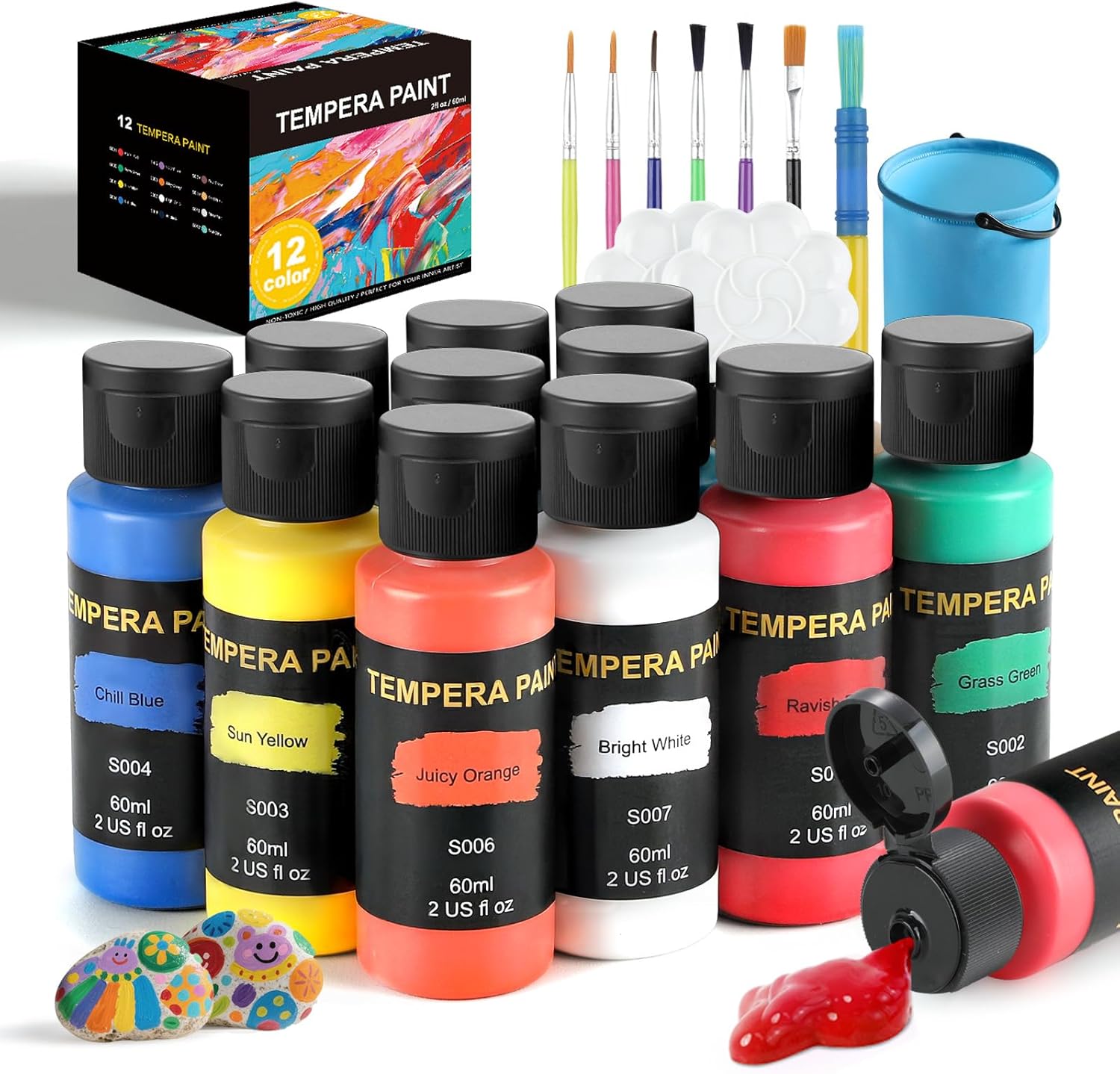
TMOL’s 12-color tempera set includes 12 bottles, six brushes, two palettes and a foldable bucket. The transparent, labeled bottles have aluminum-sealed flip-top caps that the seller says prevent drying and spills while keeping paint fresh for repeated use.
The listing says the formula dries smoothly without cracking or peeling and works on paper, cardboard and wood. It is described as certified non-toxic and suited to ages 6 and up.
The foldable bucket is a small sustainability win: it replaces disposable water cups and packs flat when not in use.
Best suited for: School-age kids working on projects at home or in class.
Key features:
- 12 tempera bottles
- Aluminum-sealed flip-top caps
- 6 brushes, 2 palettes, foldable bucket
- Non-toxic, ages 6+ per listing
Pros:
- Resealable caps reduce dried-out waste
- Reusable bucket and palettes
- Bold coverage
Cons and limitations:
- Ages 6+ guidance
- No specific eco ingredient claims
Buying consideration: Good for older kids who paint regularly and need a complete kit.
5. Jar Melo Washable Tempera, 8 Colors — Best for preschoolers

Jar Melo’s set includes eight 2.1 fl oz paints, three easy-grip brushes, a planet-shaped palette and a tube squeezer. The soft squeeze bottles are designed for small hands, and the squeezer helps reduce waste by pushing out the last of the paint.
The seller describes it as AP certified non-toxic and washable from skin with soap and water, while noting that porous fabrics and wood may be harder to clean. Colors are described as highly saturated and usable on paper, wood, rocks and eggs.
Best suited for: Kids 3 to 6 learning to control how much paint they use.
Key features:
- 8 colors, 2.1 fl oz each
- Tube squeezer to reduce waste
- 3 easy-grip brushes and palette
- AP certified non-toxic per listing
Pros:
- Squeezer gets every drop out
- Small-hand-friendly bottles
- Works on many craft surfaces
Cons and limitations:
- Smaller bottles than bulk packs
- May stain porous fabric
Buying consideration: Teach kids to squeeze a pea-size amount at a time to stretch each bottle.
6. Crayola Washable Kids Paint, 6 Count — Best for budget starter set

Crayola’s six-count set includes 2 oz bottles in yellow, green, yellow orange, red orange, fuchsia, teal and blue violet, as named in the listing. The paint is washable and described as smooth and creamy for blending.
Resealable caps keep paint fresh between sessions, according to the listing. It makes no eco-specific claims, but a well-capped, inexpensive starter set that gets used up completely is a reasonable low-waste choice for families just starting out.
Best suited for: Families trying kids’ painting for the first time on a small budget.
Key features:
- 6 washable paints, 2 oz each
- Resealable caps
- Ages 3+
Pros:
- Lowest price tier
- Trusted brand
- Easy to find refills
Cons and limitations:
- No eco ingredient or packaging claims
- Small bottles
Buying consideration: A sensible first set; upgrade to bulk bottles once kids paint regularly.
Buying Guide: How to Choose a Sustainable Paint Set for Kids
Look for specific claims
Named ingredients and named packaging materials are more meaningful than general words like natural or green. If a listing makes no claim, judge it on longevity instead.
Prefer resealable containers
Flip caps, sealed cups and tins keep paint usable longer, which is one of the simplest ways to reduce waste.
Buy the right volume
Frequent painters waste less with larger bottles; occasional painters waste less with small sets they will finish before they dry out.
Check the accessories
Durable brushes, palettes and buckets can be reused for years. Flimsy accessories that break quickly add to waste.
Match the format to the age
Toddlers need thick, washable paint and spill-proof cups. Preschoolers do well with squeeze bottles. School-age kids can manage watercolor pans and tempera sets.
Confirm safety statements
Look for non-toxic claims, ASTM D-4236 conformance or AP certification, especially for children under 3.
Plan to reuse and recycle
Wash out empty bottles for water or glue, reuse tins for storage, and recycle where local rules allow.
Projects That Make Paint Go Further
Small, focused projects use less paint and give kids a finished piece quickly. Try painted rock critters using stones from the garden, or the easy dinosaur painting tutorial for kids on recycled cardboard.
Common Mistakes to Avoid
- Leaving caps off so paint dries out between sessions.
- Squeezing far more paint than a project needs.
- Buying a large color range when primaries plus white and black would mix most colors.
- Throwing away tins and bottles that could be reused.
- Assuming every eco-labeled set is suitable for toddlers without checking age guidance.
- Rinsing brushes under a running tap instead of in a water jar.
FAQs
What is the most sustainable kids paint set?
Among these picks, the Honeysticks watercolor set makes the most specific claims, with 95% natural and plant-based ingredients and a recyclable metal tin.
Are washable kids paints eco-friendly?
Most are water-based, which avoids solvents. Their eco credentials vary with pigments and packaging, so check each listing for specific claims.
How can I make kids’ paint last longer?
Close caps after every use, pour small amounts into sealable cups, and save leftovers for the next session. Sets with sealed lids make this easy.
Is watercolor or tempera more sustainable?
Pan watercolors tend to last longer because kids only wet what they need. Tempera is bolder but can dry out if left open.
Can I recycle kids’ paint bottles?
Many plastic bottles and metal tins can be recycled once clean, depending on local rules. Reusing them for crafts is another option.
What age is suitable for these sets?
It varies: Nicpro is listed for age 1 and up, Honeysticks, Crayola and Jar Melo for around 3 and up, and TMOL for 6 and up.
Final Recommendation
The Honeysticks watercolor set is the best pick for families who want clear sustainability claims and long-lasting packaging. Cra-Z-Art’s bulk pack is the value choice for frequent painters who want less packaging per ounce. Toddler households should look at Nicpro for its sealable cups, school-age kids will make good use of TMOL’s resealable bottles and bucket, and Jar Melo suits preschoolers learning to control how much paint they use. Crayola’s six-count set remains a sensible, low-cost first step.




