PaintingProGuide is reader-supported. When you buy through links on this page we may earn an affiliate commission at no extra cost to you.
Ask experienced watercolorists what improved their painting most, and many will say paper, not paint. Watercolor happens in the paper: pigment settles into the texture, water spreads through the fibers, and the sheet decides whether a wash stays smooth or dries in blotches. The best watercolor paper for artists handles repeated wetting without pilling, lets you lift and glaze, and stays reasonably flat when soaked.
The single biggest difference is fiber. Professional papers are 100% cotton; most student pads are wood-pulp cellulose. Both have a place in an artist’s studio, and this guide explains which to use when.
Quick answer: For finished paintings, Arches 140 lb Cold Press (9×12 pad) is the benchmark: 100% cotton, long fibers and a classic cold press texture. For daily studies at a lower cost, the Strathmore 300 Series 140 lb pad and the Canson Graduate pad are reliable practice papers. If you paint small and often, the Donyang 5×7 140 lb bulk pack gives 64 cold press sheets for postcards and color tests.
Cotton vs Cellulose: The Difference That Matters Most
100% cotton paper has long, strong fibers that absorb water evenly and slowly. Washes stay wet longer, giving time to blend. The surface tolerates scrubbing, lifting and many glazes. Colors tend to dry more vivid and granulation shows clearly.
Cellulose (wood pulp) paper absorbs differently. Water can sit on top and dry faster, which makes smooth large washes and soft blending harder, and the surface may pill if scrubbed. It is perfectly good for sketching, color charts, studies and learning brush control, and it costs far less.
A practical approach many artists use: practice on cellulose, paint finished work on cotton, and do at least some practice on cotton so your technique transfers.
Weight and Texture Explained
| Term | What it means | Practical effect |
|---|---|---|
| 140 lb / 300 gsm | Standard artist weight | Handles moderate washes; may buckle unless taped or stretched |
| 110 lb / 230 gsm and lighter | Lighter student weight | Buckles more with heavy water |
| 300 lb / 640 gsm | Heavy weight | Stays flat with little or no stretching |
| Cold press | Moderate texture (tooth) | The most versatile surface for most styles |
| Hot press | Smooth | Fine detail, botanical work, ink and wash |
| Rough | Pronounced texture | Granulation, bold landscapes, dry brush |
Everything in this guide is cold press or a standard watercolor finish, and most is 140 lb, because that combination suits the widest range of artists.
Our Top Picks at a Glance
- Arches Watercolor Paper Pad, 140 lb Cold Press, 9×12 — Best for finished paintings and serious study
- Strathmore 300 Series Watercolor Pad, 9×12, 24 Sheets — Best for student and daily practice
- Canson Graduate Watercolor Paper Pad, 9×12 — Best for low-cost studies and illustration practice
- Soucolor Watercolor Paper Pad, 9×12, 40 Sheets — Best for more sheets per pad
- Hapikalor Watercolor Paper Pad, 9×12, 20 Sheets — Best for budget 140 lb cold press
- Donyang Watercolor Paper, 5×7, 64 Sheets — Best for postcards, cards and quick studies
| Product | Best For | Key Spec | Key Strength | Price Tier |
|---|---|---|---|---|
| Arches Watercolor Paper Pad, 140 lb Cold Press, 9×12 | Finished paintings and serious study | 100% cotton, 140 lb, cold press, 9×12 in. | Long cotton fibers prized by watercolorists | $$ |
| Strathmore 300 Series Watercolor Pad, 9×12, 24 Sheets | Student and daily practice | 140 lb (300 g), acid-free, 24 sheets | Familiar student-grade standard | $ |
| Canson Graduate Watercolor Paper Pad, 9×12 | Low-cost studies and illustration practice | 250 gsm fine grain, glue-bound | Glue binding for clean sheet removal | $ |
| Soucolor Watercolor Paper Pad, 9×12, 40 Sheets | More sheets per pad | 140 lb / 300 gsm cold press, acid-free, 40 sheets | Heavy backboard and tear-resistant binding | $$ |
| Hapikalor Watercolor Paper Pad, 9×12, 20 Sheets | Budget 140 lb cold press | 140 lb / 300 gsm cold press, acid-free, 20 sheets | Neutral pH, FSC-certified manufacturer | $ |
| Donyang Watercolor Paper, 5×7, 64 Sheets | Postcards, cards and quick studies | 140 lb / 300 gsm cold press, 64 loose sheets | Bulk small sheets for daily practice | $ |
How We Chose
These picks come from Amazon listing details and specifications checked in October 2026. We have not painted on these papers ourselves. We compared fiber content (where stated), weight, texture, sheet size, sheet count and binding against how artists use watercolor paper, and favored papers that are widely reviewed by Amazon buyers.
Criteria:
- Fiber content: cotton for finished work, cellulose for practice.
- Weight: 140 lb (300 gsm) as the baseline for wet techniques.
- Surface: cold press for versatility.
- Acid-free status for longevity.
- Format: pad size, sheet count and binding for removing sheets cleanly.
Best Watercolor Paper for Artists Reviewed
1. Arches Watercolor Paper Pad, 140 lb Cold Press, 9×12 — Best for finished paintings and serious study
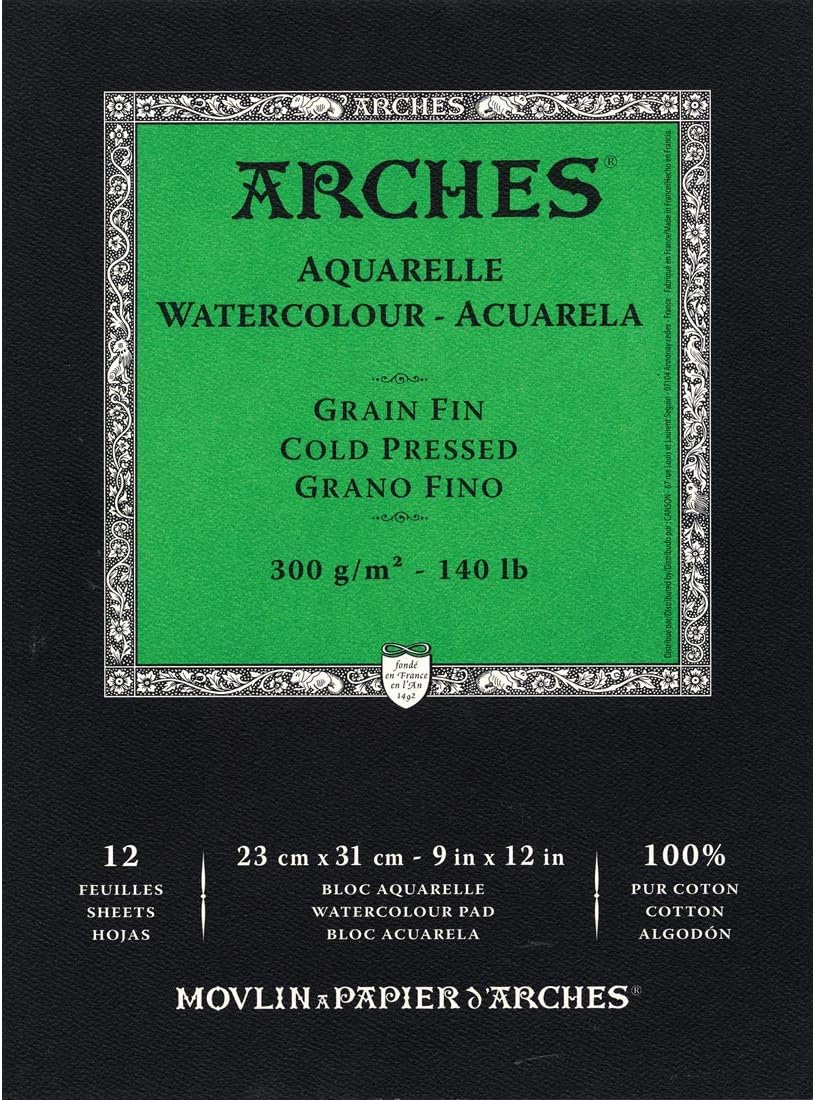
Arches is the paper many watercolor instructors point students toward when they are ready to see what the medium can really do. The listing describes natural white, 100% cotton paper with long fibers, available in cold press, hot press and rough textures. This pad is the 140 lb cold press version at 9×12 inches.
For artists, cotton matters because it behaves predictably under repeated washes. You can lay a wet-in-wet sky, let it dry, glaze over it, and lift highlights without the surface breaking down as quickly as cellulose paper typically does.
Best suited for: Finished paintings, commissions, layered glazing and artists who want their materials to stop being a limitation.
Key features:
- 100% cotton
- 140 lb cold press
- 9×12 inch pad
- Natural white tone
Pros:
- Benchmark cotton paper for watercolor
- Tolerates lifting, scrubbing and many layers
- Versatile cold press texture
Cons and limitations:
- Highest price tier in this list
- 140 lb still benefits from taping or stretching for very wet work
Buying consideration: Use Arches for finished pieces and some studies, not only “special” paintings. Practicing on cotton teaches you how good paper behaves.
2. Strathmore 300 Series Watercolor Pad, 9×12, 24 Sheets — Best for student and daily practice

Strathmore’s 300 Series is a widely used student-grade watercolor pad. The listing confirms a 9×12 size, 24 sheets, 140 lb (300 g) weight and acid-free paper, and suggests uses including watercolor, mixed media, markers and art journaling.
It is a sensible everyday pad for exercises: value studies, brush drills, color mixing and quick sketches, at a fraction of the cost of cotton.
Best suited for: Students, beginners and artists who need affordable paper for practice.
Key features:
- 24 sheets, 9×12 in.
- 140 lb / 300 g
- Acid-free
- Multi-media use
Pros:
- Affordable, widely available standard
- Standard artist weight
- Good for drills and studies
Cons and limitations:
- Not cotton, so large washes behave differently
- Listing gives little texture detail
Buying consideration: Tape sheets to a board on all four sides before wet washes. It limits buckling on 140 lb paper.
3. Canson Graduate Watercolor Paper Pad, 9×12 — Best for low-cost studies and illustration practice

Canson Graduate is positioned as a cost-efficient student paper. The listing describes 250 gsm sheets with a fine grain, glue binding for clean removal, and use with half-pan watercolors, tubes and gouache. Suggested subjects include portraits, illustrations, landscapes and florals.
At 250 gsm it is slightly lighter than 300 gsm papers, so it suits lighter washes, gouache and illustration-style work more than heavy wet-in-wet.
Best suited for: Illustration practice, gouache, students and sketch studies.
Key features:
- 250 gsm fine-grain sheets
- Glue-bound pad
- Works with pans, tubes and gouache
- 9×12 in.
Pros:
- Lowest price tier among 9×12 pads
- Fine grain suits detail
- Clean sheet removal
Cons and limitations:
- Lighter weight buckles more with heavy water
- Cellulose behavior in big washes
Buying consideration: Use this pad for gouache studies and line-and-wash work, where its lighter weight is less of an issue.
4. Soucolor Watercolor Paper Pad, 9×12, 40 Sheets — Best for more sheets per pad

Soucolor’s pad offers 40 sheets of 140 lb (300 gsm) cold press paper in a 9×12 size. The listing describes acid-free, pH-neutral natural white paper with a slightly textured surface, a tear-resistant glue binding for clean removal and a thick cover with heavy backboard.
The sturdy backboard is practical: it gives you a firm surface to paint on when you work in the pad, or to tape a removed sheet to.
Best suited for: High-volume practice, classes and painters who prefer working in a pad.
Key features:
- 40 sheets, 9×12 in.
- 140 lb cold press
- Acid-free, pH-neutral
- Heavy backboard
Pros:
- High sheet count
- Standard artist weight
- Protective cover and backboard
Cons and limitations:
- Fiber content not specified as cotton
- Mid price tier
Buying consideration: Remove a sheet and tape it down for very wet work. Painting inside a glued pad can lead to buckling at the edges.
5. Hapikalor Watercolor Paper Pad, 9×12, 20 Sheets — Best for budget 140 lb cold press

Hapikalor offers 20 sheets of heavyweight 140 lb (300 gsm) cold press paper in a 9×12 pad at a low price tier. The listing describes acid-free, neutral pH natural white sheets with a slightly textured surface, and notes FSC certification for responsibly sourced wood.
For artists building a practice routine, a cheap 140 lb cold press pad lets you paint daily without worrying about waste.
Best suited for: Daily painting, warm-ups, color charts and student kits.
Key features:
- 20 sheets, 9×12 in.
- 140 lb cold press
- Acid-free, neutral pH
- FSC-certified manufacturer
Pros:
- Low cost per sheet at artist weight
- Cold press texture
- Good for experiments
Cons and limitations:
- Fewer sheets than Soucolor
- Fiber content not specified as cotton
Buying consideration: Dedicate one pad purely to swatches and color mixing charts. Knowing how your paints behave on paper saves expensive sheets later.
6. Donyang Watercolor Paper, 5×7, 64 Sheets — Best for postcards, cards and quick studies

Small sheets are underrated. Donyang’s pack includes 64 loose 5×7-inch sheets of 140 lb (300 gsm) acid-free cold press paper. The listing says it works for watercolor plus other wet and dry media, and the manufacturer is FSC certified.
Postcard-size paper encourages finishing paintings rather than abandoning large sheets halfway. It is ideal for daily studies, greeting cards and testing color combinations before committing to a big painting.
Best suited for: Daily painting habits, cards, color tests and travel sketching.
Key features:
- 64 sheets, 5×7 in.
- 140 lb cold press
- Acid-free
- Loose sheets
Pros:
- Very low cost per painting
- Encourages small, finished studies
- Easy to tape down or carry
Cons and limitations:
- Small size only
- Fiber content not specified as cotton
Buying consideration: Tape a 5×7 sheet to a small board with artist’s tape for crisp white borders, perfect for gifting or framing.
Stretching and Taping: Keeping Paper Flat
Even 140 lb paper can buckle when soaked. Two common fixes:
- Taping. Tape all four edges of the sheet to a rigid board with artist’s tape or masking tape. This limits buckling for moderate washes and leaves a clean border.
- Stretching. Soak the sheet briefly, lay it on a board, and secure the edges with gummed paper tape. As it dries, it tightens like a drum and stays flat for heavy wet work. Let it dry fully before painting.
Heavier 300 lb paper can often be painted without either step, but it costs more per sheet.
Buying Guide: How to Choose Watercolor Paper for Artists
Prioritize cotton for finished work
If you plan to frame, sell or exhibit, use 100% cotton paper. It handles wet techniques and layering more predictably and is the long-standing choice for professional watercolor.
Use 140 lb as your baseline
Lighter papers buckle readily and may not survive scrubbing. 140 lb is the standard minimum for wet techniques, with 300 lb as the upgrade for heavy washes.
Pick a texture that matches your style
Cold press suits most artists. Hot press suits detail and botanical work. Rough suits textured landscapes and granulating pigments.
Check acid-free status
Acid-free paper resists yellowing over time. All papers in this guide state acid-free or pH-neutral where listed.
Choose the right format
Pads are convenient; blocks (glued on all sides) stay flatter; loose sheets offer more size options. Small sheets help build a daily habit.
Plan practice versus finished paper
Many artists keep a cellulose pad for studies and cotton for important work. Practicing at least sometimes on cotton helps your technique transfer.
Consider sheet size against your board
Make sure your painting board is larger than your sheet so you can tape or stretch it.
Learn More About Watercolor Surfaces
Start with our guide to how to use watercolor paper, which covers sides, sizing and taping. Curious about alternatives? See whether you can use watercolor on Bristol paper and what happens with watercolor on normal paper. For a non-paper option, read about watercolor on canvas.
Common Mistakes to Avoid
- Learning only on cheap paper. Washes behave differently on cotton, so technique may not transfer.
- Painting soaking-wet washes on unsecured 140 lb paper. Tape or stretch it first.
- Using regular masking tape that tears paper. Artist’s tape or low-tack tape removes cleanly.
- Scrubbing cellulose paper. It pills; lift gently or use cotton paper for heavy lifting.
- Touching the paper surface often. Skin oils can resist paint; handle by the edges.
- Storing paper in humid spaces. Moisture can affect sizing; keep paper flat and dry.
FAQs
What is the best watercolor paper for professional artists?
100% cotton paper, such as Arches 140 lb cold press, is the standard choice for professional watercolor. Cotton handles washes, glazing and lifting more predictably than cellulose papers.
Is 140 lb watercolor paper good enough?
Yes. 140 lb (300 gsm) is the standard artist weight. It can buckle with heavy water, so taping or stretching helps. 300 lb paper stays flatter but costs more.
What is the difference between cold press and hot press?
Cold press has a moderate texture that suits most styles and helps pigment settle. Hot press is smooth, good for fine detail and botanical work, but washes can be less forgiving.
Is cotton watercolor paper worth it?
For finished work, generally yes. Cotton paper absorbs water evenly and tolerates layering and lifting. Many artists use cheaper paper for practice and cotton for final paintings.
Which side of watercolor paper should I paint on?
Many papers can be painted on both sides, but one side often has a slightly different texture. Some cotton papers have a watermark that reads correctly on the intended front side.
Why does my watercolor paper buckle?
Paper fibers expand when wet. Lighter papers and heavy washes buckle most. Taping the sheet to a board, stretching it, or using heavier paper reduces buckling.
Final Recommendation
For paintings you plan to keep, frame or sell, choose Arches 140 lb Cold Press. For daily practice, the Strathmore 300 Series is the familiar student standard, Canson Graduate suits gouache and illustration, and Soucolor or Hapikalor offer budget 140 lb cold press pads. To build a habit of small finished studies, keep a stack of Donyang 5×7 sheets beside your palette.