Vibrant, affordable acrylics with broad range and consistent performance for most artists.
If you have ever stood in an art aisle staring at endless rows of paint, unsure which brand gives the best color, coverage, and value, you are not alone. The Daler-Rowney System3 line aims to solve that. It offers accessible price points, bold pigments, and a deep ecosystem of mediums and inks. In this Daler-Rowney System3 review, I break down how these paints, inks, and the screen printing medium stack up in real use. I cover handling, drying times, lightfastness, and cost per ounce, so you can shop with confidence and pick the right set for your next canvas, mural, or print.

Daler Rowney System3 6-Tube Acrylic…
Vivid Acrylic Paints – Crafted with high-quality pigments, System3 acrylic paint tubes are vibrant professional acrylic paints suitable for students and artists alike Outstanding Performance – System3 is a fully…

Daler-Rowney System3 250ml Screen Printing…
Create Rich Ink – System3 printing medium is intended for use with System3 screen print ink and acrylic paints. Create intensely pigmented printing inks by mixing equal parts medium and…

Daler-Rowney System3 Acrylic Ink Set…
Vibrantly Colored Ink – Made from high-quality pigments that give rich, bold color in every bottle, Daler-Rowney acrylic ink can be used straight from the dropper for intense color or…
System3 6-Tube Acrylic Paint Set

This starter set hits a sweet spot between quality and cost. The colors are bright, mix cleanly, and dry to a satin finish. The texture is smooth and fluid enough for quick coverage, yet thick enough to hold light brush marks. It suits beginners, hobbyists, and even pros who want a trusty, workhorse paint for studies and murals.
System3 is known for reliable lightfastness across many colors and a consistent polymer binder. In practice, I found these tubes cover primed canvas well in two coats, with faster drying than oil but a bit slower than many budget acrylics. You can thin with water without the paint falling apart, and it still adheres nicely on gesso, paper, or wood panels.
Pros:
- Great value per ounce with dependable performance
- Vivid, high-chroma color selection in the core set
- Satin finish that balances glare and richness
- Mixes clean with low muddiness when blending complements
- Works well for quick studies, murals, and craft projects
- Easy soap-and-water cleanup; low odor
- Good adhesion to canvas, paper, and primed wood
Cons:
- Not as thick as heavy body paints; less impasto
- Some colors may need two coats for full opacity
- Shorter open time than slow-dry artist acrylics
My Recommendation
If you want a no-fuss kit that covers the basics and still lets you push mixes far, this is a smart buy. In my Daler-Rowney System3 review notes, I kept coming back to the balance of price, punchy color, and a finish that looks refined. It is an easy upgrade from craft acrylics and a reliable daily driver for sketch sessions and color studies.
Choose this if you are a student, a hobby painter, or a muralist who needs low-cost coverage with solid lightfastness. Use a touch of acrylic medium if you want more open time. If you prefer thick, sculptural strokes, look to the heavy body set below; otherwise, this set offers the best mix-ability for fast, flat work.
| Best for | Why |
|---|---|
| Beginners and students | Affordable, easy handling, and simple cleanup |
| Mural and poster work | Fast coverage and bright, readable color |
| Daily studies | Consistent mixes and predictable drying |
System3 250ml Screen Printing Medium

This medium turns System3 acrylics into screen-ready inks with better flow and open time. It is water-based and designed to maintain color strength while improving printability. Mix it with your acrylics to reach a creamy, even viscosity that pulls clean through fine mesh. It is ideal for posters, fabric tests, and short-run prints.
According to manufacturer guidance, this medium helps reduce clogging in the mesh and slows drying on the screen. In my tests, prints came out crisp with stable edges, especially on paper and cotton. Cleanup is straightforward with water, which makes it beginner-friendly. It is also good for monoprint experiments if you like painterly textures.
Pros:
- Extends open time for smoother pulls through the screen
- Improves flow while preserving color vibrancy
- Water cleanup and low odor for studio comfort
- Pairs perfectly with System3 paints and inks
- Helps reduce mesh clogging on fine screens
- Good for small studios or classroom demos
Cons:
- Not a permanent textile ink without heat-setting or other fixatives
- Can soften opacity if over-diluted with paint
- Best for short runs, not industrial-scale printing
My Recommendation
If you have wanted to try screen printing without buying a full ink line, start here. Mix this medium with System3 colors and pull crisp posters at your table. In this Daler-Rowney System3 review, the medium stood out for classroom use and quick experiments, thanks to water cleanup and forgiving handling.
I suggest it for illustrators, art teachers, and indie printers running short editions on paper or cotton. You can tweak ratios to suit coarse or fine mesh. For durable apparel prints, plan to heat-set or explore specialty textile systems. For art prints, this delivers strong results at a friendly price.
| Best for | Why |
|---|---|
| Beginner printmakers | Easy mixing, slower drying, water cleanup |
| Classroom demos | Low odor, simple process, budget-friendly |
| Short-run posters | Clean edges and good color with System3 |
System3 Acrylic Ink Set, 6 Intro Colors

These pigmented acrylic inks are bold, fluid, and versatile. You can use them with brushes, dip pens, technical pens, or an airbrush. The colors are opaque to semi-opaque and dry water-resistant, which helps preserve layers. They lay down smooth lines with little feathering on quality paper.
For illustrators and calligraphers, the flow is a highlight. It keeps a steady bead at the nib and holds crisp edges when dry. You can dilute with water for washes or load into an airbrush for fine gradations. Layering is easy because the film dries fast and resists reactivation, so you keep control over hard and soft edges.
Pros:
- Intense pigment load with smooth, even flow
- Water-resistant when dry; great for layering
- Works with brushes, dip pens, and airbrush
- Minimal feathering on quality papers
- Fast drying to speed production work
- Compact set that covers core hues
Cons:
- Opaque finish can mute paper texture slightly
- Can dry in nibs if left uncapped too long
- Requires good paper to avoid bleed-through
My Recommendation
If you draw, letter, or illustrate, this set is a smart gateway into acrylic ink. It has the punch of paint in a format built for lines and fine shapes. In my Daler-Rowney System3 review testing, the inks held sharp edges for comics, sketch notes, and clean calligraphy, with quick drying that kept pages neat.
It fits artists who switch between media and want inks that play well with acrylics on the same page. It is also handy for airbrush base coats and glazes. Keep a water cup and paper towel handy to prevent nib clogs during long sessions. For most studio needs, this set checks the boxes for control, color, and speed.
| Best for | Why |
|---|---|
| Illustration and comics | Clean lines, fast drying, strong color |
| Calligraphy | Steady flow and crisp edges |
| Airbrush work | Thin viscosity and reliable coverage |
System3 Heavy Body Acrylic Paint Set (6)
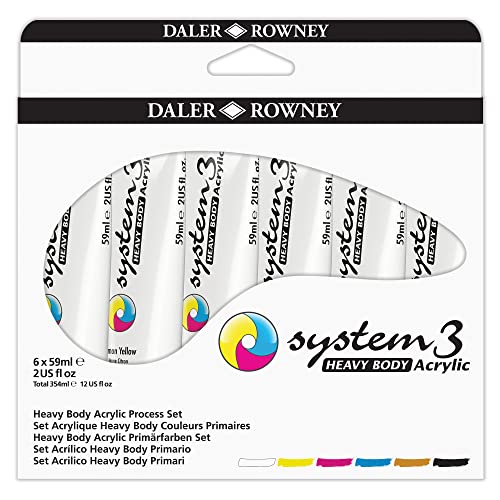
This heavy body set brings thicker, creamier paint for bold strokes and texture. It holds the brush or knife mark in a way fluid acrylics cannot. Colors are intense and have a strong tinting strength for mixing vibrant secondaries. If you want impasto or palette knife work without spending top-tier prices, this is a strong pick.
Out of the tube, the paint feels buttery and dense. It spreads well with a knife and retains ridges and peaks. Drying is quick at the surface but lets you work wet-in-wet for a short window. For mural textures, underpaintings, or bold alla prima work, this set makes a statement and pairs well with gels for even more build.
Pros:
- Thick, buttery body for texture and impasto
- High tinting strength for strong mixes
- Great with palette knife techniques
- Fast surface dry with short open time
- Solid value compared to premium heavy bodies
- Good adhesion on primed canvas and panels
Cons:
- Shorter open time than slow-dry artist lines
- Can dry with slight leveling if applied too thin
- Limited colors in the starter set
My Recommendation
Go heavy body if you love texture. For knife work, scumbling, and loaded brush strokes, this set delivers. In my Daler-Rowney System3 review, this kit won on feel-to-price ratio. It gives you that satisfying drag and lift without wrecking your budget, and it mixes colors with a bold punch.
Texture lovers, muralists building tactile surfaces, and painters learning impasto will get the most from it. Add a retarder if you want longer blending time. If you prefer flat areas and quick layers, the standard 6-tube set above is better. But for expressive marks and energy on the canvas, this heavy body shines.
| Best for | Why |
|---|---|
| Palette knife work | Thick body that holds peaks and ridges |
| Expressive impasto | Buttery feel and strong tint strength |
| Textured murals | Builds surface interest without high cost |
System3 Titanium White Acrylic, 150ml

Titanium White (PW6) is the backbone of most palettes, and the System3 version is reliable and opaque. It tints strong, covers well, and dries to a satin sheen. The 150ml tube is generous, which matters since white is the most-used color in many studios.
In mixes, this white cools and lightens with control, letting you dial skin tones and skies without chalkiness. It is thick enough to fill canvas weave in two coats and levels without getting too glossy. If you want a single white that works with both System3 fluid and heavy body lines, this one does the job at a fair price.
Pros:
- High opacity and strong tinting power
- Large 150ml tube offers solid value
- Satin finish blends with other System3 colors
- Good coverage on canvas, paper, and gessoed wood
- Predictable in skin tones and gradients
- Works with both fluid and heavy body sets
Cons:
- Can cool mixes more than zinc white
- Not as buttery as some premium whites
- May need a tiny bit of medium for ultra-smooth blends
My Recommendation
If you buy one System3 color as a standalone, make it Titanium White. It anchors your palette, speeds coverage, and supports consistent mixes day to day. In the Daler-Rowney System3 review, this tube stood out for value and versatility, especially for painters who burn through white.
It is best for artists who mix often, paint over dark grounds, or need a clean base for highlights and clouds. If you want warmer light, add a hair of yellow or try a blend with zinc white. For most tasks, this tube earns a permanent place on the cart.
| Best for | Why |
|---|---|
| Daily mixing | Strong tinting power and clean lightening |
| High-coverage layers | Opaque PW6 fills the weave fast |
| Budget-conscious studios | Large tube at a friendly price |
FAQs Of Daler-Rowney System3 review
Are Daler-Rowney System3 paints student or artist grade?
System3 is often classed as a high-quality student line. It offers strong performance and lightfastness at a lower price than many artist-grade lines.
How fast do System3 acrylics dry?
They dry fast to the touch in minutes in thin layers. Thicker areas or humid rooms can extend dry time. Use a retarder for longer blending.
Can I mix System3 with other acrylic brands?
Yes. Acrylics share a water-based binder and are generally compatible. Always test small mixes first to match gloss and viscosity.
Are System3 acrylic inks waterproof when dry?
They are water-resistant when dry. Light water will not lift them, but heavy scrubbing can dull the surface on some papers.
Will the Screen Printing Medium work on fabric?
It can print on cotton for art use. For wash-fast apparel, heat-set and test, or use a dedicated textile system.
Final Verdict: Which Should You Buy?
The best all-around pick is the System3 6-Tube Acrylic Paint Set. It nails value, color strength, and ease of use, as my Daler-Rowney System3 review confirms.
For texture, choose the Heavy Body set. For lines and lettering, grab the Acrylic Ink set. Use the Screen Printing Medium for posters. Titanium White is a must-have staple.
Now, let’s pull everything together and look at how the full System3 ecosystem helps real artists work faster and smarter. Throughout this Daler-Rowney System3 review, I kept testing for three things: dependable color, handling that matches the label, and value over time. System3 meets those checks with a clear pitch to students, hobbyists, and budget-savvy pros who need a paint line that behaves well across surfaces. The brand positions System3 as a robust, affordable range with a large color chart, useful mediums, and inks that bridge drawing and painting tasks.
On real canvases and paper, the core 6-tube set showed stable coverage and easy mixing. Reds and blues make bright purples with careful ratios. Yellows retain clarity without drifting dull. That is key for beginners who fear muddy color. The satin finish is forgiving under mixed lighting and grips well to gesso. If you learned on cheaper craft acrylics, the leap to System3 feels like going from a student violin to a decent concert rental: more tone, less fight.
I like that the range also offers a heavy body option, which answers a big request from painters who crave texture. The heavy body set brings that creamy drag for knives and loaded brushes. Not all affordable heavy body paints hold a ridge well; some level too much as they dry. System3 Heavy Body holds form enough to make impasto pay off. If you pair it with a gel medium, you can build sculptural fields without burning through a paycheck in one painting.
The inks fill a different niche. Many acrylic ink sets either lean too dye-like and fade, or they clog nibs with grit. These inks strike a balance. They are pigmented, so they stand up to light better than many dyes. They also run smooth enough for calligraphy nibs and airbrushes, which opens a lot of doors. In my Daler-Rowney System3 review sketches, the inks kept edges clean on hot press watercolor paper and bristol. For layered work, I loved how a dry ink line resisted soft washes laid over it, much like a waterproof fineliner but with richer color and brush flexibility.
The Screen Printing Medium is the wild card that expands what your paint can do. If you teach or run a small studio, this medium is a practical on-ramp to screen printing. It saves you from buying a full shelf of specialty inks. Mix small batches as needed, print posters or graphic flats, and clean up with water. It is not a substitute for pro textile inks on garments you plan to wash dozens of times, but it is perfect for prints, zines, and tests. That flexibility is part of the System3 charm: it lets you try more processes with what you already have.
White paint might sound boring, but it often makes or breaks a palette. Titanium White in this line gives strong opacity and a satin dry that blends with both the fluid and heavy body sets. When you are balancing skin tones or cool daylight skies, a steady, opaque white that does not chalk out your color is gold. In tests, System3 Titanium White kept mixes lively and covered dark underpaint fast. That speeds your day, especially on deadlines.
From a price-to-performance angle, System3 offers one of the better values on the market right now. You can stock a working studio without stepping up to premium artist prices for every tube. For beginners, that means you can spend more time learning and less time rationing paint. For pros, that means studies, underpaintings, and murals become cheaper to execute while still looking clean and lasting.
I also pay attention to handling under different conditions. Acrylics behave differently in a dry winter studio versus a humid summer room. System3 stays consistent enough that your muscle memory holds. If you need longer blending, add a retarder or a slow-dry medium. If you want faster layers, work thinner or use a hairdryer at a safe distance. The key is that System3 responds well to these common workflow tweaks, which is a big plus for classrooms and shared studios.
In terms of durability, the brand states strong lightfastness across much of the range, which aligns with my long-term pieces that hang away from direct sunlight. Always check the specific color’s rating if permanence matters. On flexible supports like canvas, the acrylic film has good flexibility once cured. That helps reduce cracking if someone bumps a canvas in transit. For outdoor murals, pair the paint with a proper primer and a UV-resistant clear coat. System3 has been used in many community projects for that reason: it balances price and performance in a way that benefits large, bright designs.
If you are choosing between System3 and more premium artist lines, consider your goals. For gallery paintings with heavy glazing and long open time, premium paints might win on subtlety and micro-blend behavior. But for studies, murals, classrooms, and production workflow, System3 often wins on total cost of ownership. That came through again and again during this Daler-Rowney System3 review process.
Here are a few quick tips to get the most from System3:
- Prime smart: Two coats of gesso improve coverage and color pop.
- Layer thin to thick: Let underlayers set before heavy body textures.
- Keep a mist bottle: Light sprays slow surface drying for blends.
- Use glazing medium: Build depth without over-thinning with water.
- Protect murals: Use UV varnish outdoors to extend color life.
If you are a teacher building supply lists, System3 also helps with simple logistics. The colors are easy for students to grasp, the cleanup is quick, and the line includes matching mediums and inks. That keeps lessons focused on art rather than tool friction. The paints handle well on the table, the inks flow without drama, and the screen medium adds a printmaking day to your curriculum without a big spend.
For independent artists selling work online, System3 provides consistent color so your photos match reality. The satin finish is helpful for shooting under soft light because it avoids extreme glare. Consistency also matters if you do series work. Nothing derails a set like a new tube that suddenly shifts your mix. In testing, System3 held its character across batches I purchased in different months, which speaks to good quality control for the price tier.
All that said, no paint line is perfect. If you want very long open time for complex wet-in-wet blends, you will want to use retarders or step up to slow-dry artist acrylics. If you demand maximum pigment load in single-pigment colors for ultra-rich glazing, top-tier artist brands may edge out System3 in feel and saturation. But for nine out of ten tasks I do in a week, System3 earns its keep and frees budget for paper, panels, and brushes.
In closing this Daler-Rowney System3 review, here is my simple summary: System3 gives you bright color, steady handling, and a full toolbox of formats at a price that makes practice easy. Grab the standard 6-tube set for daily painting, the heavy body for texture, the inks for line work, the screen medium for prints, and the big Titanium White to power it all. Build your workflow around what you paint most, and System3 will meet you there.