PaintingProGuide is reader-supported. When you buy through links on this page we may earn an affiliate commission at no extra cost to you.
Quick answer: An extension pole for paint brushes is really two parts: a threaded pole and a brush adapter that grips the brush. For the adapter, the McCauley Revolver is the sturdiest choice and adds a 360-degree mini roller; the Foxtrot multi-angle extender is the budget pick for 1 to 3 inch brushes. Pair either with the EXTEND-A-REACH 1.5 to 3 ft aluminum pole for a stiff, compact reach. If you would rather skip adapters, the ROLLINGDOG 2.5 inch adjustable-angle brush threads straight onto a pole.
Muralists, set painters, sign painters and anyone working on a wall bigger than they are eventually face the same problem: the top third of the painting is out of reach. A ladder works, but moving it every few feet is slow and every climb pulls you away from the overall view of the image. Extension poles let you stay on the ground, step back and paint high areas with longer, more fluid strokes.
Poles are also popular with large-canvas painters who like to work standing well back from the surface, a technique that encourages loose, gestural marks. This guide explains what to look for in extension poles for paint brushes, which adapters hold a brush securely and how to control a brush at arm’s length plus several feet.
How Brush Extension Systems Work
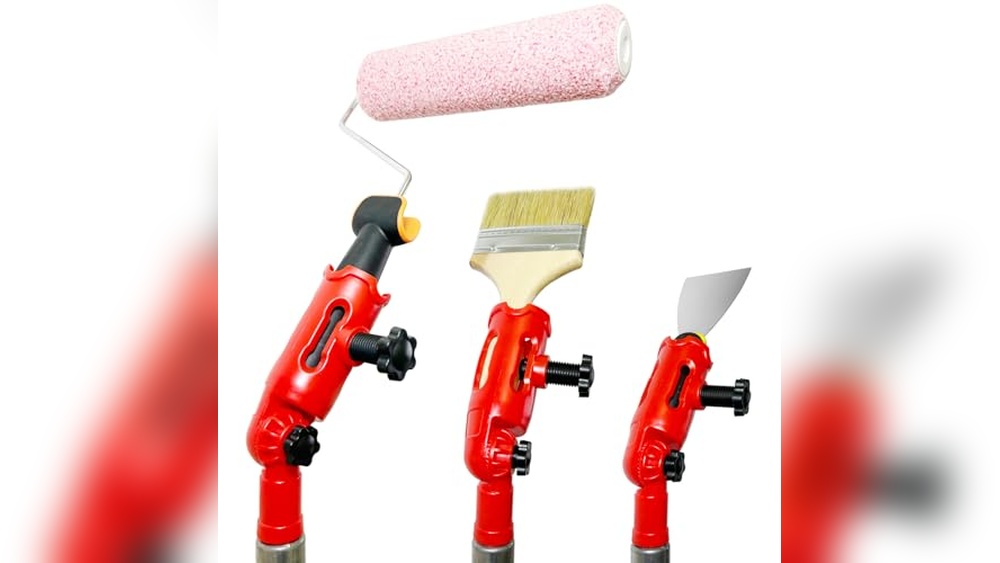
Most paint extension poles use a standard threaded tip, the same thread found on paint roller frames. A brush extender (also called a brush holder or edger tool) screws onto that tip and clamps the brush handle, usually with a pivoting head so you can set the brush at an angle. Some brushes have a threaded hole built into the handle and screw on directly. Simple screw-together poles in short sections are also available for light work.
- Pole: telescoping aluminum, fiberglass or sectional steel, with a threaded or locking tip.
- Brush adapter: clamps a brush, often pivots between 160 and 360 degrees.
- Threaded-handle brushes: screw directly onto a pole with no adapter.
Our Top Picks at a Glance
- McCauley Revolver Brush Extender and Roller Holder — Best heavy-duty brush adapter
- Foxtrot Multi-Angle Paint Brush Extender — Best budget adapter for 1 to 3 in brushes
- WYXDSDEV Multi-Angle Brush Extender — Best adapter for wider brushes up to 5 in
- EXTEND-A-REACH 1.5 to 3 ft Telescopic Pole — Best short, stiff extension pole
- ROLLINGDOG 2.5 in Adjustable Angled Brush — Best brush that threads directly onto a pole
- SACKORANGE 3-Piece 4 ft Screw-Together Pole — Best cheap sectional pole
| Product | Best For | Key Spec | Key Strength | Price Tier |
|---|---|---|---|---|
| McCauley Revolver | Heavy-duty adapter | Fits most brush handles; includes 360-degree mini roller | Compatible with threaded and locking poles | $$ |
| Foxtrot Extender | Budget adapter | Holds 1 to 3 in brushes; 160-degree pivot | Also takes rollers and scrapers | $ |
| WYXDSDEV Extender | Wide brushes | Holds 1 to 5 in brushes; 160-degree pivot | Takes larger brushes | $ |
| EXTEND-A-REACH Pole | Stiff short reach | 1.5 to 3 ft, thick aluminum | Resists wobble, 3-year warranty | $ |
| ROLLINGDOG Brush | No-adapter setup | 2.5 in synthetic, 6 angle positions | Threads onto poles | $ |
| SACKORANGE Pole | Low-cost sectional | 3 stainless sections, up to 4 ft | Use only the length you need | $ |
How We Chose
These recommendations are based on the Amazon listing details and specifications checked in October 2026, how well each product suits brush work on murals and large surfaces, and how widely each product has been reviewed by Amazon buyers. We have not used these poles or adapters ourselves.
- Grip and compatibility: the range of brush widths an adapter holds and the pole threads it fits.
- Angle control: how far the head pivots, and whether it locks.
- Stiffness: poles that resist flex give more accurate strokes.
- Reach: a mix of short poles for 8 to 10 foot walls and sectional options.
Best Extension Poles for Paint Brushes Reviewed
1. McCauley Tools Revolver Brush Extender and Roller Holder — Best for a heavy-duty brush adapter

The Revolver is a two-in-one adapter: it clamps most brush handles and also accepts McCauley 360-degree rollers, and a Speed Pro mini roller with 16 angle positions is included. The listing describes patented quick-change insertion for swapping between brush and roller and says it is compatible with threaded and locking poles.
For mural work, that combination is useful. You can roll a background color high on the wall, then switch to a brush for edges or blending without climbing down. The soft rubber contoured grip helps when you are holding a pole for long stretches.
Because it is built for heavier use, it is the adapter to choose if the wall is large and you expect to paint high areas for hours.
Best suited for: muralists and large-surface painters who switch between rolling and brushing overhead.
Key features:
- Holds most brush handle sizes
- Includes 360-degree Speed Pro mini roller with 16 angle settings
- Quick-change brush and roller insertion
- Compatible with threaded and locking poles
- Soft rubber ergonomic grip
Pros:
- Sturdiest adapter here
- Brush and roller in one tool
- Wide pole compatibility
Cons and limitations:
- Highest price tier among adapters
- Pole not described as included
Buying consideration: Set the brush angle before you load it with paint; adjusting a loaded brush overhead invites drips.
2. Foxtrot Multi-Angle Paint Brush Extender — Best for a budget adapter for 1 to 3 inch brushes

The Foxtrot extender clamps brushes from 1 to 3 inches wide and also takes rollers or scrapers. The head rotates 160 degrees up and down, so you can set the brush horizontal for ceiling bands, vertical for walls or angled into corners.
It is a simple, light tool for occasional high work, and the 1 to 3 inch range covers the brushes most muralists use for blocking in color.
Best suited for: occasional high work, DIY murals and painting rooms with tall walls.
Key features:
- Holds 1 to 3 in brushes
- 160-degree rotating head
- Works with rollers and scrapers
- Secure handle grip
Pros:
- Low price tier
- Simple to use
- Flexible angle
Cons and limitations:
- Smaller brush range than the WYXDSDEV
- Lighter construction than McCauley
Buying consideration: Tighten the clamp firmly and test with a dry brush before loading; a brush that slips under pressure will smear the wall.
3. WYXDSDEV Multi-Angle Paint Brush Extender — Best for wider brushes up to 5 inches

Similar in design to the Foxtrot, this extender accepts brushes from 1 to 5 inches and rotates 160 degrees. The listing is clear that the pole is not included.
The extra capacity matters if you block in large backgrounds on a mural with a 4 or 5 inch brush, where a 3 inch maximum would hold you back.
Best suited for: mural backgrounds and big flat areas painted with wide brushes.
Key features:
- Holds 1 to 5 in brushes
- 160-degree rotation
- Brush, roller or scraper use
- Pole not included
Pros:
- Takes wider brushes
- Low price tier
- Versatile
Cons and limitations:
- Pole sold separately
- Wide loaded brushes are heavy at full extension
Buying consideration: Use shorter pole lengths with wide brushes; the weight of a loaded 5 inch brush makes long poles harder to control.
4. EXTEND-A-REACH 1.5 to 3 ft Telescopic Pole — Best for a short, stiff extension pole

This short pole telescopes from 1.5 to 3 feet, which the listing says gives most people up to 8 to 10 feet of reach. It is made from extra-thick aluminum to resist the wobble that longer, thinner poles develop at full extension, and it carries a three-year warranty.
Short and stiff is exactly what brush work needs. A long pole is great for a roller, but with a brush you want precise control, and every extra foot magnifies small hand movements.
Best suited for: standard 8 to 10 foot walls and anyone who wants accurate brush strokes overhead.
Key features:
- 1.5 to 3 ft telescopic
- Extra-thick aluminum
- Universal threaded tip
- Locking mechanism, non-slip grip
- 3-year warranty
Pros:
- Minimal flex
- Compact to store
- Fits most threaded accessories
Cons and limitations:
- Not long enough for very tall walls or stairwells
- Adapter sold separately
Buying consideration: For tall walls, pair a short stiff pole with a stable platform rather than buying a very long pole for brush work.
5. ROLLINGDOG 2.5 in Adjustable Angled Paint Brush — Best for a brush that threads directly onto a pole

Instead of an adapter, the ROLLINGDOG brush has a jointed rubber handle with a push-button lock and six angle positions, and the end threads onto standard extension poles. The 2.5 inch angled head uses solid round tapered synthetic filament with a stainless steel ferrule.
Because the brush and connector are one piece, there is no clamp to slip. Changing the angle lets you paint over shelves or around obstacles, which helps on murals that wrap around fixed features.
Best suited for: painters who want one dedicated pole brush with no adapter.
Key features:
- 2.5 in angled synthetic brush
- Six locking angle positions
- Threads onto extension poles
- Stainless steel ferrule
Pros:
- No adapter needed
- Secure connection
- Good for edges overhead
Cons and limitations:
- Only one size
- You must clean it like any brush, joint included
Buying consideration: Because the filament is synthetic, it suits water-based acrylic and latex mural paints.
6. SACKORANGE 3-Piece 4 ft Screw-Together Extension Pole — Best for a cheap sectional pole

This pole is three stainless steel sections with threaded plastic connectors that screw together up to 4 feet. Use one, two or all three sections depending on how far you need to reach.
It is the least expensive way to add reach, and sectional poles pack small, which helps if you travel to mural sites.
Best suited for: occasional use, travel kits and light brushes.
Key features:
- 3 stainless steel sections
- Up to 4 ft total
- Threaded connectors
- Works with rollers, brushes and dusters
Pros:
- Lowest price tier
- Adjustable by section
- Packs small
Cons and limitations:
- Plastic connectors are the weak point
- Less stiff than thick aluminum
Buying consideration: Use the fewest sections that reach; each joint adds a little flex.
Buying Guide: How to Choose Extension Poles for Paint Brushes
Check thread compatibility
Most US poles and accessories share a standard threaded tip, but locking systems vary by brand. Confirm the adapter fits your pole before buying, or buy both from a brand that lists compatibility.
Choose the right length
For brush work, shorter is better. A 1.5 to 3 foot pole reaches most 8 to 10 foot walls. Use a longer pole only when you must, and expect less precision.
Prioritize stiffness
Thick aluminum and fiberglass flex less than thin steel sections. Flex turns small hand movements into wobbly lines.
Match adapter capacity to your brushes
Check the brush width range: 1 to 3 inches covers most mural brushes; go to 5 inches for wide backgrounds.
Look for angle adjustment
Pivoting heads let you keep the brush flat to the wall when you are standing below it. Locking positions are more reliable than friction-only joints.
Consider weight
Your arms hold the pole for long periods. Lighter poles and adapters reduce fatigue; heavy-duty adapters trade a little weight for security.
Technique: Painting With a Brush on a Pole
Hold the pole with one hand near the end and the other hand guiding further up, like a pool cue. Move from your shoulders and hips rather than your wrists. Load the brush lightly; paint drips down a pole quickly. Work in vertical bands from top to bottom so drips land on unpainted wall, and step back often to judge the composition from a distance, which is one of the biggest benefits of working this way.
For crisp lines high up, tape the edge first and run the brush along the tape. For blended skies on murals, use a wide brush on a short pole and long, overlapping strokes. Our guide on how to paint with large brushes covers stroke control that transfers directly to pole work, and when you finish, follow our advice on how to dry paint brushes correctly so they keep their shape.
Which Brushes Work Best on a Pole?
Not every brush suits pole work. Short, stiff synthetic flats and angles in the 2 to 3 inch range are the most predictable, because they hold their shape when pressed against a wall from a distance. Very soft brushes and long-haired liners collapse under the extra leverage, and natural bristle brushes go limp in water-based mural paints.
Angled sash brushes are especially useful high on a wall, since the long toe of the angle lets you draw a line along a ceiling or a taped edge while the pole is tilted. For large areas, a mini roller in the same adapter covers ground faster than any brush, and you can come back with a brush to soften edges or add texture.
Safety and Setup Tips
- Lay drop cloths along the base of the wall; drips from overhead travel further than you expect.
- Wear eye protection when painting ceilings or high bands with the brush above your head.
- Keep pole joints and clamps clean so they lock securely next time.
- Rest your arms every 15 to 20 minutes on long sessions.
Common Mistakes to Avoid
- Using a long roller pole for detailed brush work and fighting constant flex.
- Overloading the brush, which sends paint running down the pole and onto your hands.
- Forgetting to lock the adapter angle before painting.
- Buying an adapter that does not fit your pole thread.
- Painting from the bottom up and dripping onto finished areas.
- Leaving paint to dry in the adapter clamp, which stops it gripping next time.
FAQs
Can you put a paint brush on an extension pole?
Yes. Use a brush extender adapter that screws onto the pole and clamps the brush, or buy a brush with a threaded handle that screws on directly.
What length extension pole do I need for a brush?
For most 8 to 10 foot walls, a 1.5 to 3 foot pole is enough. Longer poles reach higher but reduce brush control.
Are extension poles universal?
Many poles share a standard threaded tip, but some brands use locking systems. Check the listing for compatibility with your adapter.
Is a brush extender good for murals?
Yes, especially for blocking in large areas and edges high on a wall. Fine detail is still easier from a ladder or scaffold.
How do I stop a brush slipping in an extender?
Tighten the clamp firmly on a clean, dry handle, test with gentle pressure before loading paint and avoid pressing hard against the wall.
Can I use an extension pole for large canvas painting?
Yes. Some painters attach brushes to short poles to paint large canvases from a distance, which encourages looser strokes and lets them see the whole piece while working.
Final Recommendation
For serious mural and large-surface work, combine the McCauley Revolver adapter with the EXTEND-A-REACH short aluminum pole; the Revolver’s included mini roller is a bonus for backgrounds. If you only need occasional reach, the Foxtrot extender (or the WYXDSDEV for brushes wider than 3 inches) on any standard threaded pole does the job at a low price. Choose the ROLLINGDOG adjustable brush if you want a single tool with no clamp to fiddle with, and the SACKORANGE sectional pole as a cheap, packable backup.