PaintingProGuide is reader-supported. When you buy through links on this page we may earn an affiliate commission at no extra cost to you.
Quick answer: Paint brush sizes are numbers that describe the width or diameter of the brush head: small numbers (and “0” sizes like 2/0, 5/0, 10/0) are tiny detail brushes, while larger numbers such as 10, 12 or 20 are broad brushes. The scale is not standardized between brands, so a size 8 from one maker may be wider than another’s. To learn the range hands-on, a mixed set like the Amazon Basics 24-brush multi-shape set or the AROIC 60-piece set lets you compare sizes side by side; for broad backgrounds and gesso, add inch-width flats such as the King Origin 0.5 to 2.5 inch pack.
Few things confuse new painters more than brush sizes. Why is a 2/0 smaller than a 0? Why does a size 6 flat look completely different from a size 6 round? And why do two size 6 rounds from different brands not match? This guide explains paint brush sizes in plain language: how the numbering works, what sizes each shape comes in, which sizes you actually need for common subjects and how to read brush sets so you buy sizes you will use.
How Paint Brush Sizes Are Numbered
Artist brushes use a number system that runs in two directions from zero.
- Whole numbers (1, 2, 4, 6, 8, 10, 12 and up): the bigger the number, the bigger the brush head. Many lines skip odd numbers above 2.
- “Aught” sizes (0, 2/0, 3/0, 5/0, 10/0, 20/0): these go smaller than 0. 2/0 is read “double aught” or “two-zero,” and the larger the number before /0, the smaller the brush. A 10/0 is tinier than a 5/0.
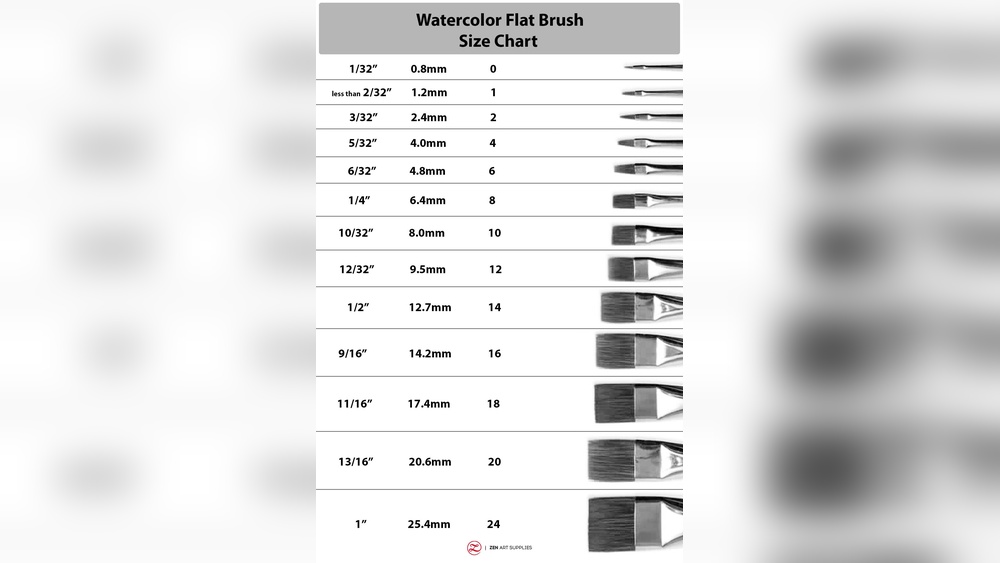
- Inch or millimeter sizes: wide flats, washes, hakes and craft brushes are often sized by the width of the ferrule, such as 1/4 inch, 1 inch or 25 mm.
The number usually reflects the ferrule width or diameter, but each manufacturer sets its own scale. Treat numbers as a guide within one brand, and compare actual widths (often listed in millimeters) when mixing brands.
Paint Brush Size Chart (Approximate)
Because sizes vary by brand, the ranges below are rough guides to help you picture each size, not exact measurements.
| Size | Typical Use | Rough Head Width |
|---|---|---|
| 20/0 to 5/0 | Hairlines, eyelashes, tiny highlights, miniatures | Well under 1 mm |
| 3/0 to 0 | Fine detail, lettering, small dots | About 1 mm |
| 1 to 4 | Small details, small leaves and features | About 1.5 to 4 mm |
| 6 to 8 | All-round medium work, filling shapes | About 5 to 8 mm |
| 10 to 14 | Larger areas, blocking in | About 9 to 15 mm |
| 16 to 24+ | Backgrounds, skies, washes on big paper | 15 mm and up |
| 1/2 to 3 inch | Gesso, large backgrounds, murals, varnish | 12 to 75 mm |
How Size Differs by Brush Shape
Round
Round brushes have a pointed tip and a round ferrule. Size describes the diameter at the ferrule. Small rounds paint fine lines; large rounds hold lots of paint and can make both broad strokes and points. A size 6 to 8 round is the most versatile single brush for many painters.
Flat and bright
Flats have long, square-ended hairs; brights are the same shape with shorter hairs. Size describes the width of the head. Flats make broad strokes and crisp edges, and turning a flat on its edge gives a thin line.
Filbert
Filberts are flat with a rounded tip. They blend softly and are popular for portraits and organic shapes. Sizes follow flats.
Liner and rigger
Long, thin hairs for continuous lines such as branches and rigging. Sizes are small, often 0 to 2, with long hair length. Our guide on how to use a liner brush for detail work explains how to load and control them.
Angle and fan
Angle brushes have slanted tips for edges and curves. Fan brushes spread hairs for foliage, grass and blending. Both are sized like flats.
Wash, mop and hake
Large, soft watercolor brushes sized in inches or large numbers, built to carry lots of water.
Which Paint Brush Sizes Do You Actually Need?
A practical starter kit is far smaller than most sets suggest:
- Small round (size 0 or 2): details, highlights, signatures.
- Medium round (size 6 to 8): most of your painting.
- Medium flat or filbert (size 6 to 10): blocking in and blending.
- Large flat (size 12 or 1 inch): backgrounds and skies.
- Liner (size 0 to 1): fine continuous lines.
Scale up with your canvas. On a 16 x 20 canvas, sizes 8 to 12 do most of the work; on an 8 x 10, sizes 2 to 6 dominate. For more on choosing small brushes, see what size brush to use for detail acrylic work, and practice control with our tutorial on how to paint dots with a round brush.
Our Top Picks at a Glance
- Amazon Basics 24-Brush Multi-Shape Set — Best set for learning sizes and shapes
- AROIC 60-Piece Paint Brush Set — Best for classrooms and multiples of each size
- ESRICH 12-Size Round-Pointed Set — Best cheap round size range
- EORTA Assorted Flat Brush Set — Best flat-only size range
- King Origin 30-Pack, 0.5 to 2.5 in — Best inch-width flats for gesso and backgrounds
| Product | Best For | Key Spec | Key Strength | Price Tier |
|---|---|---|---|---|
| Amazon Basics 24 | Learning sizes | 24 brushes, multiple shapes, polyester/nylon | Includes storage container | $ |
| AROIC 60 | Classes, groups | 60 nylon brushes in 10 sizes | Several of each size | $ |
| ESRICH 12 | Round size ladder | 12 sizes, nylon, round-pointed tips | Very low cost | $ |
| EORTA Flats | Flat size ladder | Assorted nylon flats | Flats only, no clutter | $ |
| King Origin 30 | Wide flats | 6 each of 0.5, 1, 1.5, 2, 2.5 in, synthetic | Bulk wide brushes | $$ |
How We Chose
These sets were chosen from the Amazon listing details checked in October 2026 for how clearly they cover a range of brush sizes and shapes that help painters understand sizing, how well they suit common media and how widely each product has been reviewed by Amazon buyers. We have not used these sets ourselves.
- Size spread: sets that cover small, medium and large sizes.
- Shape variety: rounds, flats, filberts, liners and fans.
- Value: low cost so you can learn before upgrading.
Best Brush Sets for Understanding Paint Brush Sizes
1. Amazon Basics 24-Brush Multi-Shape Set — Best for learning sizes and shapes

Amazon Basics includes 24 brushes in a variety of shapes and sizes, with thick, smooth polyester and nylon fibers in aluminum ferrules. A carrying container stores them tip-up.
With rounds, flats, filberts, liners and fans in several sizes, you can paint test strokes with each and learn how size and shape change the mark, which is the best way to make the numbering make sense.
Best suited for: beginners, students and anyone who wants to learn which sizes they prefer.
Key features:
- 24 brushes in multiple shapes and sizes
- Polyester and nylon fibers
- Aluminum ferrules
- Storage container
Pros:
- Wide size and shape range
- Low price tier
- Works with acrylic, oil, watercolor and gouache
Cons and limitations:
- Basic quality for fine detail
- Many brushes you may rarely use
Buying consideration: Paint a “size chart” swatch card with each brush and keep it in the container as a reference.
2. AROIC 60-Piece Paint Brush Set — Best for classrooms and multiples of each size

AROIC packs 60 nylon brushes across 10 sizes and various shapes, with anti-rust nickel ferrules and solid wood handles. The listing mentions anti-shedding bristles and easy cleanup with warm soapy water.
Multiples of each size suit classrooms, parties and painters who want separate brushes for light and dark colors.
Best suited for: teachers, groups and painters who like spare brushes.
Key features:
- 60 brushes
- 10 sizes
- Nylon, nickel ferrules, wood handles
Pros:
- Many brushes per size
- Low cost per brush
- Good for groups
Cons and limitations:
- Quality aimed at practice, not fine finishing
Buying consideration: Assign one size range per color family to keep rinse water clean.
3. ESRICH 12-Size Round-Pointed Brush Set — Best for a cheap round size range

ESRICH offers 12 nylon brushes in 12 sizes with round-pointed heads and nickel ferrules. Listed sizes run from tiny 2/0 and 0/3 up to larger numbers, giving a clear ladder from fine detail to medium strokes.
Because the shape stays the same, this set isolates the effect of size, which is exactly what you want when learning.
Best suited for: learning round sizes, rock painting and detail work on a budget.
Key features:
- 12 sizes
- Nylon round-pointed heads
- Nickel ferrules
Pros:
- Lowest price tier
- Clear size progression
- Good detail sizes
Cons and limitations:
- Basic quality
- Listing mixes some flat and fan descriptions, so check the photos
Buying consideration: Line them up from smallest to largest and label the handles with a fine marker if the numbers rub off.
4. EORTA Assorted Flat Art Paint Brush Set — Best for a flat-only size range

EORTA’s set focuses on nylon flat brushes in assorted sizes. A flat-only set shows how width increases with size number and is handy for acrylic painters who block in shapes with flats.
Use the small flats for edges and the large ones for backgrounds.
Best suited for: acrylic painters who rely on flats.
Key features:
- Assorted flat sizes
- Nylon bristles
Pros:
- Focused on one versatile shape
- Good for blocking in
Cons and limitations:
- Listing provides limited detail
- No rounds for fine lines
Buying consideration: Pair with a small round for details.
5. King Origin 30-Pack Paint Brushes (0.5 to 2.5 in) — Best for inch-width flats for gesso and backgrounds

King Origin includes five inch-width sizes, 0.5, 1, 1.5, 2 and 2.5 inches, with synthetic filament designed to hold more paint. The listing mentions oil, latex, acrylic, stain, varnish and gesso.
These illustrate the inch sizing used for wide brushes. Artists use them to gesso canvases, paint large backgrounds, seal finished work and paint murals.
Best suited for: gesso, large backgrounds, murals and varnish.
Key features:
- 30 brushes in 5 widths
- Synthetic filament
- For oil, latex, acrylic, stain, varnish, gesso
Pros:
- Bulk wide brushes
- Reusable
- Covers large areas fast
Cons and limitations:
- Not for fine art detail
- Wall-brush style handles
Buying consideration: Keep one wide brush just for varnish so it stays clean.
Brush Sizes by Subject and Medium
Landscapes
Start with a 1 inch flat or size 12 to 16 flat for the sky and large ground planes, move to a size 6 to 8 filbert or round for trees and hills, and finish with a size 0 to 1 liner for branches, grasses and fence posts. A fan brush in a medium size helps with foliage texture.
Portraits
Filberts in sizes 4 to 10 blend skin tones without hard edges. Use a size 0 to 2 round for eyes, nostrils and lips, and a larger flat for the background. Many portrait painters avoid brushes smaller than they need, because over-detailing a face early makes it look stiff.
Florals and botanicals
A medium round (size 6 to 8) with a good point can paint a whole petal in one stroke. Add a size 2 round for stamens and veins and a liner for stems.
Watercolor
Watercolorists usually go larger: a size 10 to 14 round for washes and shapes, a size 4 to 6 for smaller areas and a 1 inch flat or mop for big skies. Good watercolor rounds keep a fine point even at large sizes.
Rock painting and miniatures
Small surfaces need small brushes: sizes 2/0 to 4 for details and dots, and a size 6 flat for base coats.
Buying Guide: Choosing the Right Brush Sizes
Match size to canvas
Larger canvases need larger brushes. Using tiny brushes on a big surface makes paintings look fussy and takes much longer.
Compare millimeter widths across brands
If you mix brands, compare listed widths or check photos with a ruler, not just the number.
Consider hair length
Long-haired brushes (liners, long flats) hold more paint and make flowing strokes. Short-haired brushes (brights) give control and push thick paint.
Choose by medium
Watercolorists often use larger round sizes than oil painters, because a large round with a good point can paint both washes and details.
Buy fewer, better sizes
Once you know which sizes you use, buy those individually in better quality rather than another large set.
Mind handle length
Long handles for easel painting at a distance; short handles for desk work and watercolor.
Common Mistakes to Avoid
- Assuming a size 6 is the same across brands.
- Starting a painting with tiny brushes; block in with the largest brush that fits the shape.
- Buying sets with many similar sizes and few shapes.
- Using detail brushes for scrubbing or gesso, which ruins the point.
- Confusing 2/0 and 2; one is tiny, the other is small to medium.
- Ignoring hair length when choosing a liner or rigger.
- Storing brushes loose in a drawer where heads get bent, which makes sizes harder to judge and points harder to keep.
FAQs
What do the numbers on paint brushes mean?
They indicate the size of the brush head. Higher numbers are larger; sizes with /0 (like 2/0 or 5/0) are smaller than 0, and the bigger the number before /0, the smaller the brush.
Is a 0 or 00 brush smaller?
00 (also written 2/0) is smaller than 0.
What size brush is best for beginners?
A medium round (size 6 to 8), a small round (size 2), and a medium flat (size 8 to 10) cover most beginner needs.
Are brush sizes the same across brands?
No. Each brand uses its own scale, so compare actual widths when mixing brands.
What size brush is best for fine detail?
Sizes 0 to 3/0 rounds or spotters for details, and a 0 to 1 liner for long thin lines.
Do I need a big brush set to start painting?
No. Most painters rely on four or five brushes. A large set is useful for learning which sizes you like, but you can paint a complete picture with a small round, a medium round, a medium flat and a large flat.
How are wide brushes sized?
Wide flats, washes and craft brushes are usually measured by the ferrule width in inches or millimeters, such as 1 inch or 25 mm.
Final Recommendation
Learn paint brush sizes by using them. The Amazon Basics 24-brush set is the best all-round way to see how size and shape interact, while the AROIC 60-piece set gives classrooms and groups plenty of each size. For a focused ladder of rounds, the ESRICH 12-size set is inexpensive, and EORTA’s flats show width scaling for acrylic block-in work. Add the King Origin inch-width brushes for gesso, varnish and large backgrounds. Once you know which three or four sizes you reach for most, upgrade those to better individual brushes.