
PaintingProGuide is reader-supported. When you buy through links on this page we may earn an affiliate commission at no extra cost to you.
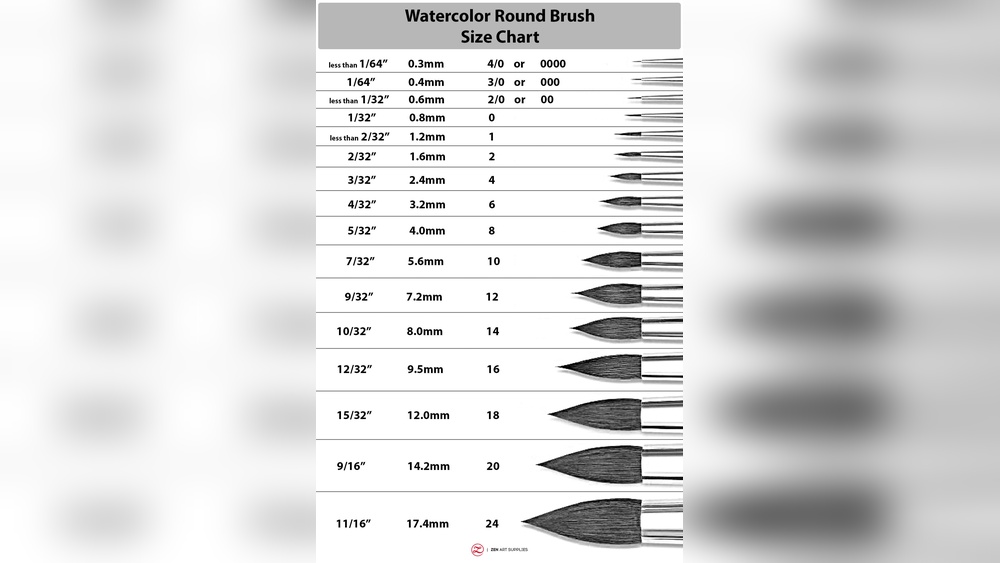
This watercolor brush sizes guide for beginners answers the question most new painters actually have: which numbers do I need, and why do the same numbers look different from one brand to the next? The short answer is that three round brushes and one flat will cover almost everything a beginner paints, and that you should compare brushes by their physical width and belly, not by the number stamped on the handle.
Below you will find what the numbers mean, a size chart by task, a starter kit you can copy, and the brush sets and beginner books that fit that kit.
Quick answer: Start with a small round (around #2) for details, a medium round (#6 to #8) for most of your painting, a large round (#12 or bigger) for washes, and a 1-inch flat for skies and backgrounds. A numbered round set such as the FENORKEY 12-piece gives you every round size from #1 to #12 so you can learn which ones you reach for; the Sdanart 10-piece adds rigger, dagger and other shapes once you are ready to explore.
How Watercolor Brush Sizes Work
Round brushes are sized by number. Smaller numbers mean thinner bellies and finer points; bigger numbers hold more water and cover more paper. Common ranges run from tiny 000 or 0 sizes up to 16, 20 and beyond. Flat brushes are usually sized by width in inches or millimeters, such as 1/4 inch, 1/2 inch or 1 inch.
Here is the catch: the numbers are not standardized across manufacturers. One brand’s #8 can be close to another brand’s #10. That is why experienced painters describe brushes by what they do, “my medium round”, rather than by number. When you shop, look at the stated hair length or width if the listing gives it, and compare against a brush you already own.
Size also interacts with shape. A round with a fat belly and a sharp point can paint both broad strokes and fine lines, which is why large rounds are so useful in watercolor. A flat gives crisp edges and even washes. Specialty shapes such as riggers, daggers and mops solve specific problems.
Watercolor Brush Size Chart by Task
| Size / Shape | Typical Use | Beginner Priority |
|---|---|---|
| Round #0–#2 | Fine details, eyes, stems, signatures | High: one small round |
| Round #4–#8 | Most everyday painting: leaves, petals, buildings | Essential: your main brush |
| Round #10–#14 | Washes, large shapes, loose florals | High: one large round |
| Flat 1/2 in–1 in | Skies, backgrounds, straight edges | High: one flat |
| Rigger / liner | Long thin lines, branches, rigging, grass | Medium: add early |
| Dagger / sword | Leaves and tapered strokes in one motion | Low: optional |
| Mop / large oval | Big wet-in-wet washes | Low: optional |
| Filbert | Soft-edged shapes, petals | Low: more common in acrylic |
A Starter Kit You Can Copy
- Small round (#2): details and fine lines.
- Medium round (#6 or #8): the brush you will use most.
- Large round (#12): washes and bold strokes.
- 1-inch flat: skies, wetting paper, backgrounds.
- Rigger (#1 or #2): branches and long lines, once you want them.
Paint with only these for a month. You will quickly notice whether you want a bigger wash brush, a sharper detail brush, or a shape such as a dagger. Buying a numbered set makes this experiment cheap because you can try neighboring sizes without guessing.
Our Top Picks at a Glance
- FENORKEY 12 Pcs Round Watercolor Brushes — Best for learning round sizes #1 to #12
- Auteonsa 12 Size Round Watercolor Brushes — Best alternative full round set
- Sdanart 10 PCS Watercolor Brushes — Best for trying rigger, dagger and other shapes
- Benicci 12-Piece Brush Set — Best mixed-shape set for watercolor and acrylic
- Watercolor for Beginners Visual Guide — Best structured 28-day plan
- Watercolour: Techniques and Tutorials for the Complete Beginner — Best technique reference
- The Beginner’s Guide to Watercolor — Best for guided exercises and projects
| Product | Best For | Key Spec | Key Strength | Price Tier |
|---|---|---|---|---|
| FENORKEY 12 Pcs Round | Learning sizes | Rounds #1–#12, nylon | Every round size in one set | $ |
| Auteonsa 12 Size Round | Full round set | Rounds #1–#12, nylon | Simple care routine | $ |
| Sdanart 10 PCS | Exploring shapes | Rigger, rounds, dagger and more | Variety of shapes | $ |
| Benicci 12-Piece | Mixed media beginners | Flat, round, fan, filbert | Practical shape mix | $ |
| Watercolor for Beginners Visual Guide | Daily practice plan | 28-day plan (book) | Structured progression | $ |
| Watercolour: Techniques and Tutorials | Technique reference | Paperback | Complete-beginner focus | $ |
| The Beginner’s Guide to Watercolor | Exercises and projects | Paperback | Guided projects | $$ |
How We Chose
These picks are based on the Amazon listing details and specifications as checked in October 2026, how well each set’s sizes and shapes match a beginner’s starter kit, and how widely each product is reviewed by Amazon buyers. We have not painted with these brushes; for the books, we rely on their titles and published descriptions only and do not summarize contents we have not read.
- Size coverage: sets that let beginners try small, medium and large rounds.
- Shape variety: whether a set includes useful extras like a rigger or flat.
- Fiber: synthetic nylon is affordable, durable and easy for beginners to care for.
- Construction: crimped ferrules and sealed handles.
- Learning support: beginner books that pair with a brush set.
Best Watercolor Brushes and Books for Beginners Reviewed
1. FENORKEY 12 Pcs Round Watercolor Brushes — Best for Learning Round Sizes

FENORKEY gives you twelve rounds, sizes 1 through 12, which is exactly what this guide recommends for learning. You can lay them out in order and see how the belly grows, then figure out which three you actually use. The tips are nylon, described as soft, flexible and resilient, with good water absorption and pigment holding.
Aluminum crimped ferrules and lacquered, waterproof wooden handles are listed. Care is simple: rinse in warm water and reshape the tip.
Best suited for: Beginners who want to discover their preferred small, medium and large rounds without guessing.
Key features (from the listing):
- 12 round brushes, sizes 1–12
- Nylon bristles
- Aluminum crimped ferrules
- Lacquered waterproof handles
Pros:
- Every round size in one set
- Low price tier
- Easy care
Cons and limitations:
- Rounds only, no flat or rigger
- Synthetic holds less water than natural hair
- Smallest size may still be too big for very fine work
Buying consideration: Once you know your favorite sizes, you can upgrade just those to better brushes and keep the rest for rough work.
2. Auteonsa 12 Size Round Watercolor Brushes — Best Alternative Full Round Set

Auteonsa also offers twelve rounds from #1 to #12 with nylon bristles, aluminum ferrules and ergonomic wooden handles. The listing describes good paint absorption and smooth application, and it recommends warm soapy water for cleaning and air drying.
Functionally it plays the same role as the FENORKEY set. Pick whichever is available at the better tier when you shop.
Best suited for: Beginners who want a complete numbered round set as an alternative to FENORKEY.
Key features (from the listing):
- 12 round sizes, #1–#12
- Nylon bristles
- Aluminum ferrules
- Ergonomic wooden handles
Pros:
- Complete size run
- Simple maintenance
- Works across media
Cons and limitations:
- Rounds only
- Little detail on tip sharpness
- Similar to other budget round sets
Buying consideration: Compare the two round sets by handle style and availability; their size runs match.
3. Sdanart 10 PCS Watercolor Brushes — Best for Trying Different Shapes

Sdanart mixes shapes instead of running through sizes. The listing names a rigger #1, fine-tip rounds #2, #10, #12 and #16, a dagger #10 and further shapes. That makes it the natural second set once you have your rounds and want to see what a rigger or dagger can do.
The bristles are nylon, described as soft with good pigment holding, and the handles are a lacquered mahogany color.
Best suited for: Beginners ready to explore specialty shapes and painters who want a single set with a rigger and dagger.
Key features (from the listing):
- 10 brushes, multiple shapes
- Rigger #1, rounds up to #16, dagger #10
- Nylon bristles
- Lacquered wooden handles
Pros:
- Covers specialty shapes cheaply
- Includes a large #16 round
- Good for experimentation
Cons and limitations:
- Fewer small and medium rounds
- Not every shape will suit beginners
- Listing text is partly keyword lists
Buying consideration: A rigger is often the first specialty brush beginners love, because branches and grass become much easier.
4. Benicci Professional Artist Paint Brush Set of 12 — Best Mixed-Shape Set

Benicci’s 12-piece set includes flat, round, fan and filbert shapes in nylon, aimed at acrylic, watercolor and mixed media. It is the set to choose if you plan to paint with both acrylic and watercolor and want flats and a fan as well as rounds.
Ergonomic wooden handles and a no-shedding bristle claim are listed. Synthetic flats are good for laying even washes and wetting paper.
Best suited for: Beginners who paint in both acrylic and watercolor, and anyone who wants flats included.
Key features (from the listing):
- 12 brushes: flat, round, fan, filbert
- Nylon bristles
- Ergonomic wooden handles
- For acrylic, watercolor and mixed media
Pros:
- Includes flats for washes
- Mixed-media friendly
- Practical shape variety
Cons and limitations:
- Fewer rounds than dedicated round sets
- Short handles and stiffer synthetics suit acrylic more than watercolor
- Filbert and fan less essential for watercolor
Buying consideration: Keep separate brushes for acrylic and watercolor; acrylic residue can affect how a brush handles water.
5. Watercolor for Beginners Visual Guide — Best Structured 28-Day Plan

This book is presented as a 28-day step-by-step plan for learning water and pigment control, fixing common mistakes and avoiding muddy colors. A daily plan pairs well with a numbered brush set because you can practice with your chosen sizes every day.
Best suited for: Beginners who want a structured daily routine.
Key features (from the listing):
- 28-day step-by-step plan (per title)
- Focus on water and pigment control
- Paperback
Pros:
- Clear structure for practice
- Addresses common beginner problems
Cons and limitations:
- We have not reviewed its contents
- Brush sizes it recommends may differ from this guide
Buying consideration: Read the preview on Amazon to see whether its teaching style suits you.
6. Watercolour: Techniques and Tutorials for the Complete Beginner — Best Technique Reference

Paul Clark’s book is part of an Art Techniques series and is aimed at complete beginners, according to its title. A technique-focused reference is useful alongside a size guide because it shows which brush to use for each effect.
Best suited for: Beginners who prefer a reference to dip into rather than a daily plan.
Key features (from the listing):
- Complete-beginner focus (per title)
- Techniques and tutorials
- Paperback
Pros:
- Reference format
- Beginner level
Cons and limitations:
- We have not reviewed its contents
- Uses British spelling in the title, which may extend to the text
Buying consideration: Check the sample pages to confirm the projects match your interests.
7. The Beginner’s Guide to Watercolor — Best for Guided Exercises

Jovy Merryl’s book promises to teach essential skills and techniques through guided exercises and projects. Exercise-led books are a good match for beginners learning how each brush size behaves on paper.
Best suited for: Beginners who learn best by completing projects.
Key features (from the listing):
- Guided exercises and projects (per title)
- Paperback
Pros:
- Project-based learning
- Beginner focus
Cons and limitations:
- We have not reviewed its contents
- Higher tier than the other books
Buying consideration: Pair it with your three main rounds and a flat to work through the exercises.
Buying Guide: How to Choose Watercolor Brush Sizes as a Beginner
Buy rounds first
Rounds are the workhorse of watercolor. A good large round can do washes, broad strokes and, using its point, surprisingly fine lines. Start there before buying anything else.
Go bigger than you think
Beginners often choose brushes that are too small and end up fiddling. A larger brush holds more water, keeps washes even and encourages looser painting. If in doubt between two sizes, take the larger one.
Check the point
A round should come back to a sharp point when wet. If the tip splits or stays blunt, the brush will frustrate you in detail work regardless of size.
Choose synthetic to start
Synthetic nylon brushes are affordable and durable. Natural sable and squirrel hold more water and are lovely to use, but they cost far more and need more care. Learn on synthetics first.
Add one flat and one rigger
A 1-inch flat is the fastest way to wet paper and lay skies. A rigger handles long lines. Those two plus three rounds is a complete beginner kit.
Match brush size to paper size
On small postcards, a #2, #6 and #10 might be enough. On quarter-sheet or larger paper, you will want a #12 or bigger and a wide flat.
Keep Building Your Brush Skills
Fine lines take practice. Our guide on how to use a liner brush for detail work shows how to load and hold a rigger, and our walkthrough on painting dots with a round brush is a quick way to learn how your round sizes differ.
Common Mistakes to Avoid
- Buying only tiny brushes and painting every area with a #2.
- Assuming a #8 from one brand matches a #8 from another.
- Leaving brushes standing in water, which bends tips and loosens ferrules.
- Using a watercolor brush for acrylic and then back again.
- Ignoring the flat; it makes skies and backgrounds far easier.
- Buying a huge mixed set before knowing which shapes you use.
FAQs
What size watercolor brushes should a beginner buy?
A small round around #2, a medium round around #6 to #8, a large round #12 or larger, and a 1-inch flat. Add a rigger when you want long, fine lines.
Are watercolor brush sizes the same across brands?
No. Numbers vary between manufacturers, so a #8 from one brand can be closer to a #10 from another. Compare physical size when possible.
What is the most useful watercolor brush size?
For many painters it is a medium-to-large round, around #8 to #12, because it holds enough water for washes and still comes to a point for details.
Do I need expensive brushes to start watercolor?
No. Synthetic brushes are affordable and perfectly good for learning. Upgrade the sizes you use most once you know your preferences.
What is a rigger brush used for in watercolor?
A rigger, or liner, has long thin hairs that hold enough paint for long continuous lines such as branches, grass and ship rigging.
Can I use watercolor brushes for gouache?
Yes. Gouache works well with the same synthetic rounds and flats. Clean them thoroughly between media.
Final Recommendation
Copy the starter kit above and you will rarely feel limited as a beginner. If you want to find your favorite sizes quickly, a numbered round set such as FENORKEY or Auteonsa is the cheapest way to experiment. Add the Sdanart set when you are curious about riggers and daggers, or choose Benicci if you also paint in acrylic and want flats included. A beginner book with a daily plan or projects turns those brushes into real progress.




