A candle flame is one of the smallest subjects you can paint and one of the most convincing tests of whether you understand light. The flame itself takes up a thumbnail of space, yet the glow it throws on the wax, the table, and the surrounding dark determines whether the painting feels warm and alive or flat and posterlike.
This guide explains how to paint a candle flame in oil with a realistic glow, covering palette, the structure of a real flame, layering order, and the soft-edge handling that oil paint does better than almost any other medium.
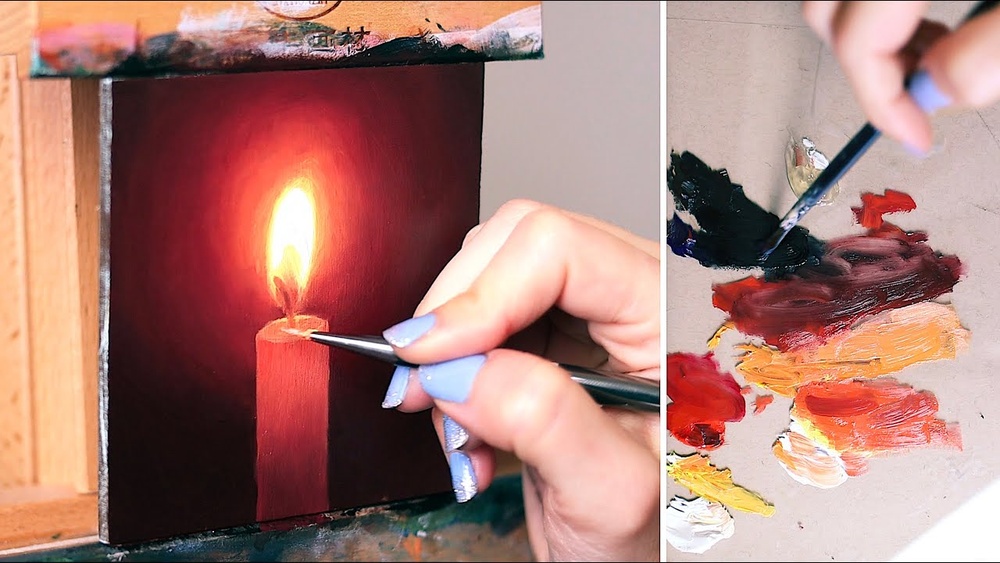
Quick answer: To paint a realistic candle flame in oil, start with a dark, warm background, then paint the flame as a teardrop with a near-white core, a yellow body, and a thin orange edge, plus a small blue zone at the base near the wick. Blend the outer edge softly into a halo of transparent warm color, and light the wax and nearby surfaces with the same warm tones. The glow comes from contrast with the dark surroundings, not from making the flame larger.
How a Real Candle Flame Is Structured
Painters often treat a flame as a single yellow shape, but a closer look shows distinct zones. Knowing them gives you a map to follow.
| Zone | Where | What You See | Oil Mix Suggestion |
|---|---|---|---|
| Blue base | Bottom of the flame, around the wick | Small, faint blue or violet cup | Ultramarine + white, very thin, partly transparent |
| Dark inner zone | Just above the wick | Slightly darker, cooler area inside the flame | Body yellow dulled with a touch of the base color |
| Bright core | Lower middle of the flame | Brightest spot, nearly white | Titanium white + tiny amount of lemon yellow |
| Luminous body | Most of the flame | Warm yellow | Cadmium yellow light or hue + white |
| Outer edge and tip | Perimeter and pointed top | Orange to deep orange, fading out | Cadmium orange or yellow + a little red, blended soft |
| Halo | Air around the flame | Soft glow fading into darkness | Transparent orange or yellow glazed thinly |
The wick itself sits inside the base of the flame. It is usually dark with a glowing orange or red tip. Painting it gives the flame a believable anchor.
Materials for an Oil Candle Painting
- Surface: Oil-primed or acrylic-gessoed panel or canvas. A smooth panel helps with fine soft blending, and a small size such as 8 x 10 or 9 x 12 inches keeps the project manageable.
- Colors: Titanium white, lemon yellow, cadmium yellow light (or hue), cadmium orange (or hue), cadmium red or pyrrole red, alizarin crimson or a permanent alternative, burnt umber, burnt sienna, ultramarine blue, and transparent red oxide if available.
- Brushes: Small round (size 2 or 4) synthetic or sable, a small filbert, a soft fan or mop brush for blending, and a larger flat for the background.
- Mediums and solvents: Odorless mineral spirits for thinning early layers and cleaning, and a simple glazing medium such as linseed oil mixed with solvent, or a commercial alkyd glazing medium.
- Extras: Palette knife, lint-free rags, a cotton swab for lifting halo areas, and a reference photo or a lit candle in a dark room.
Pigment strength and handling vary widely between oil paint grades and brands, and the yellows in particular matter here. For an overview of styles, materials, and what to look for when buying, our guide to oil painting styles and supplies is a good starting point.
Setting Up Your Reference
Real flames flicker, so a photo is the most reliable reference. Photograph a candle in a dim room with the camera set to a slightly underexposed setting. Overexposed flame photos turn the whole flame pure white and lose the color zones. Take several shots so you can choose a flame with a clean, tall shape rather than one bent by a draft.
Observing the real candle is still useful. Watch how the glow on the wax changes as the flame moves and how far the warm light reaches across the table. Those observations help you judge how wide the halo should be.
How to Paint a Candle Flame in Oil: Step by Step
- Tone the surface. Brush a thin wash of burnt umber or transparent red oxide thinned with solvent over the whole panel. Wipe back with a rag where the flame and the brightest wax will be. Let it set for 20 to 30 minutes until tacky.
- Sketch the candle. Use a small brush and thinned umber to outline the candle body, the wick, and the teardrop flame. Keep the flame small; on a 9 x 12 panel, a flame of 1 to 1.5 inches tall is typical for a single pillar candle.
- Block in the darks. Paint the background with a deep, warm dark mixed from burnt umber and ultramarine. Near the flame, shift the dark toward warmer browns and red-browns, because the light warms the air nearest the source. Keep the paint thin so you can work into it.
- Paint the candle body. Wax is translucent, so the area just below the flame glows. Mix a warm cream from white, a little yellow, and a touch of orange for the top rim and the area beneath the flame. Shift to cooler, darker tones as the candle descends into shadow. Add a slightly brighter, almost glowing rim where melted wax pools around the wick.
- Lay in the flame body. Fill the teardrop with cadmium yellow light mixed with some white. Make the top a pointed tip and the bottom slightly rounded.
- Add the core. Mix white with a tiny amount of lemon yellow. Place it in the lower middle of the flame, keeping it smaller than the yellow body. Blend its edges into the yellow with a clean, soft brush.
- Edge the flame. Mix cadmium orange or yellow-orange and paint a thin line around the outer edge, especially near the tip. Blend inward so the transition is gradual.
- Paint the blue base and wick. Using very thin ultramarine and white, add a faint blue cup at the base of the flame. Paint the wick as a short dark line, curving slightly, with a tiny orange-red ember at the tip.
- Soften the outer edge. With a clean, dry fan or mop brush, lightly stroke across the flame’s outer edge to dissolve it into the surrounding dark. The edge should not have a hard outline anywhere except perhaps a small part of the tip.
- Build the glow. Once the painting is touch dry, usually after several days depending on paint and medium, glaze a thin layer of transparent orange or yellow around the flame using glazing medium. Feather it outward in a circle. Repeat in later sessions to intensify the halo if needed.
- Add reflected light. Touch warm highlights on any nearby surfaces: the table, a candle holder, or the edge of the candle itself. These details sell the idea that the flame is emitting light.
- Final accents. Re-establish the brightest point of the core with a tiny stroke of near-white if the glazing dulled it. Let the painting dry fully before varnishing, which for oil typically means waiting several months depending on thickness.
Why the Glow Depends on Contrast
Paint can never be as bright as a real flame. The trick is relative value. A flame on a white background looks pale and weak; the same flame on a near-black background looks blinding. That is why most candle paintings are dark overall. Keep the background and most of the scene low in value, and reserve your lightest lights for the flame core and a few reflected highlights.
Temperature contrast helps too. Surrounding a warm flame with cool darks, such as blue-tinged shadows away from the light, makes the warm area feel hotter. Many classic candlelit paintings, including works associated with Georges de La Tour and the Dutch tenebrist painters, rely on this approach of a single light source and dramatic darkness.
Soft Edges and Wet-Into-Wet Blending
Oil paint stays workable for hours, which is ideal for flames. Wet-into-wet blending lets you place the yellow, white, and orange side by side and merge them gently. A few tips:
- Use a separate clean brush for each color zone, or wipe the brush between strokes, to keep the flame from turning muddy.
- Blend with light, feathering pressure. Pressing hard drags dark background paint into the flame.
- If the edge gets too dark, let it dry and use a glaze later rather than scrubbing.
- Follow the fat-over-lean rule: early layers thinner with more solvent, later layers with more oil or medium, so the painting dries without cracking.
Soft atmospheric transitions show up in other subjects as well. The approach used in our fog painting guide for oils applies directly to building a candle’s halo.
Painting Multiple Candles and Group Scenes
When painting several candles, each flame creates its own glow, and the glows overlap. The area between two flames becomes lighter and warmer than the rest of the background. Vary flame heights slightly, because real flames are never identical. If one candle is closer to the viewer, make its flame larger and its edges a touch sharper, while flames further back become smaller and softer.
For a candlelit portrait or still life, decide which surfaces face the flame. Those planes receive warm light, and planes turned away fall quickly into shadow. The light falls off fast, so objects even a short distance away should be noticeably darker.
Common Mistakes and Fixes
Flame looks like a yellow sticker. The edges are too hard and the colors too uniform. Add the white core and orange edge, then soften the perimeter with a dry brush.
Flame too large. Beginners often exaggerate the flame to show it is bright. Measure it against the candle width in your reference. A smaller flame with a strong halo reads brighter.
Background too light. If the flame does not glow, darken the surroundings. Even a mid-tone background can kill the effect.
Wax looks solid and opaque. Add a gradient of warm glow just under the flame inside the candle top, and let a faint warm tint show through the upper edge.
Halo has a visible ring. Glazes were applied with a hard boundary. Use less medium, feather outward with a dry brush, or apply several very thin layers.
Practice Exercises
Before attempting a full still life, try these short studies on small boards or canvas paper:
- Paint five flames side by side on a dark ground, each with a different ratio of core to body, to see what reads as brightest.
- Paint the same candle on a dark background and on a mid-gray background to compare the glow.
- Do a 20-minute study using only burnt umber, cadmium yellow, and white to focus on value rather than color.
Reflective, curved surfaces add another challenge. If you enjoy the light-handling side of this subject, the seashell oil painting tutorial covers glossy highlights on rounded forms.
FAQs
What colors do I need to paint a candle flame in oil?
Titanium white, a lemon or cool yellow, a warm yellow, an orange, a red, burnt umber, and ultramarine blue cover a convincing flame and dark background. A transparent orange or red oxide is useful for glazing the glow.
How do I make a painted flame look like it is glowing?
Keep the background dark, make the flame core the lightest value in the painting, soften the flame’s outer edge, and glaze a thin transparent warm halo around it. Adding warm reflected light on nearby surfaces strengthens the illusion.
Should a candle flame have a black outline?
No. Real flames have no outline. The edge should dissolve gradually into the surrounding air. Any dark line around the flame will make it look like a cartoon or decal.
How long should I wait before glazing the glow?
Wait until the underlying layer is touch dry, which can range from about a day for thin layers with fast-drying colors to several days for thicker paint. Glazing over wet paint tends to lift and muddy the colors.
Can I paint a candle flame with acrylics instead?
Yes, but acrylics dry quickly, so soft blending is harder. Work in small sections, use a retarder medium, or build the glow with several thin glazes. Oil remains easier for smooth flame gradients.
Why does my flame look green or dirty?
Yellow mixed with any blue or black, even from a contaminated brush, turns greenish. Use clean brushes for the flame, keep the blue base separate and very thin, and avoid mixing umber into the yellows.
Final Thoughts
A candle flame teaches the core lesson of light in painting: brightness is created by what surrounds it. Keep the scene dark, give the flame clear internal zones, soften every edge, and let the warmth spill onto nearby surfaces. With a few small studies, you will be able to place a convincing flame into larger still lifes and portraits.
If you want to keep developing your oil technique or explore which styles and materials fit your goals, read our full oil paintings resource with expert tips and buying advice.