
PaintingProGuide is reader-supported. When you buy through links on this page we may earn an affiliate commission at no extra cost to you.
Amsterdam acrylic ink is Royal Talens’ liquid acrylic: pigment suspended in a water-based acrylic binder, thin enough to use with a dip pen, brush or dropper, and permanent once it dries. The listing we checked is the 30 ml bottle of Titanium White 105, and it promises brilliant color, a water-based and odorless formula, waterproof results when dry and extreme lightfastness.
This Amsterdam acrylic ink review covers what those claims mean in practice, how a single-color bottle fits into a working ink palette, its limits, and the other acrylic inks worth comparing, from professional single jars to budget multi-color sets.
Quick answer: Amsterdam Acrylic Ink is a strong choice when you want individual, lightfast colors from an established maker, and the Titanium White bottle is especially useful for highlights over darker inks. If you prefer to buy single colors from a broad professional range, compare Daler-Rowney FW and Liquitex Professional Acrylic Ink. If you want many colors at once for pouring, lettering or experimenting, the Mont Marte 12-color or Nicpro 18-color sets are easier starting points.
Our Top Picks at a Glance
- Amsterdam Acrylic Ink, Titanium White 105, 30 ml — Best for opaque white highlights and building a single-color palette
- Liquitex Professional Acrylic Ink, 1 oz — Best for mixing with an existing acrylic paint system
- Daler-Rowney FW Acrylic Ink, 29.5 ml — Best for dip pen, technical pen and airbrush use
- Mont Marte Acrylic Ink, 12 x 20 ml — Best starter set of essential colors
- Nicpro Acrylic Ink, 18 x 30 ml — Best multi-color set with larger bottles
- Roizefar Acrylic Ink Set, 16 colors — Best budget set with metallic colors
| Product | Best For | Key Spec | Key Strength | Price Tier |
|---|---|---|---|---|
| Amsterdam Titanium White | Highlights, white line work | 30 ml bottle, water-based | Waterproof dry, lightfast per listing | $ |
| Liquitex Professional Ink | Mixing with acrylic paint | 1 oz jar, satin finish | Intermixable with Liquitex paints | $ |
| Daler-Rowney FW Indigo | Pens and airbrush | 29.5 ml, 45-color line | Multi-use, high lightfastness claim | $ |
| Mont Marte 12 x 20 ml | First ink set | 12 essential colors | Pipette bottles | $$ |
| Nicpro 18 x 30 ml | Pouring, lettering, variety | 18 colors, dropper bottles | Larger bottles in a set | $$ |
| Roizefar 16 colors | Metallic accents, crafts | 16 colors incl. gold, silver, copper | Includes palette and 2 brushes | $$ |
How We Chose
We have not used these inks ourselves. This review relies on the Amazon listing details and specifications checked in October 2026, on how well each ink’s format and stated properties suit common acrylic ink uses (pen work, washes, airbrushing, pouring and mixed media), and on how widely each product is reviewed by Amazon buyers. Claims such as lightfastness and permanence are reported as the maker states them.
Our criteria were:
- Permanence: acrylic inks should be water-resistant once dry so you can layer over them; every pick says so.
- Lightfastness information: a stated rating or clear claim beats vague wording.
- Format: single bottles for building a professional palette, sets for exploring color.
- Dispensing: dropper or pipette caps make pen loading and pouring cleaner.
- Maker transparency: pigment, opacity or color codes in the listing are a plus.
Amsterdam Acrylic Ink Review: The Details
1. Amsterdam Acrylic Ink, Titanium White 105, 30 ml — Best for White Highlights and Single-Color Buying

The Amsterdam listing is brief, but every line matters for an ink. It describes brilliant colors, a water-based formula, waterproof once dry, extreme lightfastness and an odorless formula, in a 30 ml bottle made by Royal Talens.
Waterproof once dry is the key property. It means you can draw a line, let it dry, and glaze watercolor, more ink or acrylic over it without the line lifting. Titanium white is a naturally opaque pigment, so a white ink in this color is the one most painters reach for when they need highlights, lettering or corrections on top of darker layers.
Best suited for: illustrators, urban sketchers and mixed-media artists who want a dependable white ink, and painters building an ink palette one color at a time.
Key features:
- 30 ml bottle, Titanium White 105
- Water-based acrylic formula
- Waterproof once dry
- Extremely lightfast and odorless, per the listing
- Made by Royal Talens
Pros:
- Permanent when dry, so layers stay put
- White is useful on its own for highlights and touch-ups
- Single-color buying lets you replace only what you use
- Lightfastness claim suits work you plan to keep or sell
Cons and limitations:
- Listing gives no viscosity, opacity rating or pigment code
- One color per bottle costs more per color than a set
- Listing does not mention a dropper cap, so pen loading may need a pipette
- White ink pigment settles; it needs a good shake before use
Buying consideration: Buy this bottle when you already know you need white ink. If you are new to acrylic ink and want to try several colors, start with a set and add Amsterdam colors later.
How acrylic ink differs from fluid acrylic and drawing ink
Acrylic ink sits at the thin end of the acrylic family. Fluid or high-flow acrylic paint is pourable but still has some body; acrylic ink is closer to water and can run through a dip pen nib or an airbrush. Traditional drawing inks such as shellac-based India ink behave differently again and are not always lightfast in color.
Because the binder is acrylic, the ink dries to a flexible, water-resistant film. That makes it ideal for layering, but it also means dried ink will not rewet. Clean pens, brushes and airbrushes promptly.
Using a white acrylic ink well
Shake the bottle thoroughly. Heavy pigments such as titanium settle quickly, and an unshaken bottle gives watery, semi-transparent results. For dip pens, load from a pipette or brush rather than dipping deep into the bottle, which overloads the nib and causes blots.
On toned paper, white ink lines read as highlights. Over dried watercolor or darker ink, one stroke may look slightly translucent; a second pass after the first dries usually builds solid coverage.
Limitations to keep in mind
The listing is thin on technical detail. Professional ink buyers often look for pigment codes and opacity ratings, and those are not printed in the Amazon text we checked. If that matters to you, check the color chart from the maker before buying a full palette.
Single bottles also add up. Ten individual colors cost noticeably more than a ten-color set, so Amsterdam ink makes the most sense once you know which colors you actually use.
Other Acrylic Inks Worth Comparing
2. Liquitex Professional Acrylic Ink, 1 oz Jar — Best for Mixing with Acrylic Paint

Liquitex’s listing is the most technical of the group. For Dioxazine Purple it states transparent opacity, lightfastness II and color code 186, and describes the ink as super fluid, highly pigmented, with a satin finish. It is intermixable with Liquitex Professional acrylic paints and mediums.
That last point is the reason to choose it. If your studio already runs on Liquitex paint and mediums, the ink slots straight in for glazes, washes and pouring mixes.
Best suited for: acrylic painters who want ink that mixes predictably with their existing paints and mediums.
Key features:
- 1 oz / 30 ml jar
- Opacity, lightfastness and color code stated
- Satin finish
- Conforms to ASTM D4236
Pros:
- Clear technical data in the listing
- Intermixable with a full paint and medium system
- Low price tier for a single color
Cons and limitations:
- Lightfastness II on this color, not the top rating
- Jar format, so you need a pipette or brush to load pens
Buying consideration: Check the lightfastness rating color by color; it varies with pigment.
3. Daler-Rowney FW Acrylic Ink, Indigo, 29.5 ml — Best for Pens and Airbrush

FW ink is one of the best-known acrylic inks for illustration, and the listing leans into versatility: use it as airbrush ink, in a technical pen or dip pen, for miniatures, or diluted as a watercolor-style ink. It is described as intensely colored, water-based, permanent and highly lightfast, and the line runs to 45 colors in 29.5 ml and 180 ml bottles.
For a buyer comparing it with Amsterdam, FW offers a larger documented color range and explicit multi-tool use.
Best suited for: illustrators and calligraphers who use pens and airbrushes as much as brushes.
Key features:
- 29.5 ml bottle with dropper
- 45-color range
- Permanent, water-based
- Made in England
Pros:
- Explicitly listed for technical pens and airbrush
- Wide color range to build from
- Dropper bottle
Cons and limitations:
- Single color per purchase
- Listing gives no per-color lightfastness rating
Buying consideration: If you use technical pens, flush them soon after use; dried acrylic ink can clog fine nibs.
4. Mont Marte Acrylic Ink Premium, 12 x 20 ml — Best Starter Set

Mont Marte bundles twelve essential colors: white, cadmium yellow, orange, scarlet, bright green, sap green, teal, phthalo blue, violet, yellow ochre, burnt umber and black. The bottles have pipettes, and the inks are described as permanent and water-resistant once dry, suitable for paper, card, canvas and some plastics.
It is the easiest way to discover which colors you use before investing in single professional bottles.
Best suited for: beginners and mixed-media artists who want a balanced palette in one purchase.
Key features:
- 12 x 20 ml bottles
- Pipette caps
- Permanent and water-resistant once dry
- Listed for airbrush, pouring, ink drawing and mixed media
Pros:
- Includes earth tones as well as brights
- Pipettes for clean dispensing
- Includes white and black
Cons and limitations:
- Smaller 20 ml bottles
- No lightfastness rating stated
Buying consideration: Treat this as a discovery set; replace favorites with larger bottles later.
5. Nicpro Acrylic Ink, 18 Colors x 30 ml — Best Multi-Color Set with Larger Bottles
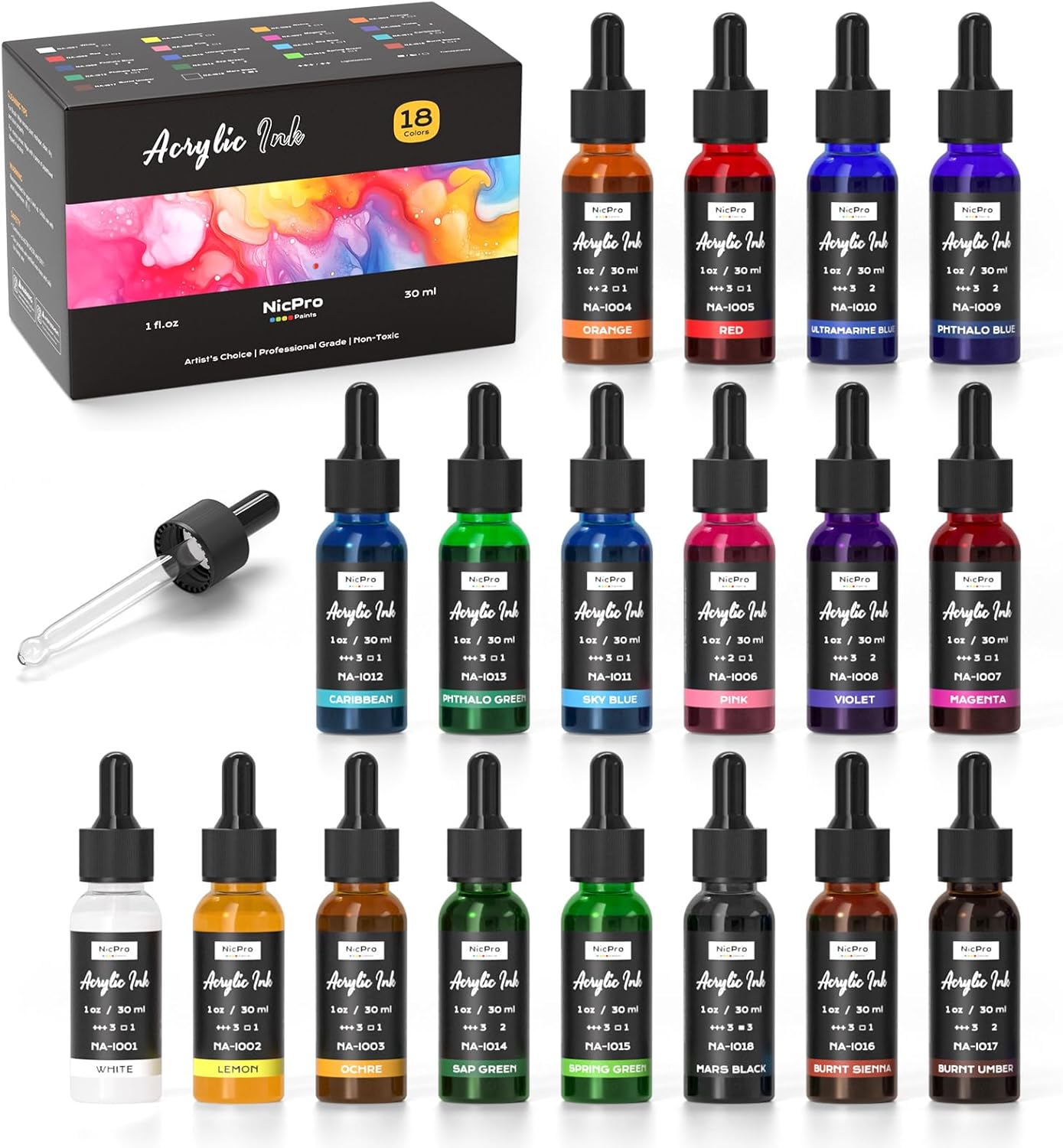
Nicpro offers 18 colors in full 30 ml dropper bottles, the same volume per bottle as the Amsterdam ink. The listing describes quick-drying, lightfast, water-resistant ink with fine pigments, suited to washes, calligraphy, underpainting and pouring, and compatible with pouring medium or airbrush thinner.
For pouring artists and letterers who go through ink quickly, the larger bottles are the practical advantage.
Best suited for: pour painters, calligraphers and hobbyists who want lots of color and volume.
Key features:
- 18 colors in 30 ml bottles
- Built-in dropper pipettes
- Lightfast and water-resistant claims
- Works with pouring medium and airbrush thinner
Pros:
- Full-size bottles across 18 colors
- Broad stated use range
- Dropper caps
Cons and limitations:
- No pigment or lightfastness ratings listed
- More colors than some beginners need
Buying consideration: If archival permanence matters, test a swatch in a sunny window for a few weeks before committing to a large piece.
6. Roizefar Acrylic Ink Set, 16 Colors — Best Budget Set with Metallics
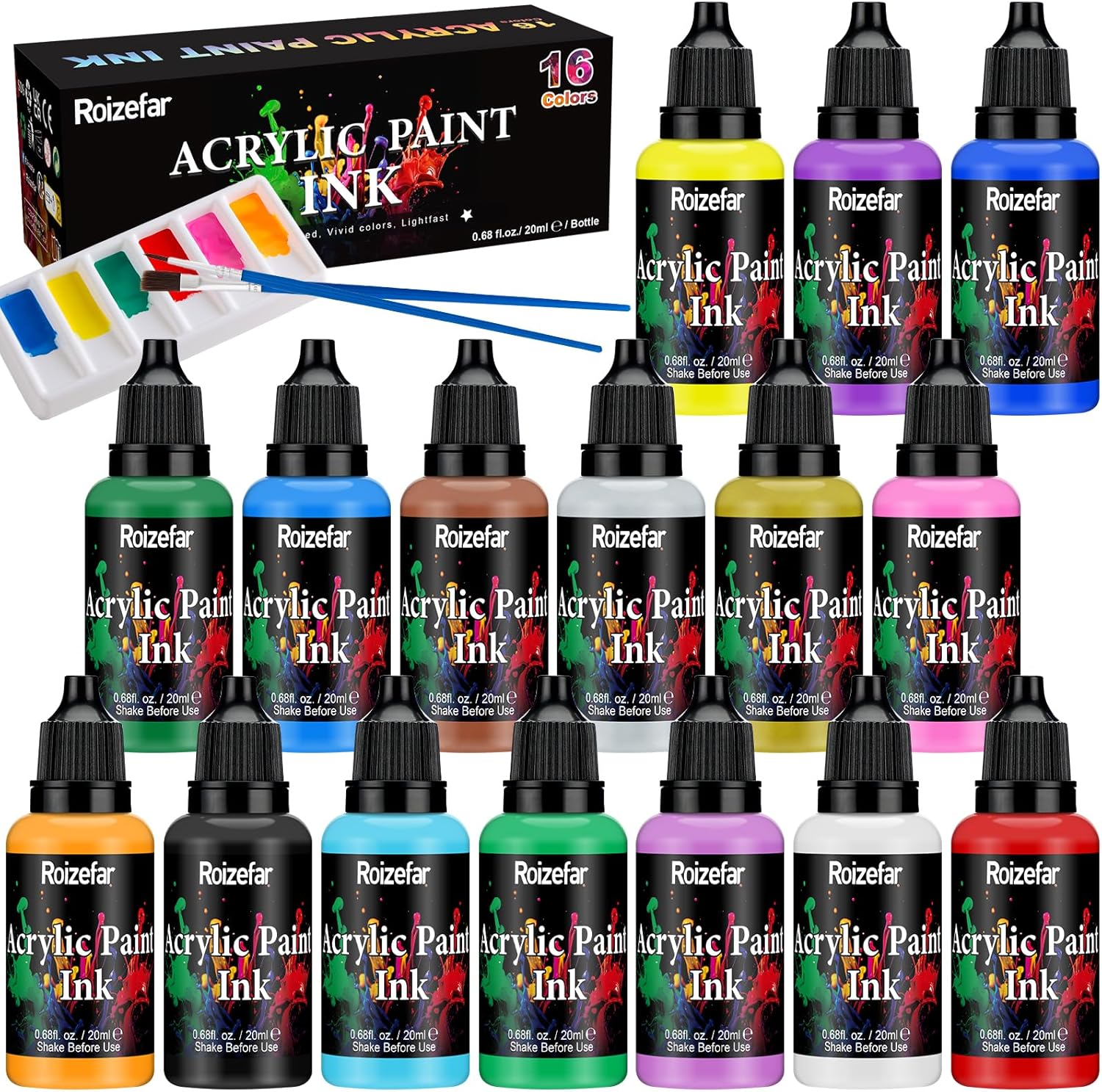
Roizefar includes 16 colors, among them gold, silver and copper metallics, plus a mixing palette and two brushes. The listing calls the inks lightfast, permanent and water-resistant once dry, and suitable for paper, card, canvas, metal, glass, wood and some plastics.
One unusual note: the listing says the ink can be wiped off wood and glass with alcohol if you make a mistake. That is handy for crafts, but it also tells you the bond on non-porous surfaces is not as strong as on paper.
Best suited for: crafters and card makers who want metallic accents without buying separate metallic paints.
Key features:
- 16 colors including 3 metallics
- Mixing palette and 2 brushes included
- Listed for paper, canvas, metal, glass and wood
Pros:
- Metallics included
- Extras in the box for a quick start
Cons and limitations:
- Alcohol removability means less durability on glass and wood
- No technical pigment data
Buying consideration: Seal craft pieces on glass or wood with a varnish if they will be handled.
Buying Guide: How to Choose Acrylic Ink
Decide between single bottles and sets
Single bottles such as Amsterdam, Liquitex and FW suit painters who know their palette. Sets suit exploration. A sensible path is a set first, then single professional bottles of the three or four colors you use most, with white usually near the top of that list.
Check permanence and lightfastness
Every acrylic ink should be water-resistant once dry, but lightfastness varies by pigment. Where a maker gives a rating, such as Liquitex’s lightfast II on Dioxazine Purple, use it. Where it does not, a simple window test on a swatch tells you a lot over a few weeks.
Match the cap to your tools
Dropper or pipette caps make it easy to fill a dip pen, a technical pen reservoir or an airbrush cup. Jars and plain caps work fine for brushes but need a separate pipette for precision.
Think about opacity
Most acrylic inks are transparent to semi-transparent, which is why they glaze so well. White and some earth colors are more opaque. If you plan to work light over dark, check that your white is a titanium white, as the Amsterdam bottle is.
Consider the surface
Paper, illustration board and primed canvas take acrylic ink well. Glass, metal and plastics need cleaning first and often a sealing varnish afterward. Absorbent papers spread ink more; hot-pressed papers keep lines sharp.
Plan for cleanup
Acrylic ink dries permanent, including inside pen nibs and airbrush needles. Rinse tools in water while wet, and use an airbrush cleaner or pen flush for anything that has started to set.
Projects to Try with Acrylic Ink
Liquid acrylic is a natural fit for bold, graphic pieces; our step-by-step on how to make DIY wall art with acrylic adapts well to ink washes and line work.
If you are still building confidence with the medium, our list of simple acrylic painting ideas for beginners gives you small projects where a white ink highlight makes a visible difference.
Common Mistakes to Avoid
- Skipping the shake; settled pigment gives weak, streaky color, especially with white.
- Dipping a pen nib deep into the bottle instead of loading it with a pipette or brush.
- Letting ink dry in an airbrush or technical pen.
- Assuming every color in a set has the same lightfastness.
- Using ink on glass or metal without degreasing the surface first.
- Mixing acrylic ink with oil-based media.
FAQs
Is Amsterdam acrylic ink waterproof?
The listing describes it as waterproof once dry. That means you can layer watercolor, more ink or acrylic over a dried line without it lifting.
Can I use Amsterdam acrylic ink in a dip pen?
Acrylic inks are commonly used with dip pens. Load the nib with a pipette or brush, work in short sessions and rinse the nib before the ink dries on it.
Is white acrylic ink opaque?
Titanium white is an opaque pigment, so white acrylic ink covers better than most colors. Over dark layers a second pass is often needed for solid coverage.
Can acrylic ink go through an airbrush?
Many acrylic inks are thin enough to airbrush, and FW and Nicpro specifically list airbrush use. Strain or shake well and clean the airbrush immediately afterward.
What is the difference between acrylic ink and India ink?
Acrylic ink uses an acrylic binder and comes in a wide range of colors; traditional India ink is usually carbon black in a shellac or similar binder. Both are water-resistant when dry.
Can I mix acrylic ink with acrylic paint?
Yes. Acrylic inks and paints share a binder type, and Liquitex states its ink is intermixable with its professional paints and mediums.
Final Recommendation
Amsterdam Acrylic Ink in Titanium White earns a place in an ink kit when you need a lightfast, permanent white for highlights, lettering and corrections. Its weakness is a sparse listing, so painters who want pigment codes and ratings may prefer Liquitex, whose listing states them.
For pen and airbrush work, Daler-Rowney FW is the more documented single-bottle option. If you are starting out, Mont Marte’s 12 colors are the easiest introduction, Nicpro’s 18 full-size bottles suit high-volume pouring and lettering, and Roizefar is the budget pick when metallic accents matter more than archival claims.





One Comment