PaintingProGuide is reader-supported. When you buy through links on this page we may earn an affiliate commission at no extra cost to you.
A rigid board changes how oil paint behaves under the brush. There is no bounce, so knife work and fine detail feel more controlled, and a well-made panel will not sag or dent the way a stretched canvas can. Boards are also cheaper to ship, easier to carry outdoors and simpler to frame. The best oil painting boards combine a stable core that will not warp with a ground that suits how you paint, whether that is smooth for portrait detail or a canvas weave for loose landscapes.
This guide compares seven boards and board packs from the October 2026 listings, splitting them into gesso-primed hardboard panels, raw hardboard you prime yourself and cotton canvas boards for practice and studies.
Quick answer: For serious oil work, Ampersand Gessobord is the best board here, with an acrylic gesso ground on wood hardboard that is thicker than most brands and suited to oils, glazing and knife work. For very fine detail, the Ampersand Primed Smooth 11×14 panel offers a super smooth surface. For practice and studies, the Simetufy 12-pack of 8×10 canvas boards with an MDF core is the best value.
Our Top Picks at a Glance
- Ampersand Gessobord 6×6, 4-pack — Best overall oil painting board
- Ampersand Primed Smooth 11×14 Panel — Best for fine detail and smooth blending
- Ampersand Museum Series Hardbord 12×16 — Best for painters who prime their own grounds
- Simetufy 12-Pack 8×10 Canvas Boards — Best value canvas boards with an MDF core
- KEFF 24-Pack Multi-Size Canvas Boards — Best variety of sizes
- ESRICH 24-Pack Square Canvas Boards — Best for square formats and small studies
- ESRICH 5-Pack 8×10 Canvas Boards — Best small pack for trying canvas boards
| Product | Best For | Key Spec | Key Strength | Price Tier |
|---|---|---|---|---|
| Ampersand Gessobord 6×6 | Finished oil paintings | 1/8 in wood hardboard, thick acrylic gesso | Even bright white, archival-style panel | $ |
| Ampersand Primed Smooth 11×14 | Fine detail, portraits | Super smooth gesso on top and sides | Semi-absorbent, acid-free ground | $ |
| Ampersand Museum Series Hardbord | Custom grounds | 12×16, 1/8 in, unprimed | Formaldehyde free, moisture resistant | $ |
| Simetufy 12-Pack 8×10 | Practice and studies | Cotton on MDF core | Will not curl or warp easily | $ |
| KEFF 24-Pack | Mixed sizes | 6 each of 5×7, 8×10, 9×12, 11×14 | Triple-primed cotton | $$ |
| ESRICH 24-Pack Square | Square compositions | 6 each of 4×4, 6×6, 8×8, 10×10 | Variety of square sizes | $$ |
| ESRICH 5-Pack 8×10 | Trying canvas boards | Cotton, acid-free primer | Low commitment | $ |
How We Chose
We have not painted on these boards ourselves. The picks are based on Amazon listing details and specifications checked in October 2026, on how well each board’s core, ground and size options suit oil painting, and on how widely each product is reviewed by Amazon buyers.
- Core material: wood hardboard and MDF over paper or cardboard cores.
- Ground: type and thickness of gesso, and whether the surface is smooth or textured.
- Archival claims: acid-free, formaldehyde-free or moisture-resistant where stated.
- Size range: useful formats for studies and finished work.
- Value: cost per board for practice packs.
Panels Versus Canvas Boards: What Is the Difference?
Gesso panels are rigid boards, usually hardboard or wood, coated directly with gesso. There is no fabric. The surface can be very smooth, which suits detailed work, glazing and smooth blending. Quality panels are designed for permanence.
Canvas boards are cotton canvas glued to a board core, then primed. You get the familiar weave texture with a rigid back. The core quality varies a lot: MDF cores resist warping better than cardboard or recycled paper cores. Canvas boards are excellent for practice, color studies and plein air, and good ones are fine for finished small paintings.
Raw hardboard is an unprimed panel that you prepare yourself with gesso or an oil ground. It gives full control over texture and absorbency.
Best Oil Painting Boards Reviewed
1. Ampersand Gessobord 6×6, 4-Pack — Best Overall

Gessobord is a wood hardboard panel primed with acrylic gesso that Ampersand describes as thicker than most brands. The listing positions it for oils, acrylics and mixed media and for fine brushwork, palette knife painting, glazing and layering. Its finish is consistently even and bright white, and the absorbency is described as not dulling colors.
This pack contains four 6×6 inch panels with a 1/8 inch flat profile. Small square panels are ideal for daily painting practice, color studies and small works for sale.
Best suited for: painters who want a professional-quality rigid surface for finished small oils.
Key features
- Wood hardboard core
- Thick acrylic gesso ground
- Even, bright white finish
- 6×6 in, 1/8 in flat, pack of 4
Pros
- Rigid, stable surface
- Suits knife work and glazing
- Flat profile frames easily
Cons
- Small size in this pack
- Smooth gesso can feel slippery at first for canvas painters
Buying consideration: If the surface feels too slick, tone it with a thin wash of burnt sienna or ochre thinned with solvent first. The toned layer adds slight grip and kills the white.
2. Ampersand Primed Smooth 11×14 Panel — Best for Fine Detail

This Ampersand panel is fully primed on top and sides with super smooth acrylic gesso. The listing describes a semi-absorbent, acid-free ground that accepts watercolor, acrylic, oil and pencil, on a durable medium-density fiberboard support suited to palette knife painting. It is designed for fine detail and smooth, fluid lines.
Because the sides are primed too, it can be displayed unframed with painted edges. At 11×14 inches with a 1/8 inch depth, it is a practical size for portraits and still lifes.
Best suited for: portrait and still life painters who want a smooth, detail-friendly surface.
Key features
- Super smooth acrylic gesso, top and sides
- Semi-absorbent, acid-free
- MDF support
- 11×14 in, 1/8 in depth
Pros
- Excellent for fine lines and blending
- Primed edges for unframed display
Cons
- Too smooth for painters who like canvas tooth
- Single panel
Buying consideration: Smooth gesso shows every brushstroke. Use soft brushes and thin first layers for the smoothest results.
3. Ampersand Museum Series Hardbord 12×16 — Best for Custom Grounds
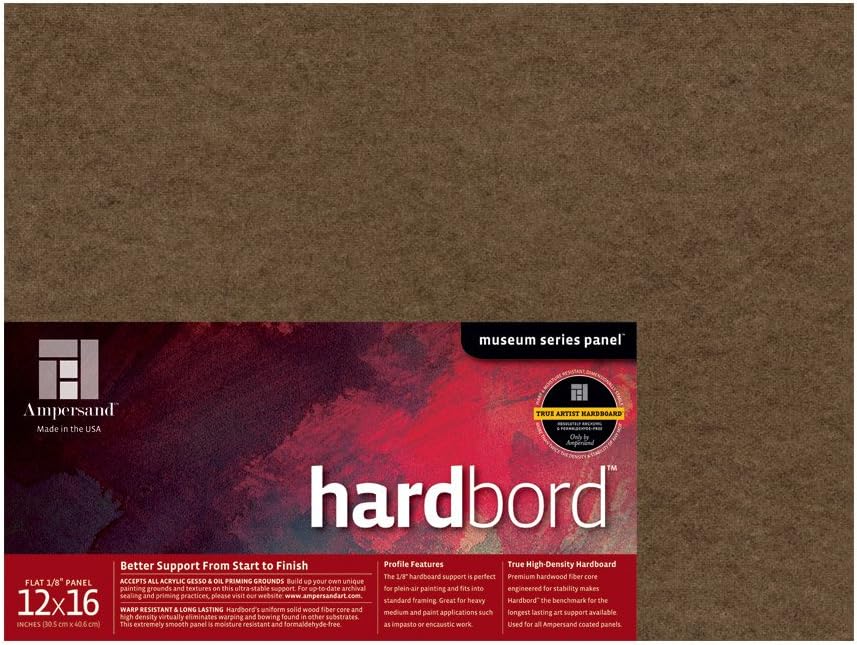
Hardbord is Ampersand’s artist-grade raw hardboard, sold unprimed. The listing describes it as moisture resistant, formaldehyde free, archival and eco-friendly, with complete priming instructions included. It must be primed before painting, and it can also be used to mount watercolor paper, photographs, fabric and prints.
Unprimed boards let you build exactly the surface you want: smooth sanded gesso for portraits, textured gesso for landscapes, or a traditional oil ground over a size.
Best suited for: experienced painters who want control over texture and absorbency.
Key features
- Unprimed high-density wood panel
- Moisture resistant, formaldehyde free
- 12×16 in, 1/8 in depth
- Priming instructions included
Pros
- Fully customizable surface
- Archival-oriented construction
Cons
- Must be primed before use
- Extra prep time
Buying consideration: Never paint oils directly on raw hardboard. Follow the included priming instructions, applying several thin coats and sanding between them for a smooth finish.
4. Simetufy 12-Pack 8×10 Canvas Boards — Best Value Practice Boards

Simetufy’s boards stand out among value packs for their core. The listing describes 100% cotton canvas on an MDF core rather than recycled paper, which helps prevent bending, curling and warping. The canvas is primed with acid-free acrylic and ready to paint, with a surface texture that holds paint without absorbing it.
Twelve 8×10 boards cover a lot of practice paintings, color studies and plein-air sketches.
Best suited for: students, daily painters and anyone who wants inexpensive boards that stay flat.
Key features
- 12 boards, 8×10 in
- 100% cotton canvas
- MDF core
- Acid-free acrylic primer
Pros
- MDF core resists warping
- Low cost per board
Cons
- Single size
- MDF adds weight compared with card cores
Buying consideration: If the primer feels absorbent with oils, add one coat of acrylic gesso before painting.
5. KEFF 24-Pack Multi-Size Canvas Boards — Best Variety of Sizes

KEFF’s pack includes six boards in each of four sizes: 5×7, 8×10, 9×12 and 11×14 inches. The listing describes 100% cotton with smooth, triple-primed surfaces suitable for acrylic, oil and mixed media. Having several sizes on hand helps you match the board to the subject instead of forcing every idea into one format.
Best suited for: painters who want to experiment with composition and scale.
Key features
- 24 boards in 4 sizes
- 100% cotton, triple primed
- Suitable for oils and acrylics
Pros
- Range of sizes in one purchase
- Standard frame sizes
Cons
- Core material not specified in the listing excerpt
- Heaviest pack here at a listed 5.95 lb
Buying consideration: The 11×14 boards are the most likely to bow if the core is thin. Store boards flat and away from humidity.
6. ESRICH 24-Pack Square Canvas Boards — Best for Square Formats

Square compositions suit still lifes, florals and abstracts, and this ESRICH pack provides six each of 4×4, 6×6, 8×8 and 10×10 inch boards. The listing describes pure cotton canvas with a smooth surface, a non-toxic, acid-free primer and a sturdy board core designed not to deform or warp.
Best suited for: daily painting challenges, small studies and gift-size works.
Key features
- 24 square boards in 4 sizes
- Pure cotton canvas
- Acid-free primer
Pros
- Square format variety
- Small sizes are quick to finish
Cons
- Small maximum size
- Smooth surface may need toning for oils
Buying consideration: Small squares are perfect for value and color studies before committing to a larger painting.
7. ESRICH 5-Pack 8×10 Canvas Boards — Best Small Trial Pack

If you just want to see whether you like painting on canvas boards, this five-pack of 8x10s is a low-commitment option. The listing describes pure cotton canvas, a safe acid-free primer and a sturdy board core that resists deformation, with oil listed among suitable paints.
Best suited for: beginners testing boards before buying larger packs.
Key features
- 5 boards, 8×10 in
- Pure cotton canvas
- Acid-free primer
Pros
- Lowest commitment
- Standard frame size
Cons
- Higher cost per board than bulk packs
Buying consideration: Use one board to test your paints and mediums on the surface before starting an important piece.
Buying Guide: How to Choose Oil Painting Boards
Core material
Hardboard and MDF cores stay flat; cardboard and recycled paper cores can warp, especially in humidity or under heavy paint. For anything you might sell or keep, choose a hardboard or MDF core.
Surface texture
Smooth gesso panels suit detail and glazing. Canvas boards give a weave that breaks up brushstrokes, which suits looser styles and landscapes. Pick the texture that matches your painting style.
Absorbency
Very absorbent grounds can make oil paint look dull and sink in. Semi-absorbent grounds, like those Ampersand describes, keep colors bright. If a board drinks paint, add a coat of gesso or tone it first.
Archival quality
Acid-free primers and formaldehyde-free boards are better for long-term stability. Look for these claims if you plan to sell or exhibit.
Size and framing
Standard sizes like 8×10, 11×14 and 12×16 fit ready-made frames. Flat 1/8 inch panels slip easily into traditional frames.
Primed or unprimed
Pre-primed boards are ready to paint. Unprimed hardboard gives full control but requires several coats of primer and sanding.
How to Prime Raw Hardboard for Oil Painting
If you choose an unprimed board like Ampersand Hardbord, preparation takes an afternoon plus drying time. Always follow the maker’s instructions, but the general process looks like this:
- Clean the surface. Wipe the board with a lightly damp cloth or denatured alcohol to remove dust and oils from handling. Let it dry fully.
- Lightly scuff the face. A fine sandpaper gives the primer something to grip.
- Apply thin coats of acrylic gesso. Brush or roll on the first coat in one direction, let it dry, then apply the next coat at right angles. Three to five thin coats are typical.
- Sand between coats if you want a smooth, eggshell surface for detail. Skip sanding if you want brush texture.
- Prime the edges and back. Sealing all sides helps keep the board stable as humidity changes.
- Let it cure. Allow the final coat to dry thoroughly before painting in oils.
Making several panels at once is efficient: lay them out in a row and work down the line, so the first board is dry by the time you finish the last.
Painting on Boards: Practical Tips
- Tone the surface with a thin, lean wash to cut the white glare and add grip.
- Keep early layers thin and lean; boards do not absorb oil the way raw canvas can.
- Use stiffer brushes on smooth panels to avoid streaky blends, or soft brushes for glazing.
- Store finished boards flat or upright with spacers so wet paint does not touch.
Drying behavior is a little different on rigid panels; our guide to speeding up oil paint drying covers safe ways to manage it. To get smooth gradients on canvas boards, see how to blend oil paint on canvas.
Common Mistakes to Avoid
- Painting on raw hardboard. Always prime it first.
- Using cardboard-core boards for finished work. They can warp and are less durable.
- Ignoring absorbency. Dull, sunken patches often mean the ground is too absorbent.
- Storing boards in damp places. Humidity can warp cores and affect primers.
- Overloading smooth panels with medium. Paint can slide and drip.
- Stacking wet paintings. Use spacers or a panel carrier.
FAQs
Are canvas boards good for oil painting?
Yes, especially for practice, studies and small works. Choose boards with an MDF or hardboard core for durability.
What is the difference between Gessobord and canvas board?
Gessobord is hardboard coated directly with gesso, giving a smooth rigid surface. Canvas boards have cotton canvas glued to a board, giving a woven texture.
Do I need to prime canvas boards for oil?
Pre-primed boards are ready to use. If the ground feels very absorbent, add a coat of acrylic gesso first. Raw hardboard like Ampersand Hardbord must be primed.
Do oil painting boards warp?
Cheaper boards with paper or cardboard cores can. Hardboard and MDF cores, like those in the Ampersand panels and Simetufy boards, are designed to resist warping.
What size board is best for beginners?
8×10 or 9×12 inches is large enough to practice brushwork and small enough to finish in one or two sessions.
Can I paint oil over acrylic gesso on boards?
Yes. Acrylic gesso is the standard primer for most modern panels and canvas boards, and oil paint adheres well to it.
Final Recommendation
For finished oils on a rigid surface, start with Ampersand Gessobord, or the Ampersand Primed Smooth panel if you need a finer surface for detail. Experienced painters who want custom grounds will appreciate Ampersand Hardbord. For practice, the Simetufy 12-pack offers a warp-resistant MDF core at a low cost per board, while the KEFF and ESRICH packs give you a wide range of sizes and square formats for studies.