

PaintingProGuide is reader-supported. When you buy through links on this page we may earn an affiliate commission at no extra cost to you.
Oil paint is a wonderful medium for an older child who is serious about art. It blends slowly, so a young painter can push color around for an hour, and it rewards patience in a way that faster paints do not. But oil paints for kids come with real questions: what age is appropriate, which solvents to avoid, how to clean brushes safely and whether a beginner should start with acrylic instead.
This guide answers those questions first, then reviews a kid-friendly student oil set and the supplies that make it work: canvas boards, brushes that can handle oil, and acrylic alternatives for children who are not ready yet. Our search turned up only one true oil paint set suited to children, so we say that plainly rather than padding the list with unsuitable products.
Quick answer: For a child aged roughly 10 and up who wants to try oils with adult supervision, the Ohuhu 24-color oil paint set is the best fit we found: small 12 ml tubes, a complete color range and ASTM D4236 and EN71-3 conformance. Pair it with the KEFF 24-pack primed canvas boards. For younger kids, start with acrylic such as the Shuttle Art 36-color set instead.
Our Top Picks at a Glance
- Ohuhu Oil Paint Set, 24 Colors — Best oil paint set for older kids
- KEFF 24-Pack Canvas Boards — Best painting surface for kids’ oil practice
- BOSOBO 20-Piece Paint Brush Set — Best brushes for detail work in oil
- Shuttle Art 36-Color Acrylic Set — Best oil-paint alternative for younger kids
- Caliart 36-Color Acrylic Set — Best matte acrylic alternative
- ONEXIZ 162-Piece Bulk Paint Brushes — Best brushes for groups and art clubs
| Product | Best For | Key Spec | Key Strength | Price Tier |
|---|---|---|---|---|
| Ohuhu Oil Set | Older kids, first oils | 24 x 12 ml tubes | Full color range, small tubes | $$ |
| KEFF Canvas Boards | Practice surface | 24 boards: 5×7 to 11×14 | Triple-primed cotton | $$ |
| BOSOBO Brushes | Detail work | 20 brushes, round and flat, nylon | Storage case included | $ |
| Shuttle Art Acrylic | Kids under 10 | 36 x 2 oz bottles + brushes | Water cleanup | $$ |
| Caliart Acrylic | Matte painting | 36 x 2 oz, matte + metallic | Low-sheen finish | $$ |
| ONEXIZ Bulk Brushes | Classes and clubs | 162 brushes: 81 flat, 81 round | Many brushes for little cost | $ |
How We Chose
We did not have children paint with these products. The picks rely on Amazon listing details and specifications checked in October 2026, how well each product’s format, safety labeling and size suit children and teens learning to paint, and how widely each product is reviewed by Amazon buyers. A Crayola washable paint set also appeared in our search, but it is a tempera-style paint for ages 3 and up, so we mention it only as a starting point for much younger children.
- Safety labeling: ASTM D4236 conformance and stated non-toxic formulas.
- Tube size: small tubes reduce waste while a child learns.
- Color range: enough colors to avoid heavy mixing at first.
- Solvent-free workflow: supplies that work without turpentine or strong mineral spirits.
- Practical extras: surfaces and brushes sized for kids’ projects.
Are Oil Paints Safe for Kids?
The paint itself is usually not the biggest risk; the solvents are. Traditional oil painting uses turpentine or mineral spirits to thin paint and clean brushes, and those give off fumes that are not appropriate for children. A kid-friendly oil setup skips solvents entirely: paint straight from the tube or with a little linseed oil, and clean brushes by wiping, then working in a vegetable oil or baby oil, then washing with dish soap and warm water.
Pigments matter too. Some artist-grade colors contain cadmium, cobalt or lead compounds, which is why reading labels is important. Student-grade sets often use hue versions of these colors. Even with a non-toxic label, the basic rules apply: no eating or drinking while painting, wash hands afterward, and keep paint away from mouths and eyes. For a fuller look at the hazards, read our guide on whether oil paint is dangerous.
What Age Is Right for Oil Paint?
There is no official age, but many art teachers introduce oils around 10 to 12, once a child can follow cleanup routines and not put things in their mouth. Children younger than that usually do better with washable tempera or acrylic, which dry fast and clean up with water. If your younger child is curious, water-mixable oils, a category of oil paint designed to clean up with water, are another route worth asking an art supply store about.
Best Oil Paints for Kids Reviewed
1. Ohuhu Oil Paint Set, 24 Colors (12 ml Tubes) — Best for older kids trying oils for the first time
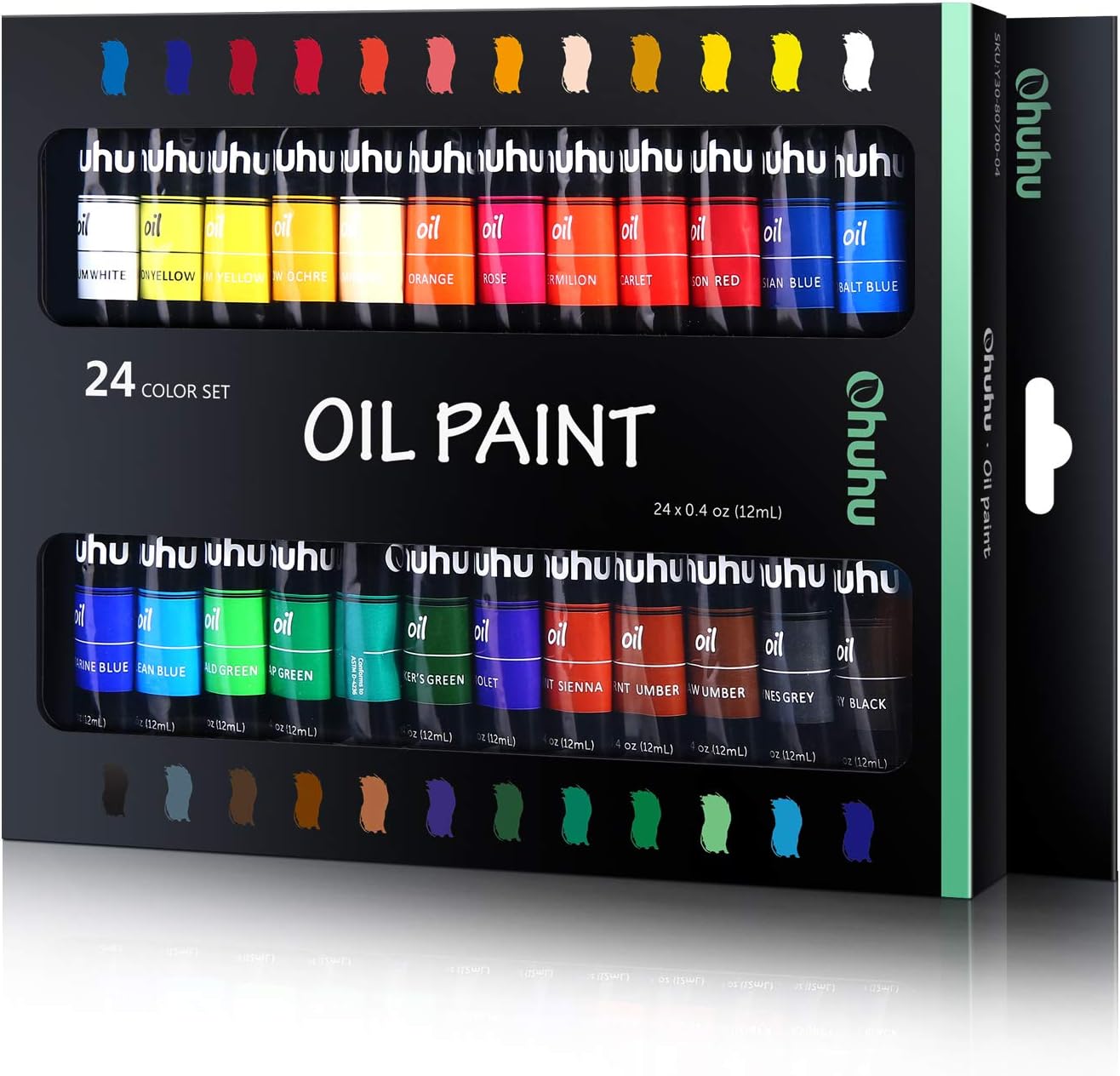
Ohuhu’s set gives a beginner 24 oil colors in 12 ml (0.4 oz) tubes. The listing names the palette, which includes titanium white, lemon and medium yellow, yellow ochre, vermilion, crimson red, Prussian, cobalt, ultramarine and cerulean blues, emerald and sap green, viridian, violet, burnt sienna, burnt umber, raw umber, Payne’s grey and ivory black, plus a flesh tint.
That is a genuinely useful range: a child can paint landscapes and simple portraits without mixing every color from scratch. The set conforms to ASTM D4236 and EN71-3, according to the listing. The seller says the paint dries quickly; bear in mind that oil paint in general dries over days rather than minutes, so plan a safe place for wet canvases.
Best suited for: Tweens and teens ready for oil painting with an adult nearby, and families who want to try oils without a big investment.
Key features:
- 24 colors in 12 ml tubes
- Named, traditional color list
- Gloss finish
- Canvas and paper listed as surfaces
- ASTM D4236 and EN71-3 conformance
Pros:
- Small tubes limit waste while learning
- Complete palette including earth tones
- Low cost for a first oil set
Cons and limitations:
- Student-grade paint is less pigment-dense than artist grade
- White runs out first; buy a larger tube
- Paper needs priming or oil-paper to avoid oil soaking in
Buying consideration: Buy a larger tube of titanium white along with the set; children use white in almost every mix.
2. KEFF 24-Pack Canvas Boards for Painting — Best for kids’ oil practice

Oil paint needs a primed surface, and canvas boards are the most practical option for kids. KEFF’s pack includes 6 boards each of 5×7, 8×10, 9×12 and 11×14 inches, 24 in total, made from triple-primed cotton and listed for oil, acrylic, watercolor, tempera and gouache.
The mix of sizes is helpful for young painters. Small 5×7 boards make quick color studies less intimidating, while 11×14 boards suit a finished piece worth hanging. Flat boards also store more easily than stretched canvases while oil paint dries.
Best suited for: Any child painting in oil or acrylic who needs plenty of affordable surfaces for practice.
Key features:
- 24 boards in 4 sizes
- Triple-primed 100% cotton
- Listed for oil, acrylic, tempera, watercolor and gouache
- Warp-resistance claim
Pros:
- Lots of surfaces for practice
- Sizes for studies and finished work
- Easy to store flat
Cons and limitations:
- Heaviest item in the list at nearly 6 pounds
- Boards are less premium than stretched canvas for display
- Highest price tier among the supplies here
Buying consideration: Use the small boards for color mixing exercises first; they build confidence before a larger painting.
3. BOSOBO 20-Piece Paint Brush Set — Best for detail work in oil

BOSOBO’s kit includes two packs of 10 round and flat tip brushes, 20 in total, with synthetic nylon bristles, rust-proof nickel ferrules and wooden handles. The listing describes them as suitable for acrylic, watercolor, oil and gouache, with no shedding.
Synthetic brushes are a good choice for kids using oils because they clean up well with the oil-then-soap method. The set leans small, which suits details, eyes and highlights rather than big backgrounds. A portable storage case is included.
Best suited for: Older kids who want neat brushes for details, and families who want the same brushes for oil and acrylic.
Key features:
- 20 brushes in round and flat tips
- Synthetic nylon bristles
- Rust-proof nickel ferrules
- Wooden handles
- Portable storage case
Pros:
- Good for both oil and acrylic
- Low cost
- Case keeps brushes together
Cons and limitations:
- Small sizes only; add a larger flat for backgrounds
- Not designed for heavy impasto
Buying consideration: Keep one set for oil and one for water-based paints so leftover oil does not spoil acrylic work.
4. Shuttle Art 36-Color Acrylic Paint Set — Best for younger kids who want an oil-painting look

For kids under about 10, acrylic is usually the better first step. It looks similar to oil on canvas, but it dries fast and cleans up with water. Shuttle Art’s set includes 36 colors in 2 oz bottles, metallic gold and silver among them, plus 12 brushes and a palette.
The listing describes creamy paint that blends and layers well, a gloss finish and ASTM D4236 conformance. Children can practice the same skills they will later use in oil, like mixing values and painting wet edges, without solvent questions.
Best suited for: Kids around 6 to 10 who want to paint on canvas like adults do.
Key features:
- 36 colors in 2 oz bottles
- Metallic gold and silver
- 12 brushes and palette
- ASTM D4236, non-toxic
- Water cleanup while wet
Pros:
- Easy water cleanup
- Lots of color
- Brushes included
Cons and limitations:
- Dries fast, so blending is harder than with oil
- Stains clothing once dry
- Not an oil paint
Buying consideration: Add a slow-drying medium for older kids who want more blending time without switching to oil.
5. Caliart 36-Color Acrylic Paint Set — Best for a matte acrylic alternative

Caliart’s 36-color set is another strong acrylic option, distinguished by a matte and metallic finish according to the listing. Matte paint photographs well and hides small brush marks, which helps young painters feel good about their results.
It includes 12 brushes, conforms to ASTM D4236, and is listed as non-toxic and acid-free. It is a sensible pick for a younger sibling painting alongside an older child who uses oils.
Best suited for: Kids who prefer a matte look or households where siblings paint side by side in different media.
Key features:
- 36 colors in 2 oz bottles
- Matte and metallic finish
- 12 brushes
- ASTM D4236
Pros:
- Low-sheen look
- Metallic accents
- Complete with brushes
Cons and limitations:
- Not oil paint
- Fast drying
- Small bottles of white
Buying consideration: If your child later moves to oils, acrylic underpaintings on canvas boards can be painted over with oil, but never paint acrylic over oil.
6. ONEXIZ 162-Piece Bulk Paint Brushes — Best for groups and art clubs

Running an art club or homeschool co-op session? ONEXIZ sells 162 brushes split into 81 flat brushes with a 0.59-inch edge and 81 round brushes with 0.39-inch tips. The listing describes nylon bristles, aluminum ferrules and plastic handles, and lists oil, acrylic, watercolor and gouache among uses.
These are classroom-grade brushes. Their value is quantity: every child gets fresh brushes, and you can retire brushes used for oil rather than cleaning them perfectly.
Best suited for: Teachers, scout leaders and parents organizing group painting sessions.
Key features:
- 162 brushes
- 81 flat (0.59 in) and 81 round (0.39 in)
- Nylon bristles
- Lightweight plastic handles
Pros:
- Very low cost per brush
- Plenty for groups
- Works across media
Cons and limitations:
- Basic quality
- Only two sizes
- Plastic handles feel light
Buying consideration: Label a cup “oil only” for group sessions so oil brushes never end up in water-based paint.
Buying Guide: How to Choose Oil Paints for Kids
Student grade is the right starting point
Student-grade oils cost less and often replace expensive pigments with hues. For kids, that is a benefit: lower cost, and often fewer hazardous pigments. Artist grade can come later if a teen sticks with it. If you are weighing brands, our reviews of Blick oil paint and Grumbacher oil paint explain how common student and studio lines compare.
Read the label for safety information
Look for ASTM D4236 conformance, which means the product has been reviewed for chronic health hazards and labeled accordingly. EN71-3 is a European toy safety standard for certain elements. Avoid colors labeled with cadmium or lead for young painters.
Choose small tubes
12 ml to 22 ml tubes are plenty for learning. Kids use far more white than anything else, so buy a separate larger tube of titanium white.
Plan a solvent-free cleanup
Skip turpentine and mineral spirits. Wipe brushes on a paper towel, work them in vegetable or baby oil, then wash with dish soap. Dispose of oily rags safely by laying them flat to dry outdoors or keeping them in a sealed metal container, as oily rags can heat up.
Pick primed surfaces
Oil soaks into raw paper and canvas, which weakens the painting over time. Canvas boards, canvas panels and oil painting paper are all primed for oil.
Consider water-mixable oils
Water-mixable oils behave like oil paint but clean up with water, which removes the solvent question. They are worth considering for children around 8 to 11 who want the oil experience.
A Simple First Oil Painting Session for Kids
- Set up near an open window and cover the table with newspaper or a drop cloth.
- Squeeze pea-sized dabs of white, a yellow, a red, a blue and burnt umber onto a palette.
- Paint a simple subject on a small canvas board: an apple, a sunset or a single flower.
- Work from dark to light and thin to thick, without solvents.
- Wipe brushes, clean them with oil and soap, and wash hands thoroughly.
- Lay the painting flat somewhere safe to dry; expect several days for thin layers.
Younger siblings can join in with washable paint. Projects like our easy ladybug painting for kids and how to paint a dinosaur for kids work well in tempera or acrylic while an older child works in oil.
Common Mistakes to Avoid
- Using turpentine with kids: skip solvents entirely and use oil-and-soap cleanup.
- Starting too young: children under about 10 usually do better with acrylic or tempera.
- Painting on unprimed paper: oil soaks in and leaves a dull, brittle result.
- Squeezing out too much paint: pea-sized amounts are plenty and reduce waste.
- Mixing up brushes: keep oil brushes separate from water-based brushes.
- Expecting fast drying: oil paintings need days; plan where they will dry.
FAQs
Can kids use oil paint?
Yes, older kids can use oil paint with supervision, especially student-grade paints labeled ASTM D4236 and a solvent-free cleanup routine. Most children under about 10 are better served by acrylic or washable tempera.
Is oil paint toxic for children?
Many student oils are labeled non-toxic, but some pigments and most solvents are hazardous. Avoid turpentine and mineral spirits, read color labels, and make sure children wash their hands and do not eat while painting.
How do kids clean oil paint brushes without turpentine?
Wipe excess paint off with a paper towel, work the bristles in vegetable oil or baby oil, then wash with dish soap and warm water until the water runs clear.
What is the best oil paint set for a beginner child?
A small student set with 12 ml tubes and a complete color range, such as the Ohuhu 24-color set, is a sensible start. Add a larger tube of white and some primed canvas boards.
Should my child start with acrylic or oil?
Acrylic is easier for most children because it dries quickly and cleans up with water. Oil suits older kids who want more blending time and can follow cleanup rules.
How long does oil paint take to dry?
Thin layers of oil paint are usually touch-dry in several days, while thick layers can take weeks. Drying varies with pigment, thickness and room conditions.
Final Recommendation
For an older child or teen ready to try oils, the Ohuhu 24-color set is the most suitable oil paint in our search, and pairing it with KEFF canvas boards and BOSOBO brushes gives a complete, low-cost starter kit. Keep cleanup solvent-free and supervise sessions. For children under about 10, start with acrylic instead: Shuttle Art for color variety, Caliart for a matte finish. Group leaders should stock ONEXIZ bulk brushes so oil and water-based brushes never mix.



One Comment