PaintingProGuide is reader-supported. When you buy through links on this page we may earn an affiliate commission at no extra cost to you.
Practice is where oil painters improve, and practice burns through surfaces. Painting every study on a stretched canvas is expensive and leaves you with a closet full of paintings you would never hang. Oil painting paper solves that. A pad of canvas-textured or specially sized paper lets you paint color studies, value sketches, master copies and plein air notes for a fraction of the cost per sheet, and the pads stack flat on a shelf.
Not all “oil paper” behaves the same, though. Some pads are coated to mimic canvas, some are heavy cotton sheets sized to resist oil, and some are budget student papers best for quick studies. This guide compares seven pads on Amazon, explains what paper weight and coating mean for oil, and shows how to prepare, tape and store paper studies so the paint does not sink or the sheet buckle.
Quick answer: For most daily practice, the Canson XL Oil & Acrylic pad is the best balance: 24 sheets of 136 lb (290 gsm) acid-free paper at 11×14, with a canvas-like texture on both sides and no priming needed. For studies you may want to keep, the Arches Huile oil paper is 100% cotton and needs no priming. For the lowest cost per sheet, the U.S. Art Supply 2-pack gives 30 sheets of 90 lb paper.
Our Top Picks at a Glance
- Canson XL Series Oil & Acrylic Pad, 11×14 — Best overall practice pad
- Arches Huile Oil Pad, 140 lb — Best premium paper for keeper studies
- Strathmore 400 Series Oil Painting Pad — Best heavyweight linen-texture paper
- U.S. Art Supply Heavy-Weight Oil Painting Pad, 2 Pack — Best value for high-volume practice
- Prudiut Canvas Paper Pad, 200 gsm — Best budget canvas paper with more sheets
- Strathmore 300 Series Canvas Paper Pad — Best classic student canvas paper
- Hapikalor Canvas Paper, 115 lb — Best low-cost 20-sheet pad
| Product | Best For | Key Spec | Key Strength | Price Tier |
|---|---|---|---|---|
| Canson XL Oil & Acrylic | Daily practice | 136 lb / 290 gsm, 24 sheets, 11×14 | No priming, both sides usable | $$ |
| Arches Huile Oil Pad | Keeper studies | 140 lb / 300 gsm, 100% cotton, 12 sheets | Sized for oil, no priming | $$ |
| Strathmore 400 Oil Pad | Finished pieces on paper | 215 lb, linen surface, 10 sheets | Heaviest sheet here | $$ |
| U.S. Art Supply 2 Pack | High-volume studies | 90 lb / 190 gsm, 30 sheets, 9×12 | Most sheets | $$ |
| Prudiut Canvas Paper | Budget practice | 200 gsm, 25 sheets, 9×12 | Glue bound, tear-off | $ |
| Strathmore 300 Canvas Paper | Student practice | 115 lb canvas texture, 10 sheets | Economical classic | $ |
| Hapikalor Canvas Paper | Low-cost practice | 115 lb / 187 gsm, 20 sheets, 9×12 | Acid-free | $ |
How We Chose
We did not paint on these papers for this guide. The picks are based on the Amazon listing details and specifications checked in October 2026, how well each pad’s weight, surface, coating and sheet count fit oil painting practice, and how widely each product is reviewed by Amazon buyers.
- Oil suitability: explicitly listed for oil, ideally without priming.
- Weight: heavier sheets buckle less under paint and medium.
- Surface: canvas-like or linen texture for realistic brush feel.
- Sheets and size: enough volume for regular practice.
- Longevity: acid-free or cotton papers for studies you keep.
Oil Paper vs Canvas Paper vs Canvas Panels
| Surface | What It Is | Best Use | Watch For |
|---|---|---|---|
| Oil paper (sized) | Paper treated to resist oil absorption | Studies, plein air notes, keeper work on paper | Premium price per sheet |
| Canvas paper | Paper with an embossed canvas texture and coating | Everyday practice and color studies | Lighter sheets can buckle |
| Canvas panels | Primed canvas glued to board | Finished small paintings | More expensive and bulkier |
| Stretched canvas | Canvas on wooden bars | Final work for display | Highest cost and storage space |
Best Oil Painting Paper for Practice Reviewed
1. Canson XL Series Oil & Acrylic Paper Pad, 11×14 — Best for everyday practice

Canson’s XL Oil & Acrylic pad is the go-to student pad for a reason. Each of its 24 sheets is a 136 lb (290 gsm) paper with a medium, canvas-like texture on both sides, and the listing states it is ready for acrylic or oil without priming. It is acid-free, bleed-proof and tape-bound.
The 11×14 size gives enough room for real compositions rather than thumbnails, and both sides being usable doubles your practice surfaces for quick color swatches on the back.
Best suited for: Students and self-taught painters doing regular studies.
Key features:
- 136 lb / 290 gsm
- 24 sheets, 11×14 in
- Canvas-like texture on both sides
- Acid-free, no priming needed
Pros:
- Strong value per sheet
- Large enough for full compositions
- Ready to use
Cons and limitations:
- Heavy oil layers can still cockle the sheet
- Tape binding means sheets tear off by hand
- Not cotton
Buying consideration: Tape the sheet to a board on all four sides before painting to keep it flat as it absorbs medium.
2. Arches Huile Oil Pad, 140 lb, 9×12 — Best for keeper studies

Arches Huile is a 100% cotton oil paper with a cold-pressed surface, 140 lb (300 gsm), 12 sheets per 9×12 pad. The listing explains that a special sizing and barrier gives a semi-absorbent surface with high tolerance to added solvents, eliminating the need to prime, and allowing paint to dry faster.
The listing also notes the cylinder-mold process distributes cotton fibers evenly to resist scratching and greasy ring formation, the halo of oil that can spread around paint on untreated paper. That makes it the best choice for studies you might frame or sell.
Best suited for: Plein air painters and serious students who want archival paper studies.
Key features:
- 100% cotton, 140 lb / 300 gsm
- 12 sheets, 9×12 in
- Sized for oil, no priming
- Resists greasy ring formation
Pros:
- Archival cotton
- Paint dries faster on the surface
- Usable for oil pastels too
Cons and limitations:
- Highest cost per sheet
- Only 12 sheets
- Too good for quick warm-ups
Buying consideration: Save Arches for studies you plan to keep; use a cheaper pad for warm-ups and swatches.
3. Strathmore 400 Series Oil Painting Pad, 9×12 — Best for heavyweight linen-texture paper

Strathmore’s 400 Series oil pad is the heaviest sheet here at 215 lb, with a linen surface that mimics canvas and helps blend and hold layers. The listing positions it as a convenient alternative to canvases or boards, intended for final art pieces in oil or oil pastel.
The weight is the advantage: a heavier sheet stays flatter under thick paint and is easier to frame without mounting.
Best suited for: Painters creating finished small works on paper, and those who dislike buckling.
Key features:
- 215 lb
- Linen-texture surface
- 10 sheets, 9×12 in
- For oil paint and oil pastel
Pros:
- Very heavy, resists buckling
- Canvas-like linen texture
- Suitable for final pieces
Cons and limitations:
- Only 10 sheets
- Higher cost per sheet
- Glue binding
Buying consideration: Use it for the best of your studies, or for small final paintings you want to mat and frame.
4. U.S. Art Supply Premium Heavy-Weight Oil Painting Pad, 2 Pack — Best for high-volume practice

U.S. Art Supply’s two-pack gives 30 sheets of 90 lb (190 gsm) paper in 9×12 pads, designed for oil and acrylic. The listing also suggests using the pad as palette paper for color mixing and for oil pastels.
At 90 lb, the paper is the lightest here, so it is best for thin paint, quick studies and color swatches rather than thick impasto. For volume practice, the sheet count is the main draw.
Best suited for: Daily warm-ups, color charts and beginners who want lots of sheets.
Key features:
- 90 lb / 190 gsm
- 2 pads, 15 sheets each (30 total)
- 9×12 in
- For oil, acrylic and oil pastel
Pros:
- Most sheets in this list
- Doubles as palette paper
- Low cost per sheet
Cons and limitations:
- Lightest weight; buckles with heavy paint
- Not for keeper work
- Smaller format
Buying consideration: Use thin paint and minimal medium on this paper; save thick passages for heavier sheets.
5. Prudiut Canvas Paper Pad, 9×12, 25 Sheets, 200 GSM — Best for budget canvas paper with more sheets

Prudiut packs 25 sheets of 200 gsm canvas-textured paper into a single-side glue-bound 9×12 pad. The listing describes the surface as holding paint well for acrylics or oils and designed for tearing off finished work cleanly.
Twenty-five sheets at the low price tier makes it a practical pad for daily exercises and class assignments.
Best suited for: Students and hobbyists who want plenty of canvas-texture sheets.
Key features:
- 200 gsm canvas-textured paper
- 25 sheets, 9×12 in
- Glue-bound for easy tear-off
- For acrylic and oil
Pros:
- Good sheet count
- Canvas texture
- Low price tier
Cons and limitations:
- Limited technical detail in listing
- Lighter than premium pads
- Not acid-free stated
Buying consideration: Try a sheet with a thin first layer before committing to a full study to see how it absorbs your paint.
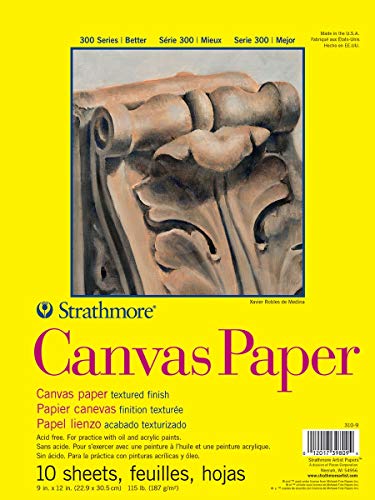
6. Strathmore 300 Series Canvas Paper Pad, 9×12 — Best for classic student canvas paper

Strathmore’s 300 Series canvas paper is a 115 lb sheet with a textured canvas finish, suitable for oil or acrylic. The listing calls it an economical way to begin oil painting. It comes in 10 glue-bound 9×12 sheets.
It is a long-standing student staple, useful for exercises in art classes and for beginners learning brush handling.
Best suited for: Beginners and class exercises.
Key features:
- 115 lb canvas-textured paper
- 10 sheets, 9×12 in
- Glue-bound
- For oil or acrylic
Pros:
- Trusted student brand
- Low price tier
- Canvas texture
Cons and limitations:
- Only 10 sheets
- Lighter weight than Canson XL
- Not for keeper work
Buying consideration: Buy several pads at once if you paint daily; 10 sheets go quickly.
7. Hapikalor Canvas Paper, 9×12, 20 Sheets, 115 lb — Best for a low-cost 20-sheet pad

Hapikalor offers 20 sheets of 115 lb (187 gsm) canvas paper in a 9×12 pad, described as acid-free and designed to mimic real canvas texture for acrylics, oils and other media. The listing also says it resists warping and handles repeated corrections.
For a low price tier, the acid-free claim is a plus for studies you might keep in a portfolio.
Best suited for: Beginners and students who want an affordable acid-free pad.
Key features:
- 115 lb / 187 gsm
- 20 sheets, 9×12 in
- Acid-free
- Canvas-like texture
Pros:
- Acid-free at a low tier
- Twenty sheets
- Lightweight for travel
Cons and limitations:
- Lighter weight than premium pads
- Brand less established
- May buckle with heavy medium
Buying consideration: Keep paint layers thin and let each one set before adding the next.
Buying Guide: How to Choose Oil Painting Paper for Practice
Check the oil rating
Look for paper explicitly listed for oil. Unprotected paper absorbs oil, which can weaken the fibers over time and leave a greasy halo around the paint.
Priming or not
Some papers, such as Canson XL and Arches Huile, are listed as needing no priming. Others benefit from a thin coat of acrylic gesso, especially if you want a less absorbent surface or plan to keep the study.
Gesso both sides, or tape down well, to reduce curling.
Weight and buckling
Heavier papers stay flatter. Around 90 lb suits thin studies; 115 to 140 lb handles normal practice; 200 lb and above behaves almost like a board.
Surface texture
Canvas or linen textures give a brush feel closer to real canvas, which makes skills transfer. Smoother sheets suit detailed work.
Size and sheet count
A 9×12 pad is good for small studies and plein air. An 11×14 pad allows fuller compositions. Buy by how many studies you paint per week.
Archival needs
For work you might keep, choose acid-free or cotton papers. For warm-ups and color charts, budget pads are fine.
How to Prepare and Paint on Oil Paper
- Tape it down. Use artist tape on all four edges to a board. It keeps the sheet flat and gives a clean border.
- Optional gesso. For unrated or lightweight papers, brush on a thin coat of acrylic gesso and let it dry.
- Start thin. Use a thin wash for the first layer; avoid flooding with solvent.
- Build fat over lean. Add more oil in later layers, just as on canvas.
- Dry flat. Leave studies taped to the board or flat on a shelf while they dry.
- Store with interleaving. Once dry, separate sheets with parchment or glassine.
Practice Ideas for a Pad of Oil Paper
- A 12-step value scale from white to black.
- A color mixing chart from your palette of primaries.
- Thumbnail studies of one landscape at different times of day.
- Master copies of a small section of a painting you admire.
- Brush stroke drills: flats, rounds, fans and knife marks.
Related Techniques
Paper studies dry faster than thick canvas work, but if you want to speed things up further, our guide on how to speed-dry oil paint on canvas covers methods that also help on paper. For mixed-media inspiration, try painted paper crafts or DIY marbled paper at home with your leftover sheets.
Common Mistakes to Avoid
- Using printer or drawing paper. It absorbs oil and degrades.
- Painting thick impasto on light paper. It buckles and cracks.
- Skipping tape. Loose sheets curl as paint and medium soak in.
- Using a lot of solvent. Heavy solvent washes can weaken paper.
- Stacking wet studies. They stick together; dry flat first.
- Saving premium paper for “someday.” Use it; practice is the point.
FAQs
Can you use oil paint on paper?
Yes, on paper made or prepared for oil. Oil-rated pads like Canson XL Oil & Acrylic and Arches Huile are designed for it; otherwise prime paper with acrylic gesso.
Do I need to gesso oil painting paper?
Not if the paper is listed as needing no priming. For other papers, a thin coat of acrylic gesso protects the fibers and reduces absorbency.
What weight paper is best for oil painting practice?
Around 115 to 140 lb suits most practice. Lighter 90 lb paper is fine for thin studies; 200 lb and above stays flattest.
Is canvas paper good for oil painting?
Canvas paper is good for practice and studies. For finished pieces you plan to sell or hang, use oil paper, panels or canvas.
How long does oil paint take to dry on paper?
Often faster than on canvas, especially on sized papers like Arches Huile, but drying still depends on paint thickness and colors.
Can I frame oil paintings on paper?
Yes. Mount the dry study on a rigid backing or mat it, and frame it as you would a work on paper, ideally without glass touching the paint.
Final Recommendation
For everyday practice, the Canson XL Oil & Acrylic pad offers the best mix of weight, size and value. Choose Arches Huile for archival studies you want to keep, and Strathmore 400 when you need a heavy, linen-textured sheet for finished small works. For volume, the U.S. Art Supply two-pack gives the most sheets, while Prudiut, Strathmore 300 and Hapikalor are dependable low-cost pads for beginners and class exercises.