PaintingProGuide is reader-supported. When you buy through links on this page we may earn an affiliate commission at no extra cost to you.
The best paint for leather jackets is a flexible, water-based acrylic leather paint, not ordinary craft acrylic. A jacket bends at the elbows, shoulders and collar every time you move, and standard acrylics dry too stiff, so they crack along those creases. Leather paints use flexible acrylic resins designed to move with the hide, and when applied in thin layers over leather that has been deglazed, they resist cracking, peeling and rubbing off.
This guide compares seven leather paint options from the Amazon listings we checked, from single bottles for back-panel designs to full kits with deglazer and finisher, and walks through the preparation and layering method that makes the difference between a custom jacket that lasts and one that flakes after a few wears.
Quick answer: For a full custom jacket, the Angelus Acrylic Leather Paint Best Sellers Kit (12 colors) is the classic choice from a brand that has made leather care products in the USA since 1907. If you want prep and protection in one box, the Smalltongue 14-Color Kit and Somime 18-Color Set both include a deglazer and an acrylic finisher. For a single-color design, a bottle of Angelus Black or Angelus White (4 oz) is enough.
Our Top Picks at a Glance
- Angelus Acrylic Leather Paint Best Sellers Kit, 12 Colors — Best overall for custom leather jackets
- Smalltongue Acrylic Leather Paint, 14 Colors with Deglazer and Finisher — Best complete kit with prep and topcoat
- Somime 18 Colors Leather Paint with Deglazer and Finisher — Best color range in an all-in-one kit
- Artecho 12 Colors Acrylic Leather Paint — Best budget multi-color set
- Angelus Acrylic Leather Paint, Black, 1 oz — Best single color for outlines and lettering
- Angelus Acrylic Leather Paint, White, 4 oz — Best larger bottle for base coats
- Colorful Leather Paint Set, 24 Colors — Best small-quantity color sampler
| Product | Best For | Key Spec | Key Strength | Price Tier |
|---|---|---|---|---|
| Angelus Best Sellers Kit | Full custom jackets | 12 x 1 oz, semi-gloss, water-based | Established leather brand | $$$ |
| Smalltongue 14 Colors | All-in-one kit | 14 x 30 ml, deglazer and finisher included | Prep and protect included | $$ |
| Somime 18 Colors | Color range plus prep | 18 colors, deglazer and finisher (30 ml each) | Most colors with prep | $$ |
| Artecho 12 Colors | Budget set | 12 x 1 oz, flexible acrylic resins | Low cost | $$ |
| Angelus Black 1 oz | Outlines, lettering | 1 oz, water-based, flexible | Single color | $ |
| Angelus White 4 oz | Base coats | 4 oz, matte, water-based | Larger size | $ |
| Colorful 24 Colors | Sampling colors | 24 x 0.4 oz, gloss | Many colors | $$ |
How We Chose
We have not painted leather with these products. Our picks are based on the Amazon listing details and specifications checked in October 2026, how well each paint’s flexibility, finish and included prep products fit painting jackets specifically, and how widely each product is reviewed by Amazon buyers.
- Leather-specific formula: flexible acrylic designed for leather rather than general craft acrylic.
- Included prep and finish: deglazer to remove factory finish and a topcoat to protect the paint.
- Color range and mixability: enough colors to design and mix.
- Bottle size: 4 oz for base coats, 1 oz for details.
- Water-based clean-up: low odor and soap-and-water cleaning.
Why Leather Paint and Not Craft Acrylic?
Craft acrylics are designed for rigid surfaces like wood and canvas. On leather that flexes thousands of times a day, they tend to crack at the elbows and along seams. Acrylic leather paints use more flexible binders that bend with the hide. They also bond better to leather once its factory finish is removed, which is why many leather paint kits include a deglazer.
Leather paint also works on faux leather and vinyl in many cases, although adhesion varies by material, so always test on a hidden area. Suede and nubuck are different: their napped surface needs specific suede dyes rather than paint.
Best Paint for Leather Jackets Reviewed
1. Angelus Acrylic Leather Paint Best Sellers Kit, 12 Colors (1 oz each) — Best for custom leather jackets
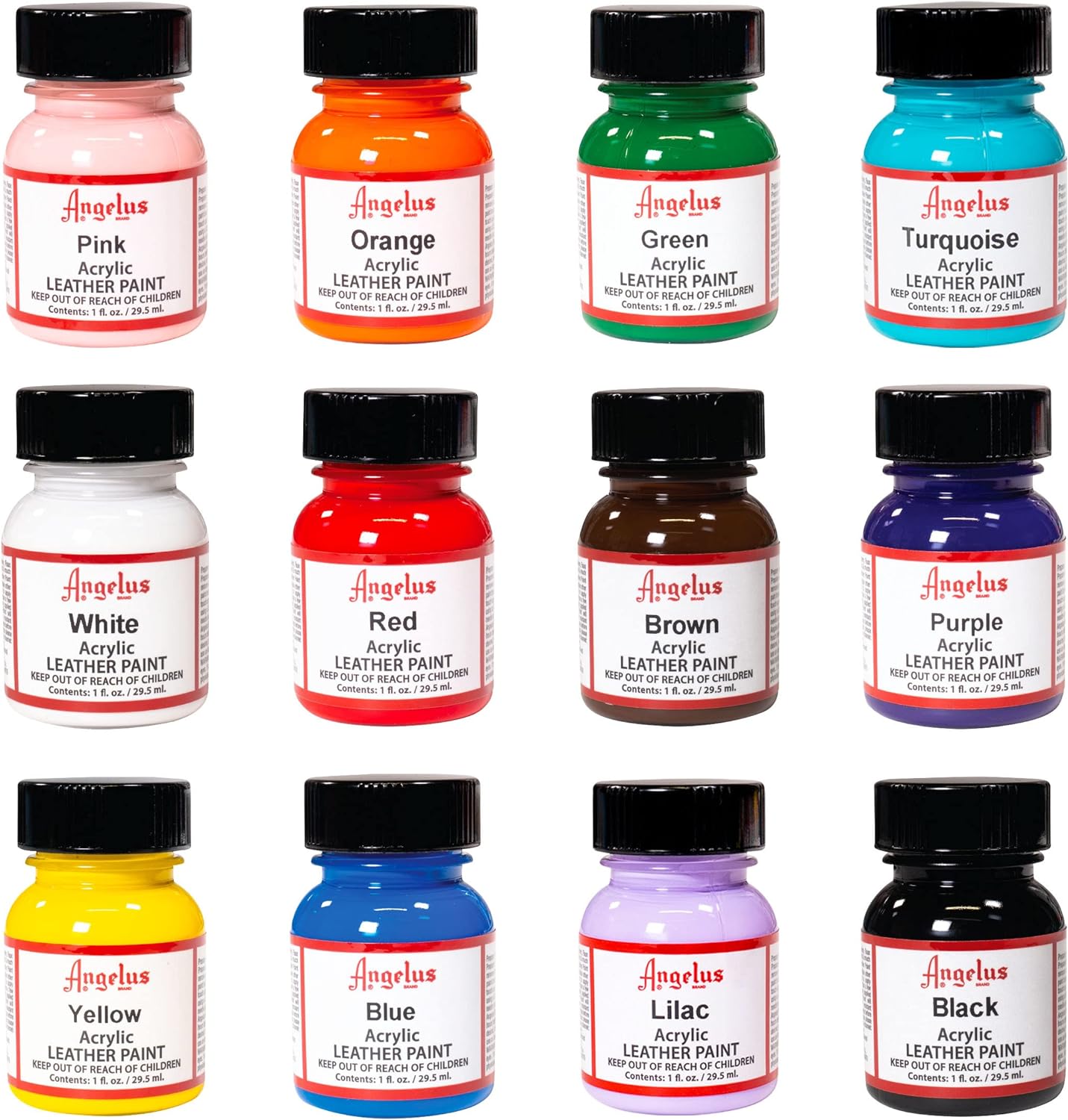
Angelus is one of the most recognized names in custom leather painting, and the brand describes itself as manufacturing shoe and leather care products in the USA for over 100 years. This kit includes 12 popular colors in 1 oz bottles. The listing says the paints can be blended for countless custom colors and applied by fine brush, sponge or airbrush, and that when properly applied they will not crack, peel, fade or rub off.
The listing names jackets specifically along with shoes, purses and furniture. The paint is water-based for easy clean-up, with a semi-gloss finish according to the details.
Best suited for: Artists customizing jackets with multi-color designs, lettering or illustrations.
Key features:
- 12 colors, 1 oz each
- Water-based acrylic
- Semi-gloss finish
- Brush, sponge or airbrush
- Listed for jackets, shoes, purses, furniture
Pros:
- Established leather paint brand
- Fully mixable
- Airbrush compatible
- Non-toxic, scratch resistant per details
Cons and limitations:
- Highest price tier here
- Deglazer and finisher sold separately
Buying consideration: Buy Angelus’s preparer/deglazer and a matching finisher too, or use the prep products from one of the kits below.
2. Smalltongue Acrylic Leather Paint, 14 Colors (30 ml) with Deglazer and Finisher — Best for an all-in-one kit with prep and topcoat
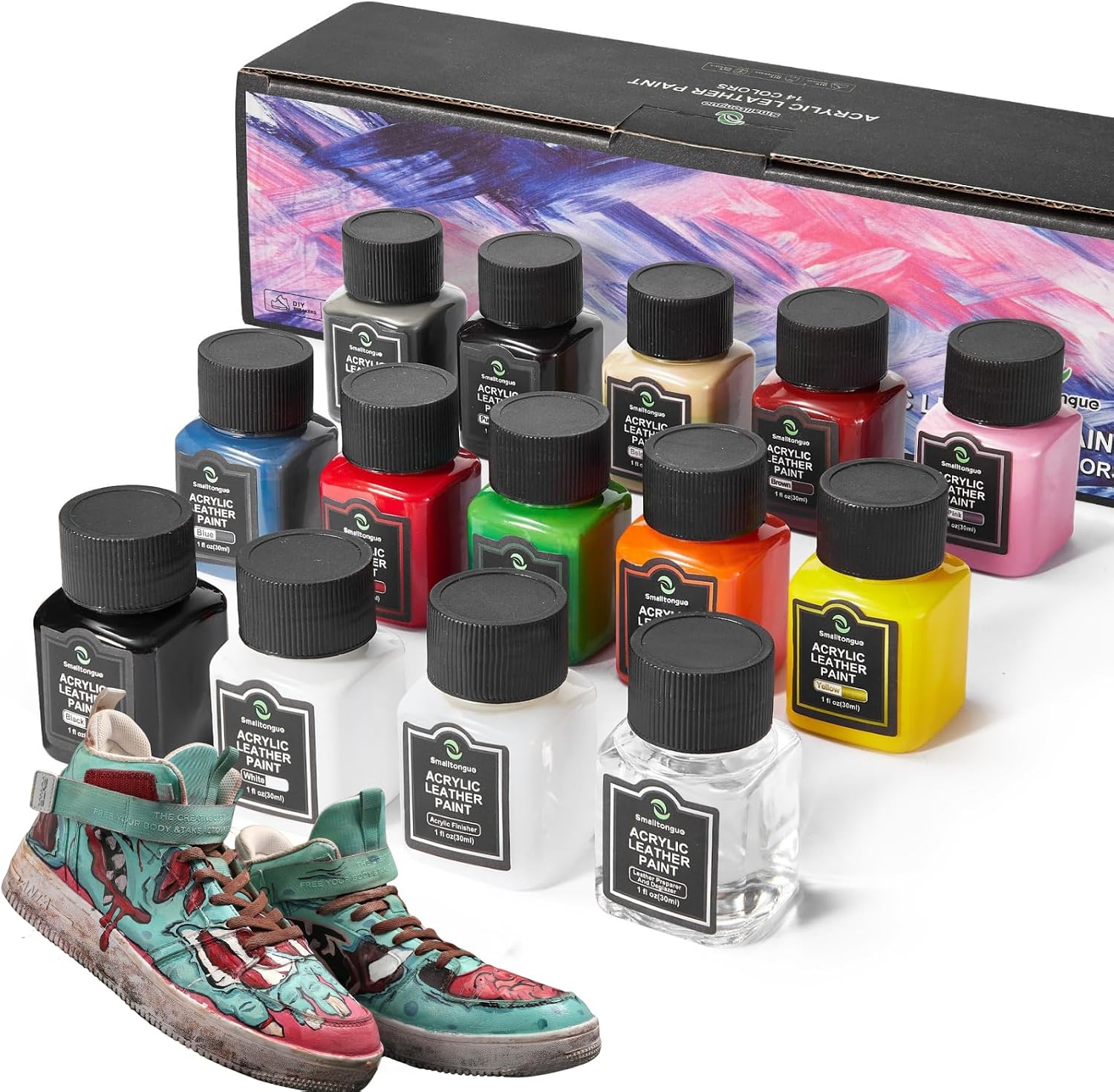
Smalltongue’s kit includes 14 colors in 30 ml bottles plus a leather preparer and deglazer and an acrylic finisher. The listing explains the deglazer removes factory glaze so paint covers easily, and the finisher protects paint from rubbing off, cracking, peeling or streaking, with a semi to high gloss top finish for smooth leathers. It also notes the paint works with an airbrush.
Having prep and topcoat in the box means a first-time jacket painter can follow the full process without hunting for extra products.
Best suited for: First-time leather painters who want everything needed in one purchase.
Key features:
- 14 colors, 30 ml each
- Leather preparer and deglazer
- Acrylic finisher
- Airbrush compatible
Pros:
- Complete process in one kit
- Good color range
- Mid price tier
Cons and limitations:
- Finisher is glossy; matte look needs a different topcoat
- Brand is less established than Angelus
Buying consideration: Follow the order on the bottles: deglaze, let dry fully, paint thin layers, then finish once the paint has dried.
3. Somime 18 Colors Acrylic Leather Paint Dye Set with Deglazer and Finisher — Best for the most colors with prep included

Somime’s set includes 18 leather paint colors plus one acrylic finisher and one leather preparer and deglazer, all 30 ml each, according to the listing. It describes paints that mix easily for custom shades, resist cracking, peeling and fading, and are non-toxic, odorless and free of harmful solvents. Jackets are named among suitable items.
Eighteen colors give more design options than most kits that include prep products.
Best suited for: Designers who want a wide palette plus prep and finish.
Key features:
- 18 colors
- Deglazer and finisher, 30 ml each
- Mixable
- Non-toxic, water clean-up
Pros:
- Largest palette among prep-included kits
- Mid price tier
Cons and limitations:
- High-gloss finish per details
- 30 ml bottles may run short on large back panels
Buying consideration: Reserve the larger colors you use most for back-panel backgrounds and buy a bigger bottle of that color if needed.
4. Artecho 12 Colors Acrylic Leather Paint, 1 oz — Best for a budget multi-color set

Artecho’s set includes 12 highly pigmented acrylic leather colors in 1 oz squeeze bottles. The listing describes flexible acrylic resins that move and bend with leather, adhering to high-flex areas, and a mixable formula for custom colors and gradients. It names leather jackets and vests among uses and says it also works on canvas, fabric, vinyl and wood.
It is a lower-cost way to get a 12-color leather palette.
Best suited for: Budget-conscious customizers and beginners.
Key features:
- 12 colors, 1 oz each
- Flexible acrylic resins
- Mixable
- Semi-gloss or matte depending on layering
Pros:
- Low-to-mid price tier
- Squeeze bottles
- Multi-surface
Cons and limitations:
- No deglazer or finisher included
- Newer brand
Buying consideration: Pair with a separate deglazer and finisher for best adhesion and durability.
5. Angelus Acrylic Leather Paint, Black, 1 fl oz — Best for outlines, lettering and single-color designs

Angelus Black is a 1 oz water-based acrylic leather paint for smooth leather goods, with leather jackets named in the listing. It is described as quick drying and flexible, made to resist cracking and peeling, with soap-and-water clean-up and no harsh smell.
Black is the workhorse for outlines, lettering and touching up scuffs on a black jacket before adding color elsewhere.
Best suited for: Outlines, lettering and scuff touch-ups on smooth leather.
Key features:
- 1 oz
- Water-based
- Quick drying, flexible
- Made in USA
Pros:
- Low price tier
- Ideal for line work
- Mixable with other Angelus colors
Cons and limitations:
- Small bottle for large areas
Buying consideration: Use a fine synthetic liner brush and thin the paint slightly for crisp lettering.
6. Angelus Acrylic Leather Paint, White, 4 oz — Best for base coats and larger areas

This 4 oz Angelus White is water-based, non-toxic and easy to clean, and the listing names jackets among the items it can transform. Details list a matte finish.
White is often used as a base under bright colors on dark leather, so a larger bottle prevents running out mid-project.
Best suited for: Base coats under bright colors and larger white areas.
Key features:
- 4 oz
- Water-based, non-toxic
- Matte finish
Pros:
- Larger quantity
- Good base under bright colors
- Low price tier
Cons and limitations:
- White needs several thin coats for full opacity on dark leather
Buying consideration: Build white in many thin layers, drying between each; thick white is the most common cause of cracking.
7. Colorful Leather Paint Set, 24 Colors, 0.4 oz — Best for sampling many colors

Colorful’s set includes 24 acrylic leather colors in small 0.4 oz bottles. The listing describes non-toxic, odorless paints that blend easily, resist fading and flaking, and clean with soap and water. Jackets are named among suitable items, and the details list a gloss finish.
Small bottles in many colors are ideal for detailed illustrations, patches and accents where you need a little of many hues.
Best suited for: Small, detailed designs that use many colors.
Key features:
- 24 colors, 0.4 oz each
- Gloss finish
- Non-toxic, odorless
Pros:
- Many colors
- Low-to-mid price tier
Cons and limitations:
- Very small quantities
- No prep or finisher
Buying consideration: Use this for details and accents, and a larger bottle for any background color.
Buying Guide: How to Choose Paint for a Leather Jacket
Choose leather-specific acrylic
Flexible leather paint resists cracking at elbows and creases far better than craft acrylic.
Plan the prep
A deglazer or leather preparer removes factory finish so paint can bond. Kits from Smalltongue and Somime include one.
Pick a finish
Finishers come in matte, satin and gloss. Match the jacket’s natural sheen or choose a contrast.
Size bottles to the design
Large back panels need 4 oz or more of the background color; details need only 1 oz or less.
Consider airbrush compatibility
Angelus and Smalltongue mention airbrush use, which suits gradients and large areas.
Test on hidden leather
Try deglazer and paint on an inside flap or hem before committing.
How to Paint a Leather Jacket
- Clean the leather with a damp cloth and let it dry.
- Deglaze the design area with a leather preparer until the shine is reduced; let it dry fully.
- Mask or sketch the design with low-tack tape or a light chalk outline.
- Apply thin coats of paint with a soft brush or airbrush; let each dry before the next.
- Build opacity gradually; several thin layers are more flexible than one thick one.
- Add details and outlines once base colors are dry.
- Apply a finisher to protect the paint from rubbing and moisture.
- Let it cure before wearing, following the product guidance.
Brush, Sponge or Airbrush?
Brushes are the most accessible tool and give the most control for lettering, outlines and illustrations. Soft synthetic brushes leave fewer streaks than stiff bristles; a flat for fills and a fine liner for details cover most designs.
Sponges lay down smooth, even base coats quickly, especially for recoloring whole panels. Dab rather than wipe to avoid streaks, and build several thin coats.
Airbrushes produce the smoothest gradients and the thinnest, most flexible layers, which is why many professional jacket painters use them for backgrounds and shading. Leather paints usually need thinning for airbrush use; follow the manufacturer’s guidance.
Caring for a Painted Leather Jacket
Treat a painted jacket a little more gently than a plain one. Avoid folding it tightly through the painted area; hang it on a wide hanger instead. Keep it away from prolonged direct heat, which can dry out both leather and paint. Clean the leather with a soft damp cloth rather than harsh cleaners or solvents, which can soften or lift acrylic. If an area wears over time, it can usually be touched up with the same paint and resealed with a fresh coat of finisher.
Design Ideas for Painted Leather Jackets
- Back-panel illustration: a band logo, portrait, animal or landscape.
- Lettering: names, slogans or dates across the shoulders.
- Florals: sleeves or collars with painted flowers and vines.
- Patches look: small painted badges scattered across the front.
- Color blocking: recolor panels such as the collar or cuffs.
- Distressed effects: dry-brushed highlights for a vintage look.
Painting on leather draws on the same brush control as other craft surfaces. Practice on smaller items first, and explore techniques like the layered scratching in our scratch art painting guide or the steady brushwork in painting pottery at home.
Common Mistakes to Avoid
- Skipping deglazing: paint sits on the factory finish and peels.
- Using craft acrylic: it cracks along creases.
- Applying thick coats: thick paint is stiff and cracks.
- Painting suede or nubuck: use suede-specific dyes instead.
- Skipping the finisher: paint can rub off on cuffs and pockets.
- Wearing it too soon: allow full curing first.
FAQs
What paint is best for leather jackets?
A flexible, water-based acrylic leather paint such as the Angelus Best Sellers Kit. Kits like Smalltongue and Somime also include a deglazer and finisher.
Can I use regular acrylic paint on a leather jacket?
It is not recommended. Regular acrylic dries stiff and tends to crack where the jacket bends. Leather paint is formulated to flex.
Do I need to deglaze leather before painting?
Yes, for best adhesion. A deglazer or leather preparer removes factory finishes so the paint can bond.
Will painted leather crack?
Leather paints applied in thin layers over prepared leather are designed to resist cracking. Thick coats and skipped prep are the usual causes of cracks.
Can I paint a faux leather jacket?
Often yes, but adhesion varies by material. Test on a hidden area first.
Does painted leather need a topcoat?
A finisher protects paint from rubbing, scratches and moisture and evens out the sheen. It is strongly recommended on jackets.
Final Recommendation
For custom leather jackets, the Angelus Acrylic Leather Paint Best Sellers Kit is the strongest choice, with mixable colors from a long-established leather care brand. If you want deglazer and finisher included, choose the Smalltongue 14-Color Kit or the Somime 18-Color Set. Artecho 12 Colors is a budget palette, while Angelus Black and Angelus White 4 oz handle lettering and base coats. The Colorful 24-Color Set suits detailed designs needing many small amounts of color.
Whichever you pick, deglaze first, paint in thin layers and seal with a finisher; those three steps decide how long the design lasts.