PaintingProGuide is reader-supported. When you buy through links on this page we may earn an affiliate commission at no extra cost to you.
Surfboard art lives in one of the harshest environments any painting can face: salt water, sand, sun, wax and constant flexing. That is why the best surfboard designs are usually thin, bold and well protected rather than thick and layered. For most surfers adding their own art to an existing board, the best paint for surfboards is a water-based acrylic paint pen used on a clean, wax-free deck or bottom, followed by a protective clear layer if you want the art to last more than a few sessions.
Quick answer: For most DIY board art, the SurfPaints Primary paint pen set is our top pick: eight colors in water-based acrylic, marketed specifically for drawing on surfboards. For crisp white line work on dark or colored boards, add the SurfPaints white acrylic pen set. If you want to brush on larger color areas, FolkArt Multi-Surface acrylic in Hawaiian Surf is an inexpensive indoor-outdoor option.
Our research turned up only a few products that genuinely fit surfboard art, so this guide covers four, plus the essentials of prep, design and protection that matter more than brand. We left out a car touch-up spray, a boat paint pen and a ding repair kit because they are designed for other jobs.
Our Top Picks at a Glance
- SurfPaints Surfboard Paint Pens, Primary Set — Best overall for surfboard art
- SurfPaints Premium Acrylic Paint Pens, White — Best for white line work and outlines
- FolkArt Multi-Surface Acrylic Paint, Hawaiian Surf — Best brush-on color for larger areas
- FGCI Surfboard Polyester Resin Kit with MEKP — Best for sealing art under a gloss coat (advanced)
| Product | Best For | Key Spec | Key Strength | Price Tier |
|---|---|---|---|---|
| SurfPaints Primary | Most board art | 8 colors, extra fine tips, water-based | Made for surfboards | $$$ |
| SurfPaints White | Outlines and lettering | 8 white pens, fine tips | Bright white on dark boards | $$$ |
| FolkArt Hawaiian Surf | Color fills | 2 oz acrylic, satin, indoor-outdoor | Low cost | $ |
| FGCI Resin Kit | Gloss coat over art | Clear polyester resin with MEKP | Low-yellowing cure per listing | $$$ |
How We Chose
We based these picks on the Amazon listing details and specifications checked in October 2026, how well each product suits adding art to a surfboard, and how widely each product is reviewed by Amazon buyers. We have not painted surfboards with these products. Board construction varies a lot, so test any product on a small, hidden area first, and check with your shaper or board manufacturer if you are unsure.
- Water-based formulas: safer for foam and fiberglass than many solvent paints.
- Control: pen tips for clean lines on curved surfaces.
- Opacity: bright colors that show on white and colored boards.
- Protection options: a way to seal art against sand and salt.
- Relevance: products designed for, or clearly suitable for, board art.
Best Paint for Surfboards Reviewed
1. SurfPaints Surfboard Paint Pens, Primary Set — Best for surfboard art overall

SurfPaints markets this set as outdoor paint pens made for drawing on surfboards. It includes eight colors: black, white, green, blue, yellow, red, pink and brown, with extra-fine tips. The listing describes vibrant water-based acrylic that dries quickly and is odorless, non-toxic and environmentally friendly, and notes you can blend colors or outline designs.
Paint pens are the easiest way to put clean, controlled art on a surfboard. They lay down thin layers, which matters because thick paint adds weight and cracks as the board flexes.
Best suited for: Most surfers adding art to the deck or bottom of their board.
Key features:
- 8 colors
- Extra-fine tips
- Water-based acrylic
- Quick-drying, odorless per listing
Pros:
- Designed for surfboards
- Precise control
- Thin, light layers
Cons and limitations:
- Higher price tier for eight pens
- Fine tips are slow for large color areas
Buying consideration: Remove every trace of wax first, then draw outlines before filling.
2. SurfPaints Premium Acrylic Paint Pens, White — Best for white line work and outlines
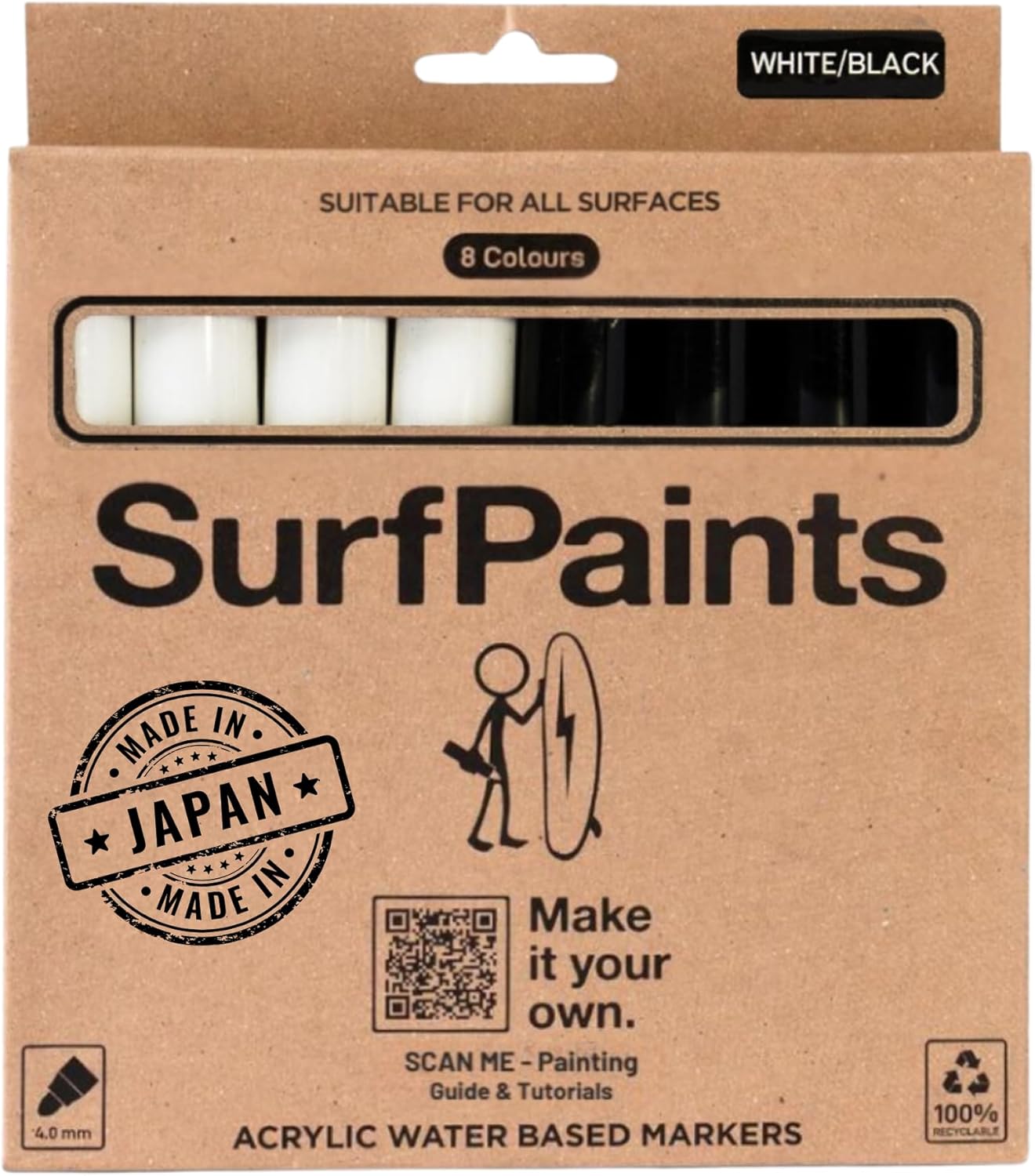
White is the most-used color in surfboard art: outlines, lettering, tribal lines and highlights on colored or tinted boards. This SurfPaints set contains eight white pens with fine points. The listing describes a quick-drying, water-based formula that lets you layer colors without smudging, and lists surfaces including wood, plastic, fabric and glass, with surfboards mentioned in the title.
Eight of the same color means you will not run out halfway through a design.
Best suited for: Outlining, lettering and white designs on darker boards.
Key features:
- 8 white pens
- Fine tips
- Water-based acrylic
- Quick-drying
Pros:
- Plenty of white
- Layering without smudging per listing
- Good on tinted boards
Cons and limitations:
- Single color
- Premium price for one color
Buying consideration: Use white last, on top of other colors, for crisp outlines.
3. FolkArt Multi-Surface Acrylic Paint, Hawaiian Surf — Best for brush-on color fills

For larger color areas, brushing is faster than filling with pens. FolkArt Multi-Surface dries to a satin finish and the listing describes it as great for indoor and outdoor projects, for surfaces including wood, glass, fabric and ceramics. Hawaiian Surf is a bright ocean blue.
It is a craft paint, so apply it thin, keep large solid areas modest to avoid adding weight, and protect it with a clear layer.
Best suited for: Filling in shapes and small color fields.
Key features:
- 2 oz, Hawaiian Surf
- Satin finish
- Indoor-outdoor formula
- Soap and water cleanup
Pros:
- Very low cost
- Easy to brush
- Ocean-themed color
Cons and limitations:
- Not designed for surfboards
- Needs protection to last in surf
Buying consideration: Thin slightly with water and apply in two light coats rather than one heavy one.
4. FGCI Surfboard Polyester Resin Kit with MEKP — Best for sealing art under a gloss coat

Professional board art is often painted on the foam blank or between layers and then sealed under resin. For DIYers, a thin clear gloss coat over finished art is the most durable protection. FGCI’s kit is a clear polyester laminating resin for surfboard shapers and repair, which the listing says has a low-yellowing cure that preserves the color of base coats and paint underneath. It includes MEKP hardener.
This is an advanced step. Polyester resin is for polyester boards only (not epoxy or many soft-top boards), it has strong fumes, and adding resin adds weight. If you are not comfortable with glassing, a surf shop can apply a gloss coat for you.
Best suited for: Experienced DIYers sealing art on polyester boards.
Key features:
- Clear polyester laminating resin
- MEKP hardener included
- Low-yellowing cure per listing
- For shaping and repair
Pros:
- Durable protection for art
- Surf-specific product
- Clear finish preserves color
Cons and limitations:
- Polyester boards only
- Strong fumes, needs ventilation and gloves
- Requires skill to apply evenly
Buying consideration: Check your board construction first; using polyester resin on an EPS/epoxy board can damage the foam.
Know Your Board Before You Paint
Polyester (PU) boards are the traditional construction, with polyurethane foam and polyester resin. They are the most common for DIY art and compatible with polyester gloss coats.
Epoxy (EPS) boards use expanded polystyrene foam and epoxy resin. Solvents in some spray paints and polyester resin can attack EPS foam through any crack or ding, so stick with water-based paint and epoxy-compatible clear coats.
Soft-top boards have a foam deck that is not ideal for paint. Art usually goes on the slick bottom, with paint pens, and wears faster.
How to Paint a Surfboard Step by Step
- Strip the wax. Use a wax comb and then a wax remover or a cloth with a little mineral spirits on a PU board, or the cleaner recommended for your board. Any wax left behind stops paint sticking.
- Clean and dry. Wipe with rubbing alcohol and let dry.
- Lightly scuff (optional). A very light scuff with fine sandpaper on the glossy surface improves grip. Do not sand through the glass.
- Sketch your design. Use a pencil lightly or tape out shapes.
- Outline first. Draw outlines with a paint pen.
- Fill colors. Use pens or thin brushed acrylic, building light layers.
- Let it dry fully. Give it at least a day.
- Protect. Apply a clear coat compatible with your board, or have a shop apply a gloss coat.
- Wax again. Rewax the deck once everything has cured.
Planning a Design That Suits the Board
Before drawing, lay the board on the floor and step back. Look at the outline shape, the stringer running down the middle, the fin boxes and any existing logos. Good surfboard art works with these features: designs that are symmetrical around the stringer feel balanced, and patterns that follow the rail line emphasize the board’s shape. Sketch a few ideas on paper using a traced outline of the board, then transfer the strongest one with light pencil marks or tape. Decide on a palette of three to five colors; a limited palette looks more intentional and is easier to touch up later.
Protecting Surfboard Art
Unprotected paint pen art on a deck will wear under wax, sand and feet. On the bottom it lasts longer but still scrapes. You have three main options. A water-based clear spray or brush-on sealer compatible with your board adds light protection. A resin gloss coat gives the most durable, glassy finish but adds weight and requires skill. Or simply accept wear as character and touch up your art each season.
Whatever you choose, avoid aggressive solvent spray paints on epoxy or EPS boards, and test everything on a small area first.
Paint Pen Techniques on a Curved Board
Surfboards curve in two directions at once, from nose to tail (rocker) and from rail to rail. That makes long, straight lines harder than they look. A few habits help.
Prime the pen on scrap. Shake water-based paint markers as directed and press the tip on cardboard until paint flows evenly. Starting on the board with a dry tip leaves a scratchy line.
Use tape as a guide. Flexible vinyl pinstripe tape or low-tack masking tape follows the curve of the board and gives a straight edge to draw against. Pull it off once the paint is dry to the touch.
Work in short strokes for fills. Fill areas with overlapping short strokes in one direction, let dry, then go over again in the other direction. This avoids streaks.
Keep the board stable. Rest it on padded sawhorses or a couch cushion so it does not rock while you draw.
Layer light to dark, then outline. Lighter colors first, darker colors over them, and outlines last for crisp edges.
Touch-Ups and Long-Term Care
Even protected art fades in strong sun and wears where the board meets sand and wax. Store the board in a board bag out of direct sunlight, rinse with fresh water after each session, and avoid leaving it in a hot car, which can soften wax and stress paint and resin. At the end of the season, strip old wax, check the art and redraw worn lines with the same pens. Keeping a note of which pen colors you used makes touch-ups seamless.
When to Use a Professional
For a complete custom spray job, color tints in the glass, or resin-sealed art on an expensive board, a shaper or ding repair shop is the safer route. They know how different foams and resins react to paints and can add weight-conscious gloss coats. DIY paint pen art is ideal for personalizing a board you already own; full refinishing is a craft of its own.
Design Tips for Surfboards
Bold lines and simple shapes read better from the beach and handle wear more gracefully than tiny detail. Classic designs include pinlines along the rail, tribal patterns, waves, palm fronds, flowers and stripes running nose to tail. Consider leaving the main standing area of the deck plain, since that is where wax and feet do the most damage. The bottom of the board is the best canvas for large, detailed artwork.
The same layering and reveal ideas used in other crafts translate well: see our scratch art painting guide for scratch-through effects you can adapt to pen art. If you enjoy painting functional objects, our painted birdhouse guide covers sealing outdoor art in a gentler environment.
Buying Guide: How to Choose Paint for Surfboards
Choose water-based paint pens
They are the easiest, safest option for most boards and give the cleanest lines.
Check board compatibility
Know whether your board is PU, epoxy or soft-top before choosing paints and sealers.
Keep layers thin
Thin layers add little weight and flex with the board.
Plan protection
Decide on a clear coat or gloss coat before you start, so your paint choice is compatible.
Buy extra white and black
Outlines and lettering use these colors most.
Mind the weight
Every layer adds a little weight. Pen art adds almost nothing, but large brushed color fields and thick resin coats can change how a lightweight shortboard feels. Keep big solid areas to the bottom and use pens for most of the design.
Avoid unrelated products
Car touch-up sprays and boat paints are not designed for surfboard art and may not be compatible with board materials.
Common Mistakes to Avoid
- Painting over wax. The paint will peel off.
- Using solvent sprays on EPS boards. They can damage foam through dings.
- Thick paint. It adds weight and cracks.
- Covering the whole deck. Wax and feet will wear it quickly.
- Skipping a test patch. Always test paint and sealer first.
- Ignoring dings. Repair any cracks before painting so water does not get in.
FAQs
What paint can I use on a surfboard?
Water-based acrylic paint pens are the most popular choice for DIY surfboard art. Apply them to a clean, wax-free surface and protect with a compatible clear coat.
Do I need to remove wax before painting a surfboard?
Yes. Wax prevents paint from sticking. Remove it completely and clean the surface with rubbing alcohol.
Will paint pen art come off my surfboard?
It will wear over time, especially on the deck. A clear protective coat slows wear; touch-ups keep it fresh.
Can I spray paint a surfboard?
Professional sprays are used in board shops, but many solvent sprays can damage EPS foam. For DIY, water-based products are safer.
Should I paint the deck or bottom of a surfboard?
The bottom is the better canvas because it does not get wax and feet. Keep deck art away from the standing area.
How do I seal surfboard art?
Use a clear coat compatible with your board, or have a surf shop apply a resin gloss coat over the artwork.
Final Recommendation
For most surfers, the SurfPaints Primary pen set is the best way to add art to a board, with the SurfPaints white set for outlines and lettering. FolkArt Multi-Surface in Hawaiian Surf is an inexpensive way to brush in larger color areas.
Experienced DIYers with polyester boards can seal art under a gloss coat using the FGCI resin kit, but if you are unsure, let a surf shop handle that step. Strip the wax, keep layers thin and test first.