PaintingProGuide is reader-supported. When you buy through links on this page we may earn an affiliate commission at no extra cost to you.
A model airplane is judged up close. Panel lines, canopy frames, a crisp demarcation between a gray underside and a camouflaged top: every one of those details depends on paint that goes on thin, levels smoothly and dries without hiding the molded detail. The best paint for model airplanes is a dedicated hobby paint, either water-based acrylic or solvent-based enamel, in aircraft-appropriate colors, paired with brushes fine enough for small parts.
Quick answer: For authentic aircraft colors in an easy-cleanup formula, start with the Testors Aircraft Acrylic set, which includes grays and military tones such as Gunship Gray and Olive Drab. For a broader hobby palette that is pre-thinned for brush painting, the Nicpro 18-color model paint set adds metallics and a thinner. If you prefer enamel’s hard, self-leveling finish, the Testors enamel assorted set is the classic choice.
We compare five paint options and one brush set below, then explain acrylic versus enamel, priming plastic, and a painting sequence that keeps small parts clean.
Our Top Picks at a Glance
- Testors Aircraft Acrylic Paint Set, Earth Tone Colors — Best for military aircraft colors
- Nicpro 18 Colors Model Paint Set with Thinner — Best all-round acrylic hobby set
- Testors Enamel Paint Assorted Colors Set — Best enamel set for a hard finish
- Testors Flat Black Enamel Paint — Best for cockpits, tires and detail black
- Blablaovy 11 Pcs Detail Paint Brushes — Best brushes for small model parts
- HissiCo 36 Colors Acrylic Paint Set — Best for large foam or balsa display models
| Product | Best For | Key Spec | Key Strength | Price Tier |
|---|---|---|---|---|
| Testors Aircraft Acrylic | Military aircraft | 9 x 0.25 oz, satin; grays, olive drab, dark blue | Aircraft-specific colors | $$ |
| Nicpro Model 18 | General modeling | 18 x 20 ml, matte, plus thinner | Pre-thinned for brushing | $$ |
| Testors Enamel Set | Hard, durable finish | Assorted colors, multiple finishes | Self-leveling enamel | $$ |
| Testors Flat Black | Detail black | 0.25 oz enamel, flat | Dries in about an hour | $ |
| Blablaovy 11 brushes | Small parts | Sizes 5/0 to 7, nylon | Triangular handles | $ |
| HissiCo 36 | Large foam and balsa models | 36 x 2 oz craft acrylic | Big color range | $$ |
How We Chose
These recommendations come from the Amazon listing details and specifications checked in October 2026, how well each product fits scale model aircraft, and how widely each product is reviewed by Amazon buyers. We have not built models with these specific paints, so we report listed colors, sizes and finishes and add only established modeling practice.
- Hobby formulation: paints made for plastic models, or flexible enough for them.
- Aircraft colors: grays, greens, blues and metallics that match real aircraft.
- Thin application: paints that cover without filling in panel lines.
- Finish options: flat, satin and gloss for different parts and decals.
- Tools: brushes small enough for cockpits and landing gear.
Best Paint for Model Airplanes Reviewed
1. Testors Aircraft Acrylic Paint Set, Earth Tone Colors — Best for military aircraft colors

Color accuracy is half of a convincing model aircraft, and mixing a believable Gunship Gray from scratch is harder than it sounds. This Testors set focuses on aircraft colors, with the listing naming options like Light Ghost Gray or Dark Ghost Gray, Neutral Gray or Gunship Gray, and Gloss Dark Blue or Olive Drab. It contains nine 0.25 oz bottles with a satin finish and is listed as non-toxic.
Acrylic cleans up with water, dries faster than enamel and has little odor, which makes it practical for working at a desk at home. Note the listing’s reminder that models and airbrush are not included.
Best suited for: Builders of modern and World War II military aircraft.
Key features:
- 9 bottles, 0.25 oz each
- Satin finish
- Aircraft grays, olive drab, dark blue
- Acrylic, non-toxic
Pros:
- Aircraft-specific colors save mixing
- Water cleanup
- Low odor
Cons and limitations:
- Small bottles
- Limited to the included color family
Buying consideration: Thin slightly for brushing, or more for airbrushing, and apply several light coats.
2. Nicpro 18 Colors Model Paint Set with Thinner — Best for an all-round acrylic hobby set
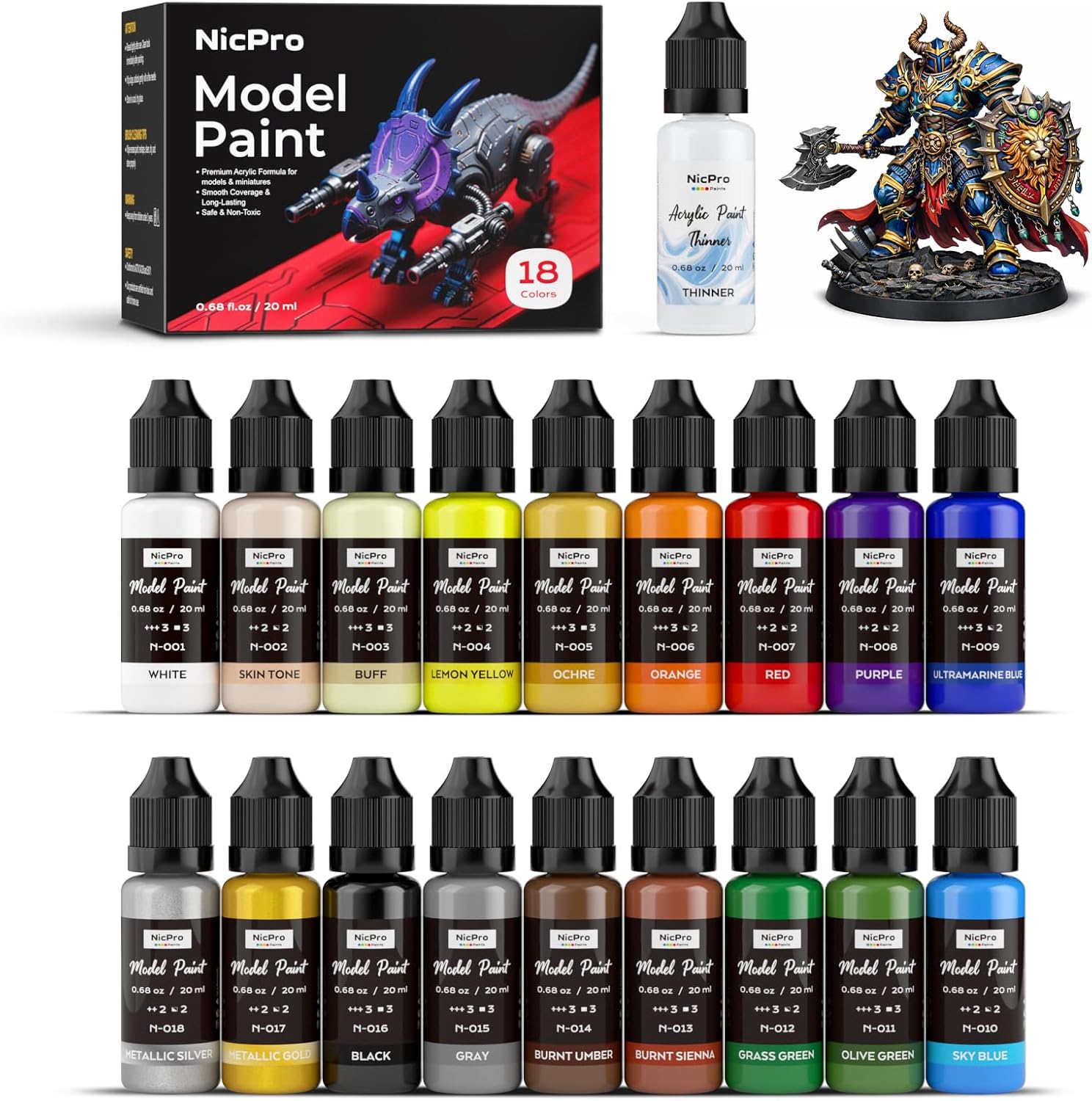
Nicpro designed this set for model kits, plastic models, miniatures, scale figures and dioramas. It includes 18 colors in 20 ml bottles, including base colors, skin tones, shadows and two metallics, plus an acrylic thinner. The paint is pre-thinned for brush painting straight from the bottle, and the listing describes a matte finish with strong opacity and UV-resistant pigments.
Metallics are useful for exhaust nozzles, propeller hubs and natural metal panels, and the thinner lets you adjust consistency for fine detail or washes.
Best suited for: Modelers who want one versatile acrylic set for aircraft, pilots and dioramas.
Key features:
- 18 colors, 20 ml each
- Includes 2 metallics and a thinner
- Matte finish
- Pre-thinned for brushing
Pros:
- Ready to brush
- Larger bottles than many hobby paints
- Includes skin tones for pilot figures
Cons and limitations:
- Not aircraft-specific colors
- Matte only; gloss needs a clear coat
Buying consideration: Apply a gloss clear coat before decals, then a matte or satin coat to finish.
3. Testors Enamel Paint Assorted Colors Set — Best for a hard enamel finish

Enamel has been the traditional model paint for decades because it levels into a smooth, hard finish that hides brush marks. This Testors assorted set is listed as made in the United States, fast-drying, with multiple finish types and 2.25 fl oz in total.
Enamels need mineral spirits or enamel thinner for cleanup and have a stronger smell than acrylics, so ventilation matters. Many modelers like them for gloss finishes and for durable topcoats on parts that will be handled.
Best suited for: Builders who want a durable, smooth, traditional finish.
Key features:
- Assorted enamel colors
- Multiple finishes
- Fast-drying per listing
- Made in USA
Pros:
- Self-leveling finish
- Durable once cured
- Classic hobby choice
Cons and limitations:
- Solvent cleanup
- Stronger odor
- Longer cure than acrylic
Buying consideration: Stir enamels thoroughly; pigment settles at the bottom of the bottle.
4. Testors Flat Black Enamel Paint — Best for cockpits, tires and detail black
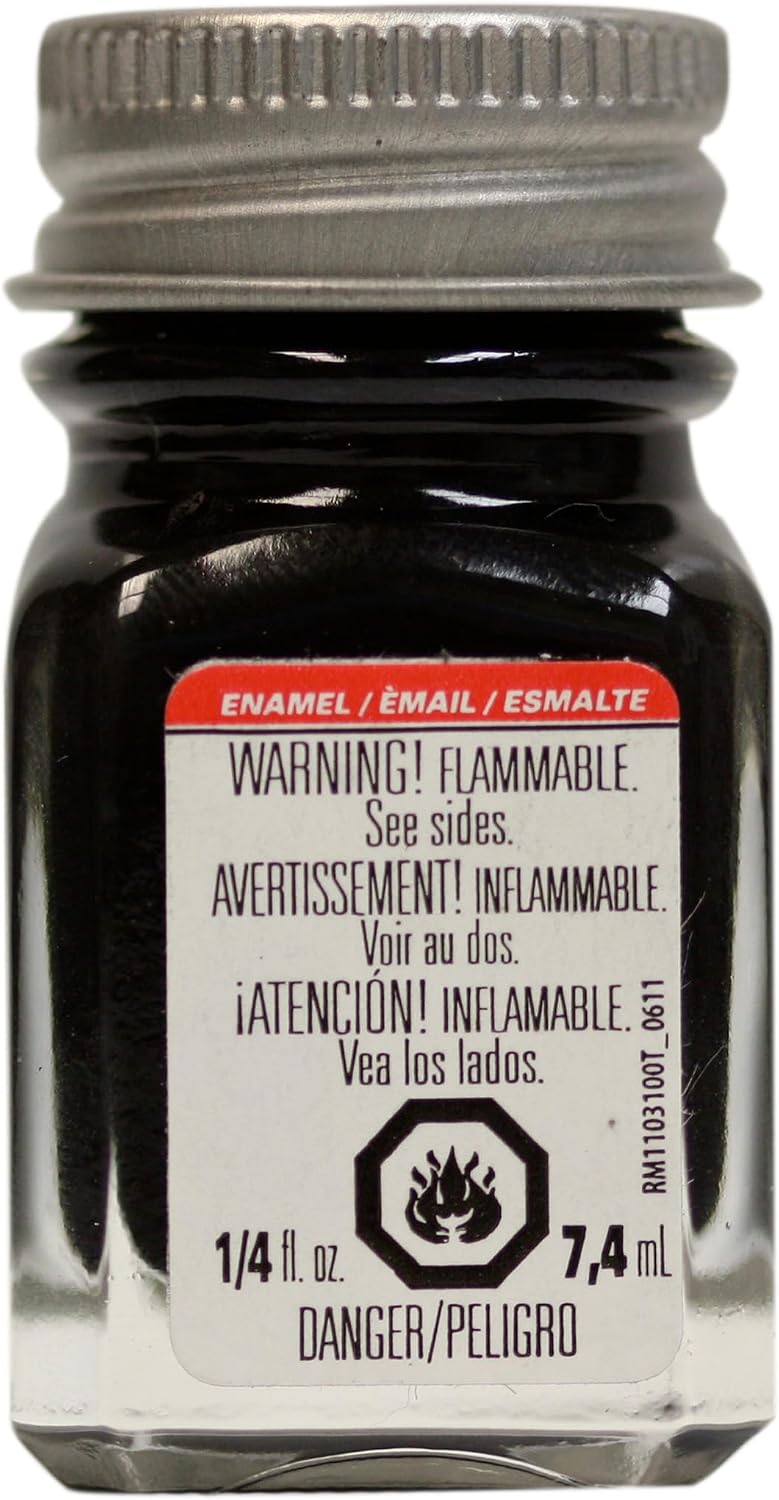
Flat black is the single most-used color on many aircraft models: cockpit consoles, tires, instrument panels, gun barrels, antiglare panels and preshading. This Testors enamel is a 0.25 oz bottle with a flat finish. The listing describes multi-surface use on metal, wood and plastic, drying in one hour, and smooth brush application for intricate detail.
It is inexpensive and worth keeping on hand regardless of which main paint you use.
Best suited for: Every aircraft model build.
Key features:
- 0.25 oz bottle
- Flat finish
- Dries in about 1 hour
- Enamel
Pros:
- Essential color
- Low price tier
- Brushes smoothly per listing
Cons and limitations:
- Small bottle
- Enamel cleanup
Buying consideration: Use a dark gray instead of pure black on large areas for more realistic scale color.
5. Blablaovy 11 Pcs Detail Paint Brushes — Best for small model parts

Good paint needs good brushes. This set includes sizes 5/0, 3/0, 2/0, 0, 1, 2, 3, 4, 5, 6 and 7 in synthetic nylon with triangular black birch handles. The listing mentions model painting directly.
The tiny sizes handle instrument dials and canopy frames; the larger ones cover small parts like drop tanks and landing gear doors.
Best suited for: Brush-painting cockpits, landing gear and other small parts.
Key features:
- 11 brushes, 5/0 to 7
- Synthetic nylon
- Triangular anti-roll handles
Pros:
- Wide size range
- Low price
- Suitable for acrylic and enamel
Cons and limitations:
- Synthetic tips wear with enamel solvents
- No protective caps
Buying consideration: Keep separate brushes for acrylic and enamel to prolong their life.
6. HissiCo 36 Colors Acrylic Paint Set — Best for large foam and balsa display models

Not every model airplane is a 1:72 plastic kit. Large foam RC planes, balsa display models and kids’ wooden planes need more paint than tiny hobby bottles hold. HissiCo’s set includes 36 colors in 2 oz flip-top bottles with 12 brushes, conforming to ASTM D-4236 and EN71.
It is a craft acrylic, so it will not match specialist aircraft colors, but it is economical for big surfaces and bright designs.
Best suited for: Large foam or balsa models, and family projects.
Key features:
- 36 colors, 2 oz each
- 12 brushes
- Flip-top bottles
- Non-toxic
Pros:
- Lots of paint
- Broad colors
- Good for big surfaces
Cons and limitations:
- Not a hobby-grade model paint
- Thicker than scale paints, may obscure fine detail
Buying consideration: Test on scrap foam first; some foams react to certain paints and sealers.
Acrylic or Enamel for Model Airplanes?
Acrylic is water-based, low odor, quick-drying and easy to clean. It is the most popular choice for brush-painting at home and for beginners. It can be less forgiving with brush marks unless thinned well.
Enamel is solvent-based, smooth and self-leveling, with a hard finish once cured. It takes longer to dry and needs ventilation and solvent cleanup.
Many builders use both: acrylic for the main colors and enamel for washes, or the reverse. Because the solvents differ, a wash of one type over the other is less likely to disturb the layer underneath, which is a useful trick.
A Painting Sequence for Model Aircraft
- Wash parts. Mild soap and water remove mold release and finger oils.
- Paint the cockpit first. It is sealed inside the fuselage once assembled.
- Assemble main parts. Fill and sand seams before painting the exterior.
- Prime. A thin primer coat shows flaws and helps paint grip.
- Paint undersides, then upper colors. Lighter colors usually go first.
- Mask demarcations. Use masking tape or putty for camouflage edges.
- Gloss coat, decals, then matte or satin coat. Gloss helps decals settle.
- Detail and weather. Paint small parts, add panel line washes and exhaust staining.
- Attach delicate parts last. Landing gear, antennas and canopy.
Brush Painting Tips for Smooth Results
Airbrushes get most of the attention, but plenty of excellent model aircraft are brush painted. The key is managing paint consistency and coat thickness.
- Thin to milk consistency. Paint straight from the bottle is often too thick for large panels. A few drops of the matching thinner on a palette make it flow.
- Use the largest brush that fits. Fewer strokes mean fewer brush marks. Save tiny brushes for tiny parts.
- Paint in one direction per coat. Follow the airflow direction, nose to tail, and alternate direction on the next coat for even coverage.
- Expect two to four coats. Thin coats that look streaky alone build into a smooth, opaque finish.
- Keep a wet edge. Work steadily across a panel so you are always blending into paint that is still wet.
- Let each coat dry fully. Rushing causes the brush to lift the layer underneath.
Weathering and Finishing Touches
Real aircraft are rarely spotless. A little weathering adds realism and depth, and it is easier than it looks.
Panel line wash. A thinned dark brown or black wash flowed into recessed panel lines makes them stand out. Apply it over a gloss coat so it runs cleanly into the lines, then wipe the excess off the surface.
Exhaust staining. Light, streaky passes of thinned brown, gray or black behind exhaust ports suggest soot. Build it slowly.
Paint chipping. Tiny dots of silver or dark gray around access panels, wing roots and cockpit edges suggest worn paint from ground crews and pilots. A small sponge or the finest brush in the Blablaovy set works well.
Fading. Lightening the upper surfaces slightly, or dry brushing a lighter shade over raised areas, mimics sun-faded paint.
Finish with your chosen clear coat to seal the weathering and unify the sheen, then add clear parts and delicate details last.
Buying Guide: How to Choose Paint for Model Airplanes
Choose a paint system
Pick acrylic or enamel as your main system and buy thinner and cleaners to match. Mixing brands and types without testing can cause problems.
Look for aircraft colors
Aircraft-specific sets save time and improve accuracy. Check color names against your model’s painting guide.
Brush or airbrush?
Brush painting is fine for small models and details. An airbrush gives smoother large areas. Most hobby paints can be thinned for airbrush use.
Think about finish
Military aircraft are usually flat or satin; airliners and racers often gloss. A clear coat controls the final sheen.
Bottle size
Hobby bottles are small; a single color may cover one model. Buy extra of the main colors.
Read the kit’s painting guide first
Most kits include a color callout chart, often referencing official color standards or specific paint brands. Make a shopping list from it before buying, and note which colors appear on large areas versus tiny parts. That tells you which colors need full bottles and which can come from a small set or be mixed. If the callouts reference a brand you do not use, conversion charts from hobby communities can help you find close matches.
Ventilation
Enamels and solvent cleaners need fresh air. Acrylics are easier for indoor desks.
More Painting Projects
Model building shares skills with other small-scale crafts. Our painted birdhouse DIY guide covers priming and sealing small wooden objects, useful if you build balsa models, and our scratch art painting guide explores layered, revealed color.
Common Mistakes to Avoid
- Painting straight from a dirty sprue. Mold release makes paint bead and peel.
- Thick coats. They hide panel lines and rivets. Thin your paint.
- Skipping primer. Primer reveals seam flaws and evens out color.
- Decals on matte paint. They silver. Apply over gloss.
- Mixing paint types carelessly. Test compatibility on scrap.
- Pure black and white. Scale models often look better with slightly lightened colors.
FAQs
What paint is best for plastic model airplanes?
Hobby acrylics and enamels made for plastic models are best. Acrylics are low odor and easy to clean; enamels give a smooth, hard finish.
Can I use craft acrylic paint on model airplanes?
Craft acrylics can work for large or simple models, but they are thicker and less precise than hobby paints and can obscure fine detail.
Do I need to prime a model airplane?
Priming is strongly recommended. It helps paint adhere, shows flaws and gives an even base color.
Should I brush paint or airbrush model airplanes?
Both work. Brush painting suits small models and details; an airbrush gives smoother coverage on large areas and camouflage.
How do I thin model paint?
Use the thinner recommended for that paint type, adding a little at a time until the paint flows smoothly without being watery.
What finish should a model airplane have?
It depends on the aircraft. Many military aircraft are flat or satin, while airliners often look glossy. Apply gloss before decals, then your final clear coat.
Final Recommendation
If you build military aircraft, start with the Testors Aircraft Acrylic set for accurate grays and greens, and keep Testors flat black enamel for cockpit and detail work. The Nicpro 18-color set is the best all-round acrylic choice, with metallics and a thinner, while the Testors enamel set suits builders who prefer a hard, smooth finish.
Add the Blablaovy brush set for small parts. For large foam or balsa display planes, the HissiCo set gives you plenty of color economically.