PaintingProGuide is reader-supported. When you buy through links on this page we may earn an affiliate commission at no extra cost to you.
Cotton is the canvas most acrylic paintings are made on, and for good reason. It is affordable, takes acrylic gesso well, stretches easily and comes in every size from 4×4 inch minis to gallery formats. The best cotton canvas for acrylic paint is the one whose format matches how you work: flat canvas panels for practice, classes and framing, or stretched cotton on wooden bars for paintings you want to hang. Within each format, the details that matter are how well it is primed, what the core or frame is made of and whether the sizes suit your subjects.
Quick answer: If you want stretched cotton you can hang, the FIXSMITH 8-pack of 11×14 stretched canvas is the best all-round pick: 100 percent cotton, triple primed with 8 oz acid-free gesso, on pinewood bars. For daily practice, the Simetufy 30-pack of 8×10 cotton panels gives you a rigid MDF core at a low cost per board. If you want a mix of sizes in one box, the KEFF 24-pack of 5×7 to 11×14 canvas boards covers four common sizes.
Cotton Canvas Basics for Acrylic Painters
Cotton duck and weave
Most artist canvas is cotton duck, a tightly woven plain-weave fabric. Its regular texture is predictable under the brush, which many acrylic painters prefer for even coverage and controlled blending. Weight, measured in ounces per square yard before or after priming, gives a rough idea of thickness; heavier canvas has a firmer feel.
Priming
Nearly all cotton canvas sold today is pre-primed with acrylic gesso, which works for both acrylic and oil. Triple-primed surfaces are smoother and less absorbent. If a surface feels too thirsty or too rough, one or two extra coats of gesso fix it.
Panels and stretched canvas
Canvas panels glue cotton to a flat board. The best ones use MDF or a dense board core that resists warping; cheaper ones use paper board. Stretched canvas wraps cotton around wooden bars and has depth for hanging. Panels are cheaper, stack flat and travel well; stretched canvases look finished and are better for larger work.
Profile depth
Standard stretched canvas is around 5/8 inch deep. That depth usually goes into a frame. Gallery-wrapped canvases are deeper and often hang without a frame with painted sides.
Our Top Picks at a Glance
- FIXSMITH Stretched Canvas, 11×14, 8 Pack — Best overall stretched cotton canvas
- ESRICH Stretched Canvas, 12×16, 10 Pack — Best for larger practice and party paintings
- GOTIDEAL 14-Piece Multi-Size Stretched Canvas — Best stretched size variety
- Simetufy 30 Pack 8×10 Cotton Canvas Panels — Best bulk panels for daily practice
- KEFF 24-Pack Canvas Boards, 4 Sizes — Best multi-size panel set
- Simetufy 12 Pack 8×10 Canvas Boards — Best smaller pack of MDF-core panels
- ESRICH 5 Pack 8×10 Canvas Boards — Best budget trial pack
| Product | Best For | Key Spec | Key Strength | Price Tier |
|---|---|---|---|---|
| FIXSMITH 11×14 Stretched | Paintings to hang or frame | 8 x 11×14, 5/8″ profile, 8 oz gesso, pinewood | Triple primed, cotton not alkaline-rinsed | $$ |
| ESRICH 12×16 Stretched | Larger practice, paint parties | 10 x 12×16, 5/8″ profile, 8 oz primed, pinewood | Larger size in bulk | $$ |
| GOTIDEAL 14-Piece Stretched | Trying sizes | 4×4, 5×7, 8×10, 11×14 sizes, medium grain | Five size options | $$ |
| Simetufy 30 Pack Panels | Daily practice | 30 x 8×10, MDF core, triple primed | Rigid and economical | $$ |
| KEFF 24-Pack Boards | Varied studies | 6 each of 5×7, 8×10, 9×12, 11×14, triple primed | Four sizes in one box | $$ |
| Simetufy 12 Pack Boards | Smaller supply | 12 x 8×10, MDF core, acid-free | Same core, smaller pack | $ |
| ESRICH 5 Pack Boards | Trial or kids | 5 x 8×10, cotton, board core | Lowest upfront cost | $ |
How We Chose
We chose these canvases using the Amazon listing details and specifications checked in October 2026, how well each product’s cotton surface, priming, core or frame and size range suit acrylic painting, and how widely each product is reviewed by Amazon buyers. We have not painted on them. Construction details come from the listings.
- 100 percent cotton surface stated in the listing.
- Priming: acid-free acrylic gesso, with triple priming preferred.
- Core or frame: MDF for panels; pinewood bars for stretched canvas.
- Size range that suits common acrylic subjects and frames.
- Pack value for practice, classes and series.
Best Cotton Canvas for Acrylic Paint Reviewed
1. FIXSMITH Stretched White Canvas, 11×14, 8 Pack — Best for paintings to hang or frame
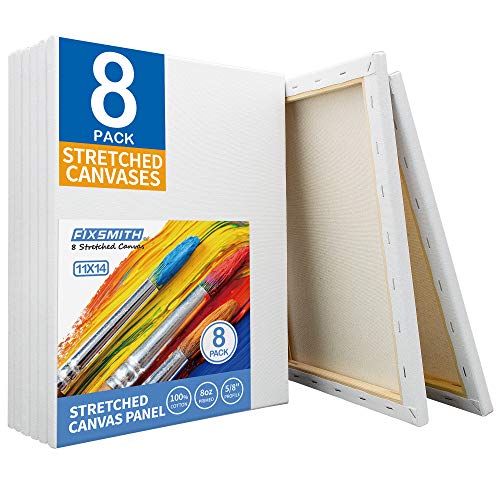
FIXSMITH’s stretched canvases are 100 percent cotton that, according to the listing, has not been rinsed with alkaline chemicals, keeping the natural tone and flexibility of the fibers. Each canvas is pre-coated with 8 oz of acid-free acrylic gesso, described as triple primed, and stretched and stapled onto pinewood bars with a 5/8 inch profile.
11×14 is one of the most useful sizes in acrylic painting. It fits standard frames, is large enough for a landscape or still life with room to breathe, and small enough to finish in a session or two. Eight of them is enough for a short series or a month of weekly paintings.
Because these are standard-profile canvases, plan on framing them for a finished look, or paint the edges if you want to hang them unframed.
Best suited for: Acrylic painters producing finished pieces at a common frameable size.
Key features:
- 8 canvases at 11×14
- 100% cotton
- Triple primed with 8 oz acid-free gesso
- Pinewood stretcher bars
- 5/8″ profile
Pros:
- Common frame size
- Well primed
- Wooden bars
- Money-back guarantee stated
Cons and limitations:
- Standard profile usually needs framing
- Single size
Buying consideration: Check that corners are square before painting; a quick tap on the back keys or bars can settle small twists.
2. ESRICH Stretched Canvas, 12×16, 10 Pack — Best for larger practice and paint parties

ESRICH’s 10-pack of 12×16 stretched canvases uses cotton pre-coated with acid-free acrylic gesso at a stated 8 oz primed weight. The canvas is nailed to a 5/8 inch pinewood frame.
A 12×16 canvas gives noticeably more room than 11×14 without moving into large-format territory. It is a comfortable size for paint-and-sip events, where everyone needs the same canvas, and for practice landscapes where a wider format helps.
Best suited for: Hosts of painting parties, teachers and painters who want bulk mid-size canvas.
Key features:
- 10 canvases at 12×16
- Cotton, acid-free acrylic gesso
- 8 oz primed weight
- 5/8″ pinewood frame
Pros:
- Good bulk value
- Slightly larger than standard 11×14
- Wooden frames
Cons and limitations:
- 12×16 frames are less common than 11×14
- Priming coat count not stated
Buying consideration: Buy frames before painting if you want a framed finish; 12×16 sizes are easier to find online than in stores.
3. GOTIDEAL 14-Piece Multi-Size Stretched Canvas — Best for trying several stretched sizes

GOTIDEAL’s 14-piece pack includes stretched canvases at 4×4, 5×7, 8×10 and 11×14 (two of each), plus four additional 5x7s, according to the listing. The cotton has a medium grain, is pre-coated with acid-free acrylic gesso and is nailed to a wood frame.
A size mix is useful when you are still figuring out your scale. Minis at 4×4 are great for color studies and small gifts; 5×7 and 8×10 suit quick paintings; 11×14 suits finished work.
Best suited for: Newer acrylic painters who want stretched canvas in several sizes.
Key features:
- 14 canvases, sizes 4×4 to 11×14
- 100% cotton, medium grain
- Acid-free acrylic gesso
- Wood frames
Pros:
- Size variety
- Stretched and ready to hang
- Good for gifts and studies
Cons and limitations:
- Only two of the largest size
- Medium grain may be too coarse for very fine detail
Buying consideration: Use the minis to test color schemes before painting the larger canvases.
4. Simetufy 30 Pack 8×10 Cotton Canvas Panels — Best for daily practice

Simetufy’s 30-pack uses 100 percent cotton canvas glued to a sturdy MDF board, triple-primed with gesso and acid-free. The listing says the panels will not bend or curl and that the surface suits acrylic, oil, colored pencil, pastel, tempera and gouache.
An MDF core is the detail that sets this apart from many cheap panels, which use paper board that can warp with wet paint. Thirty panels at 8×10 is enough for a painting-a-day challenge.
Best suited for: Painters doing daily studies, students and teachers.
Key features:
- 30 panels at 8×10
- 100% cotton, acid-free
- Triple-primed
- MDF core
Pros:
- Rigid, warp-resistant core
- Low cost per panel
- Easy to store
Cons and limitations:
- Panels need frames or easels to display
- MDF adds weight
Buying consideration: Store panels flat and stacked with paper between them once paintings are dry.
5. KEFF 24-Pack Canvas Boards, 4 Sizes — Best for varied studies
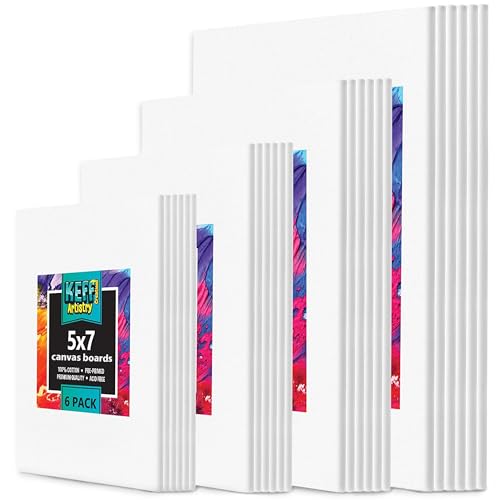
KEFF’s 24-pack includes six each of 5×7, 8×10, 9×12 and 11×14 canvas boards. The surfaces are 100 percent cotton and triple-primed, and the listing describes them for acrylic, oil and mixed media.
Four sizes in one box is useful for a range of exercises: small value studies at 5×7, standard practice at 8×10 and 9×12, and more finished panels at 11×14.
Best suited for: Learners and hobbyists who want a variety of panel sizes.
Key features:
- 24 boards: 6 each of 5×7, 8×10, 9×12, 11×14
- 100% cotton
- Triple-primed
Pros:
- Four sizes
- Good for structured practice
- Fits common frame sizes
Cons and limitations:
- Core material not stated
- Higher price tier than single-size packs
Buying consideration: Keep panels flat while drying if you use thick, wet layers.
6. Simetufy 12 Pack 8×10 Canvas Boards — Best for a smaller pack of MDF-core panels

This smaller Simetufy pack offers twelve 8×10 cotton panels with an MDF core instead of recycled paper board, acid-free priming and a surface the listing says holds paint without absorbing it.
It is the same concept as the 30-pack, sized for painters who want fewer panels or are trying the brand first.
Best suited for: Painters who want rigid panels but not 30 of them.
Key features:
- 12 panels at 8×10
- 100% cotton
- Acid-free acrylic primer
- MDF board core
Pros:
- Warp-resistant core
- Low price tier
- Ready to paint
Cons and limitations:
- Single size
- Fewer panels per pack
Buying consideration: Compare cost per panel with the 30-pack if you paint frequently.
7. ESRICH 5 Pack 8×10 Canvas Boards — Best for a budget trial

ESRICH’s 5-pack of 8×10 boards uses pure cotton canvas and a non-toxic, acid-free primer over a sturdy board core that the listing says resists deformation.
Five panels is a low-commitment way to try acrylic painting or to supply a child’s art project.
Best suited for: Beginners, kids and anyone needing a few boards quickly.
Key features:
- 5 boards at 8×10
- Pure cotton
- Acid-free primer
- Board core
Pros:
- Lowest upfront cost
- Compact pack
- Widely usable
Cons and limitations:
- Small quantity
- Priming coats not specified
Buying consideration: Add a coat of gesso for a smoother surface if needed.
Preparing Cotton Canvas Before You Paint
Pre-primed cotton is ready out of the wrapper, but a few minutes of preparation can make a noticeable difference to how acrylic behaves on it.
Add a coat of gesso for a smoother surface
Budget canvases sometimes have a slightly thirsty or uneven surface. Brush on a thin coat of acrylic gesso in one direction, let it dry, then apply a second coat at right angles. For a very smooth surface, sand lightly with fine sandpaper between coats. This is worth doing for portraits and detailed work.
Tighten a slack stretched canvas
If a stretched canvas feels loose, lightly mist the back with water and let it dry flat; cotton tends to shrink as it dries, which tightens the surface. Do not soak it, and do not use this on panels.
Tone the ground
A thin wash of a mid-tone color, such as diluted burnt sienna or a neutral gray, removes the stark white and makes it easier to judge values. It also stops small gaps between strokes from shining through as white specks.
Sizes that suit common subjects
- 5×7 and 4×4: color studies, thumbnails, small gifts and ornaments.
- 8×10 and 9×12: still lifes, single flowers, pet portraits and daily practice.
- 11×14 and 12×16: landscapes, fuller still lifes and finished pieces for framing.
Buying Guide: How to Choose Cotton Canvas for Acrylics
Choose your format first
Panels for practice, classes and framing; stretched canvas for paintings you want to hang or sell.
Check the core or frame
MDF-core panels resist warping. Pinewood stretcher bars are sturdier than fiberboard or paper.
Look at priming
Triple priming gives a smoother, less absorbent surface. You can add gesso for an even smoother finish.
Match sizes to frames and subjects
8×10 and 11×14 fit standard frames. 12×16 gives more room. Minis suit studies and gifts.
Consider texture
Medium grain is the all-round choice. For fine detail, sand lightly between extra gesso coats.
Buy in quantity for practice
Bulk packs lower the cost per canvas and make it easier to paint often without hesitation.
Related Canvas Guides
Get more from cotton canvas with our guide to acrylic underpainting on canvas, see how acrylic paint behaves on canvas board, and learn how to seal acrylic paint on canvas once a painting is finished.
Common Mistakes to Avoid
- Buying paper-core panels for heavy, wet layers and getting warped boards.
- Leaving unpainted canvas edges on a piece you plan to hang without a frame.
- Choosing an unusual size and then struggling to find a frame.
- Skipping a toned ground and fighting the bright white surface.
- Stacking panels before the paint is fully dry.
- Using your best canvas for experiments; keep cheap panels around for testing new techniques.
- Painting a gallery-style piece on a thin 5/8 inch profile and expecting it to look finished without a frame.
FAQs
Is cotton canvas good for acrylic paint?
Yes. Cotton canvas primed with acrylic gesso is the most common surface for acrylic painting.
Should I buy canvas panels or stretched canvas?
Panels for practice, classes and framing; stretched canvas for display pieces.
Do I need to gesso pre-primed cotton canvas?
No, but an extra coat can make the surface smoother and less absorbent.
What does triple primed mean?
The canvas has three coats of gesso, which gives a smoother and more consistent surface.
What size canvas is best for beginners?
8×10 and 11×14 are manageable sizes that fit common frames.
Is cotton or linen better for acrylic?
Cotton is more affordable and works well; linen offers a different texture and more stability at large sizes.
Final Recommendation
For stretched cotton canvas that hangs well and fits common frames, choose the FIXSMITH 11×14 pack. Go with ESRICH 12×16 if you want a larger practice size or are hosting a party, and GOTIDEAL if you want stretched canvas in several sizes. For practice panels, the Simetufy 30-pack with its MDF core offers the best value, the KEFF 24-pack provides size variety, and the Simetufy 12-pack and ESRICH 5-pack are smaller entry points.