PaintingProGuide is reader-supported. When you buy through links on this page we may earn an affiliate commission at no extra cost to you.
Buying canvas for a class is a logistics problem as much as an art one. You need enough identical surfaces for every student, a size everyone can finish in the session, a price per piece that fits the budget, and boards sturdy enough to survive being carried home by a seven-year-old or stacked wet on a classroom shelf. The best canvas for art classes is usually a bulk pack of primed canvas boards with an MDF core, most often 8×10 for short sessions and 11×14 for longer ones, with a pack of stretched canvases kept for finished projects and paint-and-sip style events.
Quick answer: For most classes, the Simetufy 52 Pack 8×10 Canvas Boards are the most practical buy: a big count, fine-grained cotton and a 3mm MDF core. The YONEVALON 48 Pack 8×10 Boards add 10 oz triple priming for a better surface, and the Simetufy 32 Pack 11×14 Boards suit longer sessions and older students. For finished pieces students hang at home, the FIXSMITH 11×14 Stretched Canvas 8 Pack is the step up.
This guide is for school art teachers, community class instructors, homeschool groups, studio workshop hosts and paint party organizers. It compares bulk packs and then covers how many canvases to order, which sizes suit which ages and session lengths, and how to keep a class running smoothly.
Our Top Picks at a Glance
- Simetufy 52 Pack 8×10 Canvas Boards — Best overall bulk pack for classes
- YONEVALON 48 Pack 8×10 Canvas Boards — Best primed surface in a bulk pack
- Simetufy 32 Pack 11×14 Canvas Boards — Best for longer sessions and older students
- KEFF 24-Pack Canvas Boards, 4 Sizes — Best for mixed-age groups and varied projects
- FIXSMITH 11×14 Stretched Canvas, 8 Pack — Best for finished take-home and paint party pieces
- ESRICH 8×10 Canvas Boards, 5 Pack — Best for a small group or trial session
| Product | Best For | Key Spec | Key Strength | Price Tier |
|---|---|---|---|---|
| Simetufy 52 x 8×10 | Large classes | 52 boards, fine-grained cotton, 3mm MDF | Highest count | $$ |
| YONEVALON 48 x 8×10 | Better surface in bulk | 48 boards, 3mm, 10 oz triple primed | Stated heavy priming | $$ |
| Simetufy 32 x 11×14 | Longer sessions | 32 boards, cotton, MDF core | Bigger size in bulk | $$ |
| KEFF 24 Multi-Size | Mixed ages | 6 each of 5×7, 8×10, 9×12, 11×14 | Size choice per student | $$ |
| FIXSMITH 11×14 Stretched | Take-home pieces, events | 8 pack, 8 oz triple primed, 5/8 in | Ready to hang | $$ |
| ESRICH 8×10 x 5 | Small group trial | 5 boards, cotton, board core | Low commitment | $ |
How We Chose
We did not run classes with these specific packs. Our picks are based on the Amazon listing details and specifications checked in October 2026, how well each pack’s count, size, rigidity and priming fit group teaching, and how widely each product is reviewed by Amazon buyers. We left out a 12-pack 8×10 board that is a smaller version of a pack already listed.
Criteria for class use:
- Count per pack: enough identical boards for a whole group, with spares.
- Cost per board: class budgets are tight, so bulk value matters.
- Rigidity: MDF cores survive handling, stacking and the trip home.
- Size for session length: 8×10 for an hour, 11×14 for two hours or more.
- Surface quality: primed well enough that student work looks good.
- Storage: flat boards stack in cupboards; stretched canvases take more space.
Best Canvas for Art Classes Reviewed
1. Simetufy 52 Pack 8×10 Canvas Boards — Best for large classes

Simetufy pitches this 52-pack directly at art teachers, group workshops and prolific beginners. Each 8×10 panel is pre-primed with acid-free acrylic gesso for both acrylic and oil, with an acid-free, fine-grained cotton surface over a rigid 3mm MDF core that the listing says prevents bending and warping.
Fifty-two boards covers two sessions for a class of 25 with spares, or a term of weekly projects for a small group. The 8×10 size is the classroom standard: students can finish a project in an hour, it fits standard frames for parents, and it stacks neatly.
The fine-grained surface is forgiving for beginners who want clean edges and smooth color.
Best suited for: School teachers, after-school programs, homeschool co-ops and community workshops.
Key features:
- 8×10 inch, 52 pack
- Fine-grained 100% cotton, acid-free
- 3mm MDF backing
- Pre-primed for acrylic and oil
Pros:
- Highest count in this guide
- Rigid MDF survives handling
- Classroom-standard size
- Smooth for beginners
Cons and limitations:
- Single size
- Large box to store
- Gesso weight not stated
Buying consideration: Write each student name on the back in pencil before the session; it saves sorting identical boards later.
2. YONEVALON 48 Pack 8×10 Canvas Boards — Best for a better surface in bulk

YONEVALON lists 48 panels at 8×10, each 3mm thick and 10 oz triple pre-primed with acid-free acrylic gesso, with 100% cotton and a surface texture designed to hold paint well. It names acrylic, tempera, oil, watercolor, gouache and pour paint as compatible.
The stated 10 oz triple priming is unusually specific for a bulk pack. Better priming means student paint sits on top and looks brighter, which matters when the class is for adults or older students who care about results.
Best suited for: Adult classes, high school art and paint parties where results matter.
Key features:
- 8×10 inch, 48 pack
- 3mm thick
- 10 oz triple primed acid-free gesso
- 100% cotton
Pros:
- Stated heavy priming
- Bulk count
- Many media listed
Cons and limitations:
- Slightly fewer boards than the Simetufy 52
- Single size
Buying consideration: For pour classes, set boards on cups over a covered table; 3mm boards are light enough to tilt easily.
3. Simetufy 32 Pack 11×14 Canvas Boards — Best for longer sessions and older students

Simetufy also offers 32 flat 11×14 boards, pre-primed with acid-free acrylic, 100% cotton with a surface that holds paint without absorbing it, on an MDF core. The listing names schools, painting classes and kids.
11×14 gives older students and adults space for a full landscape or still life in a two to three hour session. It is too large for most one-hour classes with young children.
Best suited for: Teen and adult classes, workshops and multi-session projects.
Key features:
- 11×14 inch, 32 pack
- 100% cotton, acid-free
- MDF core
- Pre-primed
Pros:
- Larger size in bulk
- Rigid
- Fits standard frames
Cons and limitations:
- Takes longer to fill
- Bigger storage footprint
Buying consideration: Pair 11×14 boards with larger brushes; small brushes on a big board slow beginners down.
4. KEFF 24-Pack Canvas Boards, 4 Sizes — Best for mixed-age groups and varied projects
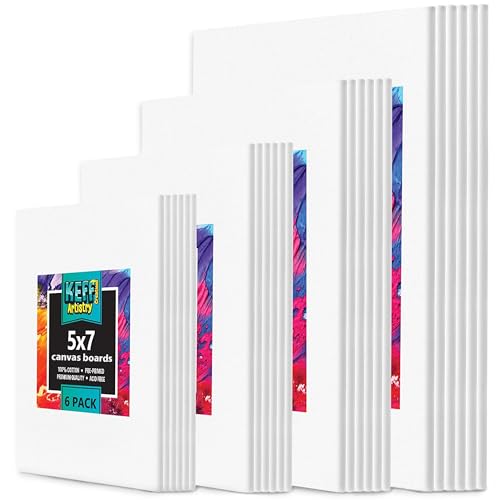
KEFF packs six boards each of 5×7, 8×10, 9×12 and 11×14, all 100% cotton and triple primed. For a mixed-age group or a family class, sizes let younger children work small while older students go bigger.
It also suits a multi-week course that moves from small studies to a final larger piece.
Best suited for: Family classes, mixed-age homeschool groups and structured courses.
Key features:
- 24 boards in 4 sizes
- 100% cotton
- Triple primed
- Multi-media
Pros:
- Size choice
- Triple priming
- Good for progressive courses
Cons and limitations:
- Only six boards per size
- Not enough for a large uniform class
Buying consideration: Use 5×7 for warm-up exercises at the start of class and 9×12 or 11×14 for the main project.
5. FIXSMITH 11×14 Stretched Canvas, 8 Pack — Best for finished take-home and paint party pieces
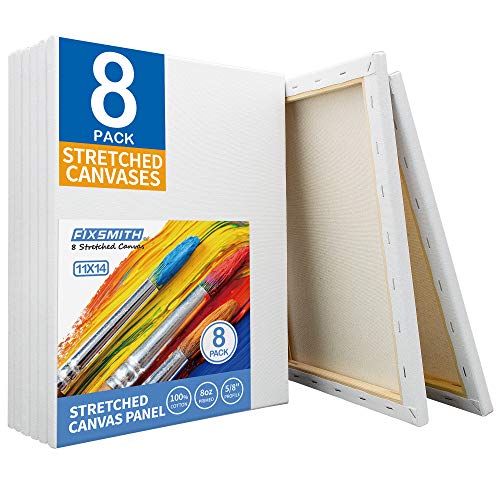
FIXSMITH lists 100% cotton canvas, not rinsed with alkaline chemicals, stretched and stapled onto pinewood bars, triple primed with 8 oz acid-free acrylic gesso, at a 5/8 inch profile. The listing names beginners, kids, educators and students among intended users.
Stretched canvas makes a class feel special. Students leave with a piece they can hang immediately, which is why paint-and-sip events use it.
Best suited for: Paint parties, final projects and adult workshops where students take home a finished piece.
Key features:
- 11×14 inch, 8 pack
- 100% cotton
- Triple primed, 8 oz gesso
- 5/8 inch pinewood bars
Pros:
- Ready to hang
- Triple primed
- Feels like a real painting
Cons and limitations:
- More expensive per piece than boards
- Bulkier to store and carry wet
Buying consideration: Stretched canvases dent if pressed from the front; remind students to support the back when painting firmly.
6. ESRICH 8×10 Canvas Boards, 5 Pack — Best for a small group or trial session

ESRICH packs five 8×10 boards with a smooth pure cotton surface, non-toxic acid-free primer and a sturdy board core. It is a small pack for a private lesson, a tiny group or a trial before ordering in bulk.
Test the same project you plan to teach on one board to check timing and paint use.
Best suited for: Private tutors, small groups and teachers testing a lesson plan.
Key features:
- 8×10 inch, 5 pack
- Smooth pure cotton
- Non-toxic, acid-free primer
- Sturdy board core
Pros:
- Small and cheap
- Good for lesson testing
- Smooth surface
Cons and limitations:
- Too few for a class
- Priming detail limited
Buying consideration: Paint your demo piece on the same surface students will use so expectations match.
Buying Guide: How to Choose Canvas for Art Classes
Match size to session length and age
Young children (5 to 8) do well on 5×7 or 8×10 in a 45 to 60 minute session. Older children and teens handle 8×10 to 11×14 in an hour or two. Adults in two to three hour workshops can fill 11×14 or larger. When in doubt, go smaller; unfinished paintings frustrate students more than small ones.
Boards or stretched canvas
Boards are cheaper, flatter, easier to store and survive handling. Stretched canvas costs more but delivers a hang-ready result. Many teachers use boards for practice and stretched canvas for final or special sessions.
Rigidity for young hands
MDF cores do not bend when a child presses hard or carries the board under an arm. Paper-core boards can warp with wet acrylic and disappoint students.
How many to order
Plan one canvas per student per project, plus about 10 to 15 percent extra for mistakes, late joiners and your own demonstration piece. Bulk packs of 48 to 52 are efficient for groups of 20 to 25.
Media compatibility
Acrylic is the classroom standard because it dries fast and cleans up with water. Pre-primed boards suit acrylic and tempera. Watercolor does not work well on standard primed canvas; use paper for that.
Storage and drying
Wet boards need a drying rack or flat space. Boards are thin enough to dry on a rack; stretched canvases need more space. Plan where 25 wet paintings will sit for an hour before students take them home.
Budget per student
Divide the pack price by the number of boards. Bulk 8×10 boards are usually the lowest cost per student; stretched canvases cost several times more per piece.
Running a Smooth Canvas Painting Class
Prepare stations in advance. Pre-pour paint into palettes or egg cartons, set out water cups, paper towels and two or three brushes per student.
Tone or pre-sketch for beginners. For a guided project, lightly sketch the main shapes on each canvas or provide a simple outline to trace. It removes the fear of the blank surface.
Demonstrate step by step. Paint your demo on the same canvas size, one stage at a time, and pause for students to catch up.
Protect surfaces and clothes. Cover tables, provide aprons or old shirts, and keep wipes handy.
Plan cleanup time. Leave ten minutes at the end for washing brushes and stacking wet paintings.
Label everything. Names on the backs of canvases, in pencil or marker, before painting starts.
Sample Canvas Plans by Group
Kindergarten to second grade, 45 minutes: 5×7 or 8×10 boards, three primary colors plus white, one large flat and one round brush each. Projects: a simple sunflower, a rainbow, a handprint animal. Expect thick paint and plan an hour of drying.
Grades three to six, one hour: 8×10 boards, a limited palette of five colors, three brushes. Projects: a silhouette sunset, a night sky with a moon, a simple still life of fruit. Introduce mixing secondary colors.
Middle and high school, 60 to 90 minutes: 8×10 or 9×12 boards for exercises, 11×14 for projects. Teach value studies, color temperature and composition. A two-session project on 11×14 lets students refine work.
Adult beginners, two to three hours: 11×14 boards or stretched canvas. A guided landscape or floral, painted in stages with demos. Adults usually want a result they are proud to hang.
Paint and sip, two hours: 11×14 stretched canvas, pre-sketched outlines, five or six colors, three brushes. Keep the design simple and bold so everyone finishes.
Project Ideas for Class Canvases
A group can paint individual panels that combine into one large piece, a great end-of-term display; see how to plan a multi-canvas wall art set. Older students enjoy lettering projects like painting a quote on canvas, and dramatic contrast projects on a black canvas are a fun change from white backgrounds.
Common Mistakes to Avoid
- Choosing a canvas too big for the session, leaving students with unfinished work.
- Ordering exactly one per student with no spares.
- Using paper-core boards that warp with wet acrylic.
- Not planning drying space for a full class of wet paintings.
- Giving beginners only tiny brushes for a large board.
- Forgetting to label canvases before painting.
FAQs
What size canvas is best for a kids art class?
8×10 is the most common. 5×7 works for very young children or short sessions.
How many canvases should I buy for a class?
One per student per project plus 10 to 15 percent spare, and one for your demonstration.
Are canvas boards good enough for art classes?
Yes. Primed boards with MDF cores are durable, affordable and look good with acrylic paint.
Should I use stretched canvas for a paint party?
Stretched canvas gives guests a ready-to-hang piece, which is why many paint parties use it. Boards are cheaper for practice classes.
What paint should students use on canvas?
Acrylic is the classroom standard. It dries fast and cleans up with soap and water.
How do I store canvas boards for a class?
Store them flat in a dry cupboard. Leaning stacks can warp over time.
Final Recommendation
For a typical class, the Simetufy 52-pack of 8×10 boards gives the best balance of count, rigidity and surface. Choose the YONEVALON 48-pack when you want heavier priming for adult or older student work, and the Simetufy 32-pack of 11×14 boards for longer sessions. The KEFF multi-size pack suits mixed ages, the FIXSMITH stretched canvases make special sessions and paint parties feel finished, and the ESRICH five-pack is a smart way to test a lesson before ordering in bulk.
One last planning tip: order canvas at least a week before the first session and open the box on arrival. Count the boards, check that none are warped or scuffed, and store them flat. Discovering a shortfall the morning of a class is the most avoidable problem in teaching painting.