PaintingProGuide is reader-supported. When you buy through links on this page we may earn an affiliate commission at no extra cost to you.
Watercolors for painters range from children’s washable cakes to artist-grade pigments, and the difference shows in transparency, mixing and how colors look once dry. For most people starting out, a good student pan set offers the best balance of quality, convenience and price.
Our product data for this search covers pan sets aimed at beginners, travelers, families and classrooms rather than professional tube paints. We compare five sets on what the listings say about binder, pigment and packaging, add one accessory most watercolorists use, and explain how student and artist-grade paints differ so you know when to upgrade.
Quick answer: The MeiLiang 36-Color Set is the strongest all-round choice here, with a gum arabic binder and a metal palette box. Travelers should pick the Pagather 24-Color Kit with its water brush, and families on a budget the Dushco 48-Color Set.
Our Top Picks at a Glance
- MeiLiang 36-Color Watercolor Set in Metal Box — Best for beginners and hobbyists who want a quality pan set
- Pagather 24-Color Mini Travel Watercolor Kit — Best for a complete travel kit with water brush
- Dushco 48-Color Solid Watercolor Set — Best for maximum colors at a very low price
- Ultimate Stationery Watercolor Set (2 x 12 colors) — Best for two simple sets for sharing
- FUMILE Bulk Watercolor Sets (5 x 8 colors) — Best for classrooms and parties
- JusArt Watercolor Paper Tape (0.5 in x 200 ft) — Best for clean borders and flat paper
| Product | Best For | Key Spec | Key Strength | Price Tier |
|---|---|---|---|---|
| MeiLiang 36-Color Watercolor Set in Metal Box | Beginners and hobbyists who want a quality pan set | 36 colors; gum arabic binder; metal case with ring | Metal box doubles as palette | $$ |
| Pagather 24-Color Mini Travel Watercolor Kit | A complete travel kit with water brush | 24 solid pans; magnetic walnut case; water brush; bag | All-in-one for sketching on the go | $$ |
| Dushco 48-Color Solid Watercolor Set | Maximum colors at a very low price | 48 solid cakes; 3 wooden brushes; non-toxic | Huge range for experimenting | $ |
| Ultimate Stationery Watercolor Set (2 x 12 colors) | Two simple sets for sharing | 2 sets of 12 colors; mixing palette lids; 2 brushes | Detachable palette lid | $ |
| FUMILE Bulk Watercolor Sets (5 x 8 colors) | Classrooms and parties | 5 sets of 8 semi-dry colors with brushes | Washable, kid-friendly | $ |
| JusArt Watercolor Paper Tape (0.5 in x 200 ft) | Clean borders and flat paper | 1/2 in wide; 200 ft; low residue | Bleed-resistant clean edges | $ |
How We Chose
These picks come from Amazon listing details and specifications checked in October 2026, how well each set’s binder, color count and packaging fit different painters, and how widely each product is reviewed by Amazon buyers. We note where listings give little information on pigments.
We compared:
- Binder and pigment information in the listing
- Number and range of colors
- Case quality and palette space
- Portability
- Safety labeling for children
- Value for the price tier
Student vs Artist-Grade Watercolor
Watercolor quality depends mostly on pigment and binder. Artist-grade paints use more pigment, often single pigments per color, and gum arabic binder. They mix cleanly and stay vibrant. Student-grade paints use less pigment and more filler, which can make mixes duller. Children’s paints are formulated for washability and safety first.
Student sets are perfectly good for learning washes, mixing and composition. Upgrade a few key colors to artist grade once you know which ones you use most; that gives the biggest improvement for the money.
Best Watercolors for Painters Reviewed
1. MeiLiang 36-Color Watercolor Set in Metal Box — Best for beginners and hobbyists who want a quality pan set

MeiLiang’s set is one of the most widely recommended budget pan sets, and the listing explains why it stands above toy paints: it uses gum arabic, the traditional watercolor binder, which the maker says adds gloss and transparency and intensifies color. The listing also describes high pigment quality, good mixing and no chalky or grainy feel when dry.
Thirty-six colors come in a sturdy metal case whose flip lid works as a palette, with a metal ring underneath to hold it in one hand. A brush is included. For a beginner, that is a complete, portable start.
Thirty-six colors is more than you strictly need, since watercolor rewards mixing. Many painters pick eight to twelve favorites from a set like this and use the rest occasionally.
Best suited for: Beginners and hobby painters who want a capable, portable pan set for landscapes, sketching and cards.
Key features:
- 36 watercolor pans
- Gum arabic binder
- Metal case with palette lid
- Thumb ring on the base
- Brush included
Pros:
- Traditional binder for transparency
- Durable metal case
- Wide color range
Cons and limitations:
- Student-level pigments compared with artist-grade paints
- Many convenience colors
- Included brush is basic
Buying consideration: Swatch every color on watercolor paper when it arrives. A swatch card shows which colors are transparent, which granulate and which stain.
2. Pagather 24-Color Mini Travel Watercolor Kit — Best for a complete travel kit with water brush

Pagather’s kit packages 24 solid watercolor pans in a magnetic walnut wood case, with a refillable water brush and accessories in a zippered fabric bag. The listing describes richly pigmented pans that activate with little water and positions the set for outdoor sketching and travel.
A water brush, which stores water in the handle, means you can paint without a separate water cup, a big convenience for urban sketching and travel journaling.
Best suited for: Travelers, urban sketchers and journalers who want a compact, complete kit.
Key features:
- 24 solid watercolor pans
- Magnetic walnut wood case
- Refillable water brush
- Zippered fabric storage bag
Pros:
- Ready to paint anywhere
- Attractive wooden case
- No water cup needed
Cons and limitations:
- Pigment grade not specified
- Wood case heavier than plastic
- Smaller mixing area
Buying consideration: Practice with the water brush at home; controlling flow by squeezing the barrel takes a few sessions.
3. Dushco 48-Color Solid Watercolor Set — Best for maximum colors at a very low price

Dushco’s set offers 48 solid watercolor cakes and three wooden brushes in a reusable plastic box. The listing highlights highly pigmented cakes, non-toxic and acid-free certification, and less mess than tube paints.
For kids, families and casual painters exploring color, 48 cakes at the lowest price tier is a lot of fun. Serious study benefits more from fewer, higher-quality colors, but this is an easy, low-risk way to start.
Best suited for: Families, kids and casual painters who want lots of colors to explore.
Key features:
- 48 solid watercolor cakes
- Three wooden brushes
- Reusable plastic box
- Non-toxic and acid-free per listing
Pros:
- Very low price tier
- Large color range
- Safe for children
Cons and limitations:
- Budget pigments
- Plastic box
- Many similar colors
Buying consideration: Use it to discover which colors you reach for, then buy those in better quality later.
4. Ultimate Stationery Watercolor Set (2 x 12 colors) — Best for two simple sets for sharing

This two-pack provides two sets of 12 colors, each with a transparent case whose detachable lid works as a separate mixing palette, plus two brushes. The listing describes high-pigment, water-soluble colors that are washable, eco-friendly and MSDS-conforming.
Twelve colors is a sensible limited palette for learning to mix, and two sets mean siblings, friends or a parent and child can paint together.
Best suited for: Beginners, families and pairs who want two identical basic sets.
Key features:
- Two 12-color sets
- Detachable lids as mixing palettes
- Two brushes
- Washable, non-toxic
Pros:
- Two sets for sharing
- Simple limited palette
- Very low price tier
Cons and limitations:
- Basic pigments
- Plastic cases
- Small pans
Buying consideration: A limited palette is a good teacher. Try mixing greens, oranges and violets from the primaries before reaching for convenience colors.
5. FUMILE Bulk Watercolor Sets (5 x 8 colors) — Best for classrooms and parties

FUMILE’s bulk pack contains five semi-dry watercolor sets of eight colors each, with brushes. The listing emphasizes bright colors, easy blending, washable formulas and child safety, and positions the pack for art classes, parties and family use.
Five identical sets keep a group activity simple. Washable paint is the right choice for younger children and shared spaces.
Best suited for: Teachers, party hosts and parents supplying several children.
Key features:
- Five sets of eight colors
- Semi-dry watercolor pans
- Brushes included
- Washable and non-toxic
Pros:
- Cost-effective for groups
- Washable
- Identical sets avoid squabbles
Cons and limitations:
- Children’s quality paint
- Only eight colors per set
- Not for serious study
Buying consideration: The same pack appears at different prices on Amazon; check the current offer.
6. JusArt Watercolor Paper Tape (0.5 in x 200 ft) — Best for clean borders and flat paper
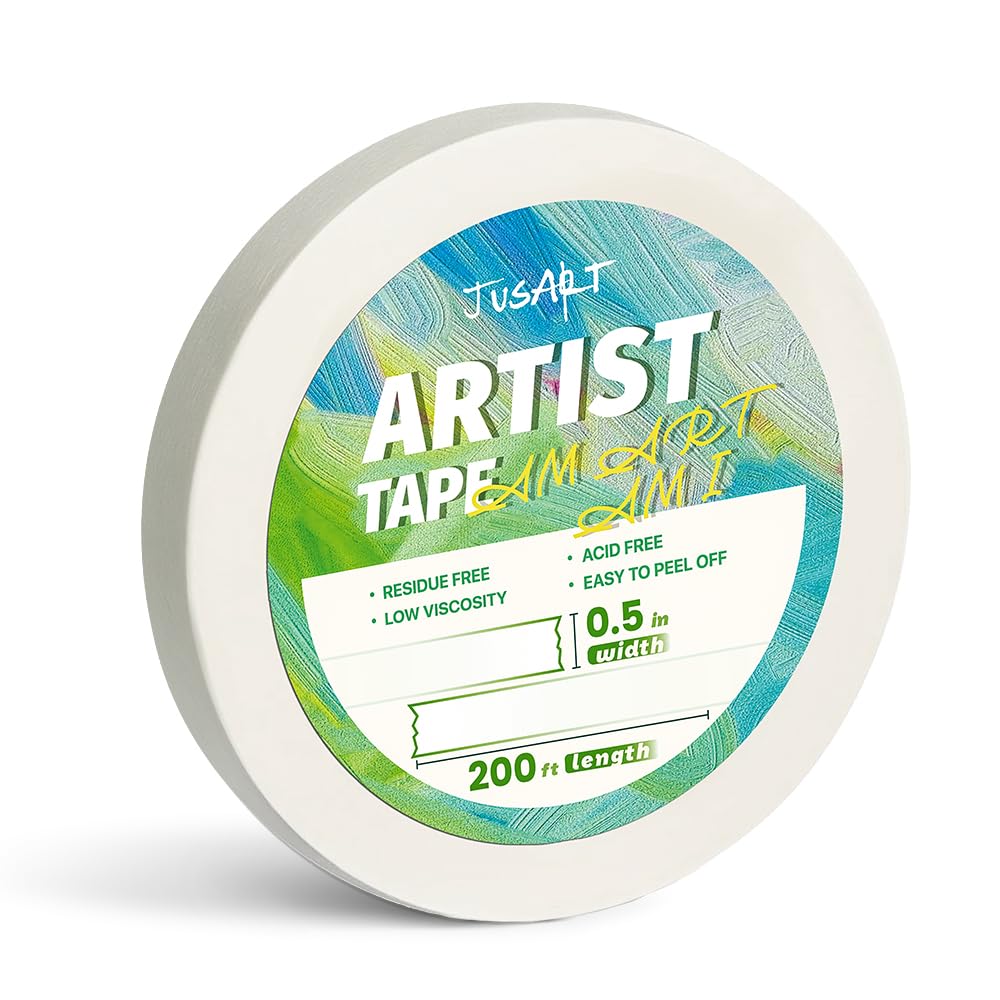
Not a paint, but an accessory every watercolorist uses. JusArt’s tape is 0.5 inch wide and 200 feet long, made from premium pulp with a translucent cool white finish. The listing says it holds securely to paper borders, removes without residue, minimizes paper damage and resists pigment bleed for clean edges.
Taping paper to a board keeps it flatter as it gets wet and gives finished pieces a crisp white border, a small detail that makes cards and wall art look finished.
Best suited for: Any watercolor painter who wants clean borders and flatter paper.
Key features:
- 0.5 inch wide
- 200 feet long
- Low-residue removal
- Bleed-resistant edges
- Tears by hand
Pros:
- Clean, professional borders
- Long roll
- Very low price tier
Cons and limitations:
- Narrow width for heavy buckling
- Not a substitute for stretching thin paper
- Remove slowly to avoid tearing
Buying consideration: Peel the tape slowly at a low angle, away from the painting, once the paper is fully dry.
Building a Simple Watercolor Palette
Instead of using all 36 or 48 colors, try a limited palette:
- A warm and a cool yellow
- A warm and a cool red
- A warm and a cool blue
- A burnt sienna or similar earth
- Optionally a green and a dark neutral
From these you can mix most colors in nature. Limiting your palette also makes paintings more harmonious, because every mix shares the same few pigments.
Wet the pans with a drop of water a minute before painting so they release color easily, and keep a scrap of the same paper you paint on to test mixes.
Paper Matters as Much as Paint
Even the best watercolors look poor on thin paper. Use watercolor paper of at least 140 lb (300 gsm), which resists buckling. Cotton paper handles washes and lifting better than cellulose. Tape the paper to a board on all four sides to keep it flatter as it dries.
Paper texture changes the look of a painting too. Cold-press paper has a gentle tooth that suits most subjects and catches granulating pigments. Hot-press paper is smooth, ideal for fine detail and botanical work. Rough paper has a pronounced texture for loose, expressive landscapes.
If budget is tight, spend it on paper before paint. A student set on good cotton paper will outperform artist paints on thin cellulose paper almost every time.
Essential Watercolor Techniques to Practice
Flat wash. Tilt the board slightly and pull even, overlapping strokes of the same mix across the paper. This teaches you how much water and pigment a brush holds.
Graded wash. Start with strong color and add water to the mix with each stroke, so the wash fades smoothly. Skies and backgrounds rely on it.
Wet-in-wet. Drop color into a damp area and let it spread. Soft clouds, foliage and blooms come from controlling this.
Glazing. Let a layer dry fully, then paint a transparent color over it. Glazing builds depth without mud, provided the layer underneath is completely dry.
Lifting. Use a damp, squeezed brush or a tissue to remove color for highlights and clouds. Non-staining colors lift more easily, which your swatch card will reveal.
Buying Guide: How to Choose Watercolors
Pans or tubes
Pans are convenient, portable and less wasteful. Tubes are better for large washes and filling custom palettes. Beginners usually start with pans.
Many painters fill an empty palette from tubes and let them dry into pans, getting the best of both.
Binder and pigment
Gum arabic is the traditional binder. Listings that mention pigment load, transparency and lightfastness tell you more about quality than color count.
Number of colors
Twelve to twenty-four colors is plenty. Large sets are fun but encourage less mixing.
Case and palette
Metal cases are durable and often have palette lids. Plastic is light and cheap. Check that there is enough mixing space or plan to use a separate palette.
Portability
Travel kits with water brushes and compact cases are ideal for sketching on the go.
Safety for children
For young children, choose washable, non-toxic sets labeled for kids. Artist pigments can contain materials not intended for children.
Watercolor Projects to Try
Ready to paint? Our step-by-step guide on painting landscapes with watercolors is a good first project for any set here. For gifts and decor, try DIY watercolor greeting cards or our tutorial on watercolor-style wall art.
Common Mistakes to Avoid
- Painting on thin printer or sketch paper
- Using every color in a large set instead of mixing
- Scrubbing dry pans instead of pre-wetting them
- Overworking washes until they turn muddy
- Skipping swatches and guessing how colors dry
- Removing tape before the paper is fully dry
FAQs
What watercolors are best for beginners?
A student-grade pan set with a gum arabic binder and 12 to 36 colors, such as the MeiLiang set, gives good results without a large investment.
Are pan or tube watercolors better?
Pans are convenient and portable; tubes are better for big washes and custom palettes. Both use the same kinds of pigment.
How many watercolor colors do I need?
A limited palette of six to eight colors can mix almost anything. Larger sets add convenience.
What paper should I use with watercolors?
Watercolor paper of at least 140 lb (300 gsm). Cotton paper handles washes best.
Are kids’ watercolors different from artist watercolors?
Yes. Kids’ paints prioritize washability and safety; artist paints prioritize pigment strength and lightfastness.
How do I make watercolor pans last longer?
Use clean water and brushes, let pans dry before closing the box and avoid scrubbing them hard.
Final Recommendation
For most new watercolorists, the MeiLiang 36-color set is the best starting point thanks to its gum arabic binder and durable metal box. Travelers and urban sketchers will find the Pagather kit more convenient because of its water brush and compact case.
Families and casual painters can explore with the Dushco 48-color set or the Ultimate Stationery two-pack, and teachers and party hosts should look at the FUMILE bulk sets. Add a roll of JusArt tape, whatever paints you choose, for flatter paper and cleaner borders.