PaintingProGuide is reader-supported. When you buy through links on this page we may earn an affiliate commission at no extra cost to you.
Quick answer: Winsor & Newton paint brushes range from student synthetics to the famous Series 7 Kolinsky sable. For watercolor, the Series 7 Kolinsky Sable Round, size 2 is the benchmark: crisp point, strong snap and even flow. For oil, the Artists’ Oil Hog Filbert, long handle is a dependable traditional bristle brush. If you want a full set of shapes at a lower cost before investing in Winsor & Newton singles, the Nicpro 30-piece set or Fuumuui 25-piece set are practical alternatives.
Winsor & Newton has been making artist materials in Britain since 1832, when chemist William Winsor and painter Henry Newton opened their London shop. Today the company is best known for its paints, but its brushes are just as respected, particularly Series 7, often described as the reference standard for watercolor brushes. Its range also covers hog bristle for oil, synthetic brushes for acrylic and blends designed to imitate sable at a lower price.
This guide explains the main Winsor & Newton brush lines, what makes Series 7 special, how to choose the right brush for your medium and when a cheaper alternative makes more sense.
Natural Hair vs Synthetic: Where Winsor & Newton Fits
Winsor & Newton makes both, and the choice comes down to medium and budget. Kolinsky sable has microscopic scales along each hair that hold water and pigment, and a natural taper that forms a fine point. That combination is why sable is prized for watercolor. Hog bristle, by contrast, is stiff with split ends, ideal for pushing thick oil paint. Synthetics have improved enormously and are the practical choice for acrylic, which would damage natural hair, and for painters who prefer animal-free materials. Many experienced painters own a mix: one or two sable rounds for watercolor, hog bristle for oil and synthetics for everything else.
Winsor & Newton Brush Lines Explained
| Line | Hair or Filament | Best Medium | Who It Suits |
|---|---|---|---|
| Series 7 | Kolinsky sable | Watercolor, gouache, ink | Serious watercolorists and illustrators |
| Series 7 Miniature | Kolinsky sable, short hair | Miniature and fine detail | Detail and miniature painters |
| Sceptre Gold II | Sable and synthetic blend | Watercolor | Painters wanting sable-like handling for less |
| Cotman | Synthetic | Watercolor | Students and beginners |
| Artists’ Oil Hog | Hog bristle | Oil, alkyd | Oil painters |
| Winton Hog | Hog bristle | Oil, acrylic | Students and budget oil painters |
| Galeria and University | Synthetic | Acrylic | Acrylic painters at various levels |
Lines are periodically updated or renamed, so check current listings for availability and exact fiber descriptions.
What Makes Series 7 Special
Series 7 has a famous history: it was developed in 1866 for Queen Victoria, who asked for a fine sable watercolor brush. It is still hand-made using Kolinsky sable, which comes from the tail of the Siberian weasel. The listing focuses on three qualities that matter most in watercolor:
- Point: a crisp tip that stays sharp during use, so one brush can paint both broad strokes and hairlines.
- Snap and spring: the brush returns to shape with enough give for sensitive control.
- Flow control: the belly holds plenty of color and releases it evenly for long, gestural strokes.
Those qualities explain why many watercolorists consider a single good sable round more valuable than a drawer full of cheaper brushes.
Our Top Picks at a Glance
- Winsor & Newton Series 7 Kolinsky Sable Round, Size 2 — Best Winsor & Newton brush for watercolor detail
- Winsor & Newton Artists’ Oil Hog Filbert, Long Handle, Size 2 — Best Winsor & Newton brush for oil
- Nicpro 30-Piece Paint Brush Set — Best budget set alternative
- Fuumuui 25-Piece Set with Palette Knife — Best shape-variety alternative
- Golden Maple 10-Piece Detail Brush Set — Best budget detail alternative
| Product | Best For | Key Spec | Key Strength | Price Tier |
|---|---|---|---|---|
| Series 7 Round #2 | Watercolor and ink detail | Kolinsky sable, 2.1 mm | Crisp point, snap, flow | $$ |
| Artists’ Oil Hog Filbert #2 | Oil and alkyd | Hog bristle, long handle | Soft-edged broad marks | $$ |
| Nicpro 30-Piece | Complete budget kit | Nylon, 30 brushes in many shapes | Double-crimped ferrules, roll case | $$ |
| Fuumuui 25-Piece | Shape variety | 9 shapes + palette knife | Waterproof canvas roll | $$ |
| Golden Maple 10-Piece | Miniature detail | Sizes 5/0 to 8, nylon | Protective tubes | $$ |
How We Chose
We chose these brushes from the Amazon listing details and specifications checked in October 2026, judging how well each represents Winsor & Newton’s quality brushes or offers a sensible alternative, how its fiber and shape fit common media and how widely it is reviewed by Amazon buyers. Brand history is drawn from well-established public information. We have not used these brushes ourselves.
Best Winsor & Newton Paint Brushes (and Alternatives) Reviewed
1. Winsor & Newton Series 7 Kolinsky Sable Round, Size 2 — Best for watercolor detail

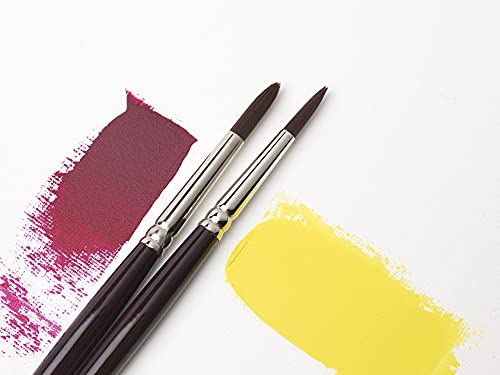
Winsor & Newton calls Series 7 “the world’s finest watercolor brush.” This size 2 round is about 2.1 mm wide at the ferrule, small enough for botanical detail, lettering and fine features, yet a quality sable round holds enough color to paint petals or leaves in one stroke.
The point is what you pay for: a fine Kolinsky tip that keeps its shape stroke after stroke. Combined with the brush’s snap and controlled flow, it lets a painter work with fewer brushes and more confidence.
If you want a single, versatile Series 7 for general watercolor, many painters choose a larger round such as size 6 or 8; the size 2 is the specialist detail size.
Best suited for: watercolorists, illustrators and botanical painters.
Key features:
- Kolinsky sable
- Round, size 2, about 2.1 mm
- Crisp point, snap and spring
- Even color flow
Pros:
- Benchmark watercolor brush
- Excellent point retention
- Lasts for years with care
Cons and limitations:
- High price for a small brush
- Not suited to acrylic or oil scrubbing
- Natural hair requires careful cleaning
Buying consideration: Never leave a sable brush standing in water. Rinse, reshape and dry flat, and use it only with watercolor, gouache or ink.
2. Winsor & Newton Artists’ Oil Hog Filbert, Long Handle, Size 2 — Best for oil painting

This is a natural hog bristle filbert from Winsor & Newton’s Artists’ Oil range, made in the United Kingdom. The listing describes a flat head with an oval tip that creates a broad mark with a soft edge, and notes that it is shorter and thicker than an extra-long filbert for extra control.
Filberts are the go-to shape for many oil painters because they handle blocking in, blending and soft edges. Hog bristle moves stiff oil paint well, and long handles let you stand back from the easel.
Best suited for: oil and alkyd painters, especially for portraits and landscapes.
Key features:
- Hog bristle
- Filbert, size 2
- Long handle
- Made in the UK
Pros:
- Classic oil painting brush
- Soft-edged marks
- Good control
Cons and limitations:
- Small size for large canvases
- Natural bristle softens if left in water
Buying consideration: Buy it in two or three sizes; filberts in sizes 2, 6 and 10 cover most oil work.
3. Nicpro 30-Piece Paint Brush Set — Best for a budget set alternative

Nicpro’s 30-piece set includes eight flats, six rounds, six filberts, three angles and three fans, plus other shapes, with nylon bristles, double-crimped aluminum ferrules and birch handles in a portable nylon canvas roll.
It is not a Winsor & Newton product. It is here as a practical way to explore shapes before buying Winsor & Newton singles in the shapes you use most.
Best suited for: beginners and painters building a full shape range cheaply.
Key features:
- 30 nylon brushes
- Flats, rounds, filberts, angles, fans
- Double-crimped aluminum ferrules
- Canvas roll
Pros:
- Wide shape and size range
- Protective roll
- Mid price tier
Cons and limitations:
- Not natural hair
- Not a Winsor & Newton brush
Buying consideration: Use it for acrylic and practice, and save sable for watercolor.
4. Fuumuui 25-Piece Set with Palette Knife — Best for shape variety

Fuumuui includes 24 brushes in nine shapes, including wide flat, flat, filbert, fan, dagger, cat tongue, round, angle and rigger, plus a palette knife and a waterproof canvas roll with separate compartments.
Unusual shapes like dagger and cat tongue let you experiment before deciding whether to invest in premium specialty brushes.
Best suited for: painters wanting to explore specialty shapes.
Key features:
- 24 brushes in 9 shapes plus palette knife
- Synthetic bristles
- Birch handles
- Waterproof canvas roll
Pros:
- Many specialty shapes
- Includes palette knife
- Organized storage
Cons and limitations:
- Synthetic only
- Listing performance claims not verified
Buying consideration: Try the rigger for branches and the dagger for leaves; they show how shape changes the mark.
5. Golden Maple 10-Piece Detail Brush Set — Best for budget detail work

Golden Maple offers 10 detail brushes in sizes 5/0, 3/0, 2/0, 0, 1, 2, 3, 4, 6 and 8 with nylon heads, triangular easy-grip wood handles and protective tubes.
For acrylic miniatures, models and rocks, which would quickly wear out a sable brush, a set like this is a sensible companion to a Series 7 reserved for watercolor.
Best suited for: miniatures, models and acrylic detail.
Key features:
- 10 sizes, 5/0 to 8
- Nylon heads
- Triangular grip handles
- Protective tubes
Pros:
- Low cost detail sizes
- Comfortable grip
- Tubes protect tips
Cons and limitations:
- Synthetic points wear faster than sable
Buying consideration: Replace the tube after every clean to keep tips straight.
Buying Guide: How to Choose Winsor & Newton Paint Brushes
Choose by medium first
Sable (Series 7) and sable blends for watercolor; hog bristle (Artists’ Oil, Winton) for oil; synthetics (Galeria, University, Cotman) for acrylic and student watercolor.
Pick the most useful size
For watercolor, a size 6 or 8 round is the most versatile; add a size 2 for detail. For oil, filberts and flats in sizes 2, 6 and 10 cover most work.
Consider long vs short handles
Short handles for watercolor and desk work; long handles for easel painting in oil and acrylic.
Budget for one premium brush
One Series 7 round often improves watercolor results more than a full set of cheaper brushes.
Think about ethics and alternatives
Kolinsky sable is natural hair. Some painters prefer high-quality synthetics or blends for ethical or practical reasons.
Care determines lifespan
Premium brushes last for years only if cleaned and stored properly.
Building a Winsor & Newton Brush Kit by Medium
Watercolor kit
Start with one quality round, either a Series 7 or a Sceptre Gold II blend, in size 6 or 8. Add a size 2 round for detail, a synthetic flat (around 1/2 inch) for washes and edges, and a Cotman or other synthetic rigger for fine lines. Four brushes are enough for most watercolor subjects.
Oil kit
Hog bristle filberts in sizes 2, 6 and 10, a flat in size 8 and a soft synthetic round for details and signatures. Long handles help you keep a distance from the canvas, which improves judgment of the whole painting.
Acrylic kit
Synthetic flats and filberts in medium sizes, a small round for detail and a large flat for backgrounds. Synthetics stand up to acrylic’s fast drying and are easy to clean with water.
Mixed-media kit
If you work across media, keep separate brushes for each. Water-based and oil-based paints leave residues that can affect each other, and sable should never be exposed to acrylic.
Buying Genuine Winsor & Newton Brushes
Because Series 7 is so well known, buy from the brand’s official store listing or established art suppliers. Check that the handle markings, series name and size are clear, that the listing names Kolinsky sable and that the product images match the brand’s packaging. A price far below the usual range for the size is a warning sign.
Compare and Learn More
See how the brand stacks up in our Princeton vs Winsor & Newton brushes comparison, and read our answer to are Winsor and Newton brushes good. If you are choosing paint too, our Gamblin vs Winsor & Newton guide compares the two brands’ oils. To protect your investment, follow our tips on how to dry paint brushes correctly and how to keep paint brushes from shedding.
Caring for Sable and Hog Brushes
- Rinse watercolor brushes in clean water, then wash occasionally with mild soap.
- Wipe oil brushes on a rag, rinse in odorless mineral spirits and wash with brush soap.
- Reshape the head while damp and dry flat or tip-down.
- Store dry sable brushes away from moths, in a ventilated box or case.
- Never let acrylic dry in a sable brush; keep sable for watercolor.
Common Mistakes to Avoid
- Using a Series 7 with acrylic, which can damage the delicate hair.
- Buying a tiny Series 7 when a medium size would be more versatile.
- Standing brushes in the water jar on their tips.
- Storing damp sable brushes in a closed case.
- Expecting hog bristle to work well with fluid watercolor.
- Buying many premium brushes at once instead of the one or two you need.
- Scrubbing paper or canvas with a sable round, which wears the point quickly; use a stiff synthetic for lifting and scrubbing.
FAQs
Are Winsor & Newton brushes good?
Yes. Series 7 is widely regarded as a benchmark watercolor brush, and the hog bristle ranges are respected for oil. Their student lines are reliable budget options.
What is Winsor & Newton Series 7?
Series 7 is Winsor & Newton’s top watercolor brush line, hand-made from Kolinsky sable, first developed in 1866 for Queen Victoria.
What size Series 7 should I buy first?
Many watercolorists choose a size 6 or 8 round as their first Series 7 because it handles washes and detail. A size 2 is a specialist detail brush.
Can I use Series 7 with acrylic paint?
It is not recommended. Acrylic can dry in the hair and damage it. Use synthetics for acrylic.
Which Winsor & Newton brushes are best for oil?
The Artists’ Oil hog bristle range is a strong choice, with Winton hog brushes as a budget option.
Is Sceptre Gold II a good alternative to Series 7?
Sceptre Gold II blends sable with synthetic fibers to give sable-like handling at a lower price. It is a common choice for watercolorists who want better than a student brush without the cost of pure Kolinsky.
How long does a Series 7 brush last?
With careful use in watercolor and proper cleaning and storage, a Series 7 can last for many years.
Final Recommendation
For watercolor, invest in a Winsor & Newton Series 7 Kolinsky round; the size 2 here is ideal for detail, and a size 6 or 8 makes a versatile first purchase. For oil, the Artists’ Oil hog filbert is a classic, dependable shape. Fill out your kit with a budget set like the Nicpro 30-piece or Fuumuui 25-piece for acrylic and experiments, and use the Golden Maple detail set for miniatures so your sable stays reserved for watercolor.