
PaintingProGuide is reader-supported. When you buy through links on this page we may earn an affiliate commission at no extra cost to you.
Baseboards are a cutting-in job from start to finish. You paint a narrow strip of trim along two edges at once, the wall above and the floor or carpet below, usually while kneeling, often in a semi-gloss that shows every wobble. The best paint brushes for baseboards are 1.5 to 2 inch angled synthetic brushes with a sharp, tapered tip and a short or comfortable handle, plus a few small trim brushes for corners, quarter round and detailed profiles. A wide roller has little role here; brush control does.
Quick answer: The Wooster Shortcut 2-Inch Angle Sash Brush is our top pick for baseboards: a short handle that is comfortable at floor level and a blended nylon and polyester angle for clean lines. The PinStone 3-Pack 2-Inch Short Handle Angled Brushes are a great value multi-pack for whole-house trim, and the GACDR Slant Lining Fitch 6-Pack handles corners and detailed profiles.
This guide is for homeowners and DIY painters refreshing baseboards, shoe molding and quarter round in latex or enamel. It compares seven brushes and sets, then explains the technique and prep that give straight, drip-free lines without hours of taping.
Our Top Picks at a Glance
- Wooster Shortcut 2-Inch Angle Sash Brush — Best overall baseboard brush
- PinStone 3 Pack 2 Inch Short Handle Angled Brushes — Best value multi-pack for whole-house trim
- Bates 6 Pack Angle Brushes, 1 to 2 Inch — Best budget set of angled sizes
- GACDR Slant Lining Fitch Trim Brushes, 6 Pack — Best for corners and detailed profiles
- ROLLINGDOG 2PC Trim and Edging Brushes — Best specialty edging brushes
- Bates Trim Paint Brush Set, 5/8 to 1 Inch — Best small brushes for quarter round
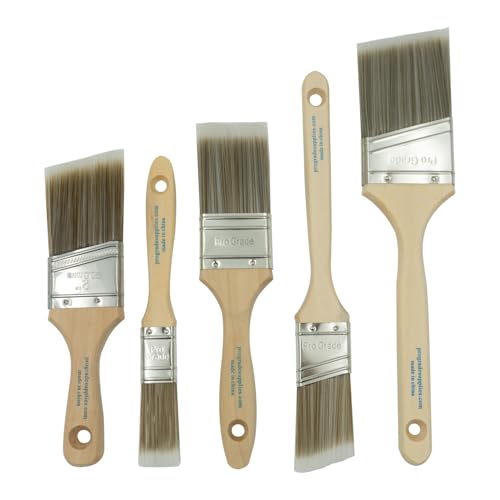
- Pro Grade 5-Piece Paint Brush Set — Best kit for baseboards plus doors and trim
| Product | Best For | Key Spec | Key Strength | Price Tier |
|---|---|---|---|---|
| Wooster Shortcut 2 in | Overall baseboards | Nylon/polyester angle, 2 in handle | Comfort and control at floor level | $ |
| PinStone 3 x 2 in | Whole-house trim | 3 x 2 in angle, synthetic, rubber short handle | Spares for a big job | $ |
| Bates 6 Pack Angles | Budget sizes | 1, 1.5, 2 in angled, wooden handles | Multiple sizes | $ |
| GACDR Fitch 6 Pack | Corners and profiles | 2 each of 0.5, 0.75, 1 in, firm micro tips | Razor-sharp lines | $ |
| ROLLINGDOG 2PC | Specialty edging | Square 4-sided and triangle 3-sided heads | Unique shapes for corners | $ |
| Bates Trim 3 pcs | Quarter round, shoe molding | 5/8, 3/4, 1 in | Fine bristle ends | $ |
| Pro Grade 5-Piece | Trim plus doors | 1 to 2.5 in incl. 2 in angle stubby | Complete kit | $ |
How We Chose
We did not paint baseboards with these brushes. Our picks are based on the Amazon listing details and specifications checked in October 2026, how well each brush’s shape, size and handle suit baseboard work, and how widely each product is reviewed by Amazon buyers.
What mattered:
- Angled, tapered tips for clean lines against walls and floors.
- Width: 1.5 to 2 inches matches most baseboard heights.
- Handle: short or comfortable grips for work near the floor.
- Synthetic bristles for latex and acrylic trim enamel.
- Small brushes for corners, quarter round and detailed profiles.
- Shedding resistance for glossy finishes.
Best Paint Brushes for Baseboards Reviewed
1. Wooster Shortcut 2-Inch Angle Sash Brush — Best for baseboards overall

The Wooster Shortcut is a 2 inch angled sash brush with a flexible Shergrip handle only 2 inches long. Wooster lists a white nylon and gold polyester blend for all paints and a brass-plated steel ferrule.
At floor level, a long handle is awkward: it bumps the wall, and your wrist bends uncomfortably. The short handle lets you hold the brush close to the bristles like a pencil, which gives fine control along the top edge of the baseboard. A 2 inch width covers a typical baseboard face in one or two passes.
The angled cut lets you lay a clean line against the wall above and the floor below.
Best suited for: Anyone painting baseboards, especially without taping.
Key features:
- 2 inch angled sash
- Nylon and polyester blend
- 2 inch flexible handle
- Brass-plated steel ferrule
Pros:
- Excellent control at floor level
- Clean edge
- Works with latex and oil
- Compact
Cons and limitations:
- Single brush
- May be too wide for very small profiles
Buying consideration: Cut the top edge first in one long, steady stroke, then fill the face, then cut the bottom edge.
2. PinStone 3 Pack 2 Inch Short Handle Angled Brushes — Best for whole-house trim

PinStone packs three 2 inch angled brushes with short rubber handles, stainless steel ferrules and synthetic bristles described as resilient and shed free, for all paints. The listing says the angle creates sharp, clean lines along edges and corners, and the short grip gives control in confined spaces.
Three identical brushes are practical for a whole-house trim job: one in use, one wrapped for the next coat, one spare. The rubber grip also reduces fatigue over long sessions.
Best suited for: DIYers painting baseboards in several rooms.
Key features:
- 3 x 2 inch angled brushes
- Synthetic bristles
- Short rubber handle
- Stainless steel ferrule
Pros:
- Value multi-pack
- Comfortable short grip
- Clean edge
- Shed-free claim
Cons and limitations:
- All the same size
- No small brush for corners
Buying consideration: Keep one brush for primer and two for finish coats to avoid primer residue in the final coat.
3. Bates 6 Pack Angle Brushes, 1 to 2 Inch — Best for a budget set of angled sizes

Bates packs six angled brushes from 1 to 2 inches with wooden handles. The listing describes angled edges for precision, cutting in and tight corners, and bristles suitable for all paints, varnishes and stains.
Different widths help when baseboards vary between rooms: a 2 inch for tall modern baseboards, 1.5 inch for standard ones, 1 inch for shoe molding and around door casings.
Best suited for: Budget DIY projects where baseboard sizes vary.
Key features:
- 6 angled brushes, 1 to 2 inch
- Wooden handles
- For paint, varnish and stain
Pros:
- Several sizes
- Very affordable
- All angled for cutting in
Cons and limitations:
- Bristle material not specified
- Long handles less handy at floor level
Buying consideration: Choke up on the handle near the ferrule for better control near the floor.
4. GACDR Slant Lining Fitch Trim Brushes, 6 Pack — Best for corners and detailed profiles

GACDR lists two each of 0.5, 0.75 and 1 inch slant fitch brushes with firm, micro-tipped synthetic bristles and a high-density filament head designed to keep a sharp edge. The wooden handles are designed to reduce fatigue.
Fitch brushes are small, firm and precise. On baseboards, they handle inside and outside corners, decorative routed profiles, and the narrow gap where baseboard meets door casing.
Best suited for: Painters with detailed baseboard profiles or many corners.
Key features:
- 6 brushes: 2 each 0.5, 0.75, 1 inch
- Firm micro-tipped synthetic bristles
- Slant cut
- Wooden handles
Pros:
- Precise in tight spots
- Sharp edge
- Spares included
Cons and limitations:
- Too small for long runs
- Firm bristles can leave marks if overloaded
Buying consideration: Use these for corners and profiles only, then blend into the main run with your 2 inch brush.
5. ROLLINGDOG 2PC Trim and Edging Brushes — Best for specialty edging
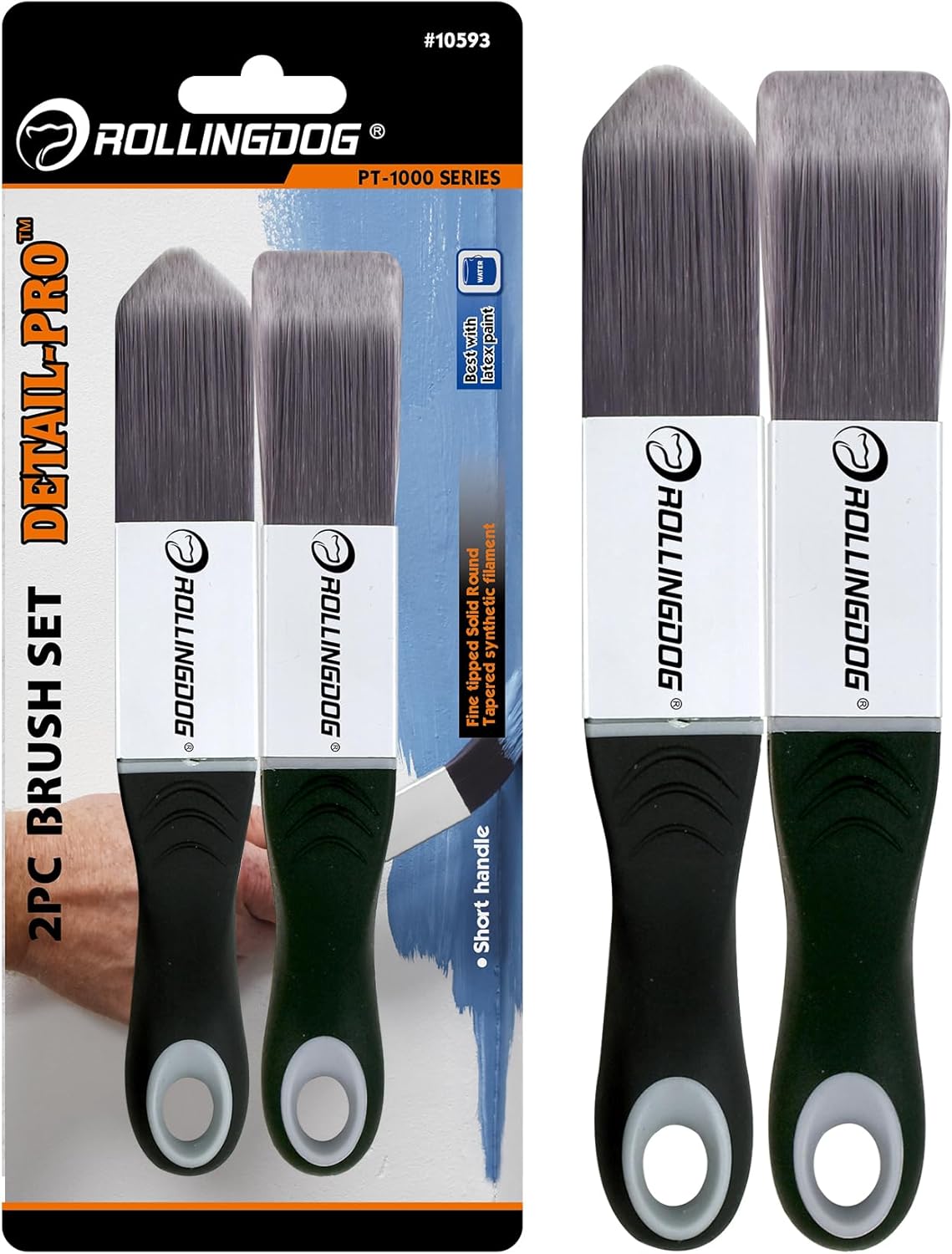
ROLLINGDOG offers two unusual brushes: a square, four-sided trim head (about 22 mm per side) and a triangular, three-sided short angled head (about 24 mm per side). Each head uses solid round tapered filament that comes to an angular tip.
The triangle head is designed for corners, where it can reach into the joint between baseboard and wall, or into inside corners, with less risk of touching the adjacent surface.
Best suited for: Painters who struggle with corners and want a specialty tool.
Key features:
- 2 brushes: square and triangular heads
- Solid round tapered filament
- Angular tip
Pros:
- Unique corner reach
- Tapered for precision
Cons and limitations:
- Unconventional shapes take practice
- Small heads hold less paint
Buying consideration: Practice on a scrap board before using specialty shapes on visible trim.
6. Bates Trim Paint Brush Set, 5/8 to 1 Inch — Best for quarter round and shoe molding

Bates packs three trim brushes at 5/8, 3/4 and 1 inch with finely bristled ends, ergonomic grips and shed-resistant construction.
Quarter round and shoe molding are only about half an inch to an inch tall. A small brush covers them without slopping paint on the floor.
Best suited for: Painting quarter round, shoe molding and narrow trim.
Key features:
- 3 brushes: 5/8, 3/4, 1 inch
- Fine bristle ends
- Ergonomic grip
- Shed resistant
Pros:
- Right size for small molding
- Affordable
- Comfortable
Cons and limitations:
- Too small for tall baseboards
- Bristle type not stated
Buying consideration: Slide a paint shield or putty knife along the floor while painting quarter round to keep paint off the floor.
7. Pro Grade 5-Piece Paint Brush Set — Best for baseboards plus doors and trim

Pro Grade includes a 1 inch flat, 1.5 inch angle, 2 inch flat, 2 inch angle stubby and 2.5 inch angle, with adhesive-bonded bristles to prevent shedding.
If you are painting baseboards along with doors, window trim and casings, this set covers everything. The 2 inch angle stubby is especially handy for baseboards because of its short handle.
Best suited for: DIYers repainting all the trim in a room or house.
Key features:
- 5 brushes incl. 2 in angle stubby
- Flats and angles 1 to 2.5 inch
- Adhesive-bonded bristles
Pros:
- Complete kit
- Stubby for baseboards
- Bristle retention focus
Cons and limitations:
- Bristle material not detailed
- More brushes than baseboards alone need
Buying consideration: Use the 2.5 inch angle on tall baseboards and the stubby around radiators and pipes.
Buying Guide: How to Choose Paint Brushes for Baseboards
Angled sash brushes are the core tool
An angled tip lets you place paint precisely against the wall and floor. Most baseboard painters rely on a 1.5 to 2 inch angle for the bulk of the work.
Handle length
Short handles give better control near the floor and reduce wrist strain. If you prefer a standard handle, choke up close to the ferrule.
Synthetic bristles
Most trim paints today are water-based acrylic enamels. Nylon and polyester blends hold their shape and lay these paints down smoothly.
Small brushes for profiles
Decorative baseboards and quarter round need small brushes. A set of fitch or trim brushes in 1/2 to 1 inch is useful for corners and details.
Tip quality
Tapered and flagged tips produce finer lines and smoother finishes. Cheap brushes with blunt tips make cutting in harder.
Spares for big jobs
Whole-house baseboards take several days. Multi-packs let you swap to a clean brush rather than washing between every coat.
Comfort
Rubber or ergonomic grips reduce fatigue during long sessions. Kneeling pads help too.
How to Paint Baseboards Without Tape
- Vacuum and clean. Dust and pet hair on baseboards end up in the paint. Wipe with a damp cloth and a mild cleaner, then let dry.
- Sand lightly if the existing finish is glossy, then wipe off dust.
- Caulk gaps between baseboard and wall, and fill nail holes. Let dry.
- Protect the floor with a drop cloth, or slide a paint shield along as you go on hard floors. On carpet, push the pile down with a putty knife or use tape on the carpet edge.
- Load the brush lightly, dipping only the bottom third and tapping off excess.
- Cut the top edge in long, steady strokes, letting the angle lead.
- Fill the face in long horizontal strokes.
- Cut the bottom edge carefully, with the shield or putty knife protecting the floor.
- Finish with a light, full-length stroke to smooth brush marks, then let dry before the second coat.
Tape or Freehand?
Painter tape can help beginners, especially along floors, but tape lines can bleed on textured walls and take time to apply. Many experienced painters cut in freehand with a good angled brush, which is faster and gives equally clean results once you practice. A practical compromise is to tape the floor edge and freehand the wall edge.
Choosing a Sheen for Baseboards
Baseboards take scuffs from shoes, vacuums and pets, so most painters use semi-gloss or satin. Semi-gloss is the most durable and easiest to wipe clean but shows brush marks more; satin is more forgiving. With either, a quality brush and light coats matter more than the sheen itself.
Brush Care Between Coats
Wrap brushes in plastic between coats on the same day so they do not dry out. Clean thoroughly at the end of the day. To keep your angled brushes cutting clean lines for years, see our guides on keeping brushes from shedding and drying brushes correctly. For wider trim and adjacent walls, the guide on painting with large brushes helps you keep a wet edge.
Common Mistakes to Avoid
- Painting dusty baseboards and trapping debris in the finish.
- Overloading the brush and getting drips on the floor.
- Using a long-handled brush at floor level and losing control.
- Skipping caulk, leaving visible gaps above the baseboard.
- Applying a thick coat of semi-gloss that sags.
- Painting carpet edges by accident because the pile was not protected.
FAQs
What size brush is best for baseboards?
A 1.5 to 2 inch angled sash brush suits most baseboards. Use smaller brushes for quarter round and detailed profiles.
Should I use an angled or flat brush for baseboards?
Angled. It gives cleaner lines against the wall and floor.
How do I paint baseboards without getting paint on the floor?
Use a paint shield or putty knife along the floor, tape carpet edges, and load the brush lightly.
What paint finish is best for baseboards?
Semi-gloss or satin. Semi-gloss is the most durable; satin hides imperfections better.
Do I need to sand baseboards before painting?
Lightly sand glossy finishes so new paint bonds, then wipe off the dust.
Can I paint baseboards with a roller?
Small rollers can help on tall, flat baseboards, but a brush is still needed for edges, so most painters brush the whole job.
Final Recommendation
For most baseboards, the Wooster Shortcut angle sash brush is the best single tool, with a short handle for control and a quality blend for clean lines. Buy the PinStone 3-pack for a whole-house job, the Bates 6-pack for budget variety, and the GACDR fitches or ROLLINGDOG specialty brushes for corners and profiles. Use the Bates trim set for quarter round, and the Pro Grade kit if you are painting doors and casings too.
Before you start a whole house, paint one short run of baseboard in a closet or behind a door. It lets you test the paint, the brush and your technique where mistakes will not show, and it tells you how long each coat takes so you can plan the rest of the job realistically.




