

PaintingProGuide is reader-supported. When you buy through links on this page we may earn an affiliate commission at no extra cost to you.
Liquitex Basics acrylic is the student and beginner line from Liquitex, one of the oldest names in acrylic paint. Basics is thick and creamy with a satin finish, holds peaks and brushstrokes, and is intermixable with Liquitex Professional colors and mediums. That combination of decent body, a familiar brand and a forgiving price is why so many art classes, beginners and hobby painters start with it.
Liquitex sells Basics in individual tubes, small multi-color sets and larger sets, including a popular 48-tube box. When we checked Amazon in October 2026, we could not verify a current 48-tube Basics listing, so this guide focuses on what Basics is, how to build a palette from individual tubes and smaller sets we could verify, the companion Basics gesso, and a 48-color alternative if you want a big set in one purchase.
Quick answer: Liquitex Basics is a reliable student-grade acrylic: thick, creamy, satin-finish paint with good pigment load that retains brushstrokes and mixes cleanly. Start with a large 250 ml tube of Basics Titanium White, because white runs out first, and prime surfaces with Liquitex Basics Gesso. Add Basics colors as individual tubes or small sets, such as the 6-tube Metallics set. If you want 48 colors in one box and cannot find the Basics 48 set, the Artbreezing 48-color set is a budget alternative.
What Is Liquitex Basics Acrylic?
Basics is positioned below Liquitex Professional. Professional colors use more pigment and offer more single-pigment options and published permanence ratings; Basics uses fine art pigments at a lower cost, with some hue substitutions for expensive pigments. Liquitex describes Basics as having good pigment load, a thick, creamy consistency and a satin finish, and as ideal for learning color theory and mixing.
Because Basics is intermixable with Professional colors and mediums, you can mix the two lines on one palette. That makes it easy to upgrade gradually: keep Basics for underpainting and large areas, and buy Professional versions of the colors you use most.
Consistency and finish
Basics is closer to heavy-body than fluid. It holds peaks and brushstrokes, which is good for expressive brushwork and light impasto, and it can be thinned with water or medium for washes and glazes. The satin finish is a middle ground between matte and gloss; varnish can change the final sheen.
Who uses Basics
Students, beginners, art teachers and hobby painters are the core audience. Many experienced painters also keep Basics for underpainting, large backgrounds and experimentation.
Our Top Picks at a Glance
- Liquitex BASICS Acrylic, Titanium White, 250 ml — Best essential Basics tube
- Liquitex BASICS Acrylic Gesso, 16 oz — Best primer for Basics paintings
- Liquitex BASICS Metallics Set, 6 x 22 ml — Best small Basics set to add shine
- Artbreezing 48 Colors Acrylic Paint Set — Best 48-color alternative
| Product | Best For | Key Spec | Key Strength | Price Tier |
|---|---|---|---|---|
| Basics Titanium White 250 ml | Every palette | 8.45 oz tube, satin | Large white supply | $ |
| Basics Gesso 16 oz | Priming surfaces | 16 oz bottle | One coat usually enough (listed) | $ |
| Basics Metallics 6 x 22 ml | Metallic accents | 6 metallic colors, medium viscosity | Lightfast, satin (listed) | $$ |
| Artbreezing 48 Colors | 48 colors in one box | 48 x 22 ml | Wide palette | $$ |
How We Chose
These picks are based on the Amazon listing details and specifications as checked in October 2026, how well each product fits building and using a Liquitex Basics palette, and how widely each is reviewed by Amazon buyers. We have not painted swatches with these specific products; descriptions come from Liquitex’s and Artbreezing’s listings.
- Core palette value: products every Basics painter needs.
- Compatibility: intermixable with Liquitex lines.
- Volume: large tubes for the most-used colors.
- Range: options for painters who want a big set.
Liquitex Basics Products Reviewed
1. Liquitex BASICS Acrylic Paint, Titanium White, 250 ml — Best Essential Basics Tube
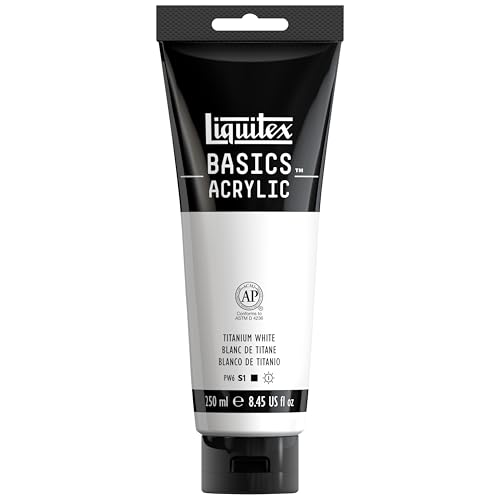
This 250 ml (8.45 oz) tube of Basics Titanium White is the single most useful Basics purchase. Liquitex describes it as thick and creamy with a satin finish and good pigment load, retaining peaks and brushstrokes, and ideal for learning color theory and mixing.
White goes into most mixtures, so it runs out far faster than any other color. A large tube means you are not rationing it halfway through a painting. It is intermixable with Liquitex Professional colors and mediums and conforms to ASTM D4236.
Best suited for: Every Basics painter, especially students and anyone using a small color set.
Key features (from the listing):
- 250 ml (8.45 oz) tube
- Titanium White
- Thick, creamy, satin finish
- Good pigment load
- Intermixable with Liquitex Professional
Pros:
- Large volume of the most-used color
- Holds brushstrokes
- Easy to mix
Cons and limitations:
- Single color
- Student grade
- Satin may need varnish for gloss
Buying consideration: Buy white in the largest size you can store; it is the color you will replace first in any set.
2. Liquitex BASICS Acrylic Gesso, 16 oz — Best Primer for Basics Paintings
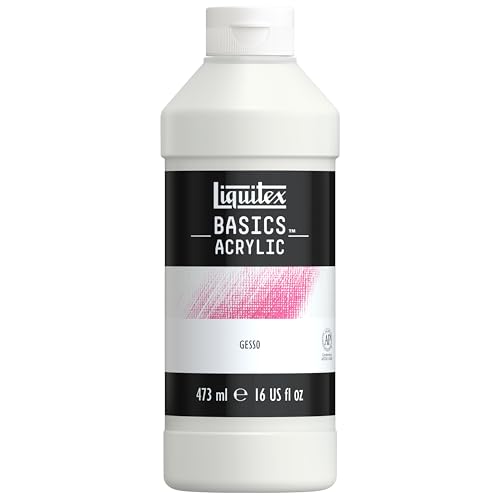
Basics Gesso is a value acrylic gesso for preparing surfaces for acrylic and oil paint. Liquitex says one coat is usually all that is required, and the 16 oz bottle covers many canvases and panels.
Use it to prime raw canvas, wood panels, paper and cardboard, or to add an extra smooth layer over pre-primed canvas. It is intermixable with Liquitex products, so you can tint it with Basics colors to tone a surface in one step.
Best suited for: Painters priming their own surfaces or adding coats to budget canvases.
Key features (from the listing):
- 16 oz (473 ml) bottle
- Acrylic gesso for acrylic and oil
- One coat usually enough (listed)
- Satin finish
Pros:
- Value primer
- Works under oil and acrylic
- Can be tinted
Cons and limitations:
- Student-grade gesso
- Thin coats may need sanding for smoothness
- Not for watercolor grounds
Buying consideration: For a smoother surface, apply two thin coats in crossing directions and sand lightly between them.
3. Liquitex BASICS Acrylic Paint Set, Metallics, 6 x 22 ml — Best Small Basics Set

This Basics set includes six 22 ml tubes: Metallic Red, Metallic Magenta, Metallic Purple, Metallic Blue, Metallic Aqua Green and Metallic Green. The listing describes medium viscosity, a satin finish, lightfast fine art pigments and a range of opacities.
It is a good way to add shimmer to abstracts, florals and décor pieces without leaving the Basics line.
Best suited for: Basics painters who want metallic accents.
Key features (from the listing):
- 6 x 22 ml tubes
- Metallic red, magenta, purple, blue, aqua green, green
- Medium viscosity, satin
- Lightfast fine art pigments (listed)
Pros:
- Adds shine within the Basics range
- Intermixable
- Compact set
Cons and limitations:
- Small tubes
- Specialty colors only
- No metallic gold or silver in this set
Buying consideration: Metallics look best over a dark base; test them over black and white to see the difference.
Alternative Worth Comparing
4. Artbreezing 48 Colors Professional Acrylic Paint Set — Best 48-Color Alternative

If you wanted the Basics 48-tube set specifically, the Artbreezing 48-color set is a verified alternative with 48 tubes of 22 ml. The listing describes pigment-rich, smooth, quick-drying paint that is lightfast, water-resistant and crack-free, for canvas, wood and paper.
It is not Liquitex, so you lose the guaranteed intermixability with Liquitex mediums and Professional colors, but most acrylics mix together fine in practice.
Best suited for: Beginners who want 48 colors in one box.
Key features (from the listing):
- 48 x 22 ml tubes
- Warm-to-cool color range
- Quick drying, lightfast claims (listed)
- Also sold in 24 and 36-color sets
Pros:
- Large palette in one purchase
- Compact tubes
- Low commitment
Cons and limitations:
- Not Liquitex
- Claims unverified
- Small tubes for frequent painters
Buying consideration: Swatch every color when the set arrives so you know which tubes overlap.
Building a Liquitex Basics Palette
You do not need 48 colors to paint well with Basics. A practical starter palette is: Titanium White (large tube), a cool yellow such as Primary Yellow, a warm yellow or Yellow Medium Azo, a warm red such as Cadmium Red Medium Hue, a cool red such as Primary Red or Quinacridone Crimson, Ultramarine Blue, Phthalocyanine Blue, Burnt Umber and Mars Black. Those nine tubes mix a full range of greens, oranges, purples, browns and grays.
Add convenience colors later, such as Yellow Oxide or Raw Sienna for landscapes, Light Blue Permanent for skies, or the Metallics set for décor. Buying individual tubes this way often costs less than a large set where several colors go unused.
Using Liquitex Basics with Mediums
One advantage of staying within the Liquitex family is that its mediums are designed to work with Basics. A few are especially useful for students.
Gel mediums for texture
Mixing a heavy gel into Basics adds body for impasto, extends paint without losing much color and keeps knife marks crisp. It is a cost-effective way to build texture with student paint.
Glazing medium for transparency
Basics is fairly opaque. A glazing medium thins it into transparent layers with enough binder to keep the film strong, which is better than thinning with lots of water. Glazes let you shift color and deepen shadows over a dry underpainting.
Slow-drying medium for blending
Acrylic dries fast, which can make soft blends difficult for beginners. A slow-drying medium or retarder extends working time so you can blend skies, skin and gradients.
Pouring medium for fluid art
Basics is too thick to pour on its own. Mixed with a pouring medium to a honey-like consistency, it becomes usable for acrylic pours and flip-cup techniques.
Basics for Different Techniques
Impasto: Basics holds peaks well, so it handles light impasto straight from the tube; add gel for thicker texture. Washes: thin with water for underpaintings and toned grounds, keeping dilution moderate. Dry brushing: its creamy body drags nicely over textured canvas for grass, bark and weathered surfaces. Detail work: thin slightly with water or flow aid so fine lines flow from a liner brush. Mixed media: Basics sits happily over collage, under pastels and alongside acrylic markers.
Basics in the Classroom
Art teachers favor Basics for good reasons. It is affordable enough to buy in volume, consistent from tube to tube, conforms to ASTM D4236 for educational use and behaves like “real” acrylic, so students learn genuine color mixing and brush handling rather than fighting thin craft paint. Large tubes of white, black and primaries go a long way in a shared classroom palette, and Basics Gesso keeps surface costs down when students prime their own boards.
Caring for Basics Tubes and Paintings
Basics tubes last a long time if you treat them well. Wipe the thread and cap before closing so the cap seals completely; dried paint in the threads lets air in and hardens the paint near the opening. Squeeze from the bottom and roll the tube as it empties. Store tubes at room temperature, never in a freezing garage, because frozen acrylic can turn lumpy and unusable.
On the palette, a wet palette keeps Basics workable for hours. On the painting, allow layers to dry before varnishing; thin paintings may be ready in a few days, while thicker impasto passages need longer. A gloss or satin varnish evens out sheen differences between Basics colors and mediums and protects the surface from dust and UV light.
Label any custom mixes you save in small jars with the colors and ratios you used. Basics is consistent enough that you can recreate a favorite mixture months later from those notes.
Keep a small spray bottle of water nearby too; a light mist over the palette every few minutes slows skinning on hot or dry days.
A First Painting Exercise with Basics
To learn how Basics mixes, paint a simple color-wheel landscape on a primed panel. Mix greens from Primary Yellow and Ultramarine, then from Yellow and Phthalo Blue, and compare the two. Mix purples from both reds and Ultramarine. Use Burnt Umber with Ultramarine for a rich near-black instead of Mars Black. Within an hour you will know your palette better than any color chart could tell you.
Basics vs Liquitex Professional
| Feature | Liquitex Basics | Liquitex Professional |
|---|---|---|
| Grade | Student / beginner | Artist |
| Pigment load | Good | Higher |
| Pigments | Fine art pigments, some hues | More single-pigment colors |
| Body | Thick, creamy, holds brushstrokes | Heavy Body and Soft Body lines |
| Finish | Satin | Varies by line |
| Intermixable | Yes, with Professional colors and mediums | Yes |
Buying Guide: How to Buy Liquitex Basics
Buy white big
A 250 ml white tube is the best value purchase in the line.
Choose sets or singles
Small sets are convenient; singles let you build exactly the palette you need.
Pair with Basics or Professional mediums
Gel, glazing and retarder mediums extend what Basics can do.
Prime your surfaces
Basics Gesso prepares canvas, wood and paper inexpensively.
Know when to upgrade
Replace your most-used colors with Professional tubes as your work develops.
Check listings carefully
Large sets can be out of stock or listed by third-party sellers; confirm what is included before buying.
Read Our Full Review
For a closer look at how Basics performs color by color, see our in-depth Liquitex Basics acrylic paint review. For project ideas, try our simple acrylic painting ideas for beginners.
Common Mistakes to Avoid
- Buying a huge set but a small white.
- Assuming Basics hue colors behave exactly like true cadmiums.
- Thinning Basics heavily with water instead of medium for glazes.
- Skipping gesso on raw wood or paper.
- Letting paint dry in brushes during long sessions.
- Ignoring that acrylic dries slightly darker than it looks wet.
FAQs
Is Liquitex Basics good for beginners?
Yes. Basics is a widely used student-grade acrylic with good pigment load, a thick creamy consistency and a satin finish, ideal for learning color mixing.
Is Liquitex Basics heavy body?
It is thick and creamy and holds brushstrokes, behaving close to heavy-body paint, though Liquitex’s Professional Heavy Body line is thicker and more pigmented.
Can I mix Liquitex Basics with Professional colors?
Yes. Liquitex states Basics is intermixable with Liquitex Professional colors and mediums.
What is the difference between Basics and Professional?
Professional has higher pigment load and more single-pigment colors; Basics is more affordable with some hue substitutes.
Does Liquitex Basics dry glossy or matte?
Basics dries to a satin finish. Varnish can make it glossier or more matte.
Where can I find the Liquitex Basics 48 tube set?
We could not verify a current 48-tube listing on Amazon in October 2026. Individual tubes, small Basics sets and alternative 48-color sets are available.
Final Recommendation
Liquitex Basics acrylic is a dependable choice for learning and everyday painting. Start with a 250 ml Titanium White and Basics Gesso, build your palette from individual Basics tubes or small sets like the Metallics, and upgrade favorite colors to Professional over time. If you want 48 colors in one box and cannot find the Basics set, the Artbreezing 48-color set is a reasonable stand-in.


3 Comments