
PaintingProGuide is reader-supported. When you buy through links on this page we may earn an affiliate commission at no extra cost to you.
Texture paste, usually sold as modeling paste, is what turns a flat acrylic painting into something with real relief. It is a thick acrylic medium loaded with a solid filler such as marble dust, applied with a palette knife to build ridges, peaks, cracks, stucco and sculpted forms that you can paint over once dry. The best texture paste for acrylic painting holds its shape without slumping, dries hard without cracking, bonds firmly to canvas or board, and accepts paint evenly afterward.
Prices and quality vary widely. Professional pastes use marble dust in a pure acrylic polymer emulsion and can be carved or sanded; craft-grade pastes are cheaper and come in big tubs for textured wall art and large abstracts. Below we compare six modeling pastes currently listed on Amazon, explain the differences between heavy, light and flexible pastes, and show how to apply them so they do not crack.
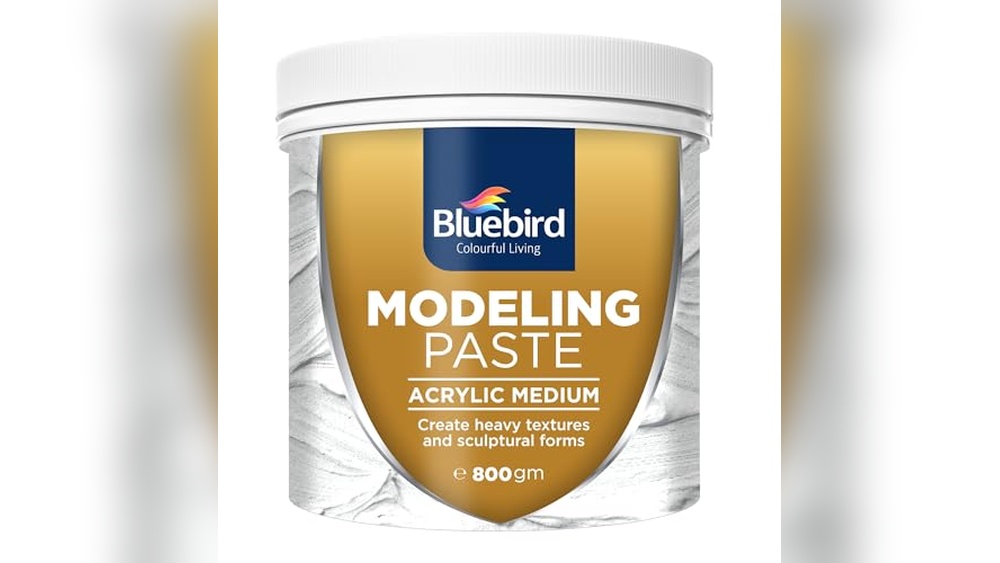
Quick answer: The Liquitex Professional Modeling Paste is the best texture paste for acrylic painting when quality matters: marble dust in 100 percent polymer emulsion that dries stone-hard and can be sanded or carved. For big textured canvases on a budget, Handy Art Modeling Paste (32 oz) offers a large, resealable tub of heavy-bodied paste that dries non-cracking and sandable. The Bluebird Thick Modeling Paste (800 g) is a good middle ground for high-density relief.
Our Top Picks at a Glance
- Liquitex Professional Modeling Paste, 237 ml — Best overall professional texture paste
- Handy Art Modeling Paste, 32 oz — Best large tub for textured canvases
- Bluebird Thick Modeling Paste, 800 g — Best high-density paste for bold relief
- Endhokn Thick Modeling Paste, 600 ml — Best for tinting and quartz-sand texture
- Nicpro Modeling Paste, 571 ml — Best quick-drying value paste
- Nariolar Modeling Paste, 400 g — Best small tub for trying texture art
| Product | Best For | Key Spec | Key Strength | Price Tier |
|---|---|---|---|---|
| Liquitex Professional Modeling Paste | Fine art and carving | 237 ml, marble dust | Dries stone-hard, sandable | $$ |
| Handy Art Modeling Paste | Large textured works | 32 oz resealable tub | Non-cracking, sandable, made in USA | $$ |
| Bluebird Thick Modeling Paste | Bold, high relief | 800 g | High density, quick drying | $$ |
| Endhokn Thick Modeling Paste | Tinting and custom texture | 600 ml | No shrinkage claim, tintable | $$ |
| Nicpro Modeling Paste | Value layering | 571 ml | Quick drying, creamy | $ |
| Nariolar Modeling Paste | Trying texture art | 400 g | Firm, holds stacked forms | $ |
How We Chose
Our selections are based on the Amazon listing details and specifications checked in October 2026, how well each paste’s stated composition, consistency and drying behavior fit acrylic texture work, and how widely each product is reviewed by Amazon buyers. One listing appeared twice under the same product ID, so we counted it once.
Criteria:
- Body and peak retention: how well the paste holds sculpted shapes.
- Crack resistance: claims about drying without cracking, especially in thick layers.
- Finished surface: whether it can be sanded, carved or painted over.
- Compatibility: mixing with acrylic paint and mediums.
- Volume and value: container size relative to the scale you work at.
Texture Paste, Modeling Paste and Gel: What Is the Difference?
“Texture paste” and “modeling paste” are used almost interchangeably. Both are acrylic polymer mediums with fillers that make them opaque and stiff. Heavy modeling paste dries very hard and can be carved. Light modeling paste uses lightweight fillers so thick layers stay light on the canvas. Flexible modeling paste stays bendable, which suits canvas that will flex. Heavy gel medium, by contrast, has no filler and dries clear, so it holds texture while letting color show through. If you want opaque, sculptural relief, choose a paste; if you want transparent texture, choose a gel.
Best Texture Paste for Acrylic Painting Reviewed
1. Liquitex Professional Modeling Paste, 237 ml (8 oz) — Best for Fine Art and Carving

Liquitex describes this as a marble paste made of marble dust and 100 percent polymer emulsion, used to build heavy textures. It is lightweight and non-toxic, dries to the hardness of stone, and can be sanded or carved when thoroughly dry. That carving ability is the key difference from many craft pastes: you can incise lines, scrape back and refine forms after the paste has set.
It is intermixable with Liquitex Professional acrylic colors and mediums, so you can tint it before applying or paint over it afterward. It conforms to ASTM D4236. The jar is relatively small, so it is better suited to accents and medium-sized works than to covering huge canvases.
Best suited for: fine artists who want archival, carvable texture and predictable results with professional acrylics.
Key features:
- 237 ml jar
- Marble dust in 100 percent polymer emulsion
- Dries stone-hard; sandable and carvable
- Matte finish
- Intermixable with Liquitex acrylics
Pros:
- Professional, archival composition
- Can be sanded and carved
- Very widely reviewed
Cons and limitations:
- Small jar for the price tier
- Very rigid when dry; thick layers on flexible canvas need care
Buying consideration: for large, thick applications on stretched canvas, build in layers and consider a rigid panel to reduce cracking risk.
2. Handy Art Modeling Paste, 32 oz, Opaque White — Best for Large Textured Works

Handy Art packs a heavy-bodied white paste into a 32 oz resealable, wide-mouth quart container, which makes loading a palette knife easy. The listing describes a paste that dries to a hard, opaque white finish that is permanent, non-cracking, highly durable and sandable once cured.
You can mix it directly with acrylic paint for custom colored paste or apply it white and paint over it. It is AP certified non-toxic, free of a long list of common allergens, and made in the USA. For textured abstracts, wall art and big canvases, the volume is hard to beat.
Best suited for: artists making textured wall art, large abstracts and mixed media where volume matters.
Key features:
- 32 oz resealable tub
- Heavy-bodied, opaque white
- Dries hard, non-cracking, sandable
- AP certified, made in USA
Pros:
- Big volume for large works
- Wide mouth suits palette knives
- Very widely reviewed
Cons and limitations:
- Craft-oriented rather than professional fine art grade
- Heavy when applied very thick
Buying consideration: keep the lid tight and wipe the rim clean; dried paste around the lid lets air in and skins the surface.
3. Bluebird Thick Modeling Paste, White, 800 g / 28.2 oz — Best for Bold, High Relief

Bluebird markets this as a high-density acrylic medium for texture, thickness and dimension. The listing describes a creamy consistency with good workability for detailing, and a quick-drying formula designed to dry without cracking so you can build layers.
At 800 grams it offers plenty of material for sculpted florals, palette-knife peaks and textured backgrounds. It works on canvas, wood and other surfaces.
Best suited for: painters who want dense, bold relief and sculptural texture on canvas or wood.
Key features:
- 800 g container
- High-density formula
- Quick drying, designed not to crack
- For canvas, wood and more
Pros:
- Good volume at a mid price tier
- Holds bold relief
- Widely reviewed
Cons and limitations:
- Composition not detailed beyond acrylic
- Fast drying shortens sculpting time
Buying consideration: work in sections so the paste does not skin over before you finish sculpting each area.
4. Endhokn Thick Modeling Paste, 30 oz / 600 ml — Best for Tinting and Custom Texture

Endhokn emphasizes versatility. The listing describes a high-density, water-based paste for canvas, linen, wood and cardstock that can also serve as an acrylic primer. It claims strong adhesion, no shrinkage during curing, no cracking after full hardening and a waterproof surface once cured.
It blends with acrylic paint and gel mediums to make colored paste, can be painted over after curing, and the listing suggests adding quartz sand to change the texture. That makes it a flexible option for experimenting with grit, stucco and sand effects.
Best suited for: experimental painters who like to tint paste and add grit or sand.
Key features:
- 600 ml container
- High-density, water-based
- Tintable with acrylic paint
- Accepts added quartz sand
Pros:
- Versatile for custom textures
- No-shrink and no-crack claims
- Can double as primer
Cons and limitations:
- Newer listing
- Primer use is not a substitute for proper gesso on all surfaces
Buying consideration: test sand additions on a scrap board first; too much grit weakens the paste.
5. Nicpro Modeling Paste, 571 ml / 28.2 oz — Best for Quick-Drying Value Layering

Nicpro’s paste offers a large container at a low price tier. The listing describes a creamy consistency with good workability for fine detail and larger forms, and a quick-drying formula that dries rapidly without cracking so you can build multiple layers.
It is suited to sculpting, modeling and adding texture to canvas, wood and other surfaces. As a value option it is a sensible choice for practice, classes and textured backgrounds.
Best suited for: beginners and budget-minded artists building layered texture.
Key features:
- 571 ml container
- Creamy, workable consistency
- Quick drying
- For canvas, wood and more
Pros:
- Low price tier for the volume
- Builds layers quickly
- Widely reviewed
Cons and limitations:
- Little detail on composition
- Quick drying reduces working time
Buying consideration: mist the paste lightly with water while working if it starts to skin over.
6. Nariolar Modeling Paste, 400 g / 14.1 oz — Best for Trying Texture Art

If you want to test texture art before buying a big tub, Nariolar’s 400 g paste is the smallest and cheapest option here. The listing describes a thick, firm consistency for sculpting structures, heights and dimension, with stacked forms that hold without collapsing.
It is described as fast-drying to help prevent cracking, with strong adhesion on canvas, wood and metal. That is enough paste for several small canvases or one textured floral piece.
Best suited for: first-time texture painters and small projects.
Key features:
- 400 g container
- Thick, firm consistency
- Fast drying
- For canvas, wood and metal
Pros:
- Lowest price tier
- Firm body for stacked forms
- Good trial size
Cons and limitations:
- Small volume
- Fewer buyer reviews
Buying consideration: use it for small works or accents, then buy a larger tub once you know you enjoy texture painting.
How to Apply Texture Paste Without Cracking
- Use a rigid support (panel or canvas board) for very thick applications, or a well-stretched canvas for moderate texture.
- Prime the surface with acrylic gesso if it is not already primed.
- Apply paste with a palette knife in layers no thicker than about a quarter inch at a time, unless the label allows more.
- Let each layer dry before adding the next; thick layers dry from the outside in.
- Avoid drying with heat or fans at high speed, which can cause surface cracks.
- Once fully dry, sand or carve if desired, then paint over with acrylic or glaze to enhance texture.
Texture Effects You Can Build With Paste
Once you have a tub of paste, the tool you apply it with matters as much as the paste itself. A palette knife drawn flat across the surface leaves smooth plateaus with crisp edges, ideal for modern abstracts. Pressing the knife in and lifting straight up pulls stiff peaks for sculpted petals and sea foam. A notched spreader or old comb makes parallel ridges that read as wood grain, ploughed fields or rain.
Stencils are one of the easiest ways to get professional-looking relief: lay a stencil on the canvas, spread a thin, even layer of paste across it, then lift the stencil away while the paste is still wet. Sponges dabbed into paste give a stucco or plaster wall effect. For cracked earth or aged frescoes, some artists apply a thick layer and let it dry naturally, accepting fine surface cracks as part of the look, then seal and glaze over them.
Whatever effect you choose, a thin glaze of transparent color wiped back with a rag once the paste is dry will settle into the low areas and leave the high points lighter, which makes the texture read far more strongly.
Buying Guide: How to Choose Texture Paste for Acrylic Painting
Composition
Professional pastes like Liquitex specify marble dust in a pure acrylic polymer emulsion. Craft pastes may not list their fillers. For archival work, choose a paste that tells you what is in it.
Heavy, Light or Flexible
Heavy paste is hardest and best for carving. Light paste reduces weight on large canvases. Flexible paste resists cracking on flexible supports. Choose based on your support and how thick you plan to build.
Container Size
Small jars suit accents and fine art pieces. Textured wall art and big abstracts use a lot of paste, so quart tubs save money. Remember that paste in an opened tub slowly dries if not sealed well.
Drying Time
Quick-drying pastes let you layer faster but give less time to sculpt. Very thick applications take much longer to dry through, regardless of brand.
Paintability
Most pastes dry matte and absorbent, which makes paint grip well. Glazing thin color over dried paste and wiping back highlights the texture beautifully.
Tinting
Mixing acrylic paint into paste before application creates colored relief and saves a painting step. Add paint gradually; too much liquid paint softens the paste and reduces peak retention.
Support
Rigid panels handle thick paste better than flexible canvas. On stretched canvas, keep texture moderate or use a flexible paste.
Texture Techniques to Try Next
Paste is only one way to add dimension. Our guides on creating texture with acrylic paint and creating texture in acrylic painting cover palette knife work, sponges, gels and dry brushing. For a finished project, try DIY wall art with acrylic using a tub of modeling paste.
Common Mistakes to Avoid
- Applying one very thick layer that cracks as it dries.
- Using heavy paste on a loose, flexible canvas that bends.
- Painting over paste before it has dried all the way through.
- Adding too much paint or water to the paste and losing texture.
- Leaving tubs open so the paste skins over and develops lumps.
- Using a soft brush to apply paste instead of a palette knife.
- Drying thick texture with a heat gun, which can crack or bubble the surface.
FAQs
What is the best texture paste for acrylic painting?
Liquitex Professional Modeling Paste is a reliable professional choice because it uses marble dust in pure acrylic emulsion and can be sanded or carved. For large projects, bigger tubs like Handy Art Modeling Paste give better value.
Is modeling paste the same as texture paste?
Mostly, yes. Both are thick acrylic mediums with fillers used to build texture. Manufacturers use the terms interchangeably, though some offer separate heavy, light and flexible versions.
Can I mix acrylic paint into modeling paste?
Yes. Mixing acrylic paint into the paste tints it so you can apply colored texture directly. Add paint gradually to keep the paste stiff enough to hold peaks.
How long does texture paste take to dry?
Thin layers may be dry to the touch within an hour or two, but thick applications can take a day or more to dry through. Drying time depends on thickness, humidity and the brand.
Why did my modeling paste crack?
Cracking usually happens when paste is applied too thickly in one go, dried too quickly with heat, or applied to a flexible support that bends. Build in thinner layers and use a rigid panel for heavy texture.
Can I use texture paste on wood?
Yes. Most pastes here list wood as a suitable surface. Sand and prime the wood with gesso first for better adhesion.
Final Recommendation
For fine art texture you can carve and sand, choose Liquitex Professional Modeling Paste. For big textured canvases and wall art, Handy Art’s 32 oz tub is the best value, while Bluebird’s 800 g paste suits bold, high-density relief. Pick Endhokn if you like tinting paste or adding sand, Nicpro for a quick-drying budget option, and Nariolar if you just want to try texture art on a small piece first.


One Comment