
PaintingProGuide is reader-supported. When you buy through links on this page we may earn an affiliate commission at no extra cost to you.
An impasto medium for acrylics lets you build thick, sculptural paint without squeezing out tube after tube of color. Mixed with acrylic paint, a heavy gel or impasto medium holds brush and knife marks as it dries, stretches expensive pigment, and keeps the paint film flexible. Modeling paste goes further, building hard, opaque relief you can carve or sand.
The best choice depends on whether you want transparent texture that keeps color rich, an opaque ground you will paint over, or simply cheap bulk for large textured abstracts. This guide covers each, from professional heavy gel to economical tubs.
Quick answer: Liquitex Professional Gloss Heavy Gel is the best impasto medium for acrylics when you want crisp peaks with transparent, glossy color. For more volume at a lower tier, U.S. Art Supply Impasto Clear Gel and Handy Art Gel Medium both dry clear and hold knife marks. If you want hard, opaque structure to sculpt or sand, choose a modeling paste such as Nicpro’s 571 ml tub.
Our Top Picks at a Glance
- Liquitex Professional Gloss Heavy Gel — Best overall impasto medium for acrylics
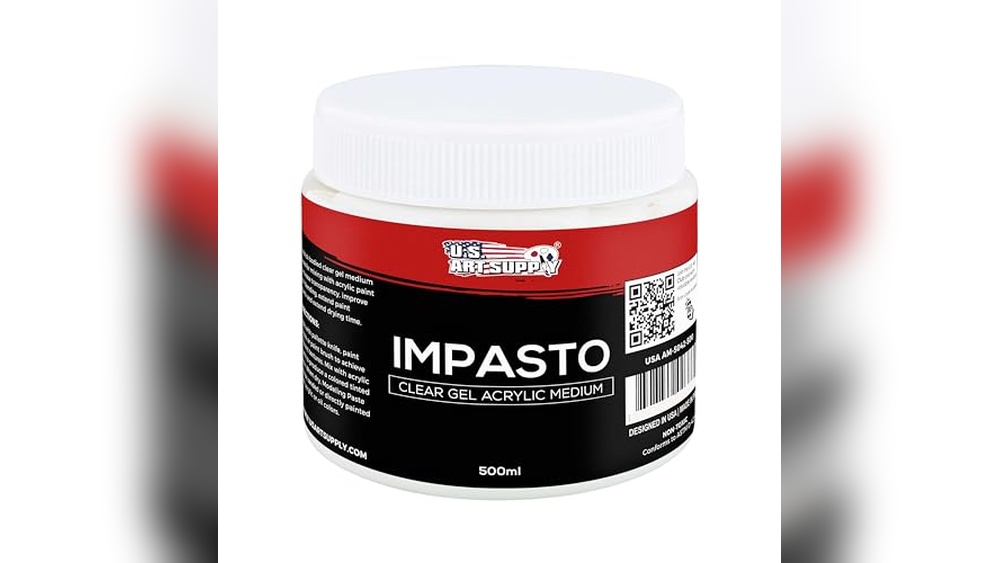
- U.S. Art Supply Impasto Clear Gel — Best value clear impasto gel
- Handy Art Acrylic Gel Medium (32 oz) — Best large tub for big textured work
- Mont Marte Impasto Acrylic Medium — Best budget impasto medium
- Nicpro Modeling Paste — Best for sculpted, opaque relief
- Bluebird Thick Modeling Paste — Best small tub of modeling paste
| Product | Best For | Key Spec | Key Strength | Price Tier |
|---|---|---|---|---|
| Liquitex Gloss Heavy Gel | Transparent, glossy impasto | 8 oz, extra heavy body | Professional, intermixable | $$ |
| U.S. Art Supply Impasto Gel | Clear texture on a budget | 500 ml tub, dries clear | Strong adhesion, flexible | $$ |
| Handy Art Gel Medium | Large textured paintings | 32 oz quart, dries clear | Wide-mouth container | $$ |
| Mont Marte Impasto Medium | Budget texture | 500 ml, matte, dries clear | Retains brush strokes | $ |
| Nicpro Modeling Paste | Opaque relief and sculpting | 571 ml, white | Quick drying (listed) | $ |
| Bluebird Modeling Paste | Small projects | 150 g, high density | Low commitment | $ |
How We Chose
Picks are based on the Amazon listing details and specifications for each medium as checked in October 2026, how well each product’s body, finish and clarity fit acrylic impasto, and how widely each is reviewed by Amazon buyers. We have not tested drying or cracking; claims such as “dries without cracking” are presented as the maker’s.
- Body: how stiff the medium is and how well it holds peaks.
- Clarity: clear gels keep color saturated; pastes are opaque white.
- Finish: gloss, matte or satin when dry.
- Flexibility and adhesion: important on canvas that flexes.
- Volume and value: impasto uses a lot of material.
Gel Medium vs Impasto Medium vs Modeling Paste
Heavy gel medium is acrylic polymer thickened to a stiff, buttery body. It dries clear or translucent, and mixed with paint it extends color while keeping transparency and gloss or matte sheen depending on the product. Heavy gels are the most flexible choice for painting impasto on canvas.
Impasto medium is often a name for the same family of products. Some are formulated with fillers for extra body and dry translucent or matte. The key is whether the listing says it dries clear and retains marks.
Modeling paste contains solid fillers, such as marble dust, and dries opaque, hard and often matte. It is great for sculpted relief, textured grounds and carving, but it is less flexible than gel, so very thick paste on stretched canvas can crack if the canvas moves. Rigid panels are a safer support for heavy paste.
Best Impasto Mediums for Acrylics Reviewed
1. Liquitex Professional Gloss Heavy Gel Medium — Best Overall Impasto Medium

Liquitex Heavy Gel is an extra-heavy-body medium that dries to a transparent or translucent gloss finish. The listing confirms it is intermixable with Liquitex Professional acrylic colors and mediums and conforms to ASTM D4236.
Mixed with color, it holds sharp knife edges and brush ridges while letting light pass through the paint, which keeps impasto passages jewel-like rather than chalky. It is the medium to choose when texture and color richness both matter.
The 8 oz jar suits small and medium pieces. Painters working large will want a bigger container or a budget gel for underlayers.
Best suited for: Acrylic painters creating expressive impasto on canvas or panel who want transparent, glossy texture.
Key features (from the listing):
- Extra heavy body gel
- Dries transparent to translucent gloss
- 8 oz (237 ml) jar
- Intermixable with Liquitex acrylics
- ASTM D4236
Pros:
- Holds crisp peaks
- Keeps color saturated
- Professional brand consistency
Cons and limitations:
- Small jar for large work
- Gloss may not suit every style
- Higher tier per ounce
Buying consideration: Use the gloss version for depth and a matte heavy gel if you want texture without shine. You can combine them in different areas.
2. U.S. Art Supply Impasto Clear Acrylic Gel Medium — Best Value Clear Impasto Gel

U.S. Art Supply’s impasto gel is designed to increase the body of acrylic paint for dramatic impasto, dimensional texture and structure. The listing says it maintains peaks, ridges and knife marks as it dries, dries clear when used alone (with transparency varying by thickness) and is non-yellowing.
It also offers strong adhesion and flexibility when dry, making it useful as a collage adhesive for heavier materials. Note that the listing text mentions a 32 oz tub while the details say 500 ml; expect the size shown on the product you select.
Best suited for: Painters who want clear impasto texture without paying professional-gel prices.
Key features (from the listing):
- Clear impasto gel
- Dries clear, non-yellowing (listed)
- Holds peaks and knife marks
- Flexible with strong adhesion
- Tub packaging
Pros:
- Good value
- Doubles as a mixed-media adhesive
- Wide tub for knives
Cons and limitations:
- Size information conflicts in the listing
- Clarity varies with thickness
- Less brand documentation
Buying consideration: Thick applications dry cloudier and take longer. Build very heavy impasto in two or three layers rather than one.
3. Handy Art Acrylic Gel Medium, 32 oz — Best Large Tub for Big Textured Work

Handy Art’s 32 oz gel comes in a resealable, wide-mouth quart container that suits palette knives and wide brushes. The listing describes a thick white gel that dries clear and transparent, keeping color saturation, designed to increase body for impasto and texture.
It is AP certified non-toxic and made in the USA. A quart is the right scale for large abstracts and textured backgrounds.
Best suited for: Painters producing large textured pieces or teaching groups.
Key features (from the listing):
- 32 oz quart
- Thick gel, dries clear
- Wide-mouth resealable container
- AP certified non-toxic
- Made in the USA
Pros:
- Large volume
- Knife-friendly container
- Dries transparent
Cons and limitations:
- Listing wording on viscosity is muddled
- Finish sheen not clearly specified
- Bulky to store
Buying consideration: Keep the lid clean and tightly closed; dried gel on the rim can prevent a good seal and dry out the whole tub.
4. Mont Marte Impasto Acrylic Medium, 500 ml — Best Budget Impasto Medium

Mont Marte’s impasto medium is made for creating texture and 3D surfaces. The listing says it dries clear, mixes with acrylic paints, retains brush strokes and cleans up with water. The details list a matte finish.
It is an economical choice for students and for building texture under later glazes.
Best suited for: Students and hobby painters who want affordable, matte impasto texture.
Key features (from the listing):
- 500 ml (17 oz)
- Dries clear, matte finish
- Retains brush strokes
- Water cleanup
- Non-toxic
Pros:
- Low tier
- Matte finish reduces glare
- Good for underlayers
Cons and limitations:
- Less detail on body and flexibility
- Matte can slightly dull darks
- Not as stiff as professional heavy gels
Buying consideration: For strong peaks, mix less paint into the medium or let it firm up for a few minutes before applying.
5. Nicpro Modeling Paste, 571 ml — Best for Sculpted, Opaque Relief

Nicpro’s modeling paste is a creamy, workable paste for sculpting, modeling and adding texture to canvas, wood and other surfaces. The listing describes quick drying without cracking, allowing multiple layers and detailed relief.
Unlike clear gels, modeling paste dries white and opaque, so it is used as a textured ground that you paint over, or tinted with paint for pastel colors. It suits stencil texture, sculpted florals and heavy relief.
Best suited for: Mixed-media artists and painters building relief, stencil textures or sculpted elements.
Key features (from the listing):
- 571 ml (28.2 oz)
- White acrylic paste
- Creamy, workable consistency
- Quick drying (listed)
Pros:
- Large volume
- Builds hard, defined relief
- Good for stencils and carving
Cons and limitations:
- Opaque, not for transparent impasto
- Less flexible than gel on stretched canvas
- Crack-free claim depends on thickness and support
Buying consideration: Use rigid panels for very thick paste, and build in layers to reduce cracking risk.
6. Bluebird Thick Modeling Paste, 150 g — Best Small Tub of Modeling Paste

Bluebird’s 150 g tub is a high-density white modeling paste for texture, thickness and dimension. The listing describes a creamy consistency, quick drying without cracking and use on canvas, wood and more.
It is a small, low-cost way to try modeling paste before buying a larger container.
Best suited for: Beginners curious about relief work and painters doing small accents.
Key features (from the listing):
- 150 g tub
- High-density white paste
- Quick drying (listed)
- For canvas, wood and more
Pros:
- Low commitment
- Good for small accents
- Easy to store
Cons and limitations:
- Small volume
- Opaque
- Little technical detail
Buying consideration: Try it with a stencil and palette knife on a small panel to see how it builds before committing to larger work.
A note on oil mediums: products such as Lukas Artist Painting Butter are alkyd-based oil painting mediums. Its listing mentions acrylic use, but alkyd oil mediums should not be mixed into acrylic paint; use it only with oil colors.
How to Paint Acrylic Impasto with Gel Medium
Start with a primed rigid panel or a well-stretched canvas. Mix gel and paint on the palette with a knife, typically somewhere between equal parts and mostly gel, depending on how saturated you want the color. More gel means more transparency and less pigment per stroke.
Apply with a palette knife or stiff brush, working in one or two decisive strokes. Overworking flattens the texture. Let thick layers dry thoroughly before adding more; thick acrylic skins over quickly but remains soft inside for a while. Finish with a varnish suited to textured surfaces, such as a spray varnish, which reaches into recesses without pooling.
Tools and Techniques for Acrylic Impasto
Palette knives
A trowel-shaped painting knife is the classic impasto tool. Long, flexible blades lay down smooth planes of color with crisp edges; short, stiff blades create choppy ridges. Clean the knife between colors to keep strokes clean and avoid muddy blends.
Stiff brushes
Bristle or firm synthetic brushes leave visible strokes in gel-loaded paint. Use them for directional texture, like grass, waves or the swirling marks often associated with expressive painters.
Sgraffito and tools
While the medium is still soft, you can scratch into it with the end of a brush handle, a comb or a skewer to reveal layers beneath. Modeling paste is especially good for this because it holds sharp lines once set.
Stencils and texture grounds
Spread modeling paste through a stencil with a knife, lift the stencil and let it dry for raised patterns. Once dry, glaze over it with fluid acrylic so color collects in the recesses and highlights the relief.
Layering for strength
Build thick passages in stages, letting each layer dry before adding the next. That reduces the risk of a skin forming over wet paint, which can lead to cracks or soft centers that dent easily.
Buying Guide: How to Choose an Impasto Medium for Acrylics
Clear or opaque
Clear gels keep color rich and transparent. Modeling pastes dry white and opaque. Choose gel for colored impasto and paste for sculpted grounds.
Body and peak retention
Heavy and extra-heavy gels hold sharp peaks. Softer gels level more. Check listings for “holds peaks” or “retains brush strokes”.
Sheen
Gloss gels deepen color; matte gels reduce glare. Some painters mix both to control sheen.
Flexibility and support
Gels stay more flexible than pastes. On stretched canvas, favor gels for heavy texture; on rigid panels, paste is safe.
Volume
Impasto eats material. Use budget tubs for underlayers and bulk, and professional gels for final, visible passages.
Compatibility
Stick to acrylic mediums with acrylic paint. Oil and alkyd mediums do not mix with acrylics.
Related Guides
For an overview of every acrylic medium type, see our guide on what medium to use with acrylic paint. When your textured painting is dry, our walkthrough on how to varnish an acrylic painting explains how to protect impasto without filling its texture.
Common Mistakes to Avoid
- Applying very thick impasto in one layer, which slows drying and risks cracking.
- Using modeling paste heavily on flexible stretched canvas.
- Overmixing paint into gel until it loses body.
- Mixing oil-based mediums into acrylic paint.
- Varnishing before thick passages have cured.
- Leaving tub lids loose, so the medium skins over.
FAQs
What is the best impasto medium for acrylic paint?
A heavy gel medium, such as Liquitex Professional Gloss Heavy Gel, is the most versatile choice because it holds peaks, dries clear and stays flexible. Budget gels from U.S. Art Supply and Handy Art are good for larger volumes.
Is gel medium the same as impasto medium?
They overlap. Most acrylic impasto mediums are thick gels. Some include fillers and dry more translucent or matte. Check whether the product dries clear and retains marks.
What is the difference between modeling paste and gel medium?
Modeling paste contains fillers and dries opaque, hard and often matte; gel medium dries clear and stays more flexible. Paste is for relief and grounds, gel for colored impasto.
Can I use impasto medium on stretched canvas?
Yes, especially gels. Very thick modeling paste is better on rigid panels because it is less flexible.
How long does acrylic impasto take to dry?
Thin texture can dry in hours, while very thick passages may take days to cure fully. Drying depends on thickness, humidity and temperature.
Can I mix impasto medium with cheap acrylic paint?
Yes. Gel extends paint and adds body, which can make student paints more usable for texture, though color strength drops as you add more gel.
Final Recommendation
For impasto with rich, transparent color, Liquitex Professional Gloss Heavy Gel is the best impasto medium for acrylics. Use U.S. Art Supply or Handy Art gels when you need volume, and Mont Marte for budget matte texture. Choose Nicpro or Bluebird modeling paste for sculpted, opaque relief, ideally on a rigid panel.




