PaintingProGuide is reader-supported. When you buy through links on this page we may earn an affiliate commission at no extra cost to you.
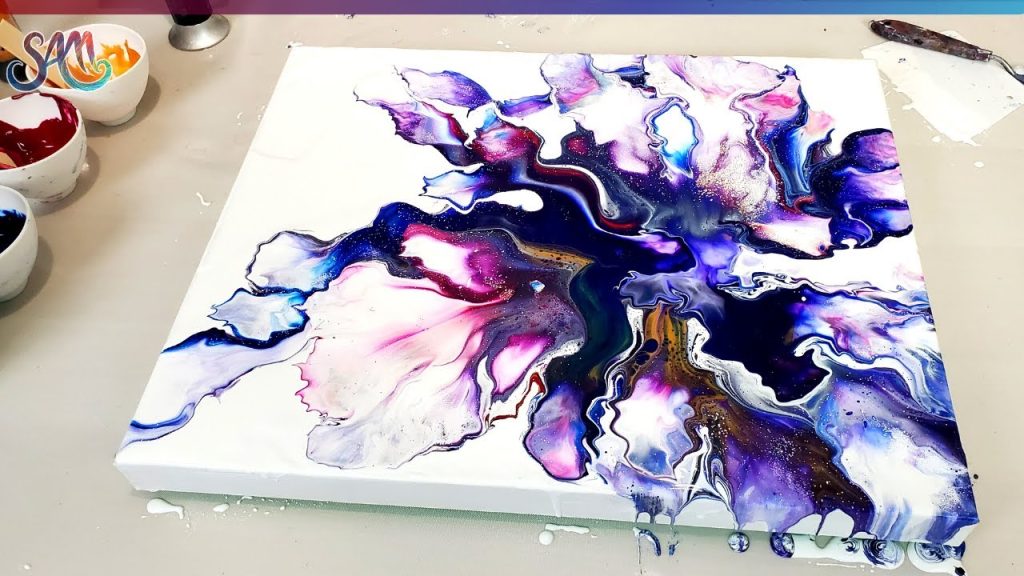
Acrylic pour painting, also called fluid art, replaces the brush with gravity. You thin acrylic paint with a pouring medium until it flows like warm honey, layer colors in a cup, then pour and tilt the canvas so the colors move, stretch and form cells. No drawing skill is needed, but consistency, ratios and drying conditions decide whether you get crisp lacing and cells or a muddy, cracked mess.
This guide explains how pouring works, the supplies you need, how to mix paint to the right consistency, the main pouring techniques, and how to dry and finish a pour. We then review seven Amazon products, from pre-mixed pouring kits to Floetrol and a cordless blower for Dutch pours.
Quick answer: For your first pours, a complete kit like the Nicpro Acrylic Pouring Starter Kit removes the guesswork, since it includes paints, pouring medium, silicone oil, canvases and tools. Once you want to mix your own, pair a bulk paint set such as Nicpro 14-color 500 ml bottles with Floetrol, a widely used pouring additive. For shimmer without mixing, ABEIER pre-mixed metallic pouring paints pour straight from the bottle.
How Acrylic Pouring Works
Regular acrylic is too thick to flow and too weak to stay intact if you simply add lots of water. A pouring medium solves both problems: it thins the paint while keeping the binder strong, so colors flow, level out and dry without cracking as easily. The medium also slows drying, giving colors time to move.
Cells, the round openings where underlying colors show through, form when paints of different densities interact, and many pourers encourage them with a few drops of silicone oil. Our explainer on whether you can do a paint pour with regular acrylic paint covers how craft and artist acrylics behave differently.
Supplies for Acrylic Pour Painting
- Acrylic paint: pre-mixed pouring paint, or regular acrylic plus a pouring medium.
- Pouring medium: a dedicated art pouring medium or a conditioner like Floetrol.
- Cups and stir sticks: one cup per color plus a larger cup for layering.
- Surface: stretched canvas, wood panels, tiles or coasters.
- Silicone oil (optional): for cells.
- Something to raise the surface: push pins or cups under the canvas so paint can drip off.
- Protection: a plastic tablecloth or a tray with raised edges, gloves and an old shirt.
- A level surface for drying, and a torch or heat gun if you want to pop bubbles and encourage cells.
Getting the Consistency Right
Consistency is the single biggest factor in a successful pour. The common target is “warm honey” or melted ice cream: when you lift the stir stick, the paint should flow off in a smooth ribbon that briefly mounds on the surface before leveling out.
A starting ratio
For regular acrylic with Floetrol, many pourers start around 1 part paint to 1 to 2 parts Floetrol, then add water a few drops at a time until the ribbon test looks right. Heavy-body paints need more medium; fluid and craft paints need less. Pre-mixed pouring paints are designed to be used as is or with minimal adjustment.
Test before you pour
- Too thick: paint mounds and does not spread; colors stay blocky.
- Too thin: colors bleed together, sink to mud and are prone to crazing as they dry.
- Uneven: if colors have very different consistencies, the thicker ones will dominate.
Mix each color separately, stir slowly to avoid bubbles, and let mixed paint rest for a few minutes so bubbles rise.
Seven Pouring Techniques to Try
1. Dirty pour
Layer all colors in one cup, then pour directly onto the canvas and tilt. It is the simplest and most popular starting technique.
2. Flip cup
Layer colors in a cup, place the canvas on top, flip both together, then lift the cup. Paint bursts out in a round puddle that you tilt outward.
3. Puddle pour
Pour each color one by one into a central puddle, creating concentric rings, then tilt.
4. Tree ring pour
Move the cup slowly in a small circle or back and forth while pouring to build rings that look like wood grain.
5. Swipe
Pour stripes of color, then drag a thin layer of white or another color across the top with a paper towel or palette knife to reveal cells.
6. Dutch pour (blow technique)
Pour colors onto a wet base coat, then push them with air from a straw, hair dryer on cool, or a dedicated pouring blower to create petals and lace.
7. String pull
Dip a string in paint, lay it on the surface in a curve and pull it off to create flower-like shapes.
Step by Step: Your First Dirty Pour
- Cover your work area and raise the canvas on cups so paint can drip off.
- Optionally, coat the canvas with a thin base layer of white pouring paint to help colors flow.
- Mix three to five colors to warm-honey consistency; add a drop or two of silicone to some colors if you want cells.
- Pour colors into one cup in layers, alternating light and dark.
- Pour onto the canvas in a line or circle, then tilt slowly until the surface and edges are covered.
- Pass a torch or heat gun briefly over the surface to pop bubbles and encourage cells.
- Move the canvas to a level, dust-free spot to dry.
Drying, Crazing and Finishing
Pours hold a lot of paint and can take one to three days to dry to the touch, longer to cure fully, depending on thickness and humidity. Keep them level and away from dust and drafts. Crazing, a network of fine cracks, is often caused by too much water, very thick layers or drying too fast; using more medium and less water, and avoiding fans or heaters, usually helps. Once fully cured, clean off any silicone residue and seal with a varnish or resin for gloss and protection.
Pouring is ideal for small functional pieces too; our guide to DIY acrylic pour coasters shows how to seal them for use. Jars and vases are another option; see whether you can use acrylic paint on glass jars before you start.
Our Top Picks at a Glance
- Nicpro Acrylic Pouring Kit, 19 Colors — Best complete starter kit
- ABEIER Metallic Pouring Paint Set, 18 x 2 oz — Best pre-mixed metallic set
- Nicpro 8 Colors Metallic Pour Paint Kit, 8.45 oz — Best large-volume metallic kit
- Nicpro 20 Colors Iridescent Pour Paint Kit — Best for color-shifting effects
- Flood Floetrol, 1 Gallon — Best pouring additive for mixing your own
- Nicpro 14 Colors Bulk Acrylic Paint, 500 ml — Best bulk paint to mix with medium
- Cordless Acrylic Paint Pouring Blower — Best tool for Dutch pours
| Product | Best For | Key Spec | Key Strength | Price Tier |
|---|---|---|---|---|
| Nicpro Pouring Starter Kit | Complete start | 19 colors, medium, silicone, canvases, tools | Everything included | $$ |
| ABEIER Metallic Pouring Set | Pre-mixed shimmer | 18 x 2 oz, pre-mixed | Pour from bottle | $$ |
| Nicpro 8 Metallic Pour Kit | Big metallic pours | 8 x 8.45 oz, pour oil, gloves | Large bottles | $$ |
| Nicpro 20 Iridescent Kit | Color-shift effects | 20 x 8.45 oz, pour oil, gloves | Iridescent shades | $$$ |
| Flood Floetrol | Mixing your own | 1 gallon additive | Large volume | $$ |
| Nicpro 14 Colors 500 ml | Bulk base paint | 14 x 16.9 oz bottles | Paint for many pours | $$$ |
| Cordless Pouring Blower | Dutch pour | 3 nozzles, 5 speeds, 8000mAh | Controlled airflow | $$ |
How We Chose
We compared Amazon listings checked in October 2026 on what each product contributes to a pour (paint, medium, cell additive or tools), whether paints are pre-mixed, bottle sizes, safety statements and how widely each listing is reviewed by Amazon buyers.
- Pre-mixed convenience vs mix-your-own value.
- Volume per color, since pours use a lot of paint.
- Included extras like silicone, gloves and canvases.
- Fit for specific techniques.
Best Acrylic Pour Painting Supplies Reviewed
1. Nicpro Acrylic Pouring Kit, Artist Starter Supplies — Best for a complete starter kit

Nicpro’s starter kit contains 19 acrylic colors, pouring medium, silicone oil, canvases, gloves, strainers, mixing sticks and an instruction manual. The listing says the tools support cell and tool effects using cups, pipettes, combs, a strainer, a palette knife and a dotting pen.
Having medium, silicone and surfaces in one box removes most of the beginner trial and error over what to buy.
Best suited for: First-time pourers who want everything in one purchase.
Key features:
- 19 colors
- Pouring medium and silicone oil
- Canvases, gloves, strainers, sticks
- Instruction manual
Pros:
- Complete kit
- Instructions from basic to advanced
- Tools for multiple techniques
Cons and limitations:
- Paint volume per color may be limited for large pours
- Upper-mid price tier
Buying consideration: Start with small canvases to stretch the included paint across more experiments.
2. ABEIER Metallic Acrylic Pouring Paint Set, 18 Colors — Best for a pre-mixed metallic set

ABEIER offers 18 metallic shades in 2 oz bottles with pouring medium already mixed in, so you can pour into a cup or directly onto the surface. The listing states ASTM D-4236 conformance and says the paint can create cellular effects.
Pre-mixed paint removes the hardest beginner variable: consistency.
Best suited for: Beginners who want shimmer without measuring ratios.
Key features:
- 18 metallic colors, 2 oz each
- Pre-mixed with pouring medium
- ASTM D-4236
Pros:
- No mixing needed
- Wide metallic range
- Mid price tier
Cons and limitations:
- 2 oz bottles go quickly on large canvases
- Metallic-only palette
Buying consideration: Use on small canvases, coasters or tiles where 2 oz goes further.
3. Nicpro 8 Colors Metallic Acrylic Pour Paint Kit — Best for large-volume metallic pours

This Nicpro kit includes eight metallic pouring paints in 8.45 oz bottles (pearl white, gold, silver plus blue, turquoise, violet, red and copper), pre-mixed with pouring medium. It also includes 2 oz of pour oil for cells, 50 gloves, five pipettes and three disposable tablecloths.
Large bottles make it practical for bigger canvases and repeated pours.
Best suited for: Pourers moving to larger canvases.
Key features:
- 8 x 8.45 oz pre-mixed metallics
- Pour oil, gloves, pipettes, tablecloths
- Non-toxic per listing
Pros:
- Large volume
- Cell oil included
- Cleanup supplies included
Cons and limitations:
- Only eight colors
- Metallic finish only
Buying consideration: Pearl white works well as a base coat for metallic dirty pours.
4. Nicpro 20 Colors Iridescent Metallic Pour Paint Kit — Best for color-shifting effects
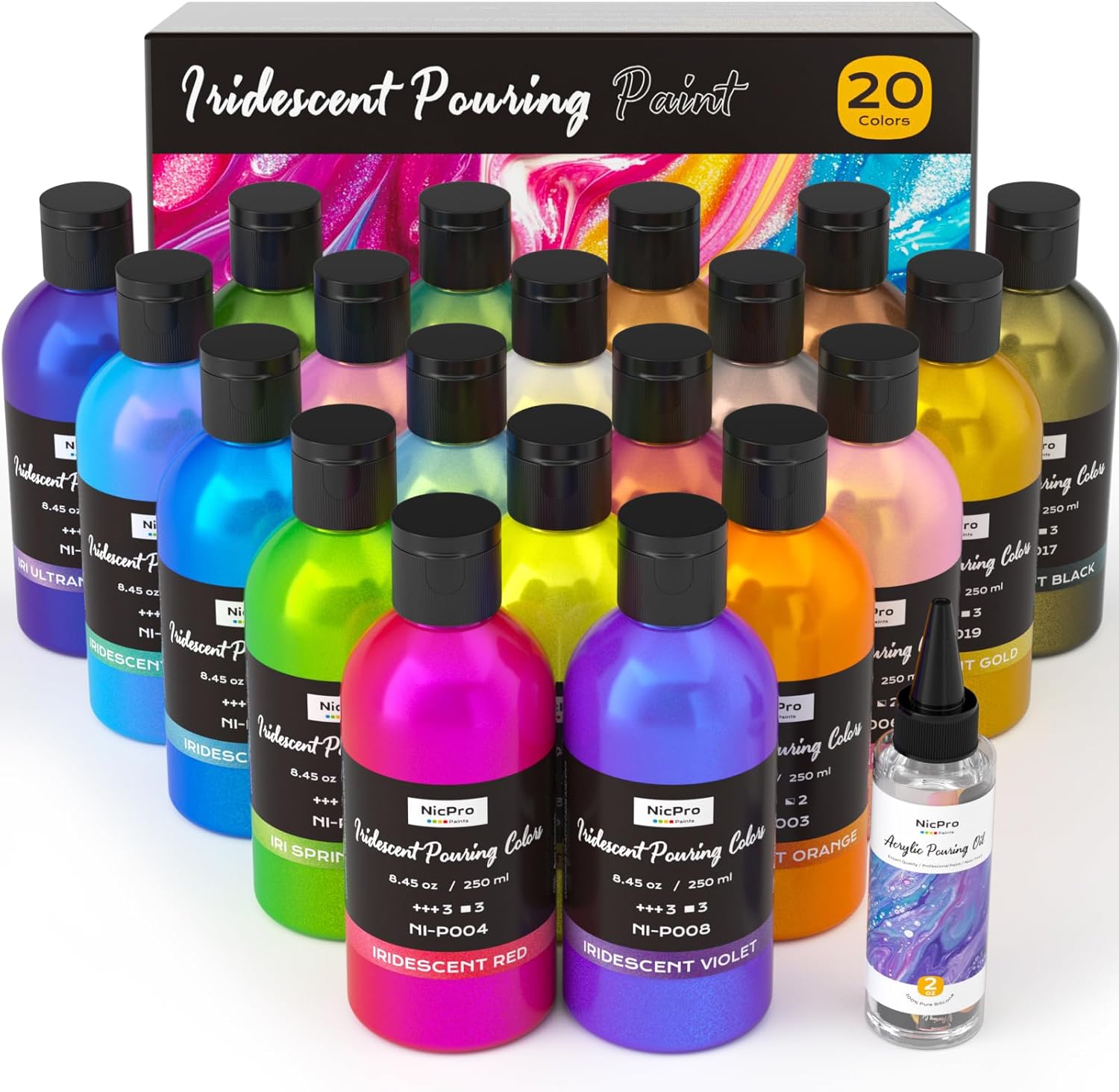
Nicpro’s iridescent kit offers 20 color-shifting shades in 8.45 oz bottles, pre-mixed with pouring medium, plus pour oil, 50 gloves, pipettes and tablecloths. The listing says colors shift under different light and angles.
Iridescent paints add movement to pours that changes as viewers walk past.
Best suited for: Experienced or ambitious pourers who want premium effects.
Key features:
- 20 iridescent colors, 8.45 oz each
- Pre-mixed
- Pour oil and accessories
Pros:
- Distinctive shimmer
- Large total volume
- Ready to pour
Cons and limitations:
- Highest price tier
- Iridescence can be subtle under dim light
Buying consideration: Pair iridescent colors with a dark base coat to make the shift more visible.
5. Flood Floetrol, 1 Gallon — Best for mixing your own pouring paint

Floetrol is a latex paint conditioner originally made for house painting, but the listing explicitly describes it as a pouring medium for acrylic art that helps create cells and improves consistency. It improves flow and leveling and extends open time.
A gallon is enough for a great many pours, which makes it one of the most economical ways to make your own pouring paint.
Best suited for: Pourers who mix regular acrylic and want low cost per pour.
Key features:
- 1 gallon (128 fl oz)
- Improves flow and leveling
- Soap and water cleanup
Pros:
- Very economical
- Widely used by pourers
- Helps cell formation
Cons and limitations:
- Not an artist-grade archival medium
- Strain if lumps form
Buying consideration: Strain Floetrol through a mesh if you notice small lumps, and test ratios on scrap before a big canvas.
6. Nicpro 14 Colors Large Bulk Acrylic Paint Set, 500 ml — Best for bulk paint to mix with medium

This Nicpro set includes 14 essential colors such as white, Mars black, red, yellow, blue, green and burnt umber, each in a 16.9 oz squeeze bottle. The listing describes creamy, fast-drying, fade-resistant, non-toxic paint for many surfaces.
Pours consume paint quickly, and large bottles mixed with medium cost much less per pour than pre-mixed kits.
Best suited for: Regular pourers mixing their own paint.
Key features:
- 14 x 500 ml bottles
- Core colors including white and black
- Non-toxic per listing
Pros:
- Large volume
- Also usable for brush painting
- Lower cost per ounce
Cons and limitations:
- Needs pouring medium
- Upfront cost is higher
Buying consideration: Keep white separate: you will use far more of it as a base coat.
7. Cordless Acrylic Paint Pouring Blower — Best for Dutch pours

This compact blower has three interchangeable nozzles, five speeds plus a blast mode, and an 8000mAh rechargeable battery. The listing describes it for acrylic pouring and Dutch pour techniques, as well as watercolor and fluid art.
Controlled airflow makes Dutch pour petals and lace far easier than blowing through a straw.
Best suited for: Pourers exploring Dutch pours and blown techniques.
Key features:
- 3 nozzles
- 5 speeds plus blast mode
- Cordless, 8000mAh battery
Pros:
- Precise air control
- Portable
- Rechargeable
Cons and limitations:
- Single-purpose tool
- Upper-mid price tier
Buying consideration: Start at the lowest speed; strong air can blow paint off the canvas.
Buying Guide: How to Choose Acrylic Pouring Supplies
Pre-mixed or mix your own
Pre-mixed pouring paints save time and guarantee a usable consistency. Mixing your own with Floetrol or a pouring medium is cheaper per pour.
Volume
An 8×10 pour can use several ounces of paint. Larger bottles matter more for pouring than for brush painting.
Color choice
Three to five colors per pour is plenty. Include a white or light color to separate darker ones and avoid mud.
Cell additives
Silicone oil encourages cells; use only a drop or two per color and clean the surface before varnishing.
Surfaces
Stretched canvas, cradled wood panels, tiles and coasters all work. Seal raw wood first.
Cleanup and safety
Use gloves and a covered workspace. Let leftover paint dry and dispose of skins in the trash rather than rinsing large amounts down the drain.
Where to Use Your Pours
Finished pours make striking wall pieces; see our guide to DIY wall art with acrylic for sizing and hanging ideas. If you want a break from pouring, our simple acrylic painting ideas for beginners use the same paints with a brush.
Common Mistakes to Avoid
- Too much water. It weakens the paint and causes crazing.
- Uneven consistencies. Match all colors before layering.
- Too many colors. More colors usually means more mud.
- Drying on an uneven surface. Paint keeps moving until it sets.
- Overusing silicone. A drop or two is enough.
- Varnishing too soon. Wait for a full cure and remove silicone residue first.
FAQs
What do I need to start acrylic pour painting?
Acrylic paint, a pouring medium (or pre-mixed pouring paint), cups, stir sticks, a canvas, something to raise it, and a protected workspace. Silicone oil is optional for cells.
What is the best ratio for acrylic pouring?
Many pourers start around 1 part paint to 1 to 2 parts Floetrol, adding water drop by drop until the paint flows like warm honey. Adjust for your paint brand and test first.
Why are there no cells in my pour?
Cells depend on density differences, consistency and additives. Try a drop of silicone in some colors and a brief pass with a torch, and make sure paints are not too thick.
Why is my acrylic pour cracking?
Crazing often comes from too much water, thick layers or drying too fast. Use more medium, less water and dry in a stable room.
How long does an acrylic pour take to dry?
Usually one to three days to the touch depending on thickness and humidity, and longer to cure fully before varnishing.
Can I use regular acrylic paint for pouring?
Yes, if you mix it with a pouring medium. Thinning with water alone usually leads to weak, cracked results.
Final Recommendation
For a first pour, the Nicpro starter kit gives you paint, medium, silicone, canvases and tools in one box. If shimmer is the goal, ABEIER’s pre-mixed metallics are the easiest entry, while the larger Nicpro metallic and iridescent kits suit bigger and more ambitious pieces. Once you know you love pouring, switch to the Nicpro 500 ml bulk paints with Floetrol for the lowest cost per painting, and add the cordless blower when you are ready to explore Dutch pours.