PaintingProGuide is reader-supported. When you buy through links on this page we may earn an affiliate commission at no extra cost to you.
Ask three painters for the best acrylic paint for canvas and you will get three brand names, but the qualities they are describing are the same: opacity that hides the canvas weave, enough body to keep a brushstroke, smooth blending before it dries, and color that does not shift dramatically from wet to dry. Price and quantity matter too, because canvas painting, especially at 16×20 and larger, uses far more paint than people expect.
We compared six acrylics for canvas work, from a value 24-color set to 500 ml bulk bottles for big canvases. Rather than repeat the same advice found on every product page, this guide focuses on the properties that make paint behave well on canvas, an opacity cheat sheet, how to handle color shift and drying time, and how to get a professional-looking finish.
Quick answer: For most canvas painters, the Artkey 24-color set gives the best value: a butter-like consistency, strong coverage claims and labeled 2 oz bottles. For large canvases, the Nicpro 14-color bulk set in 16.9 oz bottles supplies the volume. Painters who love visible brushstrokes should consider the thicker HissiCo 36-color set.
Our Top Picks at a Glance
- Artkey Acrylic Paint Set, 24 Colors — Best overall acrylic paint for canvas
- Nicpro 14-Color Bulk Acrylic Set, 16.9 oz — Best for large canvases
- HissiCo 36-Color Acrylic Set — Best for textured brushwork
- Caliart Acrylic Paint Set, 36 Colors — Best matte finish for canvas
- TMOL Acrylic Paint Set, 24 Colors — Best paint and brush bundle
- KOLOR KINGDOM 24 x 12 ml Tubes — Best budget tubes for studies
| Product | Best For | Key Spec | Key Strength | Price Tier |
|---|---|---|---|---|
| Artkey 24 | All-round canvas work | 24 x 2 oz, semi-gloss | Butter-like body, labeled bottles | $$ |
| Nicpro Bulk 14 | Large canvases | 14 x 16.9 oz, gloss | Volume of core colors | $$ |
| HissiCo 36 | Texture | 36 x 2 oz, thick body | Holds brush marks | $$ |
| Caliart 36 | Matte look | 36 x 2 oz, matte + metallic | Low glare | $$ |
| TMOL 24 | Starter bundle | 24 x 2 oz + 12 brushes | Brushes included | $$ |
| KOLOR KINGDOM 24 | Studies | 24 x 12 ml tubes | Low cost | $ |
How We Chose
We did not paint on canvas with these products. The picks are based on Amazon listing details and specifications checked in October 2026, how well each paint’s consistency, coverage claims, finish and volume suit canvas painting, and how widely each product is reviewed by Amazon buyers. The Shuttle Art 36-color set also appeared; it is a capable choice that we cover in other guides, and it overlaps heavily with the Caliart and HissiCo 36-color options here.
- Body: soft to heavy paint that holds a stroke on the canvas weave.
- Coverage: claims of strong coverage in one or two coats.
- Finish: matte, semi-gloss or gloss to suit display and photography.
- Volume: enough paint for the canvas sizes you work on.
- Mixing palette: useful whites, blacks, earths and primaries.
Four Paint Properties That Matter on Canvas
Opacity
Opaque paint covers what is underneath; transparent paint lets it show through. Neither is better, but you need to know which you have. Most student sets include both, and lighter colors like yellow are naturally less opaque.
Body
Body is thickness. Fluid paint flows and levels; heavy body holds peaks. On a vertical easel, soft-to-heavy body paint is easier because it does not run.
Color shift
Acrylic contains a binder that looks milky when wet and clear when dry, so many colors dry slightly darker. Test a swatch on scrap canvas and let it dry before matching colors across a painting.
Open time
Acrylic dries fast, often within minutes in a thin layer. That is great for layering and frustrating for blending. Retarder mediums, misting and working in sections help.
Opacity Cheat Sheet for Common Colors
| Color Family | Typical Opacity | Tip |
|---|---|---|
| Titanium white | Very opaque | Use for coverage and highlights |
| Earth tones (umbers, siennas, ochre) | Opaque to semi-opaque | Great for underpaintings |
| Cadmium-style reds and yellows (and hues) | Opaque | Cover well over darks |
| Lemon and light yellows | Semi-transparent | Paint over white for brightness |
| Phthalo and ultramarine blues | Transparent | Ideal for glazes and shadows |
| Quinacridone-type pinks and magentas | Transparent | Glaze for glowing color |
Labels on student and craft paints often do not state opacity, so a quick swatch over a black line on scrap canvas tells you which colors cover and which glaze.
Best Acrylic Paint for Canvas Reviewed
1. Artkey Acrylic Paint Set, 24 Colors (2 oz) — Best for all-round canvas work

Artkey’s 24 colors come in 2 oz (59 ml) bottles. The listing describes paint that glides smoothly with strong coverage in both large areas and fine details and a butter-like consistency, which is a good body for canvas: thick enough to cover the weave, soft enough to blend.
Bottles are tightly sealed against leaks and drying and labeled with color names, and the finish is semi-gloss, a forgiving middle ground for canvas. At the price checked, it is excellent value for a 24-color palette.
Best suited for: Hobby and intermediate painters working on canvases up to about 16×20 inches.
Key features:
- 24 colors in 2 oz bottles
- Butter-like consistency
- Semi-gloss finish
- Color names on bottles
- Leak-resistant caps
Pros:
- Strong value
- Good body for canvas
- Organized, labeled bottles
Cons and limitations:
- No brushes listed
- No metallics
- Student-grade pigment
Buying consideration: Add a large white; it is the color canvas paintings use most.
2. Nicpro 14-Color Large Bulk Acrylic Paint Set, 16.9 oz — Best for large canvases

Large canvases and abstract work devour paint. Nicpro’s bulk set gives you 14 essential colors, including white, Mars black, red, yellow, blue, green and burnt umber, in 16.9 oz (500 ml) squeeze bottles, about 236 ounces in all, with a palette knife, sponge and color wheel.
The listing describes rich, creamy paint with good coverage, quick drying and resistance to light, water and fading, and a gloss finish. A limited palette of big bottles also encourages mixing, which leads to more harmonious paintings.
Best suited for: Painters working on 24×36 inches and up, muralists on canvas and abstract painters.
Key features:
- 14 colors x 16.9 oz
- Includes white, Mars black and burnt umber
- Palette knife, sponge, color wheel
- Gloss finish
- Fade and crack resistance claims
Pros:
- Huge volume per color
- Core mixing palette
- Squeeze bottles
Cons and limitations:
- Only 14 colors
- Gloss finish
- Heavy bottles
Buying consideration: Mix large batches of background colors in lidded cups so you do not run out mid-canvas.
3. HissiCo 55-Piece Acrylic Paint Set, 36 Colors — Best for textured brushwork

HissiCo’s 36 colors are described as having a fantastic thick consistency, with rich pigment and good blending and layering. Thick paint keeps the marks of brush and knife on canvas, which gives landscapes, florals and abstracts a lively surface.
The kit includes 2 oz flip-top squeeze bottles, 12 brushes and a palette, and conforms to ASTM D4236 and EN71.
Best suited for: Painters who like expressive, visible brushstrokes.
Key features:
- 36 colors in 2 oz flip-top bottles
- Thick consistency
- 12 brushes and palette
- ASTM D4236 and EN71
Pros:
- Holds texture
- Big palette
- Easy dispensing
Cons and limitations:
- Needs thinning for smooth gradients
- Finish not stated
- Thicker paint dries slower in the center
Buying consideration: Use flat bristle brushes for texture; soft synthetics flatten thick paint.
4. Caliart Acrylic Paint Set, 36 Colors — Best for a matte finish on canvas

Caliart lists a matte and metallic finish, 36 colors in 2 oz bottles and 12 brushes. The listing describes creamy paint with great covering power for large areas and fine details.
Matte paint photographs without glare, a real advantage if you share or sell your canvases online. Metallic gold and silver are included for accents.
Best suited for: Painters who photograph or sell their work and prefer a contemporary matte look.
Key features:
- 36 colors in 2 oz bottles
- Matte finish plus metallics
- 12 brushes
- Crack and fade resistance claims
Pros:
- Glare-free surface
- Metallic accents
- Large palette
Cons and limitations:
- Matte can look flat until varnished
- Student-grade pigment
- Small bottles for big canvases
Buying consideration: Use a satin varnish if darks look dull after drying; it restores depth without much shine.
5. TMOL Acrylic Paint Set, 24 Colors with 12 Brushes — Best for a paint and brush bundle
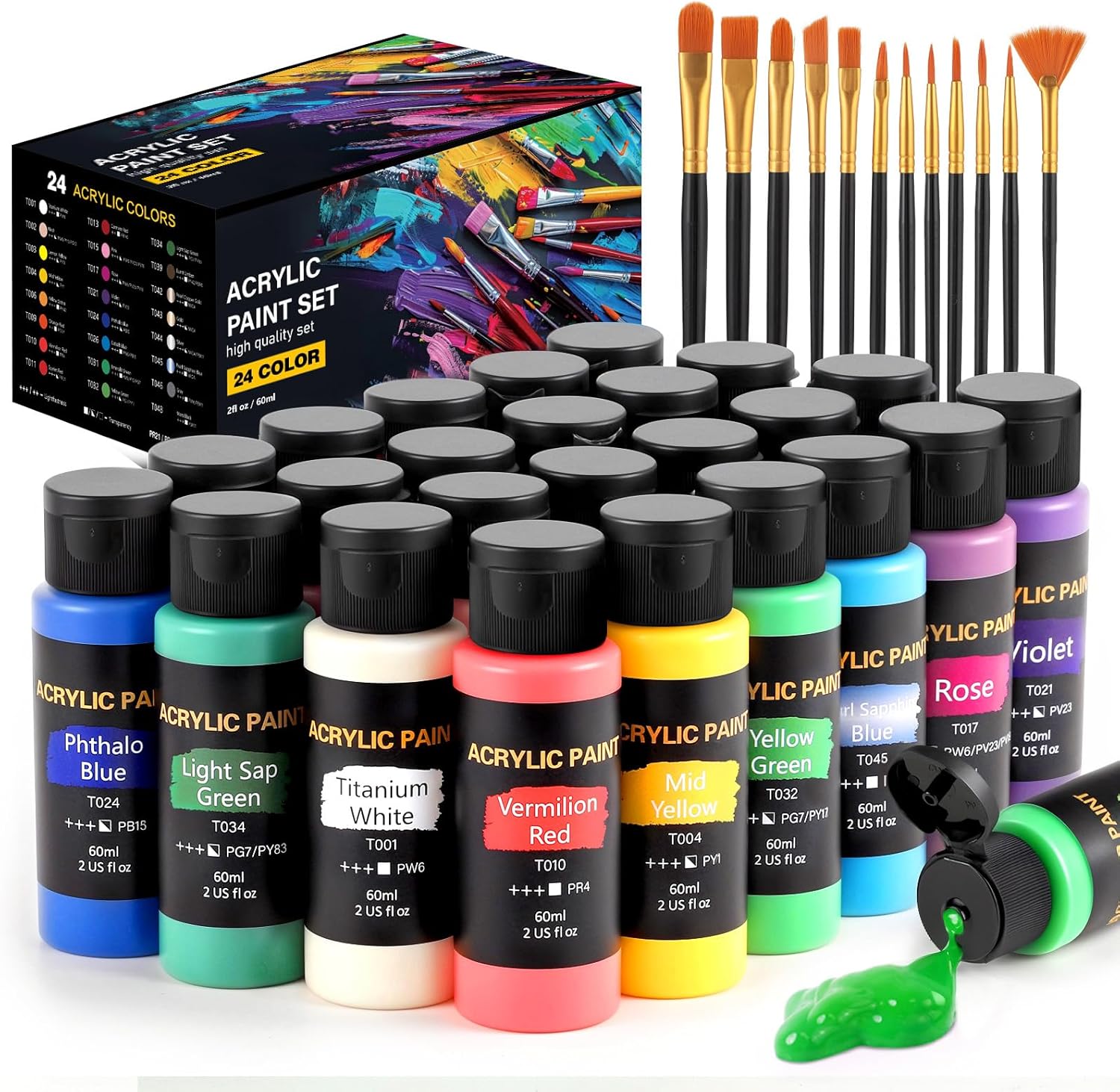
TMOL names canvas first among its uses and includes 24 colors in 2 oz bottles plus 12 brushes. The listing describes paint that glides on smoothly, dries quickly and keeps its vibrant shades, and conforms to ASTM D4236.
It is a convenient one-box start for someone buying their first canvas paint.
Best suited for: New painters who need brushes too.
Key features:
- 24 colors in 2 oz bottles
- 12 brushes
- Canvas named in title
- ASTM D4236
Pros:
- Brushes included
- Mid-size bottles
- Simple palette
Cons and limitations:
- Finish not clearly specified
- No metallics
- Basic brushes
Buying consideration: Practice on canvas panels before stretched canvas; they are cheaper and flatter.
6. KOLOR KINGDOM Acrylic Paint Set, 24 x 12 ml — Best for budget studies

KOLOR KINGDOM’s 24 tubes of 12 ml include 3 brushes. The listing describes premium consistency for blending, layering and texture, gloss finish and ASTM D4236 and EN71-3 certification.
Small tubes are ideal for color studies on small canvases, practice exercises and testing palettes before buying larger bottles.
Best suited for: Students and anyone doing small studies and exercises.
Key features:
- 24 colors in 12 ml tubes
- 3 brushes
- Gloss finish
- ASTM D4236 and EN71-3
Pros:
- Lowest price tier
- Portable
- Tubes stay fresh
Cons and limitations:
- Small quantities
- Only 3 brushes
- Not for large canvases
Buying consideration: Paint 6×6 or 8×8 studies to practice mixing before committing paint to a big canvas.
Buying Guide: How to Choose Acrylic Paint for Canvas
Match body to your style
Heavy body for texture and knife work, soft body for smooth blending, fluid for glazes and pours. Many painters use more than one.
Buy volume where you need it
Large white, plus big bottles of your most-used colors, saves money and frustration on larger canvases.
Choose a finish for display
Matte for photography, gloss for vivid color, semi-gloss for balance. Varnish can change it later.
Student vs artist grade
Student and craft paints are ideal for learning. Artist-grade paint has more pigment and better lightfastness for work you sell.
Check safety labeling
Look for ASTM D4236 conformance and non-toxic claims, especially for home studios.
Plan for mediums
Retarder, glazing and gel mediums expand what any set can do on canvas.
Get More From Any Set: A Starter Palette and Two Mediums
Large sets are convenient, but you will paint better canvases by choosing a short working palette from them. A reliable starter palette is titanium white, a warm yellow, a cool yellow, a warm red, a cool red or magenta, ultramarine or another warm blue, a phthalo-type or other cool blue, burnt umber and black. With those, you can mix convincing skies, greens, skin tones and grays, and your colors will relate to each other because they share the same parents.
Two inexpensive mediums then solve most canvas problems. A glazing or flow medium thins paint without weakening it, so you can lay transparent layers over dry paint for glowing shadows and smooth skies. A retarder or slow-dry medium extends working time for wet-into-wet blending, which is otherwise difficult with fast-drying acrylic. Add either in small amounts, following the label, and test on scrap canvas first.
Finally, keep a separate “dirty” brush for mixing on the palette and a clean one for painting. It keeps colors from going muddy, which is the most common reason student paintings look dull even when the paint is perfectly good.
Stretched Canvas, Panels or Canvas Paper?
Stretched canvas has a slight bounce under the brush and is ready to hang, which makes it the natural choice for finished pieces. Canvas panels are rigid, cheaper and easier to store, so they suit practice, plein air sessions and thicker texture that might crack on a flexing surface. Canvas paper is the most economical of all and works well for studies, although it needs taping down to stop curling. Most painters use all three: paper for exercises, panels for studies and stretched canvas when a composition is worth committing to. Whichever you choose, the same paint works on all of them, so you can move between surfaces without buying a new set.
Working on Canvas: A Practical Sequence
- Prepare: add a coat of gesso to store-bought canvas for a smoother surface if desired.
- Tone: wash the canvas with a thin mid-tone to kill the white.
- Sketch: draw lightly with thinned paint or a pencil.
- Block in: lay large shapes of color with a big flat brush.
- Refine: build form with smaller brushes and thicker paint.
- Detail: add highlights and final accents.
- Finish: let the painting cure, then varnish.
For each stage, we have detailed guides: underpainting on canvas with acrylic, using acrylic paint on canvas board and sealing acrylic paint on canvas.
Common Mistakes to Avoid
- Ignoring color shift: colors dry darker; swatch first.
- Overworking drying paint: it lifts and streaks; let layers dry, then repaint.
- Too much water: it weakens adhesion; use medium to thin.
- Skipping a toned ground: white canvas makes values hard to judge.
- Using only transparent colors for coverage: mix in an opaque color or white.
- Not varnishing: dust and uneven sheen dull finished paintings.
FAQs
What is the best acrylic paint for canvas beginners?
A 24-color student set in 2 oz bottles, such as Artkey or TMOL, is a great start. Add a large white and some canvas panels.
Why does acrylic paint look streaky on canvas?
Thin paint, transparent colors and overworking cause streaks. Use two thin coats of more opaque paint and let each dry.
Does acrylic paint dry darker on canvas?
Many acrylics dry slightly darker because the binder turns from milky to clear. Test swatches before color matching.
How do I make acrylic paint blend better on canvas?
Work quickly in sections, mist the canvas lightly, or add a retarder or slow-dry medium.
Is heavy body acrylic better for canvas?
Heavy body is better for texture and impasto. Soft body is easier for smooth blends. Both work on canvas.
How much acrylic paint do I need for a large canvas?
Large canvases need much more than small sets provide. Buy bulk bottles of your main colors, especially white.
Final Recommendation
For most canvas painters, Artkey’s 24-color set offers the best combination of body, coverage and value. Choose Nicpro’s 500 ml bulk bottles for large canvases, HissiCo for textured brushwork, Caliart for a matte, photo-friendly surface, TMOL when you need brushes in the box, and KOLOR KINGDOM tubes for small studies and practice.