
PaintingProGuide is reader-supported. When you buy through links on this page we may earn an affiliate commission at no extra cost to you.
Camel hair brushes are one of the art world’s oldest misnomers. Despite the name, they rarely contain any hair from camels. “Camel hair” is a trade term for a soft, inexpensive natural-hair blend, traditionally made from hairs such as squirrel, pony, goat or ox, and today some brushes sold under the name are synthetic imitations. What all of them share is softness: they hold plenty of watery paint, release it gently and suit watercolor washes, tempera, poster paint and classroom work.
That makes the best camel hair brushes a practical, budget-friendly choice for students, teachers and crafters, not a substitute for fine sable. This guide compares six options currently sold on Amazon.com, from bulk classroom canisters to small sets and mop brushes, and explains how to get the most from soft, low-cost brushes.
Quick answer: For classrooms, the Royal & Langnickel Natural Camel Hair Brush Assortment (144 pieces) is the best camel hair brush option: a canister of natural-hair brushes at a low cost per brush. For an individual student starter, the MBS 5-Piece Camel Hair Artist Brush Set covers rounds and flats for very little money. For soft washes and glazes, add the Royal & Langnickel Camel Mop 3-Pack.
Our Top Picks at a Glance
- Royal & Langnickel Natural Camel Hair Assortment, 144 pc — Best for classrooms and art programs
- S&S Worldwide Camel Hair Brush Assortment, 144 pc — Best alternative classroom bulk pack
- MBS 5-Piece Camel Hair Artist Brush Set — Best budget starter set for students
- Royal & Langnickel Camel Mop Brush Set, 3 pc — Best for soft washes and glazes
- Royal & Langnickel Crafter’s Choice Flat Camel Set, 7 pc — Best for craft painting and varnishing
- Duro Art Camel Hair Lacquering Brush — Best for smooth lacquer and varnish coats
| Product | Best For | Key Spec | Key Strength | Price Tier |
|---|---|---|---|---|
| R&L Natural Camel Hair 144 pc | Classrooms | 144 assorted natural-hair brushes, canister | Lowest cost per brush | $$$ |
| S&S Worldwide 144 pc | School and camp programs | 144 brushes, wood and plastic | Bulk supply | $$$ |
| MBS 5-Piece Set | Individual students | #2 and #4 rounds, 1/4 and 1/2 in flats + bristle flat | Very low price | $ |
| R&L Camel Mop 3 pc | Washes and glazes | Mop shape, 1/2 in | Holds lots of liquid | $ |
| R&L Crafter’s Choice Flat 7 pc | Craft painting | 7 flat brushes, synthetic camel | Works with most craft mediums | $ |
| Duro Art Lacquering Brush | Varnish and lacquer | Camel hair, hardwood handle | Smooth, streak-reducing coats | $ |
How We Chose
We did not paint with these brushes for this guide. Picks are based on the Amazon listing details and specifications checked in October 2026, how well each brush set’s hair type, shapes and quantity fit common camel-hair uses, and how widely each product is reviewed by Amazon buyers. Listings for budget brushes are often brief, so we describe only what the listings state.
- Intended use: watercolor and water-based paints, washes, tempera, crafts and varnishing.
- Hair type: natural camel-hair blend versus synthetic camel imitations.
- Shapes and sizes: rounds for detail, flats for fills, mops for washes.
- Quantity and cost per brush: crucial for teachers.
- Handle and ferrule quality: rust-resistant ferrules and sturdy handles.
We excluded a boar-bristle hair styling brush that appeared in the search results because it is a grooming product, not an art brush.
Best Camel Hair Brushes Reviewed
1. Royal & Langnickel Natural Camel Hair Brush Assortment, 144 pc Canister — Best for classrooms and art programs
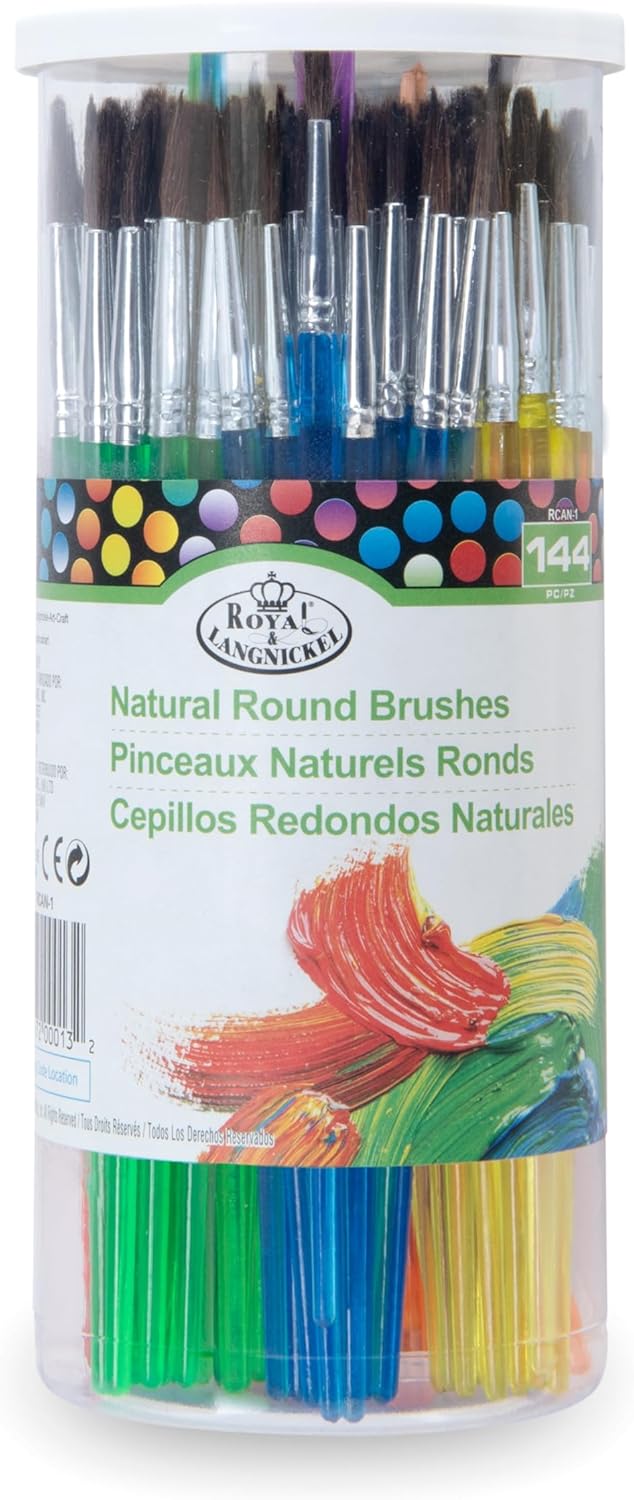
Royal & Langnickel is a long-established US brush maker, and this canister is a classic school supply: 144 assorted natural camel hair brushes, according to the listing. The product details list a natural bristle type and assorted sizes.
A canister format keeps brushes upright and organized on a shared table, and the quantity means every student can have several brushes without sharing. For teachers buying for a year of watercolor, tempera and poster paint lessons, the cost per brush is hard to beat.
Best suited for: elementary and middle school art rooms, camps, community programs and anyone who needs brushes in quantity.
Key features:
- 144 assorted brushes
- Natural camel hair
- Canister storage
- Assorted sizes
Pros:
- Very low cost per brush
- Organized storage
- Natural hair holds water well
Cons and limitations:
- Limited detail on exact size breakdown
- Soft hair is not ideal for thick acrylic or oil
Buying consideration: Teach students to rinse brushes and store them bristles-up; soft natural hair loses its shape quickly if left standing in water.
2. S&S Worldwide Camel Hair Brush Assortment, Pack of 144 — Best for school and camp programs

S&S Worldwide supplies schools, camps and activity programs, and this pack contains 144 camel hair brushes. The listing details note wood and plastic materials and a flagged bristle type.
It is a direct alternative to the Royal & Langnickel canister for programs that already buy supplies from S&S. Listing details are sparse, so expect a basic, practical classroom brush.
Best suited for: schools, camps and recreation programs with high brush turnover.
Key features:
- 144 brushes
- Wood and plastic construction
- Flagged bristle type listed
Pros:
- Bulk quantity
- Supplier focused on programs and classrooms
Cons and limitations:
- Highest price tier in this guide
- Minimal listing detail
Buying consideration: Compare the per-brush cost with the Royal & Langnickel canister before ordering, since both serve the same need.
3. MBS 5 Piece Camel Hair Artist Brush Set — Best for individual students

This tiny set covers the essential shapes for a student: a #2 round, a #4 round, a 1/4 inch flat, a 1/2 inch flat, plus a 1/2 inch flat in black bristle, according to the listing. It describes fine camel hair bristles, painted round handles and steel ferrules.
The listing says the brushes work with oil and water-based paints. In practice, the soft camel hair brushes suit water-based paints best, while the black bristle flat is the one to use for thicker paint.
Best suited for: students, beginners trying watercolor or tempera, and craft kits.
Key features:
- #2 and #4 rounds
- 1/4 and 1/2 inch flats
- 1/2 inch black bristle flat
- Steel ferrules, painted handles
Pros:
- Lowest price tier
- Covers basic shapes
- Includes one stiffer bristle brush
Cons and limitations:
- Basic construction
- Small sizes only
Buying consideration: Use the rounds for details and the flats for washes; keep the bristle brush for thicker paints.
4. Royal & Langnickel Camel Brush Set, Mop, 3 pc — Best for soft washes and glazes

Mop brushes have a rounded, full head that holds a lot of liquid and lays it down softly, which is why they are prized for watercolor washes, wet-in-wet skies and gentle glazes. This Royal & Langnickel pack includes three camel-style mop brushes, with a listed brush width of 0.5 inches.
Note that the product details list the material as synthetic, so this set appears to use a synthetic camel-hair imitation rather than natural hair. That is not a drawback for most uses; synthetic mops are durable and easy to clean.
Best suited for: watercolor washes, skies, soft blending and applying even glazes.
Key features:
- Three mop brushes
- 0.5 inch width
- Material listed as synthetic
Pros:
- Holds lots of water or glaze
- Soft, even application
- Low price tier
Cons and limitations:
- Small width for large washes
- Listed as synthetic rather than natural hair
Buying consideration: For large paper, consider adding a wider mop or flat wash brush alongside these.
5. Royal & Langnickel Crafter’s Choice Flat Camel Hair Brush Set, 7 pc — Best for craft painting

The Crafter’s Choice set gives seven flat brushes designed for craft projects. The listing describes them as quality synthetic camel brushes that work with nearly all craft mediums and surfaces, for crafters of all skill levels.
Flat brushes are the workhorses of craft painting: base coating wood, painting stripes and edges, applying decoupage medium and varnishing. Synthetic “camel” hair gives a soft stroke with better durability than natural hair.
Best suited for: craft painting, decoupage, base coating and varnishing small projects.
Key features:
- Seven flat brushes
- Synthetic camel hair
- Works with most craft mediums
Pros:
- Versatile for crafts
- Durable synthetic hair
- Range of flat sizes
Cons and limitations:
- Flats only; no rounds for detail
- Limited listing detail on sizes
Buying consideration: Dedicate one or two brushes to glue and varnish so they do not contaminate your paint brushes.
6. Duro Art Camel Hair Lacquering Brush — Best for varnish and lacquer coats

Soft camel hair is excellent for laying down smooth coats of lacquer, varnish and glaze without harsh brush marks. Duro Art’s lacquering brush is described as made with soft, superior camel hair, a durable hardwood handle and a seamed, rustproof metal ferrule, according to the listing.
Use it for finishing coats on paintings, crafts and small woodwork where a stiff brush would leave streaks.
Best suited for: applying varnish, lacquer, shellac and glazes on art and craft projects.
Key features:
- Soft camel hair
- Hardwood handle
- Seamed rustproof ferrule
Pros:
- Smooth finishing coats
- Durable handle and ferrule
- Low price tier
Cons and limitations:
- Single brush
- Size listed only as medium
Buying consideration: Clean immediately with the solvent recommended for your varnish, and store flat so the hairs keep their edge.
What “Camel Hair” Really Means
In brush making, “camel hair” describes a type of brush rather than an animal. Historically it referred to soft blends of inexpensive animal hairs. These hairs are soft and absorbent but lack the spring and sharp point of kolinsky sable or high-quality squirrel. Many modern “camel” brushes are synthetic fibers made to mimic that softness.
Why does this matter? Because it tells you what to expect. Camel hair brushes are great for holding water, laying flat washes and gentle color, and they are cheap enough for students and classrooms. They are not designed for crisp detail, heavy-body acrylic or oil impasto, where stiffer synthetics or bristle brushes perform better.
Camel Hair vs Sable vs Synthetic
| Brush Type | Feel | Best For | Price |
|---|---|---|---|
| Camel hair (natural blend) | Very soft, little spring | Washes, tempera, student watercolor | Low |
| Synthetic camel | Soft, slightly springier | Crafts, washes, varnishing | Low |
| Kolinsky sable | Soft with strong snap and fine point | Professional watercolor detail | High |
| Squirrel | Extremely soft, huge water capacity | Large washes, mop brushes | Medium to high |
| Synthetic taklon/nylon | Springy, durable | Acrylic, gouache, general use | Low to medium |
| Hog bristle | Stiff, coarse | Oil and heavy acrylic | Low to medium |
Buying Guide: How to Choose Camel Hair Brushes
Match the brush to the paint
Camel hair excels with watercolor, tempera, poster paint, inks and thin glazes. For acrylic, choose synthetic camel or regular synthetic brushes. For oil, use bristle or stiff synthetics.
Choose shapes by task
Rounds handle lines and small areas. Flats handle fills, edges and washes. Mops lay down soft, wet washes and glazes. A student needs at least one of each.
Natural or synthetic camel
Natural camel blends hold more water but wear faster. Synthetic camel brushes last longer, clean easily and are fine for crafts and classrooms.
Quantity and budget
Teachers should calculate cost per brush and plan for some loss each term. Individual students can start with a small set and upgrade key brushes later.
Ferrules and handles
Rust-resistant, seamless or well-crimped ferrules prevent hair loss and wobbly heads. Short handles suit tabletop work; longer handles suit easel painting.
Expect some shedding
Budget natural-hair brushes may shed a little at first. Our guide on keeping paint brushes from shedding explains how to minimize it.
Caring for Soft Brushes
Soft hair is easy to damage. Rinse brushes in clean water during painting, never leave them standing in a water jar, and wash them with mild soap afterward. Gently reshape the tip with your fingers and dry them flat or bristles-up, never bristles-down. Our step-by-step guide to drying paint brushes correctly covers the details. For big washes and skies, pair a mop with techniques from our guide on painting with large brushes.
Practice Exercises That Suit Soft Brushes
Soft camel hair brushes reward a loose, watery approach. These quick exercises help students learn what the brushes do well.
Flat wash: tape a rectangle on watercolor paper, tilt the board slightly and pull horizontal strokes of evenly mixed color with a flat or mop, overlapping each stroke into the wet bead of paint at the bottom of the last one. The goal is an even tone with no streaks.
Graded wash: repeat the flat wash, adding a little more water to the mix with every stroke so the color fades from dark to light. This is the foundation for skies.
Wet-in-wet blooms: wet an area with clean water, then touch in color with a loaded round and watch it spread. Drop in a second color while still wet to see soft blending.
Round brush pressure strokes: press the belly of a round down for a thick mark and lift to the tip for a thin line. Practice leaves, grass and ribbons with one motion each.
Glaze layering: once a wash is completely dry, apply a second transparent color over half of it with a soft mop. Soft hair lays the glaze down without disturbing the first layer.
These exercises use little paint, work with student-grade watercolor or diluted tempera, and show quickly why soft brushes remain a staple in art rooms.
Classroom Tips for Teachers
Sort brushes by shape into labeled cups so students grab the right tool. Assign brush monitors to collect and rinse brushes at the end of class. Keep a separate set for glue and varnish. And teach one rule above all: brushes go into water to rinse, then out to rest, never left standing on their tips.
Common Mistakes to Avoid
- Using soft camel brushes with heavy-body acrylic or oil paint.
- Leaving brushes standing bristles-down in water.
- Expecting a fine sable-like point from budget camel brushes.
- Using the same brush for glue, varnish and paint.
- Drying brushes bristles-up in a cup while still wet, letting water seep into the ferrule.
- Buying bulk packs without checking the size assortment.
FAQs
Are camel hair brushes made from camels?
Usually not. “Camel hair” is a trade name for a soft blend of animal hairs or a synthetic imitation. Real camel hair is rarely used.
What are camel hair brushes used for?
Watercolor washes, tempera and poster paint, inks, soft glazes, varnishing and classroom painting.
Are camel hair brushes good for acrylic?
Natural camel hair is too soft for heavy acrylic. Synthetic camel brushes can work for fluid acrylic and craft paint.
Camel hair vs sable: which is better?
Sable has more spring and a finer point and is better for professional watercolor detail. Camel hair is much cheaper and fine for washes and student work.
Do camel hair brushes shed?
Budget natural-hair brushes may shed a few hairs, especially when new. Gentle use and proper cleaning reduce shedding.
How do I clean camel hair brushes?
Rinse in clean water, wash with mild soap, reshape the tip and dry flat or bristles-up.
Final Recommendation
For classrooms, the Royal & Langnickel 144-piece natural camel hair canister is the best value, with the S&S Worldwide 144-pack as an alternative. Individual students should start with the inexpensive MBS 5-piece set. Add the Royal & Langnickel camel mop set for soft washes, the Crafter’s Choice flats for craft projects, and the Duro Art lacquering brush for smooth varnish coats. Use camel hair for what it does best, soft and wet work, and these brushes will serve you well.




