PaintingProGuide is reader-supported. When you buy through links on this page we may earn an affiliate commission at no extra cost to you.
When you are starting out, the canvas matters less than people think and more than the price suggests. Less, because a beginner does not need linen or heavyweight cotton to learn color mixing and brush control. More, because a flimsy, under-primed surface can make even good paint look dull and patchy, and that is discouraging. The best canvas for beginners is an inexpensive, pre-primed cotton canvas in small to medium sizes, bought in a pack big enough that you can paint freely, make mistakes and paint again, with a few stretched canvases for pieces you want to hang.
Quick answer: For most beginners, the KEFF 24-Pack Canvas Boards in 4 sizes is our top pick: triple primed, 100% cotton and enough boards to practice at 5×7, 8×10, 9×12 and 11×14. For display-ready practice, the ESRICH 14-Pack Multi-Size Stretched Canvas adds squares and rectangles, and if you are starting from zero, the Nicpro 68-piece acrylic painting kit includes canvas panels, paints, brushes and a table easel.
New to painting on canvas? Our step-by-step guide to canvas painting for beginners walks through a first project. This page helps you choose the canvas itself.
Our Top Picks at a Glance
- KEFF 24-Pack Canvas Boards, 4 Sizes — Best overall canvas for beginners
- ESRICH 14 Pack Multi-Size Stretched Canvas — Best stretched canvas variety pack
- Nicpro 68 Pcs Acrylic Painting Kit with Canvas — Best complete starter kit
- FIXSMITH 11×14 Stretched Canvas, 8 Pack — Best for beginners ready to hang their work
- Simetufy 12 Pack 8×10 Canvas Boards — Best everyday practice boards
- ESRICH 3 Pack Stretched Canvas, 5×7 to 11×14 — Best tiny trial pack
- ESRICH 8×10 Canvas Boards, 5 Pack — Best cheapest way to start
| Product | Best For | Key Spec | Key Strength | Price Tier |
|---|---|---|---|---|
| KEFF 24 Boards | Most beginners | 6 each of 5×7, 8×10, 9×12, 11×14; triple primed | Size progression | $$ |
| ESRICH 14 Stretched | Display-ready practice | 2 each of 12×16, 10×12, 8×10, 5×7, 8×8, 6×6, 4×4 | Squares and rectangles | $$ |
| Nicpro 68 pc Kit | Starting from zero | 8 canvas panels, 24 acrylics, 12 brushes, easel, paper | Everything included | $$ |
| FIXSMITH 11×14 x 8 | Hangable work | 8 stretched, triple primed 8 oz, 5/8 in | Ready to hang | $$ |
| Simetufy 8×10 x 12 | Daily practice | 12 boards, cotton, MDF core | Rigid and cheap | $ |
| ESRICH 3 Stretched | Trial | 5×7, 8×10, 11×14 | Minimal commitment | $ |
| ESRICH 8×10 x 5 | Cheapest start | 5 boards, smooth cotton, board core | Lowest outlay | $ |
How We Chose
We did not paint on these canvases ourselves. The picks are based on the Amazon listing details and specifications checked in October 2026, how well each pack’s sizes, priming, format and value suit someone learning to paint, and how widely each product is reviewed by Amazon buyers.
What beginners need:
- Pre-primed surfaces so you can start straight away.
- Small to medium sizes that can be finished in one session.
- Enough quantity to practice without worrying about waste.
- Rigid boards for practice, stretched canvas for display pieces.
- Reasonable priming so beginner paint looks bright.
- Low cost per surface.
Best Canvas for Beginners Reviewed
1. KEFF 24-Pack Canvas Boards, 4 Sizes — Best for beginners overall
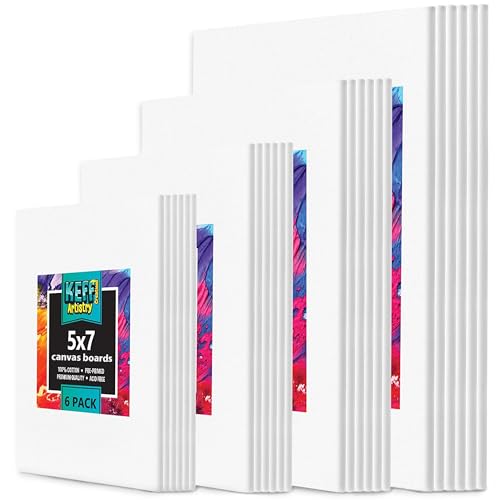
KEFF packs six canvas boards each in 5×7, 8×10, 9×12 and 11×14, all 100% cotton and triple primed with smooth surfaces for a variety of media. The listing positions the set for all ages and skill levels.
This is an ideal learning progression. Start with 5×7 studies to practice mixing and simple shapes, move to 8×10 for small scenes, and tackle 9×12 and 11×14 when you feel ready. Triple priming helps student-grade acrylic look brighter, and rigid boards are easy to store and frame.
Twenty-four boards is enough for a couple of months of regular practice.
Best suited for: Beginners in acrylic or oil who want to practice across several sizes.
Key features:
- 24 boards: 6 each of 5×7, 8×10, 9×12, 11×14
- 100% cotton
- Triple primed
- Smooth surface
Pros:
- Built-in size progression
- Triple primed
- Good quantity
- Easy to store
Cons and limitations:
- Boards need frames for display
- Smooth surface offers less tooth for dry brush
Buying consideration: Paint the same simple subject on a 5×7 and an 11×14 to learn how scale changes your approach.
2. ESRICH 14 Pack Multi-Size Stretched Canvas — Best for display-ready practice

ESRICH includes two each of seven sizes: 12×16, 10×12, 8×10, 5×7, 8×8, 6×6 and 4×4, all stretched on pinewood frames and pre-coated with acid-free acrylic gesso. The listing names oil, acrylic, watercolor, tempera and gouache.
Stretched canvas feels like “real” painting and hangs without a frame, which is motivating. The squares are great for simple abstracts and florals, and two of each size let you try a subject twice.
Best suited for: Beginners who want to hang or gift their early paintings.
Key features:
- 14 canvases, 7 sizes
- Includes squares
- Pinewood frames
- Acid-free acrylic gesso
Pros:
- Ready to hang
- Shape variety
- Two of each size
Cons and limitations:
- Stretched canvas dents more easily than boards
- Priming weight not stated
Buying consideration: Support the back of a stretched canvas with your hand or a book when pressing hard with a knife.
3. Nicpro 68 Pcs Acrylic Painting Kit with Canvas — Best for starting from zero

Nicpro bundles 24 colors of acrylic paint (12 ml each), 12 synthetic nylon brushes, 8 canvas panels at 8×10 in 100% cotton, a table easel, 16 sheets of 8×10 painting paper and a cleaning cup. The listing describes the acrylics as artist grade with a buttery consistency.
For a complete beginner, a kit removes decisions: everything you need for your first several paintings arrives in one box. The painting paper is useful for practice before committing to canvas.
Best suited for: Absolute beginners and gift-givers.
Key features:
- 8 canvas panels, 8×10
- 24 acrylic colors, 12 ml
- 12 brushes, table easel
- 16 sheets painting paper
Pros:
- Everything included
- Easel included
- Good gift
Cons and limitations:
- Small paint tubes
- Only eight canvases
Buying consideration: Use the paper sheets for color mixing exercises first, then move to the canvas panels.
4. FIXSMITH 11×14 Stretched Canvas, 8 Pack — Best for beginners ready to hang their work
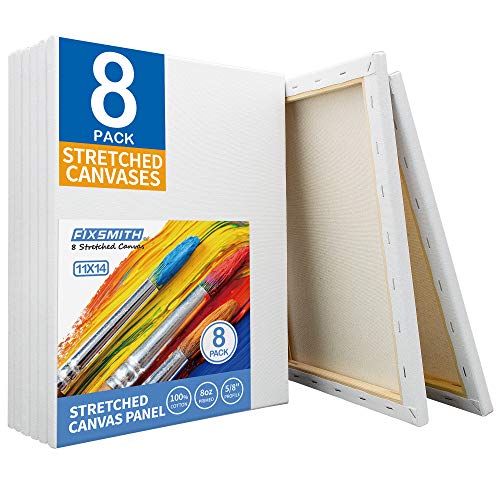
FIXSMITH lists eight 11×14 stretched canvases in 100% cotton, triple primed with 8 oz acid-free acrylic gesso, on pinewood bars at a 5/8 inch profile. The listing names beginners among intended users.
11×14 is a satisfying size for a first “proper” painting, and triple priming gives a good surface for acrylic.
Best suited for: Beginners moving from practice boards to finished pieces.
Key features:
- 11×14 inch, 8 pack
- 100% cotton
- Triple primed, 8 oz gesso
- 5/8 inch pine bars
Pros:
- Ready to hang
- Triple primed
- Consistent size for a series
Cons and limitations:
- Single size
- Bigger than ideal for very first attempts
Buying consideration: Practice your composition on a board or paper before painting the stretched canvas.
5. Simetufy 12 Pack 8×10 Canvas Boards — Best for everyday practice

Simetufy lists 12 boards at 8×10, 100% cotton and acid-free, on an MDF core, with a surface that holds paint without absorbing it. The listing says beginners can use them to practice.
Rigid MDF boards are forgiving: they do not dent, they store flat and they frame easily.
Best suited for: Beginners who paint regularly and want cheap, sturdy practice surfaces.
Key features:
- 8×10 inch, 12 pack
- Cotton, acid-free
- MDF core
- Pre-primed
Pros:
- Rigid
- Low cost
- Standard frame size
Cons and limitations:
- Single size
- Priming weight not stated
Buying consideration: Number your practice boards on the back so you can see your progress over time.
6. ESRICH 3 Pack Stretched Canvas, 5×7 to 11×14 — Best for a tiny trial

ESRICH packs one each of 5×7, 8×10 and 11×14 stretched canvas on pinewood frames, pre-coated with acid-free acrylic gesso. The listing describes it as suitable for novices.
If you are not sure painting is for you, three canvases is the smallest sensible start.
Best suited for: People curious to try painting with minimal spend.
Key features:
- 3 stretched canvases
- 5×7, 8×10, 11×14
- Acid-free gesso
- Pinewood frames
Pros:
- Minimal cost
- Three sizes
- Ready to hang
Cons and limitations:
- Only three canvases
Buying consideration: Start with the smallest canvas; finishing a painting quickly builds confidence.
7. ESRICH 8×10 Canvas Boards, 5 Pack — Best for the cheapest way to start

ESRICH lists five 8×10 boards with a smooth pure cotton surface, non-toxic, acid-free primer and a sturdy board core. It names kids and professional painters alike.
Five boards and a small set of paints is enough to find out whether you enjoy painting on canvas.
Best suited for: Beginners on the tightest budget.
Key features:
- 8×10 inch, 5 pack
- Smooth cotton
- Non-toxic, acid-free primer
- Board core
Pros:
- Lowest outlay
- Smooth surface
- Rigid
Cons and limitations:
- Only five boards
Buying consideration: Pair with a limited palette of three primaries plus white to learn mixing from day one.
Buying Guide: How to Choose Canvas for Beginners
Boards or stretched canvas
Canvas boards are cheaper, rigid and easy to store, ideal for practice. Stretched canvas hangs without a frame and feels more like a finished painting. Many beginners use boards for practice and stretched canvas for pieces they want to keep. You can also buy canvas on a roll, which our guide to stretched versus rolled canvas explains.
Start small
8×10 and 9×12 are ideal starting sizes: large enough to learn on, small enough to finish. Very large canvases need more paint, bigger brushes and more confidence.
Pre-primed is fine
Beginners do not need to prime canvas. Pre-primed surfaces are ready to use. Triple-primed canvases give slightly smoother, brighter results.
Buy enough to practice
Improvement comes from repetition. A pack of 12 to 24 surfaces lets you paint freely.
Match canvas to paint
Acrylic and oil suit standard primed canvas. Watercolor does not work well on regular canvas; use paper or special watercolor canvas. See our comparison of watercolor paper versus canvas.
Consider a kit
If you have no supplies, a complete kit with paint, brushes and canvas simplifies starting.
Your First Painting: A Simple Plan
- Choose a simple subject such as a sunset, a single flower or a landscape with three shapes. Our list of simple acrylic painting ideas for beginners has plenty.
- Tone the canvas with a thin wash of color to remove the intimidating white.
- Sketch lightly with a pencil or thin paint.
- Block in big shapes first with a large flat brush.
- Work from background to foreground.
- Add details last with a small round.
- Step back often to judge the whole painting.
Paint and Brush Basics for Beginners
Paint: student-grade acrylic is the easiest start: it dries fast, cleans up with water and works on any primed canvas. Start with a limited palette of red, yellow, blue and white to learn mixing.
Brushes: three or four synthetic brushes are enough at first: a large flat, a medium filbert, a small round and a liner.
Palette: a plastic palette, a paper plate or a sheet of palette paper all work.
Extras: a water jar, paper towels and an apron.
A Four-Week Beginner Practice Plan
Week 1, mixing: on small boards, paint color charts from your primaries and value strips from light to dark. No subjects yet; just learn how your paints behave.
Week 2, simple shapes: paint spheres, cubes and cylinders with a single light source. This teaches light, shadow and form.
Week 3, simple scenes: sunsets, a single tree, a mountain silhouette. Focus on big shapes and soft blends.
Week 4, a finished piece: choose your favorite subject from week 3 and paint it on a stretched canvas, planning composition first.
Following a plan like this uses about 15 to 20 surfaces, which is why a multi-pack of boards plus a few stretched canvases is the most practical beginner purchase.
Why Cheap Canvas Is Fine When You Start
Many beginners worry they need expensive materials. In reality, the surface makes only a modest difference while you are learning; your mixing, brush control and observation skills matter far more. Affordable, pre-primed canvas lets you paint often and treat each piece as practice. Save heavyweight canvas and linen for later, when you can see and use the difference.
Caring for Your Canvas and Finished Paintings
Store unused boards flat and stretched canvases upright in a dry place. Let finished paintings dry fully before stacking. If a stretched canvas gets punctured, our ripped canvas repair guide explains a simple fix. When you have several finished pieces, try hanging them together as a multi-canvas wall art set.
Common Mistakes to Avoid
- Starting on a canvas too large to finish.
- Buying expensive canvas and being afraid to use it.
- Using watercolor on regular primed canvas.
- Painting details before the big shapes.
- Working on a bright white canvas without toning it.
- Stacking paintings before they are dry.
FAQs
What canvas should a beginner buy?
An inexpensive pack of pre-primed cotton canvas boards in small to medium sizes, plus a few stretched canvases for pieces to hang.
What size canvas is best for beginners?
8×10 to 11×14. They are large enough to learn on and small enough to finish in a session.
Do beginners need to prime canvas?
No. Pre-primed canvas is ready to use. Extra gesso is optional for a smoother surface.
Is canvas board or stretched canvas better for beginners?
Canvas board is cheaper and sturdier for practice. Stretched canvas is better for pieces you want to hang.
What paint is best for beginners on canvas?
Acrylic paint. It dries fast, cleans with water and works well on primed canvas.
Can I use watercolor on canvas as a beginner?
Regular canvas resists watercolor. Use watercolor paper or canvas made for watercolor.
Final Recommendation
For most beginners, the KEFF 24-pack of triple-primed boards in four sizes is the best place to start. Choose the ESRICH 14-pack of stretched canvases if you want to hang your early work, the Nicpro kit if you need everything, and the FIXSMITH 11×14 eight-pack when you are ready for finished pieces. The Simetufy 12-pack is great for daily practice, and the ESRICH three-pack and five-pack are the lowest-cost ways to try painting.
Whatever you choose, the most important step is to start. Set up a small corner with your canvases, paints and brushes within reach, paint something simple this week, and keep the results. In a month you will be surprised by how much your early boards show you about your own progress, and you will know exactly what kind of canvas you want next. Painting is a skill built one surface at a time, so give yourself plenty of surfaces and permission to experiment freely, make mistakes and simply enjoy the process of learning something new, one painting at a time.