
PaintingProGuide is reader-supported. When you buy through links on this page we may earn an affiliate commission at no extra cost to you.
Interference acrylic paint is one of the strangest and most beautiful colors you can put on a canvas. In the tube it looks pale and milky. Over a white surface it almost disappears. But brush it over black or a dark color and it glows, then flips to a different hue as you move your head. That shift happens because interference pigments are thin mica flakes coated with titanium dioxide, and the coating thickness reflects one color of light while passing its complement through.
The best interference acrylic paint for most painters is GOLDEN Interference, available in fluid and heavy body versions, because the line is designed for professional use and the pigment information is clearly stated. Below we compare six options currently on Amazon.com, from single GOLDEN colors to pearlescent sets and a pour-ready interference paint, and show how to make interference colors really work.
Quick answer: GOLDEN Fluid Acrylic Interference Blue (Fine) is the best interference acrylic paint for most painters: transparent, titanium-dioxide-coated mica with excellent lightfastness and a clear blue-to-complement flip. Choose GOLDEN Heavy Body Interference Blue (Fine) if you want thick, textured strokes. For a low-cost pearl palette, the Amsterdam Pearl Set offers six colors, and pourers should look at Pouring Masters Blue Interference Pearl.
Our Top Picks at a Glance
- GOLDEN Fluid Acrylic Interference Blue (Fine) — Best overall interference acrylic
- GOLDEN Heavy Body Interference Blue (Fine) — Best for impasto and texture
- GOLDEN Fluid Interference Gold (Fine) — Best warm interference for glazing and fabric
- Amsterdam Standard Series Pearl Set, 6 Colors — Best budget pearlescent set
- U.S. Art Supply 12-Color Iridescent Set, 75 ml — Best large iridescent and interference variety
- Pouring Masters Blue Interference Pearl, 8 oz — Best for acrylic pouring
| Product | Best For | Key Spec | Key Strength | Price Tier |
|---|---|---|---|---|
| GOLDEN Fluid Interference Blue | Glazing, fine detail, mixing | 1 fl oz fluid, TiO2-coated mica | Excellent lightfastness, transparent | $ |
| GOLDEN Heavy Body Interference Blue | Impasto and texture | 2 fl oz heavy body | ASTM Lightfastness I | $$ |
| GOLDEN Fluid Interference Gold | Warm glazes, fabric, spraying | 1 oz fluid | High tinting strength, flexible | $ |
| Amsterdam Pearl Set | Budget pearlescent palette | 6 × 0.6 fl oz tubes (817-822) | 100% acrylic resin binder | $ |
| U.S. Art Supply Iridescent Set | Variety and classrooms | 12 × 75 ml incl. 4 interference pearls | ASTM D4236 and EN71 | $$ |
| Pouring Masters Interference Pearl | Fluid art | 8 fl oz ready-to-pour | Honey-like pouring viscosity | $ |
How We Chose
We did not paint with these colors for this guide. Picks are based on the Amazon listing details checked in October 2026, well-established information about how interference and pearlescent pigments behave, how well each product’s viscosity and format suit common techniques, and how widely each product is reviewed by Amazon buyers.
- True interference effect: a visible color flip over dark grounds.
- Pigment clarity: listings that state the pigment (titanium dioxide coated mica).
- Viscosity: fluid for glazing and pouring, heavy body for texture.
- Lightfastness: stated ratings for archival work.
- Value: single professional colors versus multi-color sets.
We skipped a second GOLDEN Fluid Interference Blue listing that duplicated the same color at a higher price.
Interference vs Iridescent vs Pearlescent
These terms overlap, and brands use them differently. Interference colors are transparent mica-based pigments that reflect one hue and transmit its complement, so they look different depending on angle and background. Pearlescent colors are soft, milky mica colors with a pearl-like sheen, often with a subtle interference effect. Iridescent is commonly used for metallic or shimmering paints, sometimes including interference colors. When you want the dramatic color flip, look specifically for “interference.”
Best Interference Acrylic Paint Reviewed
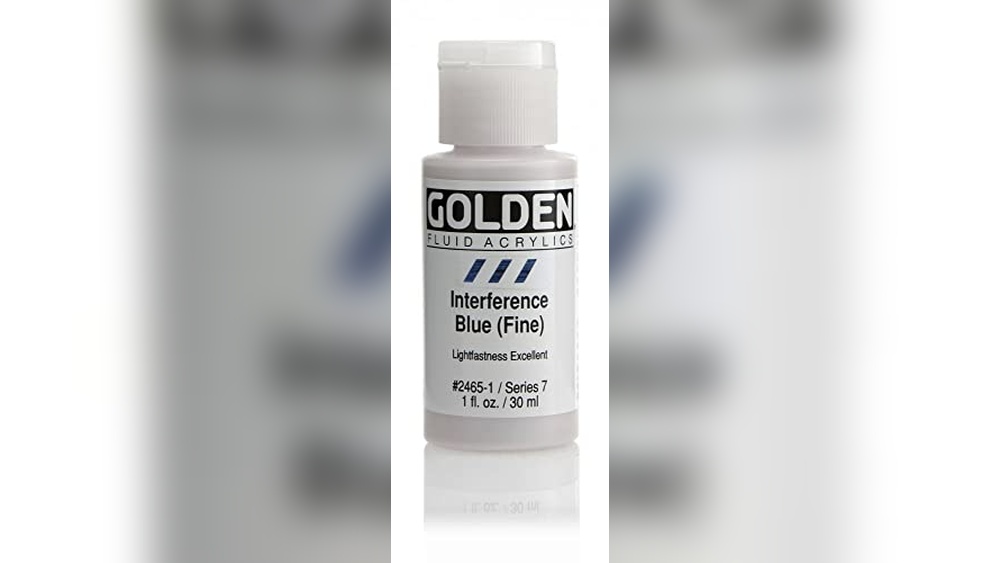
1. GOLDEN Fluid Acrylics, Interference Blue (Fine), 1 fl oz — Best for most painters

GOLDEN describes Interference Blue (Fine) as a transparent color with a unique flip between bright, opalescent blue and its complement as viewing angle changes. The pigment is titanium dioxide coated mica, lightfastness is listed as excellent, and the paint is vegan, per the listing.
As a Fluid Acrylic, it flows smoothly while retaining color intensity, tinting strength, film integrity and adhesion. GOLDEN notes it blends with all acrylic colors and readily tints gels, mediums, gessoes and grounds, which makes it versatile for glazing, staining, fine brushwork and water-media techniques. GOLDEN is an employee-owned US company.
Best suited for: painters who want a professional interference color for glazes, accents and mixed media.
Key features:
- Transparent interference blue
- Titanium dioxide coated mica
- Excellent lightfastness
- Fluid viscosity
- Mixes with acrylic colors, gels and mediums
Pros:
- Strong, clean color flip
- Professional quality and pigment transparency
- Versatile across techniques
Cons and limitations:
- Small 1 oz bottle
- Effect is subtle over light grounds
Buying consideration: Glaze it over black, deep blue or dark violet to see the full effect, and over its complement to amplify the flip.
2. GOLDEN Heavy Body Acrylics, Interference Blue (Fine), 2 fl oz — Best for impasto and texture

The Heavy Body version of Interference Blue (Fine) offers the same titanium dioxide coated mica pigment and color flip, with ASTM Lightfastness I (Excellent) rating, according to the listing. It is transparent and vegan.
Heavy Body paint has an exceptionally smooth, thick texture that retains brushstrokes and palette knife marks. Raised strokes catch light at different angles, which makes interference shifts more dramatic across textured surfaces.
Best suited for: impasto painters, palette knife work and textured abstracts.
Key features:
- Heavy body, 2 fl oz tube
- Titanium dioxide coated mica
- ASTM Lightfastness I
- Holds brush and knife marks
Pros:
- Texture amplifies the shimmer
- Larger tube
- Professional lightfastness rating
Cons and limitations:
- Too thick for fine glazes without medium
- Effect still depends on a dark ground
Buying consideration: Apply with a palette knife over a dried dark underpainting and view the piece from several angles as you work.
3. GOLDEN Fluid Interference Acrylic, Interference Gold (Fine), 1 oz — Best for warm glazing and fabric

Interference Gold gives a warm, golden flip with a cooler complement. The listing describes it as ideal for spraying, brushing and staining, and excellent for fabric application, with fine dispersion, high tinting strength, durability and flexibility.
Because it is a fluid, it works well thinned for airbrushing or as a shimmer glaze over dark backgrounds and fabric.
Best suited for: warm-toned glazes, fabric painting and airbrush work.
Key features:
- Fluid interference gold
- Suited to spraying, brushing and staining
- Recommended for fabric
- 1 oz bottle
Pros:
- Warm interference option
- Flexible film for fabric
- High tinting strength
Cons and limitations:
- Small bottle
- Subtle on light surfaces
Buying consideration: For fabric, mix with a fabric medium and follow heat-setting directions.
4. Amsterdam Standard Series Acrylic Paint Set, Pearl, 6 × 0.6 fl oz — Best for a budget pearlescent palette

Amsterdam, a brand from Royal Talens, offers a set of six pearlescent colors (numbers 817 to 822) in 0.6 fl oz (20 ml) tubes, according to the listing. The paint uses a 100% acrylic resin binder and lightfast pigments, forming a flexible film with a satin finish.
The listing notes it thins easily with water, dries in about 30 minutes in thin layers and is alkali resistant, suitable for murals and wall paintings. Pearl colors give a softer sheen than true interference colors, but they are a cost-effective way to explore shimmer.
Best suited for: beginners exploring pearlescent effects and mixed-media artists who want several shimmer colors.
Key features:
- 6 pearlescent colors, 20 ml tubes
- 100% acrylic resin binder
- Lightfast pigments
- Satin finish
- Water-thinnable
Pros:
- Affordable multi-color set
- Reputable maker
- Good for murals and mixed media
Cons and limitations:
- Pearl, not a strong interference flip
- Small tubes
Buying consideration: Mix a pearl color into a dark acrylic for a shimmering dark tone, or layer it thinly over dried color.
5. U.S. Art Supply 12-Color Iridescent Acrylic Paint Set, 75 ml Tubes — Best for large variety

U.S. Art Supply’s set includes 12 iridescent colors in large 75 ml (2.53 fl oz) tubes, including red, blue, violet and yellow interference pearl colors alongside color-shifting iridescents such as sunflower, peachy gold/pink, magic aqua/violet and ivy green/blue, according to the listing.
The listing describes smooth consistency, strong covering, color-shifting “chameleon” effects, and paint that is non-toxic, water-based and acid-free, conforming to ASTM D4236 and EN71. A double-sided color mixing wheel is included.
Best suited for: students, classrooms and hobbyists who want many shimmer and interference colors to experiment with.
Key features:
- 12 × 75 ml tubes
- Four interference pearl colors plus color-shift iridescents
- ASTM D4236 and EN71
- Color mixing wheel
Pros:
- Large tubes
- Broad shimmer variety
- Kid-safe labeling
Cons and limitations:
- Less pigment information than professional lines
- Effects vary between colors
Buying consideration: Test each color over black and white swatches to learn which ones flip and which simply shimmer.
6. Pouring Masters Blue Interference Pearl, 8 oz Pouring Paint — Best for acrylic pouring

Pour painters can add interference shimmer with this ready-to-pour color. The listing describes a honey-like consistency formulated for tilting and color movement, ideal straight out of the bottle, and suitable for dirty pour, flip cup, Dutch pour and tree ring techniques.
It works with pouring medium, silicone oil and cell activators. Interference pearl colors are especially effective in pours that include black or deep blue, where the shimmer catches light in cells and lacing.
Best suited for: acrylic pourers who want shimmer and color shift in fluid art.
Key features:
- 8 fl oz ready-to-pour
- Blue interference pearl finish
- Compatible with pouring additives
- For all common pour techniques
Pros:
- Big bottle for pours
- No mixing needed
- Strong effect in dark pours
Cons and limitations:
- Single color
- Less versatile for brushwork
Buying consideration: Pour it next to black rather than mixing it heavily into lighter colors, where the effect fades.
How to Use Interference Acrylic Paint
Paint over dark grounds
Interference colors reflect only a portion of light. Over white, the reflected and transmitted colors cancel visually. Over black or dark colors, the reflected hue pops. Start with a dried dark underpainting.
Use complements for drama
Interference Blue over orange, or Interference Gold over violet, creates a vivid flip as viewing angle changes.
Glaze thinly
Thin layers of fluid interference color, alone or mixed with a gloss medium, build shimmer without hiding the colors underneath.
Mix into dark colors
Adding interference color to a dark acrylic, such as phthalo blue or carbon black, creates a pearlescent dark that shifts in light.
Use texture
Heavy body interference over textured surfaces catches light on every ridge, producing stronger shifts.
Varnish carefully
A gloss varnish keeps interference effects crisp; matte varnish can dull them. Test varnish on a sample first. For a detailed walkthrough of GOLDEN’s fluid interference colors, see our guide on how to use GOLDEN Fluid Acrylic interference paint.
Make a Simple Interference Test Card
Before using an interference color on a finished painting, make a test card. It takes ten minutes and saves a lot of disappointment.
Paint a strip of heavy paper or a small panel with four bands: titanium white, a mid gray, carbon or mars black, and the complementary color of your interference paint (orange for Interference Blue, violet for Interference Gold). Let the bands dry fully. Then brush a thin layer of interference color across all four bands, and a second, thicker stroke beside it.
Once dry, tilt the card under a single light source. Over white, the interference color will barely show. Over gray it will begin to appear, over black it will glow, and over the complement it will flip strongly as you change the viewing angle. Comparing the thin and thick strokes shows how much paint you need for the effect you want. Keep the card in your studio as a reference whenever you plan a shimmer passage.
Interference Colors Under Different Lighting
Because interference effects depend on reflected light, the same painting can look very different under different lighting. A single directional light, like a spotlight or window light from one side, produces the most dramatic shifts. Diffuse, even lighting flattens the effect. If you are painting for display, consider where the work will hang and photograph it under directional light to capture the shimmer, ideally with a short video that shows the color moving as the camera shifts.
Buying Guide: How to Choose Interference Acrylic Paint
Decide on viscosity
Fluid for glazing, airbrushing, fabric and pouring. Heavy body for texture and impasto. Pour-ready paints for fluid art.
Check the pigment
True interference colors list titanium dioxide coated mica. Professional lines state lightfastness ratings.
Start with one or two colors
Interference Blue and Interference Gold cover cool and warm effects. Add red, violet or green later.
Consider sets for exploration
Pearlescent and iridescent sets offer many shimmer colors at low cost, though effects are softer.
Plan your ground
Buy or mix a good black or dark color for underpaintings. The ground is as important as the interference paint.
Project Ideas
Interference colors are perfect for galaxy and night-sky paintings, ocean and wave studies, abstract pours, butterfly and beetle wings, and accents on wall art. Try them in a simple piece from our acrylic painting ideas for beginners, add shimmer to DIY acrylic wall art, or experiment on glass using the prep in our guide on using acrylic paint on glass jars.
Common Mistakes to Avoid
- Painting interference colors over white and wondering why they disappear.
- Mixing interference paint into light colors, which mutes the effect.
- Applying thick, opaque layers that hide underlying colors.
- Using matte varnish that dulls shimmer.
- Judging the color from one viewing angle only.
- Expecting pearlescent paints to flip as dramatically as true interference colors.
FAQs
What is interference acrylic paint?
It is a transparent paint made with titanium dioxide coated mica that reflects one color and transmits its complement, creating a color shift depending on viewing angle and background.
What is the best interference acrylic paint?
GOLDEN Interference colors, in fluid or heavy body, are widely used and clearly labeled with pigment and lightfastness information.
Why does my interference paint look white?
Interference colors look milky over white or light grounds. Paint them over black or dark colors to see the effect.
What is the difference between interference and iridescent paint?
Interference paints show a color flip with angle. Iridescent is a broader term for shimmering or metallic paints, which may or may not include interference effects.
Can I use interference paint in acrylic pouring?
Yes. Ready-to-pour interference colors like Pouring Masters Blue Interference Pearl are designed for fluid art.
Is interference paint lightfast?
Professional interference colors such as GOLDEN’s list excellent lightfastness. Check each product’s rating.
Final Recommendation
For most painters, GOLDEN Fluid Acrylic Interference Blue (Fine) is the best interference acrylic paint, with GOLDEN Heavy Body Interference Blue for texture and GOLDEN Fluid Interference Gold for warm glazes and fabric. Choose the Amsterdam Pearl Set or the U.S. Art Supply Iridescent Set to explore shimmer on a budget, and Pouring Masters Blue Interference Pearl for fluid art. Whatever you choose, paint over dark grounds and view your work from different angles.




