

PaintingProGuide is reader-supported. When you buy through links on this page we may earn an affiliate commission at no extra cost to you.
Parents searching for organic paints for kids usually want three things: simple ingredients they can understand, no unnecessary chemicals, and less environmental impact. The tricky part is that “organic” on a paint label rarely means certified organic. Food and personal care products can carry USDA Organic certification, but children’s art paint almost never does, and none of the listings we checked claims it. The best organic-minded paints for kids are the ones that come closest in practice: plant or vegetable-based ingredients, cosmetic-grade or food-grade components, paraben-free preservation, and sustainable packaging.
This guide explains what each of those claims actually means, how to compare them, and which kids’ paints in the Amazon listings we checked offer the most natural, transparent formulas.
Quick answer: For the most natural ingredients, Jar Melo Washable Finger Paint Powder is made from vegetable powder and food-grade thickeners with no additives, per its listing. For sustainability, Honeysticks Non-Toxic Finger Paint uses cosmetic-grade colorings and bottles made from 100% reclaimed curbside plastic. For classrooms, Positive Art Paraben-Free Tempera is made in the USA and conforms to ASTM D-4236.
Our Top Picks at a Glance
- Jar Melo Washable Finger Paints Powder, 6 Colors — Best natural, vegetable-based formula
- Honeysticks Non-Toxic Finger Paint, 6 Colors — Best eco-conscious packaging
- Positive Art Washable Paint, 12 Colors, 16 oz — Best paraben-free bulk tempera, made in USA
- Colorations Paraben-Free Simply Washable Tempera — Best paraben-free AP certified classroom paint
- Nicpro 12 Colors Washable Finger Paint — Best budget toddler finger paint
- ABEIER Washable Finger Paint, 12 Colors — Best low-cost skin-contact formula
| Product | Best For | Key Spec | Key Strength | Price Tier |
|---|---|---|---|---|
| Jar Melo Paint Powder | Natural ingredients | 6 colors, vegetable powder, food-grade thickeners | No additives per listing | $$ |
| Honeysticks Finger Paint | Sustainability | 6 pots, cosmetic-grade colorings, reclaimed plastic | FSC-sourced cardboard packaging | $$ |
| Positive Art 12 Colors | Bulk classroom | 12 x 16 oz, paraben-free, ASTM D-4236 | Made in the USA | $$ |
| Colorations Paraben-Free | Classrooms | 8 x 16 oz, paraben-free, AP Seal | Independent safety seal | $$ |
| Nicpro 12 Finger Paint | Toddlers | 12 x 2 oz, water-based, ASTM D-4236 | Flip-top caps | $ |
| ABEIER Finger Paint | Budget toddlers | 12 colors, ASTM D-4236 | Skin-contact formula | $ |
How We Chose
We have not used these paints ourselves. Our picks are based on the Amazon listing details and specifications checked in October 2026, how closely each formula and package matches what parents mean by organic (natural ingredients, fewer additives, sustainable materials), and how widely each product is reviewed by Amazon buyers. We only repeat ingredient and sustainability claims that the listings make.
- Ingredient source: vegetable, plant, food-grade or cosmetic-grade components.
- Additives and preservatives: no-additive or paraben-free statements.
- Packaging: recycled plastic, FSC-certified cardboard or minimal packaging.
- Safety marks: ASTM D-4236 and AP Seal.
- Washability: clean-up from skin and surfaces with soap and water.
What “Organic” Means on Kids’ Paint
In the US, “organic” is a regulated term for agricultural products, food and some personal care products certified under the USDA National Organic Program. Art supplies fall outside that system in practice, so an “organic” claim on paint has no certification behind it unless a brand specifically shows one. That is why it pays to look past the word and check the specific claims:
- Vegetable-based or plant-based: the colors and thickeners come from plants. This is the closest to what most parents mean by organic.
- Food-grade: components are approved for use in food, which is reassuring for toddlers who put hands in mouths.
- Cosmetic-grade colorings: pigments that meet standards for skin products.
- Paraben-free: avoids one family of preservatives some families prefer to skip. It does not mean preservative-free.
- No additives: fewer ingredients overall, usually only possible in powder form you mix fresh.
- Non-toxic (ASTM D-4236, AP Seal): safety evaluations, not natural or organic claims.
Powder versus bottled paint
Liquid paint must stay usable for months in a bottle, which requires preservatives to stop mold. Powder paints that you mix with water just before painting can skip most of those additives, which is why the most natural option in this guide, Jar Melo, comes as powder. The trade-off is a minute of mixing and paint that should be used within the session.
Best Organic Paints for Kids Reviewed
1. Jar Melo Washable Finger Paints Powder for Babies, 6 Colors — Best for natural, vegetable-based ingredients
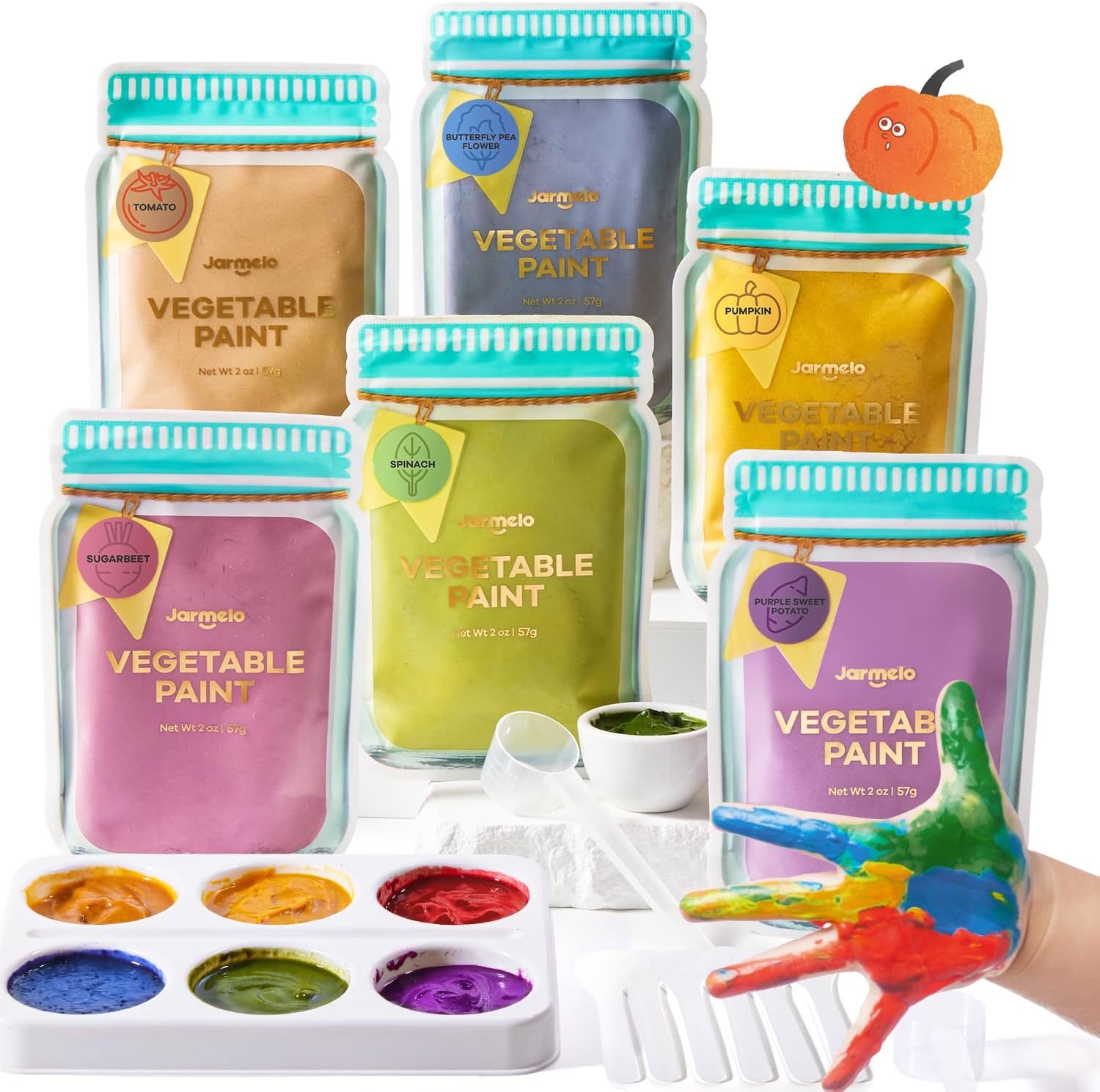
Jar Melo’s powder is made from pure vegetable powder and food-grade thickeners with no additives, according to the listing, which also says it is safe if accidentally ingested. You mix it with warm water to make a creamy, mousse-like paint. The kit includes a mixing palette, a large and small spoon and six stirring sticks.
That ingredient description is the closest to “organic” in this guide, even without certification. The listing does caution that porous fabrics and wood may absorb the paint.
Best suited for: Babies, toddlers and families who want the simplest possible ingredient list.
Key features:
- 6 vegetable-based colors
- Food-grade thickeners
- No additives per listing
- Mixing palette, spoons and sticks
Pros:
- Most natural formula here
- Mix fresh each time
- Gentle, creamy texture
- Safe if accidentally ingested per listing
Cons and limitations:
- Not certified organic
- Mixing required
- Plant colors are softer than synthetic pigments
- Can stain porous fabric
Buying consideration: Mix small amounts; vegetable paint without preservatives is best used the same day.
2. Honeysticks Non-Toxic Finger Paint, 6 Bright Colors — Best for eco-conscious packaging

Honeysticks describes its finger paint as water-based, non-toxic and made with cosmetic-grade colorings. It comes in six honeypot-style bottles made from 100% reclaimed curbside plastic, with cardboard packaging sourced from an FSC-certified supplier, according to the listing.
The thick, creamy texture is designed for control by little fingers, with less mess and fewer spills. For families who care about packaging waste as much as ingredients, this is the strongest sustainability story in the guide.
Best suited for: Eco-minded families with toddlers who want ready-to-use finger paint.
Key features:
- 6 colors
- Water-based, cosmetic-grade colorings
- Bottles from 100% reclaimed curbside plastic
- FSC-sourced cardboard
- Washable from skin
Pros:
- Strongest packaging sustainability claims
- Ready to use
- Thick texture for control
Cons and limitations:
- Highest price tier per ounce here
- Small quantity per pot
- Not certified organic
Buying consideration: Use it for special sensory sessions and a cheaper bulk paint for everyday projects to stretch your budget.
3. Positive Art Washable Paint for Kids, 12 Colors, 16 oz Bottles — Best for paraben-free bulk tempera

Positive Art’s set includes 12 tempera colors in large 16 oz bottles. The listing describes it as paraben-free, washable, kid-friendly and conforming to ASTM D-4236, with easy soap-and-water clean-up. It is manufactured in the USA.
For families or classrooms that paint often, large bottles reduce packaging waste per ounce compared with many small pots, and domestic manufacturing shortens shipping distances for US buyers.
Best suited for: Classrooms, homeschoolers and busy households.
Key features:
- 12 colors, 16 oz each
- Paraben-free
- ASTM D-4236
- Made in the USA
- Washable
Pros:
- Large volume with less packaging per ounce
- Paraben-free
- Domestic manufacturing
- Mid price tier for the volume
Cons and limitations:
- Not plant-based
- Not certified organic
Buying consideration: Decant into small reusable cups so the big bottles stay sealed and fresh.
4. Colorations Paraben-Free Simply Washable Tempera, Rainbow Plus 8-Pack — Best for paraben-free AP certified classroom paint

Colorations’ Simply Washable tempera is now paraben-free and carries the AP Seal, according to the listing. The pack includes eight 16 oz bottles, and the paint is described as not chipping, flaking or cracking when dry, working on paper, canvas, wood and cardboard.
It is a practical classroom paint for schools that want to move away from parabens while keeping an independent safety seal.
Best suited for: Schools and programs with large groups.
Key features:
- 8 colors, 16 oz each
- Paraben-free
- AP Seal
- Multi-surface
Pros:
- Independent safety certification
- Durable dry finish
- Large volume
Cons and limitations:
- Not plant-based
- Upper price tier
Buying consideration: Ask the brand which preservative replaced parabens if your family avoids other preservatives too.
5. Nicpro 12 Colors Washable Finger Paint for Toddlers, 2 oz — Best for budget toddler finger paint

Nicpro’s finger paint uses a water-based, skin-safe formula meeting ASTM D-4236, according to the listing. It includes 12 colors in 2 oz bottles with flip-top caps and a thick, smooth texture.
It does not make natural-ingredient claims, but it is a low-cost, water-based option for families balancing budget with safety.
Best suited for: Toddlers and daycares on a budget.
Key features:
- 12 colors, 2 oz each
- Water-based
- ASTM D-4236
- Flip-top caps
Pros:
- Low price tier
- Wide color range
- Easy-pour caps
Cons and limitations:
- No natural or plant-based claims
- Small bottles
Buying consideration: Pair it with vegetable powder paint: use powder for youngest siblings and Nicpro for older ones.
6. ABEIER Washable Finger Paint for Toddlers, 12 Colors — Best for low-cost skin-contact formula

ABEIER describes its finger paint as safe for direct skin contact, conforming to ASTM D-4236, non-toxic and environmentally friendly. It offers 12 colors with a thick, silky cream texture and washes from skin, fabric and plastic.
The environmental claim is general rather than specific, so treat it as a budget non-toxic paint rather than a natural or organic one.
Best suited for: Families who want an inexpensive finger paint set to start with.
Key features:
- 12 colors
- ASTM D-4236
- Skin-contact formula
- Washable
Pros:
- Low price tier
- Many colors
Cons and limitations:
- Environmental claim not detailed
- No natural-ingredient statement
Buying consideration: If natural ingredients are your priority, choose Jar Melo; if budget and color range matter more, ABEIER is fine.
Buying Guide: How to Choose Organic-Style Paint for Kids
Look for specific ingredient claims
“Vegetable powder,” “food-grade” and “cosmetic-grade” tell you more than “organic” or “natural” alone.
Decide on powder or ready-made
Powders allow fewer additives but need mixing. Bottled paints are convenient but need preservatives to stay fresh.
Check preservative statements
Paraben-free is a useful step. Ask about replacement preservatives if your family avoids them broadly.
Consider packaging
Recycled plastic, FSC cardboard and large refill bottles reduce waste.
Keep safety certification in the mix
ASTM D-4236 and AP Seal show the paint has been evaluated for toxicity. Natural ingredients and safety marks complement each other.
Match to age
Babies and young toddlers who mouth paint need taste-safe or food-grade formulas. Older kids can use paraben-free tempera.
Choosing Natural Paint by Age and Use
Babies (around 6 to 18 months)
At this stage, paint goes on hands, faces and usually into mouths. Ingredient simplicity matters more than anything else, so food-grade vegetable powder like Jar Melo, or a homemade pantry paint, is the best fit. Keep sessions short, paint on a high chair tray or a large sheet of paper on the floor, and wipe hands before snacks.
Toddlers (18 months to 3 years)
Toddlers want brighter colors and thicker paint they can smear and swirl. Honeysticks’ cosmetic-grade finger paint and Nicpro’s or ABEIER’s water-based finger paints are reasonable choices, depending on whether you prioritize packaging, budget or color range. Washable formulas reduce clean-up stress.
Preschool and early school age (3 to 6 years)
Kids now paint with brushes, make recognizable pictures and want their work to last. Paraben-free tempera like Positive Art or Colorations offers stronger color and better coverage on paper and cardboard, while still avoiding one common preservative family.
Classrooms and groups
Groups need volume. Large 16 oz bottles cut packaging waste and cost per ounce, and independent safety marks like the AP Seal make purchasing decisions easier for schools. Pair bulk paint with reusable cups and synthetic brushes for the greenest classroom setup.
Making Natural Paint at Home
For a fully known ingredient list, homemade paint is simple. Cook flour or cornstarch with water until it forms a smooth paste, cool it, divide it into jars and color each with a natural colorant: turmeric for yellow, beet juice for pink, spinach or spirulina for green, and blueberry juice for purple. Organic pantry ingredients make it as close to organic paint as possible.
Homemade paint fades and can spoil, so make small batches and discard leftovers after a day or two. It is perfect for toddlers and sensory play, less suited to keepsake artwork. Children with food allergies need a recipe that avoids their allergens, such as cornstarch instead of wheat flour.
Greener Painting Habits
- Pour small amounts so less paint is wasted.
- Reuse jars and lidded cups instead of disposable palettes.
- Paint on recycled cardboard, paper bags and scrap paper.
- Wash brushes in a bucket rather than under running water, and dispose of the water responsibly.
- Choose synthetic brushes that last for years.
- Buy larger bottles to cut packaging per ounce.
Natural colors look lovely on simple subjects. Try our step-by-step guides to painted rock critters for kids or painting an easy ladybug, which use just a few colors.
Common Mistakes to Avoid
- Trusting “organic” without details: art paint is almost never certified organic.
- Confusing non-toxic with natural: they are different claims.
- Storing mixed powder paint for days: without preservatives it can spoil.
- Overlooking packaging: lots of tiny plastic pots can outweigh an ingredient benefit.
- Ignoring stain warnings: natural colors can still stain porous fabric and wood.
- Assuming food-based is allergy-safe: check for your child’s specific allergens.
FAQs
Is there certified organic paint for kids?
Children’s art paint is rarely certified organic, and none of the listings in this guide claims USDA Organic certification. Look for specific claims like vegetable-based or food-grade ingredients instead.
What is the most natural kids’ paint?
Among the products here, Jar Melo Finger Paint Powder, made from vegetable powder and food-grade thickeners with no additives according to its listing, is the most natural formula.
Is paraben-free paint organic?
No. Paraben-free means the paint avoids one family of preservatives. It still contains other ingredients and preservatives.
Are natural paints safe for babies?
Taste-safe, food-grade formulas like Jar Melo are designed for young children who may put hands in their mouths. Always supervise and patch test.
Do natural paints wash out of clothes?
They usually wash easily from skin and smooth surfaces, but plant colors can still stain porous fabrics. Treat stains quickly with cool water and soap.
How should I store natural or powder paints?
Keep unmixed powder sealed in a cool, dry cupboard away from sunlight and humidity. Once mixed with water, use the paint within the session or store it covered in the fridge for no more than a day, then discard it. Bottled paints should be closed tightly after each use and stored upright.
Why do natural paints look less bright?
Plant-based colorants are generally softer than synthetic pigments. That is normal and part of the trade-off for simpler ingredients.
Final Recommendation
For the most natural ingredients, choose Jar Melo Finger Paint Powder, which is vegetable-based with food-grade thickeners and no additives. For sustainability, Honeysticks Finger Paint pairs cosmetic-grade colorings with reclaimed-plastic bottles and FSC cardboard.
For everyday and classroom painting, Positive Art Paraben-Free Tempera and Colorations Paraben-Free Tempera offer large, paraben-free bottles with safety certification, while Nicpro and ABEIER are affordable water-based finger paints. None is certified organic, so choose based on the specific claims that matter most to your family.




