PaintingProGuide is reader-supported. When you buy through links on this page we may earn an affiliate commission at no extra cost to you.
Plaster is one of the thirstiest surfaces a crafter will ever paint. A fresh plaster of Paris figurine, a cast wall plaque or a molded ornament soaks up the first coat of color like a sponge, which is why so many projects end up chalky, streaky or blotchy. The best paint for plaster crafts is a water-based acrylic with solid coverage, applied over a sealed or primed surface, and finished with a clear coat if the piece will be handled or kept outdoors.
This guide explains why that combination works, which acrylic sets on Amazon are the most sensible fit for plaster projects, and how to prep, paint and protect a cast so the color stays even and the surface does not powder or chip.
Quick answer: For most plaster crafts, the Apple Barrel Vibrant Spectrum 16-color matte set is the most practical pick: the listing names plaster as a recommended surface, it dries matte, and the 2 oz bottles suit basecoating small casts. Add the Apple Barrel 8 oz White as a dedicated basecoat. If you want a wider palette with brushes in the box, the Nicpro 24-color set is the better kit, and the Fantastory 36-color set adds metallics for ornaments and decorative figures.
Our Top Picks at a Glance
- Apple Barrel Vibrant Spectrum Collection (16 x 2 oz, matte) — Best overall paint for plaster crafts
- Apple Barrel Acrylic Paint, White (8 oz) — Best basecoat for plaster casts
- GOTIDEAL Acrylic Paint Set (18 x 2 oz, matte) — Best matte set with brushes included
- Artkey Acrylic Paint Set (24 x 2 oz) — Best wide-palette set for mixed craft surfaces
- Nicpro Acrylic Paint Set (24 x 2 oz) with 12 Brushes & Palette — Best all-in-one kit for beginners
- Fantastory 36-Color Acrylic Set with Metallics — Best for decorative and holiday plaster pieces
- Shuttle Art Acrylic Paint Set (16 x 12 ml tubes) — Best low-cost set for small detail work
| Product | Best For | Key Spec | Key Strength | Price Tier |
|---|---|---|---|---|
| Apple Barrel Vibrant Spectrum | General plaster crafts | 16 x 2 oz bottles, matte | Plaster listed as a surface; made in USA | $$ |
| Apple Barrel White 8 oz | Basecoating casts | 8 oz bottle, matte | Large volume of the most-used color | $ |
| GOTIDEAL 18-Color Set | Matte finishes on a budget | 18 x 2 oz, 10 brushes | Plaster named in surface list | $$ |
| Artkey 24-Color Set | Varied craft surfaces | 24 x 2 oz, semi-gloss | Wide color range, plaster listed | $$ |
| Nicpro 24-Color Kit | First-time crafters | 24 x 2 oz, 12 brushes, palette | Complete starter kit | $$ |
| Fantastory 36-Color Set | Ornaments and decor | 36 x 60 ml incl. metallics | Metallics plus sponge and knife | $$ |
| Shuttle Art 16 Tubes | Fine details, kids’ casts | 16 x 12 ml tubes | Low cost, compact | $ |
How We Chose
These picks come from the Amazon listing details and specifications we checked in October 2026, not from painting the products ourselves. We read each listing’s stated surfaces, finish, bottle size and safety labeling, then judged how well that format fits plaster work specifically. We also weighed how widely each product is reviewed by Amazon buyers, which is a rough signal that a set is established rather than a one-off listing.
Plaster changes the priorities compared with canvas painting. Here is what mattered most:
- Stated surface compatibility: listings that name plaster, plaster-like or porous craft surfaces ranked higher.
- Finish: matte finishes suit the natural look of plaster and hide small surface flaws; gloss is better left to the topcoat.
- Volume per color: plaster absorbs paint, so 2 oz bottles and larger make more sense than tiny tubes for basecoats.
- Water-based, non-toxic labeling: plaster crafts are often family or classroom projects, so ASTM D-4236 conformity and soap-and-water cleanup counted.
- Color range and extras: sets with brushes, metallics or a basecoat-friendly white earned credit when those extras genuinely help plaster projects.
Best Paint for Plaster Crafts Reviewed
1. Apple Barrel Vibrant Spectrum Collection — Best Overall for Plaster Crafts
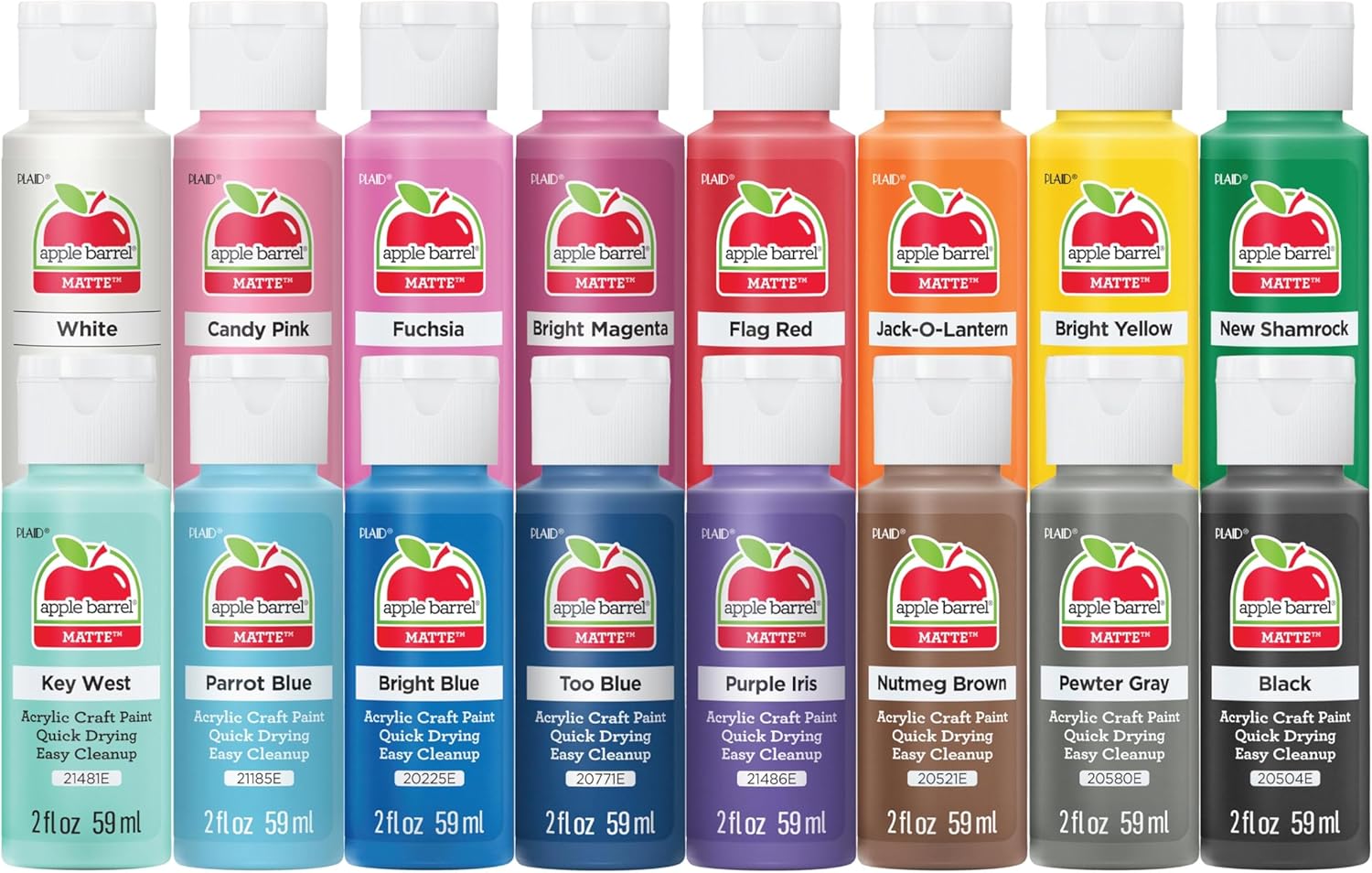
Apple Barrel is a long-running craft acrylic, and this listing is one of the few that names plaster directly among its recommended surfaces, alongside wood, Styrofoam and terra cotta. That matters because craft acrylics are formulated to grip porous decorative surfaces rather than stretched canvas.
The 16 colors dry to a matte finish, which keeps plaster looking like plaster rather than plastic. The palette leans bright and saturated, with names like Flag Red, Bright Blue and New Shamrock, plus a white, black, brown and grey for mixing and shading. The listing also notes the paint can be brushed, stamped, stenciled or sponged, which covers most plaster decorating techniques.
Best suited for: Plaster of Paris figurines, garden-style plaques kept indoors, kids’ craft casts and holiday ornaments where a flat, even color is the goal.
Key features:
- 16 assorted colors in 2 fl oz bottles
- Matte finish
- Recommended for wood, Styrofoam, plaster and terra cotta
- Soap-and-water cleanup while wet
- Made in the USA
Pros:
- Plaster is named as a compatible surface
- Matte finish flatters the texture of cast plaster
- 2 oz bottles are a sensible size for basecoating several pieces
- Easy to sponge or stencil for decorative effects
Cons and limitations:
- Bright, toy-like palette; you will mix to get subtle naturals
- Craft-grade paint, so expect to apply two coats on raw plaster
- No brushes included
- Matte paint marks more easily without a sealer on handled pieces
Buying consideration: Pair this set with a primer or a white basecoat. On unsealed plaster, matte craft acrylic is absorbed unevenly, so the first coat acts partly as a sealer.
2. Apple Barrel Acrylic Paint, White (8 oz) — Best Basecoat for Plaster Casts

White runs out first on almost every plaster project, because it is used for basecoats, for lightening mixes and for touch-ups. This 8 oz bottle is described by Apple Barrel as a size suited to basecoating and stenciling, and it dries matte like the rest of the line.
A white basecoat over a sealed cast gives every color that follows a consistent, bright starting point. It also makes transparent and lighter colors, such as yellows and pinks, look cleaner than they do directly on grey-white raw plaster.
Best suited for: Anyone painting several plaster pieces at once, classroom batches, or crafters who want an even ground before decorative color.
Key features:
- 8 fl oz bottle
- Matte finish
- Listed for wood, paper, canvas, Styrofoam and paper mache
- Water-based, non-toxic formula
- Made in the USA
Pros:
- Large volume of the color you use most
- Matte finish matches the Vibrant Spectrum set
- Very low cost per ounce compared with small bottles
- Doubles as a mixing white
Cons and limitations:
- Single color only
- Plaster is not listed on this particular bottle’s surface list, although the same line names it
- Not a true primer; on very porous plaster a dedicated sealer still helps
Buying consideration: Buy this as a companion rather than a stand-alone solution. One bottle covers the basecoats for a good number of small figurines.
3. GOTIDEAL Acrylic Paint Set (18 Colors) — Best Matte Set with Brushes

GOTIDEAL’s listing includes plaster in a long list of compatible surfaces, along with wood, stone, ceramic and decorative walls. The detail page lists a matte finish, and the set arrives with 10 brushes, so a newcomer can start painting the day it arrives.
Eighteen 2 oz colors is a practical middle ground: enough range for painted figurines and ornaments without the duplication that bigger sets sometimes have. The listing also states conformity with ASTM D-4236 and EN71-3, which is reassuring for family projects.
Best suited for: Crafters who want a matte set and basic brushes in one purchase, especially for figurines, plaques and decorative casts.
Key features:
- 18 colors in 59 ml / 2 oz bottles
- 10 brushes included
- Matte finish (per listing details)
- Plaster listed among compatible surfaces
- ASTM D-4236 and EN71-3 labeling
Pros:
- Plaster explicitly mentioned
- Brushes included
- Matte finish suits plaster
- Generous bottle size for the price tier
Cons and limitations:
- Included brushes are general-purpose; fine detail may need a better round
- Fewer colors than 24- and 36-color sets
- Coverage on raw plaster still benefits from a primer
Buying consideration: If you already own decent brushes, the Apple Barrel set gives a similar matte look; choose GOTIDEAL when the included brushes save you a separate purchase.
4. Artkey Acrylic Paint Set (24 Colors) — Best Wide Palette for Mixed Surfaces

Artkey’s bullets list plaster with canvas, fabric, wood, ceramic, rock, metal and plastic, which makes this a good set for crafters whose plaster pieces sit alongside other projects. The 24 bottles are 2 oz each and labeled with color names, and the brand describes the consistency as buttery and quick-drying.
The finish is listed as semi-gloss. That gives slightly more sheen than the matte sets above; on plaster it reads as a soft satin rather than a hard shine, which some crafters prefer for ornaments and painted figures.
Best suited for: Crafters with a mix of plaster, wood and rock projects who want one larger palette to cover everything.
Key features:
- 24 colors, 2 oz / 59 ml each
- Semi-gloss finish
- Plaster named among compatible surfaces
- Non-leaking screw caps, named bottles
- Soap-and-water cleanup
Pros:
- Wide range for decorative work
- Plaster listed
- Labeled bottles make reordering and color matching easier
- Packed in a sturdy storage box
Cons and limitations:
- Semi-gloss is less natural on plaster than matte
- No brushes included
- Like any craft acrylic, needs sealing on outdoor pieces
Buying consideration: Choose Artkey when range matters more than a strictly matte look, or plan to finish with a matte varnish if you want the sheen knocked back.
5. Nicpro 24-Color Set with 12 Brushes & Palette — Best All-in-One Kit

Nicpro packages 24 colors in 2 oz bottles with 12 brushes, a palette and a beginner guide with a color wheel. For someone painting a first plaster figurine, that removes the guesswork about what else to buy.
The listing describes the paint as fast-drying, water-resistant once dry and fade-resistant, with ASTM D-4236 conformity. The detail page shows a semi-gloss finish. Plaster is not named specifically, but the brand lists wood, rock, canvas and ceramic, and plaster behaves similarly to unglazed ceramic once sealed. Note the reminder in the listing to remove the inner seal before use.
Best suited for: Beginners, gift buyers and families who want paint, brushes and a palette in one box for plaster and other craft projects.
Key features:
- 24 colors in 2 oz bottles
- 12 brushes, palette and color-wheel guide
- Semi-gloss finish
- Fast-drying, fade-resistant per listing
- ASTM D-4236 labeling
Pros:
- Most complete kit on this list
- Color-wheel guide helps with mixing natural tones
- Large bottles for coverage
- Good value as a starter set
Cons and limitations:
- Plaster is not specifically listed
- Semi-gloss rather than matte
- Kit brushes are basic
Buying consideration: If you already own brushes, a paint-only set gives more color for the money; buy the Nicpro kit when you are starting from nothing.
6. Fantastory 36-Color Set with Metallics — Best for Decorative Plaster Pieces

Fantastory’s set is the one to look at for ornaments, holiday figurines and decorative plaques, because it includes metallic colors. Gold and silver accents are common on plaster crafts, and having them in the same set as your base colors keeps things simple.
The box also includes 12 brushes, a palette knife, a mixing palette, a color chart and an artist sponge. The sponge is genuinely useful on plaster for stippled textures and soft faux-stone effects. One caution: the listing text describes a matte finish while the detail table says gloss, so expect some variation between colors, especially the metallics.
Best suited for: Decorative plaster ornaments, holiday pieces and painted figures that need metallic highlights.
Key features:
- 36 colors at 60 ml each, including metallics
- 12 brushes, palette knife, mixing palette, sponge, color chart
- ASTM D-4236 labeling, described as odorless
- Recommended for wood, rock, clay, ceramics and fabric
Pros:
- Metallics included
- Sponge and knife suit textured plaster effects
- Largest palette on this list
- Good gift set
Cons and limitations:
- Finish description is inconsistent in the listing
- Plaster not named specifically
- More colors than many small projects need
Buying consideration: Worth it if metallics matter to your projects; otherwise a smaller matte set plus one metallic is more economical.
7. Shuttle Art Acrylic Paint Set (16 x 12 ml Tubes) — Best Budget Set for Details

Small 12 ml tubes are the wrong choice for basecoating, but they are handy for eyes, lettering, small patterns and touch-ups on plaster figures. This Shuttle Art set includes 16 colors and three bonus brushes, and the listing names clay, ceramic, wood and walls among suitable surfaces.
The brand describes the pigment as thick and the paint as permanent and waterproof once dry. The detail page lists a gloss finish. On a matte-painted plaster piece, glossy details can look intentional, such as shiny eyes on a figurine.
Best suited for: Kids’ plaster craft kits, detail colors over a matte basecoat and very low-budget projects.
Key features:
- 16 colors in 12 ml (0.4 oz) tubes
- 3 brushes included
- Gloss finish per listing
- ASTM D-4236 labeling
Pros:
- Lowest price tier on this list
- Tubes are easy for small hands and detail work
- Compact storage
Cons and limitations:
- Too little paint per color for basecoats
- Gloss finish differs from matte basecoats
- Plaster not named specifically
Buying consideration: Treat this as a detail and accent set. Use a larger bottle or the Apple Barrel white for the base layers.
Buying Guide: How to Choose Paint for Plaster Crafts
Plaster is porous, alkaline when fresh and soft compared with ceramic. Each of those properties affects which paint works and how you should apply it.
Acrylic is the default, and for good reason
Water-based acrylic craft paint is the standard choice for plaster because it is easy to clean up, dries fast and forms a flexible film that stays put once the surface is sealed. Oil paints are slow to dry and offer no advantage on craft casts. Watercolor and tempera can tint plaster, but they stay vulnerable to moisture and rub off easily unless sealed heavily.
Seal or prime the plaster first
Raw plaster pulls water out of paint so quickly that brushstrokes drag and color looks patchy. A coat of acrylic gesso, a craft sealer or a thinned first coat of white acrylic fills the pores. After that, colors go on smoothly and fewer coats are needed. This single step does more for the result than any brand choice.
Match the finish to the look you want
Matte paint makes plaster look natural and hides small bubbles and seams from the mold. Semi-gloss and gloss paints add sheen and are a little easier to wipe clean. Many crafters paint in matte and then choose a varnish sheen at the end, which gives full control over the final look.
Buy bottle sizes that match the job
Basecoats on plaster use more paint than you expect. For anything larger than a palm-sized ornament, 2 oz bottles or larger are more practical than 12 ml tubes. Keep small tubes for details, faces and lettering.
Check the safety labeling for shared projects
If children are painting, look for ASTM D-4236 conformity and water-based, soap-and-water cleanup on the listing. Remember that dry plaster dust is an irritant on its own, so sanding should be done by an adult with a mask, regardless of the paint.
Think about where the piece will live
Indoor display pieces only need a light clear coat. Plaster that goes outdoors, even on a covered porch, absorbs moisture and can crumble over time; it needs thorough sealing on all sides, including the base, with an exterior-rated clear finish. Craft acrylic alone will not waterproof plaster.
Consider metallics and specialty colors
Gold leaf effects, antique bronze and pearl accents are popular on plaster ornaments and decorative plaques. If you plan these, a set with metallics saves buying them separately, but a single metallic bottle alongside a matte set often does the job.
Painting Plaster Crafts: A Quick Workflow
- Let the cast dry completely. Thick plaster pieces can take days to dry through; a piece that feels cool or damp to the touch is not ready.
- Lightly sand mold seams and wipe away dust with a dry brush or soft cloth.
- Seal or prime the whole piece, including the underside, and let it dry.
- Basecoat with white or a mid-tone color in thin coats rather than one thick coat.
- Add colors from largest areas to smallest details, letting each layer dry.
- Use a sponge or dry-brushing for texture and highlights.
- Finish with a clear varnish or sealer suited to indoor or outdoor display.
Want to try different texture effects on your plaster pieces? Our guide to sponge painting crafts shows how to build soft, layered color with a sponge, and the bubble wrap painting technique is a fun way to add pattern to flat plaster plaques. If you enjoy surface effects, scratch art painting crafts use a similar layered approach.
Common Mistakes to Avoid
- Painting damp plaster. Trapped moisture causes peeling, bubbling and powdery patches later.
- Skipping the sealer. The first coat disappears into the surface and colors look blotchy.
- Applying thick coats. Heavy paint fills fine detail from the mold and can crack as it dries.
- Using only tiny tubes for basecoats. You will run out mid-piece and struggle to match the color.
- Leaving outdoor pieces unsealed underneath. Plaster wicks moisture from the bottom up.
- Varnishing too soon. Give acrylic time to cure before a clear coat, or the varnish can cloud.
FAQs
What kind of paint works best on plaster of Paris?
Water-based acrylic craft paint is the most practical choice. It adheres well to sealed plaster, dries quickly and cleans up with soap and water. Matte craft acrylics such as Apple Barrel give the most natural look.
Do I need to prime plaster before painting?
Yes, in most cases. Plaster is very porous, so a coat of gesso, a craft sealer or a thinned white acrylic evens out absorption. Without it, colors look patchy and you need extra coats.
How long should plaster dry before painting?
Small, thin casts may be ready in a day or two, while thick pieces can take several days or longer depending on humidity. Paint only when the piece feels dry and room temperature all the way through.
Can I use acrylic paint on plaster that goes outside?
You can, but acrylic alone will not protect plaster from moisture. Seal every surface, including the base, with an exterior-rated clear coat, and expect outdoor plaster to need maintenance over time.
Is matte or gloss paint better for plaster crafts?
Matte usually looks better and hides surface flaws. If you want sheen, paint in matte and finish with a satin or gloss varnish, which also protects the paint.
Can kids use these paints on plaster crafts?
The sets listed here are labeled non-toxic and conform to ASTM D-4236 according to their listings. Adults should handle sanding and spray sealers, and children should be supervised as with any craft supplies.
Final Recommendation
For most plaster projects, start with the Apple Barrel Vibrant Spectrum matte set and a bottle of Apple Barrel white for basecoats. It is the only set here whose listing calls out plaster directly, and its matte finish suits the material.
If you need brushes as well, the GOTIDEAL matte set is the straightforward alternative, while the Nicpro kit suits complete beginners who want a palette and guide in the box. Choose the Fantastory set for ornaments and decorative pieces that call for metallics, and keep the Shuttle Art tubes on hand for detail work. Whichever paint you choose, sealing the plaster first and varnishing at the end will make a bigger difference than the label on the bottle.