PaintingProGuide is reader-supported. When you buy through links on this page we may earn an affiliate commission at no extra cost to you.
Paint markers solve the problem every crafter runs into with a brush: crisp lettering and fine lines on small, curved or bumpy surfaces. A good paint pen puts down opaque acrylic exactly where you point it, on a rock, a mason jar, a wooden sign or a pumpkin, with no palette, water cup or cleanup. The best paint markers for DIY projects combine opaque, fast-drying acrylic with tips suited to the work, and come in a color range that covers your project without dozens of duplicates.
Tip style is the decision most people overlook. Fine bullet tips are for lettering and outlines; brush tips are for strokes and filling; dot tips make mandalas and patterns; medium chisel or round tips cover bigger shapes. This guide compares five acrylic paint marker sets sold on Amazon, explains pump-valve versus ready-to-use markers, and covers prep and sealing so marker art survives handling and weather.
Quick answer: For most DIY crafters, the Pagather 48-color dual-tip acrylic markers offer the best range: a fine tip for details and a brush tip for strokes in each marker. For rock painting, mandalas and dot patterns, the ARTISTRO 36 dual-tip markers pair a 1 mm fine tip with a 1 to 5 mm dot tip and need no pumping. For bold black lettering and outlines, the AKARUED 8-pack black paint pens are an inexpensive staple.
Our Top Picks at a Glance
- Pagather Acrylic Paint Markers, 48 Colors Dual Tip — Best overall paint markers for DIY projects
- ARTISTRO 36 Dual-Tip Acrylic Paint Markers — Best for rocks, dots and patterns
- Recheel Acrylic Paint Markers, 30 Colors Dual Tip — Best mid-size dual-tip set
- AcrylicAura 36 Color Soft Brush Tip Markers — Best brush-tip markers for strokes and lettering
- AKARUED Black Acrylic Paint Markers, 8 Pack — Best for black outlines and signs
| Product | Best For | Key Spec | Key Strength | Price Tier |
|---|---|---|---|---|
| Pagather 48 Dual Tip | Wide range, mixed projects | 48 colors, extra-fine + brush tips | Most colors | $ |
| ARTISTRO 36 Dual Tip | Rocks, mandalas, pumpkins | 1 mm fine + 1-5 mm dot tip | Ready to use, no pumping | $ |
| Recheel 30 Dual Tip | Balanced starter set | 1 mm fine + 1-5 mm brush tip | Good value | $ |
| AcrylicAura 36 Brush Tip | Brush lettering, strokes | 1-5 mm soft brush tip | Waterproof, fade resistant per listing | $$ |
| AKARUED Black 8 Pack | Outlines, signs, labels | 2-3 mm medium tip, pump valve | Opaque black in bulk | $ |
How We Chose
We compared these marker sets using their Amazon listing details and specifications, checked in October 2026, how well their tips and formulas fit common DIY surfaces, and how widely each is reviewed by Amazon buyers. We have not used these specific markers; opacity and drying notes come from the listings.
- Tip types matched to lettering, detail, dotting and filling.
- Surface range: rock, wood, glass, ceramic, fabric, paper and plastic.
- Opacity and drying as described in each listing.
- Color count versus duplicates.
- Safety: water-based acrylic with stated conformance.
Our product pool included two listings for the same Pagather 48-color set (one adds a canvas case) and a duplicate listing of the Recheel set. We include each set once.
Which Tip for Which DIY Project
- Wooden signs and labels: fine or medium bullet tips for lettering, a brush tip for decorative flourishes.
- Painted rocks: fine tips for outlines and faces, dot tips for mandalas. Brush tips wear quickly on rough stone.
- Mason jars and glass vases: medium tips with extra drying time between colors, and a clear sealer on top.
- Pumpkins: dot and medium tips for bold, simple designs that read from a distance.
- Journals, cards and scrapbooks: fine and brush tips; paper is forgiving and needs no sealing.
- Shoes and canvas bags: fine tips for details over fabric paint base colors.
Pump-Valve or Ready-to-Use?
Traditional paint markers use a valve: you shake, press the tip on scrap paper until paint flows, and repeat when it runs dry. They lay down very opaque paint but can flood if pressed too hard. Ready-to-use markers like the ARTISTRO set have pre-saturated tips that write immediately. They are easier for beginners and kids, though they may need more layers for full opacity on dark surfaces.
Water-Based Acrylic or Oil-Based?
All five sets here are water-based acrylic: low odor, easy to use indoors and suitable for most porous craft surfaces. Oil-based paint markers, sold separately by several brands, are tougher on glass, metal and glossy surfaces and resist water better without sealing, but have more odor. For most DIY crafts, acrylic markers plus a sealer are the practical choice. A useful compromise is to keep one or two oil-based markers in black or white for glass and metal projects, and use acrylic sets for everything else.
Best Paint Markers for DIY Projects Reviewed
1. Pagather Acrylic Paint Markers, 48 Colors Dual Tip — Best for mixed DIY projects

Pagather’s set gives you 48 colors, each with an extra-fine tip for intricate details and a brush tip for expressive strokes. The listing describes consistent ink flow, quick drying to prevent smearing, a fade-resistant formula and use on paper, fabric and wood.
Two tips per marker means one set handles lettering a wooden sign and filling in petals on a painted rock. Forty-eight colors includes enough shades to shade and highlight, not just flat fill.
Best suited for: Crafters who work on many surfaces and want a wide range of colors with both fine and brush tips.
Key features:
- 48 colors
- Extra-fine and brush tips on each marker
- Quick-drying, fade-resistant per listing
- For paper, fabric and wood
Pros:
- Huge color range
- Versatile dual tips
- Affordable for the count
Cons and limitations:
- Brush tips wear faster on rough surfaces
- Many similar shades
Buying consideration: Use the fine tip on rough surfaces such as rock and raw wood, and save the brush tip for smoother surfaces where it will last longer.
2. ARTISTRO 36 Dual-Tip Acrylic Paint Marker Pens — Best for rocks, dots and patterns

ARTISTRO’s markers pair a 1 mm fine tip for details and writing with a 1 to 5 mm dot tip for bold dots and patterns. The listing highlights pre-activated cotton tips that are ready to use with no pumping, odorless water-based acrylic conforming to ASTM D-4236, and surfaces including paper, canvas, wood, rock, ceramic, glass, metal, fabric and plastic. It notes extra drying time on non-porous surfaces and recommends storing markers horizontally.
The dot tip is the reason to choose this set. Dot mandalas on rocks, polka dots on pumpkins and decorative borders are faster and more even with a round dotting tip than with a brush.
Best suited for: Rock painting, dot mandalas, pumpkin decorating and kids’ crafts.
Key features:
- 36 colors
- 1 mm fine tip + 1-5 mm dot tip
- Ready to use, no pumping
- ASTM D-4236, odorless
Pros:
- No priming hassle
- Dot tip for patterns
- Broad surface list
Cons and limitations:
- May need layers on dark surfaces
- Dot tip is less suited to lettering
Buying consideration: Store markers horizontally with caps tight, as the listing recommends, to keep tips evenly saturated.
3. Recheel Acrylic Paint Markers, 30 Colors Dual Tip — Best for a balanced starter set
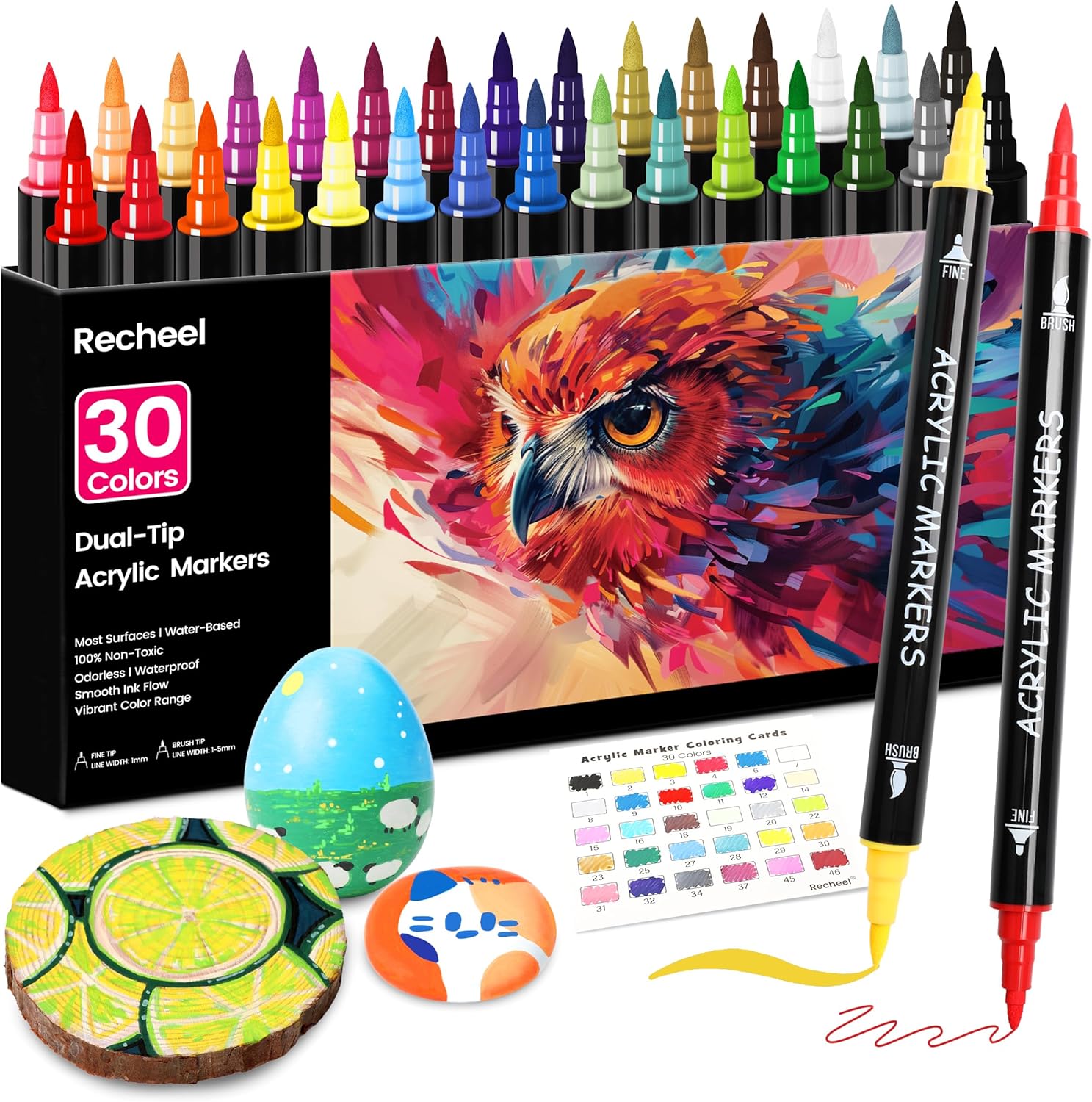
Recheel offers 30 colors with a 1 mm fine tip and a 1 to 5 mm brush tip. The listing describes highly pigmented, opaque, quick-drying, fade-resistant markers for outlining, coloring, blending and shading on paper and other surfaces.
Thirty colors is a sensible middle: enough range for most projects without a box full of near-duplicates.
Best suited for: First-time paint marker users and gift buyers who want a balanced set.
Key features:
- 30 colors
- 1 mm fine + 1-5 mm brush tips
- Quick-drying, fade-resistant per listing
Pros:
- Good value
- Dual tips
- Manageable color range
Cons and limitations:
- Fewer colors than the 48 set
- Brush tips wear on rough surfaces
Buying consideration: Practice blending by layering a light color over a darker one while the first is still slightly wet.
4. AcrylicAura 36 Color Soft Brush Tip Acrylic Markers — Best for brush strokes and lettering

AcrylicAura’s markers use a single 1 to 5 mm soft brush tip. The listing describes quick-drying, waterproof, fade-resistant ink for rock, wood, fabric, canvas and glass, non-toxic materials and a five-layer pull-out box.
A soft brush tip gives thick-and-thin strokes, which is ideal for brush lettering on signs, florals and leaves.
Best suited for: Brush lettering, florals and expressive strokes on signs and canvas.
Key features:
- 36 colors
- 1-5 mm soft brush tip
- Waterproof and fade-resistant per listing
- Pull-out storage box
Pros:
- Lovely stroke variation
- Organized storage
- Wide surface list
Cons and limitations:
- No fine bullet tip
- Brush tips can fray on rough rock
Buying consideration: For lettering, press lightly on upstrokes and harder on downstrokes to get thick-and-thin letters.
5. AKARUED Black Acrylic Paint Markers, 8 Pack — Best for black outlines and signs

AKARUED’s 8-pack contains black acrylic paint pens with 2 to 3 mm medium tips and fast-drying, opaque ink. The listing lists rock, wood, stone, ceramic, metal, pottery, terracotta, polymer clay, glass, mirrors, plastic and paper, and conformance with ASTM D-4236 and EN71-3. They are valve markers: shake, press the tip to start flow, then write.
Black is the color you use most on DIY projects: outlines, lettering, faces on rocks, labels on jars. Having eight means you can wear them out without hesitation.
Best suited for: Outlining, lettering on signs and labels, and any project that uses lots of black.
Key features:
- 8 black markers
- 2-3 mm medium tip
- Pump valve design
- ASTM D-4236 and EN71-3 per listing
Pros:
- Opaque black
- Bulk value
- Very broad surface list
Cons and limitations:
- Black only
- Medium tip not for very fine detail
Buying consideration: Prime a new valve marker on scrap paper and wipe off excess before touching your project to avoid blobs.
Buying Guide: How to Choose Paint Markers
Tip type
Fine bullet tips (around 1 mm) for lettering and details; medium tips (2-3 mm) for outlines; brush tips for strokes; dot tips for patterns.
Formula
Water-based acrylic is low odor and works on porous surfaces. Oil-based markers are tougher on non-porous surfaces.
Opacity
Opaque markers show on dark rocks, black chalkboards and wood. Test light colors on dark surfaces before buying many.
Valve or pre-activated
Valve markers are very opaque but need priming. Pre-activated markers are simpler.
Color count
More is not always better. Choose a set with the shades you need and buy extras of black and white.
Surface
Porous surfaces absorb marker paint. Glass, ceramic and plastic need longer drying and sealing.
Techniques That Make Paint Marker Art Look Better
Layer light over dark, then dark over light
Acrylic markers are opaque, but not infinitely so. On a dark rock or a black chalkboard sign, put down white first in the shapes you need, let it dry, then color over it. Bright yellows and pinks in particular look far stronger over a white underlayer. Finish with black outlines last so they sit crisp on top of everything.
Let each layer dry
Most frustration with paint pens comes from drawing over paint that is still wet. The tip drags the lower layer and picks up color, which muddies both the art and the marker. Wait until the surface is dry to the touch, a few minutes on porous surfaces and longer on glass, ceramic and plastic.
Clean a contaminated tip
If a light marker picks up dark paint, scribble on scrap paper until the true color returns. For valve markers, pressing the tip a few times on scrap helps flush it.
Fix mistakes
On non-porous surfaces, a cotton swab with a little water or rubbing alcohol can lift fresh acrylic marker. On porous surfaces like wood and rock, the easiest fix is to paint over the mistake with the background color and redraw once dry.
Plan with pencil
Sketch designs lightly in pencil on wood and paper, or with a white charcoal pencil on dark surfaces. Marker lines cover pencil easily, and planning avoids the most common mistake: running out of space for lettering.
Prep and Sealing for Common DIY Surfaces
Rocks
Wash and dry rocks fully. Smooth rocks are easiest. A base coat of acrylic gives an even background. Seal with a clear outdoor-rated sealer for garden rocks.
Wood
Sand lightly and wipe off dust. Raw wood can absorb ink and make lines spread, so a thin base coat or sanding sealer helps. Seal with a clear finish.
Glass and ceramic
Clean with rubbing alcohol. Allow extra drying time. Acrylic marker art on glass is decorative; do not assume it is dishwasher or food safe unless the product says so, and keep designs away from lip and food contact areas.
Fabric
Acrylic markers work for small details on fabric. For large designs, fabric paint is softer. Follow any heat-setting guidance on the marker label.
Pumpkins
Wipe the pumpkin clean and dry. Markers work well on smooth skin. Seal is optional since pumpkins are temporary. Painting instead of carving also keeps the pumpkin fresh for much longer, and the design can be wiped and redone if it goes wrong.
Ready for a project? Try our guides to painting DIY rocks for the garden, painting DIY ceramic tile patterns and painted wood slice art, all of which work beautifully with paint markers.
Common Mistakes to Avoid
- Pressing valve tips too hard. Paint floods and blobs.
- Using brush tips on rough rock. They fray quickly.
- Skipping the base coat on raw wood. Lines feather.
- Not sealing outdoor projects. Weather fades and lifts paint.
- Storing markers upright. Store horizontally unless the maker says otherwise.
- Assuming acrylic marker art is food safe. Check the label.
FAQs
What are the best paint markers for rocks?
Opaque acrylic markers with fine and dot tips, such as the ARTISTRO dual-tip set, work well. Seal finished rocks for outdoor use.
Are acrylic paint markers permanent?
They are permanent on porous surfaces once dry. On glass and glossy surfaces, sealing improves durability.
Do paint markers work on wood?
Yes. Lightly sand and consider a base coat so lines stay crisp, then seal.
How do I seal paint marker art?
Use a clear spray or brush-on sealer suited to the surface. Spray first over marker lines to avoid smearing.
Can I use paint markers on fabric?
For small details, yes. For large designs, fabric paint is softer and more flexible.
Why is my paint marker not working?
Shake it, and for valve markers press the tip on scrap paper to restart flow. Store markers capped and horizontal.
Final Recommendation
For most DIY projects, choose the Pagather 48-color dual-tip set. Pick ARTISTRO for rocks, dots and pumpkins, Recheel for a balanced starter set, AcrylicAura for brush lettering and florals, and keep an AKARUED black 8-pack on hand for outlines and signs.