

PaintingProGuide is reader-supported. When you buy through links on this page we may earn an affiliate commission at no extra cost to you.
You will use more white acrylic paint than any other color, often more than all the others combined. It tints every mix, builds highlights, primes over mistakes and lays down the base for lettering and craft work. That is why the best white acrylic paint for you is usually a bigger, more opaque tube or bottle than you would buy of any other color, and why it is worth knowing the difference between a titanium white for canvas and a matte craft white for wood and paper.
This guide compares seven whites, from artist-oriented titanium tubes to half-gallon classroom jugs, and explains which finish and body suit which job.
Quick answer: For canvas painting, Liquitex BASICS Titanium White (250 ml) is the best white acrylic paint for most people: thick and creamy with a satin finish, a good pigment load, and intermixable with Liquitex Professional colors. If you go through white fast, Mont Marte Signature Titanium White (500 ml) doubles the volume with a semi-matte finish. For crafts, signs and base-coating wood, Apple Barrel White dries matte and comes in 8 oz and 32 oz bottles.
Our Top Picks at a Glance
- Liquitex BASICS Titanium White, 250 ml — Best white acrylic paint for canvas
- Mont Marte Signature Titanium White, 500 ml — Best large-volume titanium white
- Nicpro White Acrylic Paint, 500 ml — Best squeeze bottle for multi-surface use
- Sax True Flow Heavy Body Titanium White, 1/2 Gallon — Best bulk white for classrooms and studios
- Apple Barrel White, 8 oz and 32 oz — Best matte white for crafts and wood
- RoseArt Snow White, 32 oz — Best gloss craft white in a large bottle
| Product | Best For | Key Spec | Key Strength | Price Tier |
|---|---|---|---|---|
| Liquitex BASICS Titanium White | Canvas painting, mixing | 250 ml tube, satin | Holds peaks and brush strokes | $ |
| Mont Marte Signature Titanium White | High-use painters | 500 ml, semi-matte | High viscosity, good coverage | $ |
| Nicpro White | Mixed surfaces | 500 ml flip-cap bottle, semi-gloss | Wide surface list | $ |
| Sax True Flow Heavy Body | Classrooms, bulk use | 64 fl oz jug, matte | Freeze-thaw stable | $$ |
| Apple Barrel White | Crafts, basecoating | 8 oz bottle, matte | Wood, paper, Styrofoam | $ |
| RoseArt Snow White | Bulk crafts | 32 oz bottle, gloss | Made in the USA, permanent | $ |
How We Chose
We based these picks on the Amazon listing details and specifications checked in October 2026, how well each white’s pigment description, body, finish and volume fit common painting jobs, and how widely each product is reviewed by Amazon buyers. We have not swatched these paints; opacity and finish notes come from the listings and from well-established properties of titanium white.
- Pigment: titanium white is the opaque, high-tinting standard for acrylic; products naming it get credit for predictability.
- Body: heavy body holds texture; fluid and craft bodies level out and cover flat areas.
- Finish: matte, satin, semi-gloss and gloss behave differently under varnish and on crafts.
- Volume: white runs out first, so we favored generous sizes.
- Surface fit: canvas, wood, paper, glass and fabric each favor a different white.
Best White Acrylic Paint Reviewed
1. Liquitex BASICS Titanium White, 250 ml — Best for canvas painting and color mixing
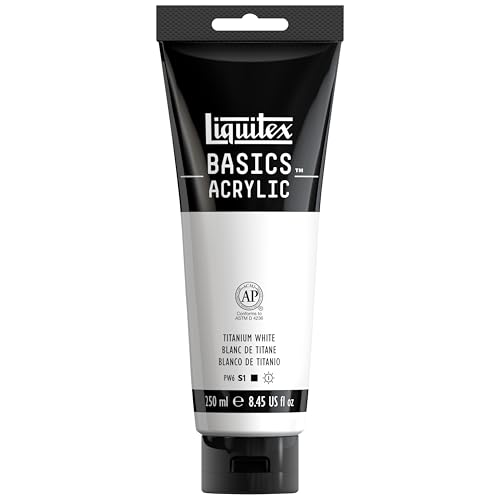
Liquitex BASICS is the student line from one of the best-known acrylic makers, and its titanium white is a dependable default. The listing describes a thick, creamy paint with a satin finish and a good pigment load that retains peaks and brush strokes. The 250 ml (8.45 oz) tube is a sensible size for white, which you will use at several times the rate of other colors.
Two details matter for painters who plan to grow. BASICS is intermixable with Liquitex Professional acrylics and mediums, so you can upgrade individual colors later without changing systems. And the paint conforms to ASTM D4236, labeled as safe for educational use. The listing also notes fade resistance.
Best suited for: Canvas painters, students and anyone learning color theory who needs a white that holds texture and tints predictably.
Key features:
- Titanium white pigment
- 250 ml / 8.45 oz tube
- Thick, creamy body with satin finish
- Retains peaks and brush strokes
- Intermixable with Liquitex Professional; ASTM D4236
Pros:
- Reliable titanium white from a major acrylic brand
- Heavy enough for impasto and texture
- Upgrade path to professional colors
Cons and limitations:
- Tube format is slower to dispense in bulk
- Satin finish may differ from matte craft colors
- Smaller than the 500 ml options
Buying consideration: If you mix a lot of pale tints, buy the white one size larger than your other colors; it will run out first.
2. Mont Marte Signature Titanium White, 500 ml — Best for high-volume painters

Mont Marte’s Signature line offers titanium white in a 500 ml (16.9 oz) container, twice the Liquitex tube. The listing promises fast drying, high viscosity for easy application, a creamy texture with excellent coverage and easy mixing with other colors and media, all with a semi-matte finish.
The surface list is broad: canvas, wood, fabric, leather, cardboard, paper and MDF. That makes it a good all-rounder for painters who split time between canvas work and crafts, and the bigger volume suits large backgrounds, gesso-style undercoats and paint-pouring white bases.
Best suited for: Painters who use a lot of white across canvas and craft projects and want titanium pigment in a large size.
Key features:
- Titanium white
- 500 ml / 16.9 oz
- Semi-matte finish
- High viscosity, fast drying
- Canvas, wood, fabric, leather, cardboard, paper, MDF
Pros:
- Large volume of titanium white
- Versatile surface list
- Semi-matte suits most work
Cons and limitations:
- Less detail on pigment load than Liquitex
- Not as heavy as dedicated heavy-body paints
- Fabric use typically needs a fabric medium for flexibility
Buying consideration: For fabric projects, mix in a textile medium so the white stays flexible and survives washing.
3. Nicpro White Acrylic Paint, 500 ml — Best for mixed surfaces in a squeeze bottle

Nicpro’s 500 ml white comes in a flip-cap squeeze bottle, which is faster and less wasteful than a tube when you need a lot of paint at once. The listing describes smooth, highly pigmented paint with a creamy texture and a matte finish in the bullets, while the product details list semi-gloss, so expect a soft sheen rather than flat chalky matte.
It claims fast drying with good coverage and fade resistance, and lists an unusually wide range of surfaces including wood, glass, stone, stretched canvas, plastic, craft foam, ceramic, terracotta and chalkboard. The details add crack resistance.
Best suited for: Crafters and mixed-media painters who move between canvas, wood, stone and terracotta and want one big bottle of white.
Key features:
- 500 ml / 16.9 oz flip-cap bottle
- Creamy, highly pigmented
- Semi-gloss per details; matte per bullets
- Fast drying, crack and fade resistant
- Non-toxic, water-based
Pros:
- Squeeze bottle is quick to dispense
- Very broad surface list
- Generous volume
Cons and limitations:
- Finish description is inconsistent
- Pigment type not named
- Glass and ceramic need sealing for durability
Buying consideration: On glass, ceramic and terracotta, seal finished work with a compatible varnish; acrylic alone will scratch and is not dishwasher safe.
4. Sax True Flow Heavy Body Titanium White, 1/2 Gallon — Best for classrooms and bulk studio use
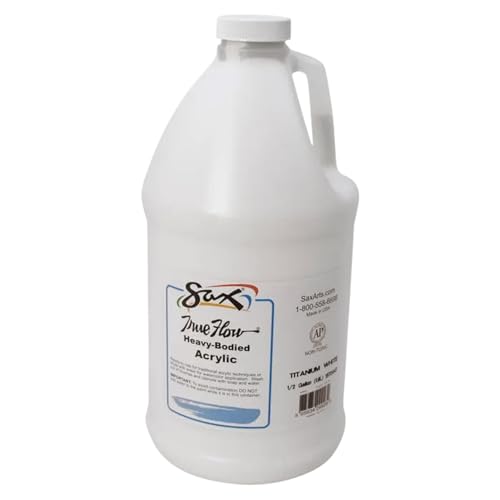
When white goes out by the cupful, a half-gallon jug is the answer. Sax True Flow is a titanium white in a 64 fl oz plastic bottle described as easy to pour and store, with a freeze-thaw stable formula and soap-and-water cleanup. It is labeled heavy body, matte, non-toxic and low odor.
Sax is a school-supply brand, and the listing calls the paint student-friendly. That is the right expectation: this is not an artist-grade white, but it is very good value for murals, large canvases, priming, set painting and classroom projects where volume matters more than ultimate opacity.
Best suited for: Teachers, mural painters, large-canvas painters and studios that burn through white.
Key features:
- Titanium white
- 64 fl oz (1/2 gallon) jug
- Heavy body, matte finish
- Freeze-thaw stable
- Non-toxic, low odor
Pros:
- Huge volume
- Freeze-thaw stability for shipping and storage
- Matte finish suits murals
Cons and limitations:
- Student-grade
- Jug is awkward for small sessions
- Decant into smaller bottles to keep it fresh
Buying consideration: Decant a working amount into a small squeeze bottle and keep the jug sealed; repeated opening lets the paint skin over.
5. Apple Barrel White Acrylic Paint — Best for crafts, wood and basecoating

Apple Barrel is the default craft paint in many American homes, and its white is a staple for basecoating, stenciling and DIY projects. It dries to a matte finish and is listed for wood, paper, canvas, Styrofoam and paper mache, cleaning up with soap and water while wet.
The 8 oz bottle suits occasional crafters. If you paint signs, furniture details or a lot of classroom crafts, the same paint comes in a 32 oz Apple Barrel White bottle, which is far better value per ounce. Craft paint is thinner and less pigmented than artist titanium white, so expect to apply two or three coats over dark surfaces.
Best suited for: Crafters, teachers and DIYers base-coating wood, paper mache and foam, or stenciling signs.
Key features:
- 8 oz bottle (also available in 32 oz)
- Matte finish
- Wood, paper, canvas, Styrofoam, paper mache
- Soap-and-water cleanup
- Non-toxic
Pros:
- Very affordable
- Matte finish suits crafts and chalky looks
- Widely available
Cons and limitations:
- Craft-grade coverage needs multiple coats
- Not intended for fine-art mixing
- Thin body does not hold texture
Buying consideration: For wood crafts, sand lightly and seal with a clear acrylic sealer after painting; the matte white marks easily if left unsealed.
6. RoseArt Snow White Acrylic Paint, 32 oz — Best for gloss craft white in bulk

RoseArt Snow White is a 32 oz water-based acrylic made in the USA and described as permanent, non-toxic and suited to blending, layering and mixing. The details list a gloss finish, which sets it apart from the matte craft whites here, and the surface list includes wood, canvas, paper, plastic, metal and clay.
Gloss white is handy for craft projects where you want a little shine without a separate varnish, such as painted clay pieces and kids’ crafts. For fine-art work, the gloss can make a white passage read differently from surrounding matte or satin colors.
Best suited for: Classrooms and crafters who want a large, affordable bottle with a glossier finish.
Key features:
- 32 fl oz bottle
- Gloss finish
- Wood, canvas, paper, plastic, metal, clay
- Water-based, permanent, non-toxic
- Made in the USA
Pros:
- Large volume
- Gloss finish without varnish
- Permanent when dry
Cons and limitations:
- Gloss may not match matte artwork
- Craft-grade opacity
- Pigment type not stated
Buying consideration: If you need a matte result for crafts, choose Apple Barrel instead; if you need shine, RoseArt saves a varnish step.
Buying Guide: How to Choose White Acrylic Paint
Titanium white versus other whites
Titanium white is the opaque, strongly tinting white used in most acrylic painting. It covers well and lightens colors quickly. Zinc white, when offered, is more transparent and gentler for glazing and subtle tints. Craft whites are often unnamed blends designed for coverage on crafts rather than for mixing. Our comparison of zinc white vs titanium white acrylic explains when each is worth having.
Body: heavy, soft or fluid
Heavy-body whites hold peaks and brush marks, which is useful for highlights and texture. Softer and craft-body whites level out smoothly for flat coverage. Fluid whites are best for pouring and airbrush.
Finish
Matte whites look chalky and are easy to paint over; satin and semi-gloss have a soft sheen; gloss is shiny and can make white passages stand out. If you plan to varnish the finished piece, the varnish will unify the finish anyway.
Volume and format
Buy white larger than other colors. Tubes keep paint fresh and are easy to control; squeeze bottles dispense faster; jugs are economical for big projects but need decanting.
Mixing off-whites and tints
Pure white rarely looks natural in a painting. Most whites in real scenes are slightly warm or cool. Read our guide on how to mix off-white acrylic paint to learn how a touch of yellow ochre, burnt umber or blue changes the temperature.
Surface and durability
On canvas, any acrylic white works. On wood, paper mache and foam, matte craft whites are easiest. On glass, ceramics and terracotta, choose a white listed for those surfaces and seal it.
Projects That Use a Lot of White
White does heavy lifting in large decor pieces. Our tutorial on making DIY wall art with acrylic uses a white ground and tints throughout, and if you are painting containers, see whether you can use acrylic paint on glass jars before you start.
Common Mistakes to Avoid
- Adding white to darken or cool every mix. White lightens but also dulls colors; sometimes a lighter hue is better than white.
- Using craft white for fine-art highlights. It may lack the opacity to pop over dark passages in one coat.
- Leaving squeeze bottle caps dirty. Dried paint in the nozzle stops the cap closing and lets the bottle dry out.
- Ignoring finish mismatch. Gloss white next to matte colors looks patchy unless the piece is varnished.
- Painting white straight onto raw wood. Tannins can bleed through; prime or seal first.
- Buying white in the same small size as other colors. You will run out mid-painting.
FAQs
What is the best white acrylic paint for canvas?
Liquitex BASICS Titanium White is a strong choice: it is a titanium white with a thick, creamy body, satin finish and good pigment load. Mont Marte Signature Titanium White is a larger-volume alternative.
Is titanium white better than regular white acrylic?
For painting on canvas, titanium white is usually better because it is opaque and tints strongly. Unnamed craft whites are designed for coverage on crafts and can be less opaque.
Why does my white acrylic look streaky?
Craft whites and thin applications often need two or three coats. Let each coat dry, use a soft flat brush and avoid overworking paint as it starts to set.
Which white acrylic paint is best for wood crafts?
A matte craft white such as Apple Barrel is easy to brush on wood. Prime or seal raw wood first, then seal the finished paint with a clear acrylic sealer.
Can I use white acrylic paint as gesso?
In a pinch, acrylic white can serve as a primer on already-sized surfaces, but true gesso has more tooth and is more absorbent. For a large primer job, a bulk white like Sax is economical.
Does white acrylic paint yellow over time?
Quality acrylic whites are generally stable. Yellowing on finished work usually comes from varnish, dirt or tannin bleed from wood rather than from the white paint itself.
Final Recommendation
If you paint on canvas, start with Liquitex BASICS Titanium White, and step up to Mont Marte Signature 500 ml when you need more volume. Nicpro’s squeeze bottle is the most convenient choice for mixed-surface crafters, and teachers or mural painters should buy the Sax half-gallon and decant it.
For crafts, Apple Barrel White in 8 or 32 oz is the matte workhorse, while RoseArt Snow White is the pick when a glossy finish saves a varnish step.


4 Comments