
PaintingProGuide is reader-supported. When you buy through links on this page we may earn an affiliate commission at no extra cost to you.
Quick answer: In the canvas panel vs stretched canvas decision, choose canvas panels for practice, studies, plein air and anything you want to frame behind glass or store flat; choose stretched canvas for finished pieces you want to hang without a frame, large formats and work with a springy surface. If you want to try both, the Shuttle Art 34-pack mixed set includes 20 panels and 14 stretched canvases. For panels alone, the FIXSMITH 11 x 14 triple-primed panels on MDF are the sturdiest here; for professional stretched canvas, look at the U.S. Art Supply 12 oz 8 x 24 six-pack.
Both surfaces start the same way: primed cotton (or cotton blend) fabric. The difference is what sits behind it. A canvas panel, also called a canvas board, glues the fabric to a rigid board such as cardboard, composite board or MDF. A stretched canvas pulls the fabric over a wooden stretcher frame and staples it on the back or sides, leaving it suspended like a drum.
That one structural difference changes how the surface feels under the brush, how much it costs, how you store and display it and how long it lasts. This comparison walks through each factor, then recommends specific panels and stretched canvases from current Amazon listings.
Canvas Panel vs Stretched Canvas: Side-by-Side
| Factor | Canvas Panel | Stretched Canvas |
|---|---|---|
| Construction | Fabric glued to rigid board (cardboard, composite, MDF) | Fabric stretched over a wooden frame |
| Surface feel | Firm, no bounce | Slight spring and give |
| Thickness | About 1/8 to 1/4 inch | Usually 5/8 to 1 1/2 inch deep |
| Cost per size | Lower | Higher |
| Storage | Stacks flat, fits in portfolios and pochade boxes | Bulky; needs racks or shelf space |
| Display | Needs a frame | Can hang unframed, especially deep profiles |
| Best sizes | Small to medium (up to about 16 x 20) | Any, including very large |
| Durability | Resists punctures; cheap cardboard can warp in humidity | Can be dented or punctured; tension can loosen |
| Ideal uses | Studies, practice, plein air, classes, framing | Finished work, gallery display, large paintings |
Canvas Panels Explained
A panel gives you a hard surface that does not move when you press a palette knife into it or scrub in an underpainting. That firmness is excellent for detailed work, small studies and techniques like sgraffito. Panels are also thin, so ten of them take up less space than two stretched canvases, which matters if you paint every day.
The core material is the quality variable. Inexpensive panels use pressed cardboard that can bow if you load them with wet media or store them in a damp room. Better panels use composite board or MDF, which stays flat. If you plan to keep a painting, choose acid-free materials so the board does not yellow the fabric over time.
Stretched Canvas Explained
Stretched canvas is what most people picture when they think of a painting. The fabric has a light bounce that many painters like for loose, gestural brushwork. It is also the only practical option for big pieces, because large boards get heavy and expensive.
Profile depth matters. A standard 5/8 to 3/4 inch profile is usually framed. Deep “gallery” profiles of 1 1/2 inches can hang frameless with the painting continued around the edges. Back-stapled canvases have clean sides; side-stapled canvases expect a frame. Canvas weight is typically quoted as finished weight in ounces per square yard; heavier is more durable.
Our Top Picks at a Glance
- Shuttle Art 34-Pack Panels + Stretched Canvas — Best way to compare both formats
- FIXSMITH 11 x 14 Canvas Boards, 4-pack — Best rigid canvas panel
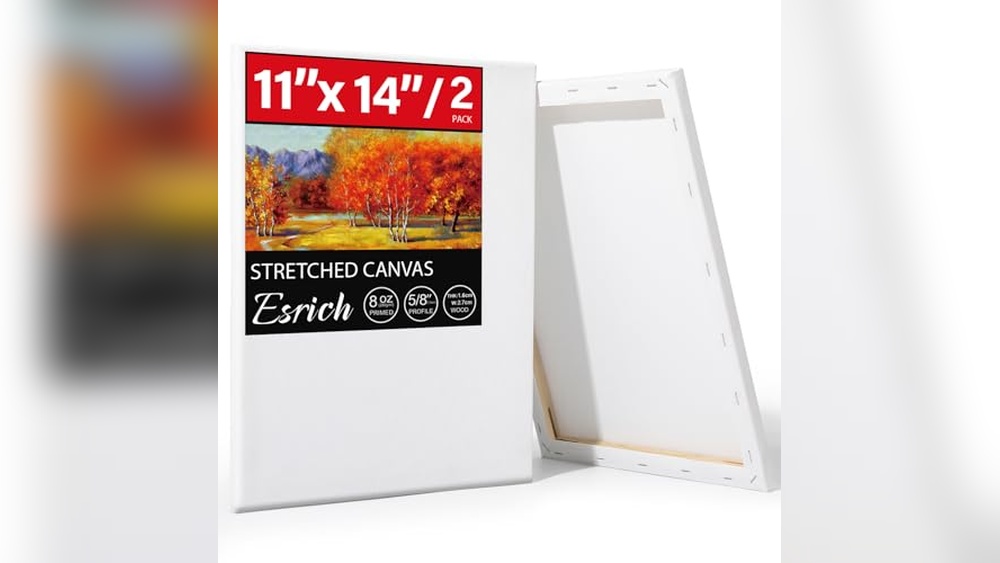
- ESRICH 11 x 14 Canvas Boards, 2-pack — Best budget canvas panel
- U.S. Art Supply 8 x 24 Stretched Canvas, 6-pack — Best professional stretched canvas
- ESRICH 9 x 12 Stretched Canvas, 2-pack — Best entry-level stretched canvas
- ESRICH 4-pack Multi-size Stretched Canvas — Best small-format sampler
- MECCANIXITY 10 x 12 Stretched Canvas, 2-pack — Best for oil studies on stretched canvas
| Product | Best For | Key Spec | Key Strength | Price Tier |
|---|---|---|---|---|
| Shuttle Art 34-Pack | Trying both formats | 20 panels + 14 stretched, 5×7 to 11×14 | 100% cotton, both types in one box | $$ |
| FIXSMITH 11×14 Boards | Rigid panels | Triple-primed cotton on MDF | Will not bend or curl | $ |
| ESRICH 11×14 Boards | Budget panels | Cotton, board core | Low cost per panel | $ |
| U.S. Art Supply 8×24 | Professional stretched | 12 oz, 3/4 in profile, back stapled | Kiln-dried pine bars | $$$ |
| ESRICH 9×12 Stretched | Entry-level stretched | 8 oz cotton, 5/8 in pine frame | Acid-free gesso | $ |
| ESRICH 4-Pack Multi-size | Small stretched sampler | 3×5, 5×7, 8×10, 10×12 | Four sizes to try | $ |
| MECCANIXITY 10×12 | Oil studies | 4/5 in profile, cotton | Medium texture for oils | $$ |
How We Chose
We selected these surfaces based on the Amazon listing details and specifications checked in October 2026, how clearly each listing states its construction (board core, frame, profile, priming and weight), how well each product represents its format in this comparison, and how widely each product has been reviewed by Amazon buyers. We have not painted on these specific products.
- Core or frame quality: MDF and composite boards, kiln-dried or pine stretcher bars.
- Priming: acid-free gesso, with triple priming noted where listed.
- Fabric: cotton content and stated weight.
- Sizes and pack value: useful sizes for practice versus finished work.
Best Canvas Panels and Stretched Canvases Reviewed
1. Shuttle Art 34-Pack Multi-Size Canvas Set — Best for comparing both formats

If you are still deciding, this set settles it with practice. It includes 20 canvas panels (eight 5 x 7, eight 8 x 10, five 9 x 12 and five 11 x 14) plus 14 stretched canvases in matching sizes. The fabric is 100% cotton, and the panels use strengthened composite cardboard to stay flat.
Painting the same subject on a panel and a stretched canvas of the same size is the fastest way to learn which surface you prefer. The listing states ASTM D4236 conformance, non-toxic and acid-free.
Best suited for: beginners, art students and anyone undecided between panels and stretched canvas.
Key features:
- 20 panels and 14 stretched canvases
- Sizes from 5 x 7 to 11 x 14
- 100% cotton, primed
- Composite cardboard panel cores
- ASTM D4236, acid-free
Pros:
- Direct side-by-side comparison
- Good value for practice
- Range of small and medium sizes
Cons and limitations:
- No large stretched sizes
- Cardboard-core panels are less rigid than MDF
Buying consideration: Use the panels for quick studies and save the stretched canvases for the paintings you want to keep.
2. FIXSMITH 11 x 14 Canvas Boards (4-pack) — Best for a rigid canvas panel

FIXSMITH glues unwashed 100% cotton canvas over acid-free MDF boards and triple-primes it with gesso. The listing says the boards will not bend or curl even with heavy paint, which is exactly the weakness of cheap cardboard panels.
At 11 x 14 inches they fit standard frames, and the firm MDF core supports palette-knife work and thick impasto.
Best suited for: oil and acrylic studies you may frame, impasto and knife painting.
Key features:
- 100% unwashed cotton
- Triple-primed acid-free gesso, 8 oz after priming
- Acid-free MDF core
- 11 x 14 inches, 4-pack
Pros:
- Stays flat
- Frameable standard size
- Handles heavy paint
Cons and limitations:
- MDF is heavier than cardboard
- Only one size per pack
Buying consideration: Seal or prime the back edge if you live somewhere humid; exposed MDF edges can absorb moisture.
3. ESRICH 11 x 14 Canvas Boards (2-pack) — Best for a budget canvas panel

ESRICH panels use pure cotton with a smooth surface over a sturdy board core, primed with an acid-free, non-toxic primer. They are listed for oil, acrylic, watercolor, gouache, tempera and pouring.
They are inexpensive enough to use freely for practice, which is often the main reason to buy panels in the first place.
Best suited for: practice paintings, classes and painting parties.
Key features:
- Pure cotton surface
- Acid-free primer
- Board core
- 11 x 14 inches, 2-pack
Pros:
- Low cost
- Smooth surface suits detail
- Standard frame size
Cons and limitations:
- Only two per pack
- Smooth surface has less tooth for heavy texture
Buying consideration: Buy several packs at once if you paint daily; small packs run out quickly.
4. U.S. Art Supply 8 x 24 Stretched Canvas (6-pack) — Best for professional stretched canvas

These are heavier 12 oz finished-weight canvases, triple primed with acid-free titanium gesso and hand-stretched onto kiln-dried pine bars. They are back stapled for clean edges and have a 3/4 inch profile.
The 8 x 24 panoramic format is great for landscapes, seascapes and triptych-style arrangements. Medium-grain cotton holds paint without soaking it up.
Best suited for: finished paintings, panoramic landscapes and multi-canvas wall sets.
Key features:
- 12 oz finished weight
- Triple-primed titanium gesso
- 3/4 in profile, back stapled
- Kiln-dried pine stretcher bars
- 8 x 24 inches, 6-pack
Pros:
- Heavier, more durable canvas
- Clean stapled edges
- Unusual panoramic format
Cons and limitations:
- Highest price tier here
- Panoramic size not for every subject
Buying consideration: Three of these hung side by side make a ready-made triptych for a sofa wall.
5. ESRICH 9 x 12 Stretched Canvas (2-pack) — Best for entry-level stretched canvas
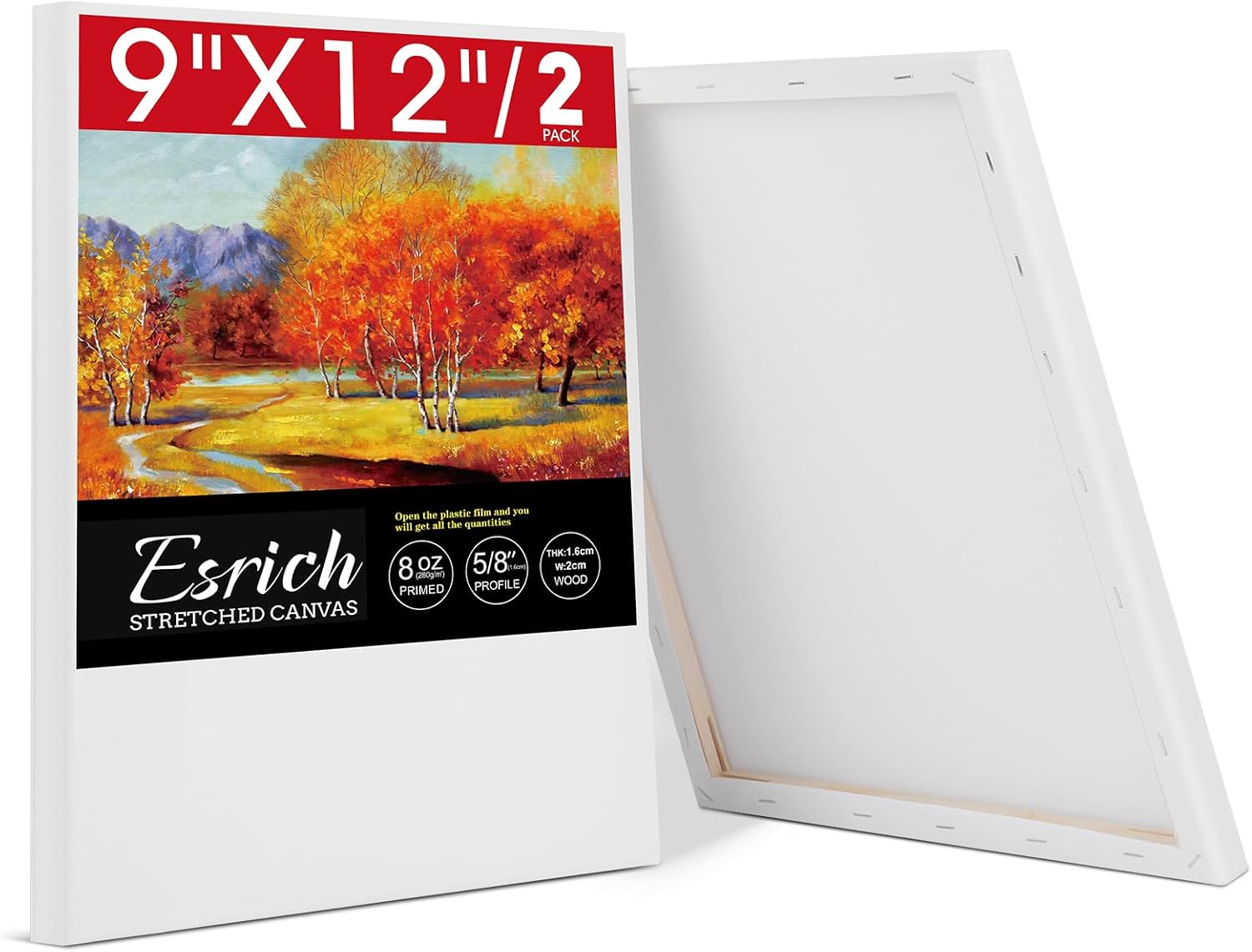
ESRICH nails cotton canvas pre-coated with acid-free acrylic gesso onto a 5/8 inch pinewood frame. Primed weight is listed at 8 oz.
It is a straightforward, affordable stretched canvas for practice and painting parties.
Best suited for: beginners trying stretched canvas for the first time.
Key features:
- 8 oz primed cotton
- Acid-free acrylic gesso
- 5/8 in pine frame
- 9 x 12 inches, 2-pack
Pros:
- Affordable
- Common, frameable size
- Light to carry
Cons and limitations:
- Lighter canvas weight than professional options
- Thin profile needs framing for a finished look
Buying consideration: Tighten slack corners with a few drops of water on the back of the canvas; it shrinks slightly as it dries.
6. ESRICH 4-Pack Multi-Size Stretched Canvas — Best for a small-format sampler

One each of 3 x 5, 5 x 7, 8 x 10 and 10 x 12 inches, all on 5/8 inch pinewood frames with acid-free gesso.
Small stretched canvases are handy for gifts and for testing how a palette or technique works before scaling up.
Best suited for: gifts, miniatures and testing ideas.
Key features:
- Four sizes
- 5/8 in pine frame
- Acid-free acrylic gesso
Pros:
- Lowest cost way to try stretched canvas
- Good for mini paintings
Cons and limitations:
- Very small sizes
- Single canvas per size
Buying consideration: Paint a color study on the 3 x 5 before committing to the 10 x 12.
7. MECCANIXITY 10 x 12 Stretched Canvas (2-pack) — Best for oil studies on stretched canvas

MECCANIXITY describes these as designed for oil painting, with a medium-textured cotton surface over a wooden frame and a 4/5 inch profile. The listing includes sensible drying advice: allow oils one to three days between layers and varnish when finished.
Internal dimensions are given as about 10.24 x 8.27 inches, which is useful if you plan to frame.
Best suited for: oil painters who want a medium-tooth stretched surface.
Key features:
- Pure cotton, medium texture
- 4/5 in profile
- 10 x 12 inches, 2-pack
- Acid-free materials
Pros:
- Oil-focused surface
- Clear usage guidance
Cons and limitations:
- Higher price per canvas than ESRICH
- Only two per pack
Buying consideration: Check the frame size against your frames before buying; 10 x 12 is less common than 9 x 12 or 11 x 14.
Verdict by Use Case
- Daily practice and studies: canvas panels. They are cheaper and store flat.
- Plein air: panels, because they fit pochade boxes and wet-panel carriers.
- Finished work to hang unframed: stretched canvas, ideally with a deeper profile.
- Large paintings over 24 inches: stretched canvas.
- Impasto and knife work: rigid MDF panels or tightly stretched heavy canvas.
- Kids and classes: budget panels or small stretched packs.
Buying Guide: How to Choose Between Canvas Panels and Stretched Canvas
Decide what happens after you paint
If the painting goes into a frame or a drawer, use a panel. If it goes straight on a wall, use stretched canvas.
Check the core or frame
MDF and composite panels stay flatter than cardboard. Kiln-dried pine or solid wood stretcher bars resist warping better than thin, unspecified frames.
Look at canvas weight and priming
Professional stretched canvas is often 10 to 12 oz finished weight. Triple priming gives a smoother, more sealed surface; single priming leaves more texture and absorbency.
Mind the profile
Thin profiles (5/8 to 3/4 inch) look best framed. Deep profiles (1 1/2 inch) can hang frameless.
Match the size to your purpose
Small sizes for studies, 11 x 14 and 16 x 20 for standard framed work, and larger stretched canvases for statement pieces.
Think about storage
If space is tight, panels win easily. A stack of twenty panels takes less room than four stretched canvases.
Go Deeper on Each Surface
For practical technique, see our guide on how to use canvas panels vs stretched canvas in your painting routine, and the companion article on stretched canvas vs canvas panel trade-offs. Brushes matter too: our Rosemary and Co vs Escoda brush comparison covers two favorite brush makers for both surfaces. Planning a set of canvases for one wall? Read how to paint a three-panel canvas set, and if a stretched canvas gets damaged, here is how to fix a ripped canvas painting.
Common Mistakes to Avoid
- Using cheap cardboard panels for paintings you want to keep for decades.
- Buying shallow-profile stretched canvas and hanging it unframed, which looks unfinished.
- Painting heavy watercolor washes on canvas panels and expecting them to stay flat.
- Storing stretched canvases leaning on their faces, which dents the surface.
- Ignoring the internal frame size when buying frames for stretched canvas.
- Assuming all “canvas boards” are the same; the core material varies widely.
FAQs
Is canvas panel or stretched canvas better for beginners?
Canvas panels are usually better for beginners because they are cheaper, easier to store and fine for practice. Move to stretched canvas when you start making paintings to display.
Can you frame a canvas panel?
Yes. Panels are thin and fit standard frames in common sizes such as 8 x 10, 11 x 14 and 16 x 20, with or without glass.
Do canvas panels warp?
Cheap cardboard cores can warp with moisture or heavy wet media. MDF or composite cores, like the FIXSMITH boards, are much more stable.
Is stretched canvas more professional?
Galleries more commonly hang stretched canvas, but many professional painters, especially plein air and small-format painters, work on high-quality panels.
Can I use oil paint on canvas panels?
Yes. Primed canvas panels accept oil and acrylic. Choose acid-free panels for oil paintings you want to last.
Why does my stretched canvas sag?
Changes in humidity and temperature loosen the fabric. Lightly misting the back with water, or tapping in corner keys on canvases that have them, usually tightens it.
Final Recommendation
There is no single winner in the canvas panel vs stretched canvas question; it depends on what the painting is for. Use panels for practice, plein air and framed work, and the FIXSMITH MDF boards are the sturdiest choice here, with ESRICH boards as a cheap practice option. Use stretched canvas for display pieces and large work; the U.S. Art Supply 12 oz six-pack is the most professional option in this list, while ESRICH stretched canvases cover budget needs. If you have never compared the two, the Shuttle Art 34-pack lets you find your preference without guessing.




