
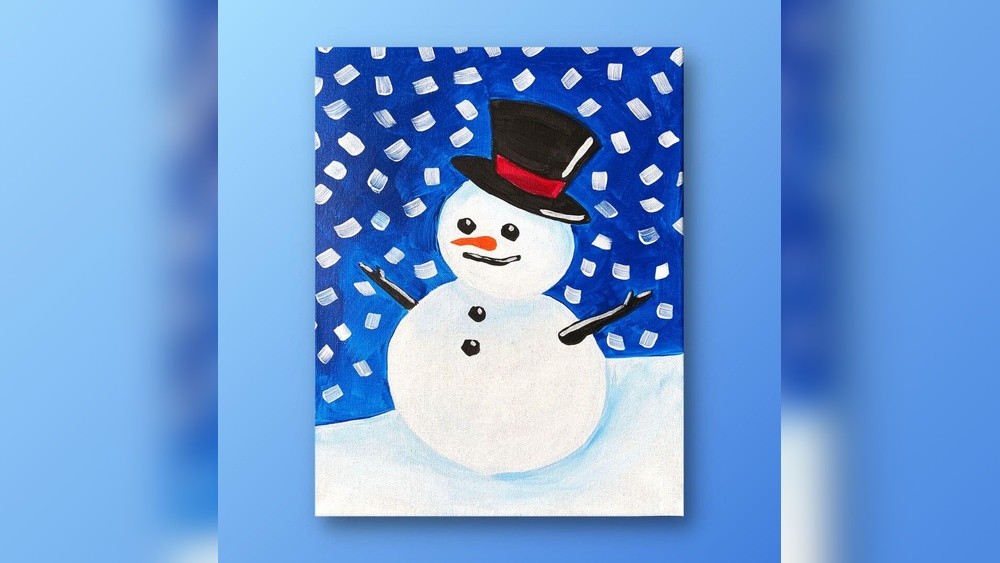
Quick answer: Here is how to paint a snowman for kids the easy way: paint a dark or blue background first so white shows up, let it dry, then paint three stacked white circles: the largest at the bottom, a medium one in the middle and the smallest on top. After the white dries (it often needs two coats), add coal-dot eyes and mouth, an orange triangle carrot nose, button dots, stick arms, a hat and a scarf. Finish with white dot snowflakes flicked or dabbed across the sky. Plan 40 to 50 minutes.
The trickiest part of painting a snowman is not the snowman. It is the fact that the snowman is white, and most kids paint on white paper. Solve that one problem with a colored background and the rest is just three circles and a handful of fun accessories.
Below is how to paint a snowman for kids easy enough for preschoolers, with a classic three-ball method, alternative tools like cups and sponges, three different snowman scenes, ideas for accessorizing and a fix list for when the white looks gray or streaky.
The Background Comes First
White paint on white paper barely shows. You have three good ways around this:
| Option | How it works | Best for |
|---|---|---|
| Painted background | Paint the paper blue, navy, purple or a sunset blend first and let it dry | Ages 5 and up, classic scenes |
| Colored paper | Start on dark blue, black or light blue construction paper | Preschoolers, quick sessions |
| Outlined snowman on white paper | Paint a pale blue sky around the snowman, leaving him white | Kids who like careful painting |
Dark backgrounds make the snowman glow and give white snowflakes something to stand out against. They also look striking on a wall. If you are planning a series of seasonal projects, the main painting for kids guide has more ideas for winter and holiday art.
Supplies
- Heavy paper or a canvas panel, held tall (portrait orientation)
- Washable tempera or student acrylic: white, blue (or navy), black, orange and two or three accessory colors such as red, green and purple
- A wide flat brush for the background, a medium round brush and a small round brush
- Circle tools (optional): a large cup, a smaller cup, a bottle cap or a cork
- Cotton swabs or a pencil eraser for dots
- An old toothbrush for snow splatter (optional)
- Water cups, paper towels, palette, smock
How to Paint a Snowman for Kids Easy: Step-by-Step
Step 1: Paint the sky
Use the wide brush to paint the whole paper blue. For a more interesting sky, start with dark blue at the top and gradually add white to your brush as you move down so the sky lightens toward the horizon. Paint a white or very pale blue snowy ground across the bottom fifth of the paper, with a slightly wavy top edge for snowdrifts.
Let the background dry fully, about 15 minutes. Painting white circles over wet blue gives a pale blue snowman.
Step 2: Paint the bottom snowball
Paint a large white circle sitting on the snowy ground, centered horizontally. It should be roughly a third of the paper’s width. To get a neat circle, kids can trace a cup with a pencil first or dip the rim of a large cup in white paint and stamp the outline, then fill it in.
Step 3: The middle and top snowballs
Paint a medium circle on top of the bottom one, overlapping slightly. Then a small circle on top for the head. Each circle should be noticeably smaller than the one below, which is what makes a snowman look balanced.
Step 4: Second coat of white
White paint is often semi-transparent, especially over a dark background. Wait 10 minutes and add a second coat. Two thinner coats look smoother than one thick one, and they dry faster.
Step 5: Let it dry
Give the snowman 10 to 15 minutes. Use the time to plan accessories: What kind of hat? What color scarf? Is it a happy, sleepy or silly snowman?
Step 6: Face
Press a cotton swab or pencil eraser in black for two eyes and a curved row of five or six small dots for a coal smile. For the carrot nose, paint a small orange triangle pointing sideways from the middle of the face. A few thin darker orange lines across the carrot make it look like a real carrot.
Step 7: Buttons and arms
Dot three black buttons down the middle snowball. Paint two thin brown stick arms angling up and out from the sides, each with two or three small branch “fingers” at the end.
Step 8: Hat and scarf
Paint a black top hat as a rectangle with a wider flat brim, sitting on the head. Add a colored band. For a scarf, paint a band of color around the neck where the head meets the middle snowball, with one end hanging down. Once dry, add stripes or dots to the scarf.
Step 9: Snowfall
Dip a cotton swab in white and dot snowflakes across the sky in different sizes. For a snowstorm effect, an adult can help flick white paint from an old toothbrush: load the bristles lightly and run a thumb across them while pointing at the paper. Practice on scrap paper first, because too much paint makes blobs.
Three Snowman Scenes to Try
Snowman at night
Paint a navy or black sky with a pale yellow moon. The snowman glows white in contrast. Add tiny white star dots and snowflakes. This is one of the most dramatic versions and great for ages 6 and up.
Melting snowman
Paint a white puddle with a wavy edge on the ground. Place the snowman’s hat, carrot, two coal eyes and stick arms floating in or around the puddle. Kids find this hilarious, and it takes about half the time of a full snowman.
Snowman from below
Paint a huge bottom snowball filling most of the lower paper, a smaller middle and a tiny head at the top, as if looking up at a giant snowman. It teaches kids about perspective in a fun way.
Easy Paint Ideas for Kids: Tools That Make Perfect Circles
Round circles are hard for small hands. These household items make it easy:
- Cups in three sizes: Dip the rim in white paint and stamp outlines, then fill in.
- Sponge circles: Cut circles from sponges or use round makeup sponges for solid, textured snowballs.
- Toilet paper tube: Press the end in paint for the smallest snowball or for snowflakes.
- Fingerprints: Three stacked fingerprints make a mini snowman. Paint a whole row of them across a card.
- Cotton balls held with clothespins: Dab snowballs with a soft, fluffy texture. The clothespin keeps fingers clean.
Easy Canvas Painting Ideas for Kids Step by Step: Snowman Accessories
Accessories give the snowman personality. Let kids mix and match:
| Accessory | How to paint it | Difficulty |
|---|---|---|
| Top hat | Tall rectangle plus a wide flat brim | Easy |
| Beanie | Half circle with a band and a pom-pom dot on top | Easy |
| Earmuffs | Two colored circles on the sides of the head, a curved band over the top | Easy |
| Scarf | Band around the neck, one end hanging, stripes once dry | Medium |
| Mittens | Small mitten shapes at the end of stick arms | Medium |
| Rosy cheeks | Pink dots dabbed with a finger or swab | Easy |
| Broom or shovel | A brown stick with a yellow fan or gray rectangle | Medium |
Easy Rock Painting Ideas for Kids: Snowman Stones
A tall, slightly flat oval rock can become a standing snowman, and three small round pebbles glued in a stack make a 3D one. Wash and dry the rock, then paint it white. Rocks usually need two or three coats of white for solid coverage, with about 15 minutes of drying between coats.
Once the white is dry, paint the face near the top: dot eyes, a dotted smile and an orange carrot nose. Add a hat across the top edge and a scarf band about a third of the way down. Buttons go below the scarf. Student acrylic grips stone better than tempera, which can flake when the rock is handled. If the snowman will live outdoors or on a windowsill, an adult can seal it with a clear water-based sealer once the paint has cured, following the label directions.
Snowman rocks make sweet holiday gifts for teachers and grandparents, and they are a good way to use up leftover white paint after the paper project.
Snowman Tips by Age
Ages 2 to 4
Use dark construction paper so no background painting is needed. Offer white paint with sponges or cotton balls for snowballs. An adult can add the face and arms with markers once dry. A fingerprint snowman is also a toddler-friendly option.
Ages 5 to 7
Paint the background and follow the full method with a cup tracing for circles. Talk about big-medium-small as you go, a gentle lesson in size order. Encourage at least one personal accessory.
Ages 8 and up
Add shading to make snowballs look round: once the white is dry, mix a little blue into white and paint a soft crescent along one side of each snowball. Try the night scene or a snowman family with different heights and outfits.
Common Problems and Fixes
- Snowman looks blue or gray. White was painted over a wet background. Let it dry and add another white coat.
- White looks streaky. Add a second coat once the first is dry. Use less water.
- Snowballs all the same size. Paint over the top one in background color once dry and repaint it smaller.
- Snowman floating. Extend the bottom snowball into the snowy ground, or paint a soft blue shadow under it.
- Snowflakes are blobs. Too much paint on the swab or toothbrush. Blot first and press lightly.
- Carrot looks like a beak. Make it longer and thinner, pointing sideways, with a couple of lines across it.
Easy Things to Paint for Kids This Winter
Snowmen pair nicely with other cold-weather subjects that use similar techniques:
- Snowy pine trees: Green triangles with white dabs on the branches.
- Penguins: Black ovals with white bellies, orange beaks and feet.
- Mittens: Mitten shapes filled with patterns, like the scarf.
- Winter night sky: Dark blue sky, moon, stars and snow-covered hills.
- Snowy lion or other animals: Paint a favorite animal with snowflakes falling around it; the lion painting tutorial for kids uses a similar circle-based approach.
Related Reading
FAQs
How do you paint a snowman for kids easy?
Paint a blue background and let it dry. Paint three stacked white circles from large to small, add a second white coat, then add dot eyes, a dot smile, an orange carrot nose, buttons, stick arms, a hat and a scarf.
How do you make white paint show up on paper?
Paint a colored background first or use dark construction paper. Let the background dry before painting white, and plan on two coats of white for solid coverage.
What are easy canvas painting ideas for kids step by step in winter?
A snowman at night, snowy pine trees, a penguin on ice, a winter cabin with a glowing window and a mitten pattern are all easy canvas projects that can be completed in one session.
How do you paint snowflakes for kids?
Dot white paint with a cotton swab in different sizes, or carefully flick white paint off an old toothbrush for a snowstorm effect. Older kids can paint simple six-pointed star snowflakes with a small brush.
What are easy paint ideas for kids during the holidays?
Snowmen, Christmas trees, ornaments, candy canes, fingerprint reindeer and winter night skies are popular. They use simple shapes, bold colors and are fun to give as gifts or cards.
How long does a snowman painting take?
About 40 to 50 minutes including drying breaks for the background and white coats. Using dark construction paper cuts the time to about 25 to 30 minutes.
Final Thoughts
A snowman painting teaches kids that background color matters, that white often needs two coats and that personality lives in the details. Once they have the three-circle method down, every snowman they paint can be completely different.
For more seasonal projects and techniques to keep little hands busy all winter, explore the full guide to fun painting techniques for kids.



One Comment