PaintingProGuide is reader-supported. When you buy through links on this page we may earn an affiliate commission at no extra cost to you.
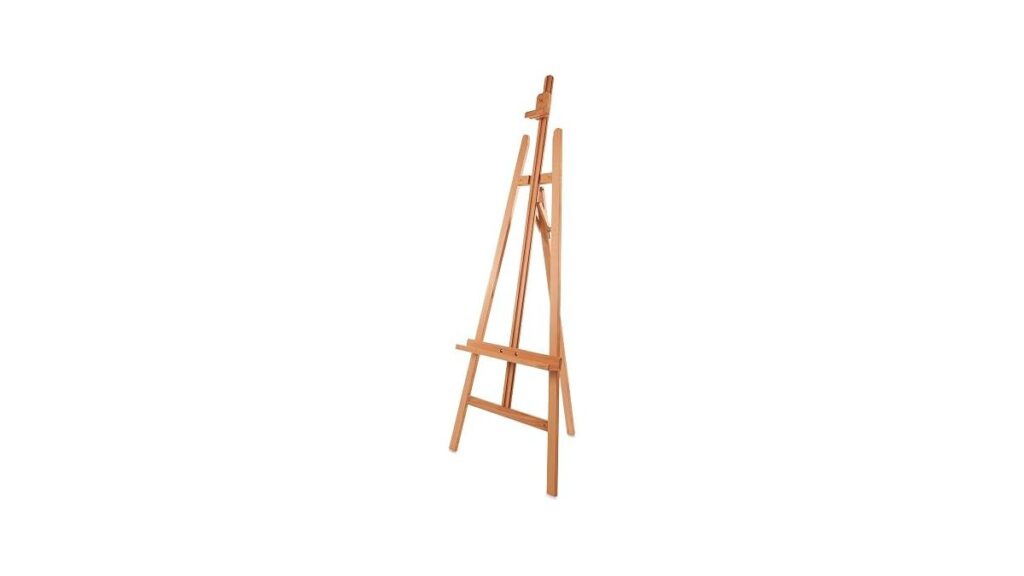
An A-frame easel is the studio easel most people can fit into a spare corner. Two front legs and a hinged back leg form a triangle, a central mast carries the canvas, and the whole thing leans back at an angle you choose. Mabef’s A-frame designs, usually called lyre easels, are a popular upgrade for painters who want solid beech construction without giving up half a room to an H-frame.
This Mabef A-frame easel review centers on the model we found on Amazon in October 2026, the Mabef M/11 Wooden Lyre Easel. We go through what its listing specifies, how an A-frame behaves compared with other easel types, and which alternatives make sense if the M/11 is not quite right for your space, canvas size or budget.
Quick answer: The Mabef M/11 Wooden Lyre Easel is the pick for painters who want a genuine Mabef A-frame in oiled beech with a ratchet canvas holder, for canvases up to 22 lb. For a lower-cost beech A-frame that holds taller displays, the Somime A-Frame Wooden Display Easel is the main alternative. If you find you need more stability for large work, the MEEDEN Versatile Studio H-Frame is the step up.
Our Top Picks at a Glance
- Mabef M/11 Wooden Lyre Easel — Best Mabef A-frame easel for home studios
- Somime A-Frame Wooden Display Easel — Best budget beech A-frame for painting and display
- MEEDEN Versatile Studio H-Frame Easel — Best upgrade when an A-frame is not stable enough
- Amazon Basics Easel Display Stand — Best lightweight stand for showing finished work
| Product | Best For | Key Spec | Key Strength | Price Tier |
|---|---|---|---|---|
| Mabef M/11 Lyre | Home studio painting | Holds up to 22 lb; 96.5 in tall | Oiled beech, ratchet holder | $$$ |
| Somime A-Frame Lyre | Budget painting and display | Displays up to 90 in; 35 kg load | Beech at a lower price tier | $$$ |
| MEEDEN H-Frame | Large canvases | 59 to 95 in; canvas to 77 in | H-frame stability with wheels | $$$ |
| Amazon Basics Display Stand | Showing finished pieces | Supports 5 lb; 2.22 lb | Folds flat, very light | $ |
How We Chose
These recommendations rest on the Amazon listing details and specifications we checked in October 2026. We have not set up or painted at these easels. We compared stated materials, load capacity, adjustment and dimensions against how an A-frame easel is actually used, and took into account how widely each product is reviewed by Amazon buyers. A small tabletop picture stand in our data was left out because it holds items only up to 16 inches and is not a painting easel.
- Material and finish: solid beech and stain-resistant finishes ranked highest.
- Load and canvas capacity: stated weight limits and maximum display height.
- Adjustability: canvas holder mechanism and tilt range.
- Footprint: how much floor space the easel needs when set up.
- Purpose: painting easel versus display stand, labeled clearly.
Mabef A-Frame Easel Review: The M/11 Lyre

The M/11 is a classic lyre design. Mabef’s listing describes oiled, stain-resistant beech, a central mast with adjustable tilt and a ratchet-adjustable canvas holder that adapts to different canvas sizes. It supports canvases or boards up to 10 kg (22 lb) and is aimed at indoor use for oil, acrylic and pastel painting or display.
Listed dimensions are 30 inches deep, 26 inches wide and 96.5 inches tall. The bullets describe the easel as lightweight at roughly 15 lb with simple assembly, while the detail table gives a different weight, so treat the bullet figure as the more realistic one and check the listing if weight matters to you.
What the ratchet holder adds
Many inexpensive A-frames use a fixed shelf with a top clamp on a wing nut. A ratchet canvas holder lets you raise or lower the canvas support in steps and lock it, so changing canvas sizes or adjusting the working height is faster and the canvas sits more securely.
Oiled beech and why it matters
Beech is dense and holds screws and bolts well, so joints stay tight over years of adjustment. An oil finish resists paint and solvent stains and can be refreshed, which suits a working studio easel.
Where the M/11 is limited
A lyre easel balances on three points. It is steady for normal brushwork, but heavy knife work on a big canvas can make any A-frame flex more than an H-frame. The tilt is a backward lean set by the rear leg, not a forward tilt or a flat position for watercolor.
Best suited for: oil, acrylic and pastel painters working on small to medium canvases in a home studio, who value Mabef’s build quality and a compact footprint.
Key features:
- Oiled, stain-resistant beech
- Ratchet-adjustable canvas holder
- Central mast with adjustable tilt
- Supports up to 22 lb
- 30 in D x 26 in W x 96.5 in H
Pros:
- Genuine Mabef construction
- Compact compared with H-frames
- Secure, quick canvas adjustment
- Classic studio look
Cons and limitations:
- Highest price tier here
- No flat or forward tilt
- Less rigid than an H-frame with large canvases
- Weight details inconsistent in the listing
Buying consideration: Think about your largest typical canvas. If it is under about 36 inches and you paint standing, the M/11 is a comfortable, long-lasting choice.
Alternatives Worth Comparing
1. Somime A-Frame Wooden Display Easel — Best Budget Beech A-Frame

Somime’s lyre easel uses beech wood in a tripod structure, and the listing states it holds panels, canvases or displays up to 90 inches high with a maximum load of 35 kg. The canvas tray height adjusts by loosening wing nuts on the support bar, and the rear support sets the angle.
The listing positions it for both painting and display, including exhibitions, wedding signs and events, and notes screws that do not damage the wood during assembly. At about 10 pounds it is easy to move around.
Best suited for: Painters on a budget who want a beech A-frame for studio work, plus anyone who needs a sturdy display easel for events.
Key features:
- Beech construction, brown finish
- Displays up to 90 in high
- 35 kg stated load capacity
- Wing-nut tray height adjustment
- About 10 lb
Pros:
- Lower price tier than the Mabef
- High stated load capacity
- Works for painting and display
- Light enough to carry
Cons and limitations:
- Wing nuts are slower than a ratchet
- Brand has a shorter track record than Mabef
- Same A-frame stability limits
Buying consideration: A practical choice if the Mabef’s price is hard to justify; tighten the wing nuts well before painting.
2. MEEDEN Versatile Studio H-Frame Easel — Best Step Up in Stability

If you are shopping for an A-frame but regularly paint big canvases, it is worth seeing what an H-frame offers. MEEDEN’s beech H-frame adjusts from 59 to 95 inches in height and holds canvas art up to 77 inches. Three sliders on the mast adjust to canvas size, and two large front wheels make it movable.
At 25.5 pounds and with a broader base, it is heavier and more planted than an A-frame. The listing title mentions tilting and a flat option; the bullets focus on vertical tilt, so confirm the range if flat work matters.
Best suited for: Painters who have outgrown a lyre easel and want more stability for large canvases.
Key features:
- Solid beech, clear coat
- Height 59 to 95 in
- Canvas up to 77 in
- Three sliders on the mast
- Two front rolling wheels
Pros:
- Much larger canvas capacity
- H-frame base resists wobble
- Wheels for repositioning
Cons and limitations:
- Larger footprint than an A-frame
- Heavier to move up stairs
- Not a Mabef if brand matters to you
Buying consideration: Measure your space first. An H-frame needs a square of floor rather than a corner.
3. Amazon Basics Easel Display Stand — Best for Displaying Finished Work

This is a display stand rather than a painting easel, and it is included because many people searching for A-frame easels also need something to show finished work. The steel tripod supports up to 5 pounds, sets up without tools and folds for transport. Plastic clips adjust the display height, and rubber feet protect floors.
It is not stable or strong enough to paint on with any pressure, but for open studios, markets, classrooms and presentations it is a light, inexpensive option.
Best suited for: Artists displaying framed or unframed work at shows, open studios and events.
Key features:
- Black steel tripod
- Supports up to 5 lb
- Tool-free setup, collapsible
- Adjustable plastic display clips
- Non-slip rubber feet
Pros:
- Very light at 2.22 lb
- Folds compactly
- Lowest price tier
Cons and limitations:
- Not designed for painting
- Low weight limit
- Plastic clips are less durable than wood or metal
Buying consideration: Buy it for display only. Painting on it will move the canvas and could tip the stand.
A-Frame, Lyre, H-Frame or Display Stand?
Easel names overlap, so it helps to be clear about what each type does well.
- A-frame or lyre: tripod layout with a central mast. Compact, good-looking, and steady for most painting on small to medium canvases. The Mabef M/11 and Somime easel belong here.
- H-frame: rectangular base with two uprights. More stable and usually able to hold much larger canvases, but heavier and bulkier.
- Display tripod: lightweight stand for showing work. Not built for painting pressure.
- Tabletop easel: a small easel used on a table, for seated work and small canvases.
Buying Guide: How to Choose an A-Frame Easel
Canvas size and weight
Check the stated load capacity and the maximum canvas height. Framed pieces and large panels are heavier than they look, and an A-frame used near its limit will feel less steady.
Adjustment mechanism
Ratchet holders are quick and secure. Wing nuts are simpler and cheaper but slower, and they need to be tightened firmly. Look at how the top clamp adjusts as well as the bottom tray.
Floor space
A-frames take less room than H-frames, but the rear leg extends behind the easel. Measure depth as well as width, particularly in small rooms.
Tilt
Most A-frames lean back only. If you also paint watercolor flat or want a forward tilt to reduce glare, you will need an H-frame or a tabletop easel with more adjustment.
Material and finish
Solid hardwood such as beech wears better than softwoods or composites. An oiled or clear-coated finish makes cleanup easier.
Painting or display
Decide whether the easel is for painting, display or both. Display stands are lighter and cheaper but not designed for painting pressure.
Setting Up an A-Frame Easel for Comfortable Painting
A well-placed easel makes painting more comfortable and improves your results. Set the canvas so its center sits roughly at eye level when you stand or sit, which reduces neck strain and helps you judge proportions. Place the easel so light comes from the side, not from behind the canvas, to avoid glare and shadows from your hand.
Spread the rear leg far enough to give a stable base, but not so far that the canvas leans back awkwardly. A slight backward lean also helps keep dust and stray paint from settling on wet surfaces. Lock every knob or ratchet before you begin, and check them again after a long session, since wood settles over time.
What Canvas Sizes Work Well on an A-Frame?
There is no single rule, but a few guidelines help. Small canvases, such as 8 x 10 or 11 x 14 inches, sit comfortably on any A-frame, although you may need to raise the tray so the work is not too low. Medium sizes from 16 x 20 up to roughly 24 x 36 inches are where a quality lyre easel like the M/11 is most at home: the canvas is secure, and the tripod base is stable enough for confident brushwork.
Beyond about 36 inches on the long side, the canvas starts to act like a sail. Leaning on it with a knife or pressing hard with a loaded brush puts leverage on the mast. Many painters still use A-frames for larger work, but they paint more gently and sometimes add weight to the base. If big canvases are your normal, an H-frame is the better tool.
Tips for Each Medium
- Oil: the backward lean helps thick paint stay put. Keep solvents and rags on a side table, since A-frames usually have no tray big enough for a full palette.
- Acrylic: works well upright. Because acrylic dries quickly, position a palette and water within easy reach so you are not walking back and forth.
- Pastel: a steeper angle lets dust fall away from the surface. Lay paper or a dust tray at the foot of the easel.
- Display: lower the tray to show work at eye height for viewers, and make sure the top clamp is snug against the frame.
Assembly Tips
Most beech easels arrive partly assembled. Lay out the parts on a soft surface, fit bolts by hand first, and only tighten fully once everything is aligned. Check that the mast slides smoothly before you tighten the final joints. If a wing nut or knob feels gritty, a small amount of paraffin wax on the threads helps it turn freely. After the first few sessions, recheck every fitting, since new wood can settle slightly.
Keep Your Easel in Good Shape
Wood easels last for decades with basic care. Our guide on how to clean and maintain a wooden easel covers removing paint buildup and caring for the finish. If floor space is very tight, see how to use a tabletop easel correctly, or try painting seated with a lap easel.
Common Mistakes to Avoid
- Using a display tripod for painting. It is not built to resist brush pressure.
- Overloading an A-frame. Respect the stated weight limit, especially with framed work.
- Setting the rear leg too narrow. A narrow stance makes the easel tippy.
- Overtightening wing nuts. Firm is enough; too much force can crush wood.
- Ignoring the top clamp. An unsecured canvas can slip when you press hard.
- Expecting a flat tilt. Most A-frames only lean back; plan accordingly for watercolor.
FAQs
Is the Mabef M/11 an A-frame easel?
Yes. The M/11 is a lyre easel, which is a type of A-frame: a tripod layout with a central mast and a rear leg that sets the angle.
How much weight can the Mabef M/11 hold?
Mabef’s listing states it supports canvases or boards up to 10 kg (22 lb).
Is an A-frame or H-frame easel better?
An A-frame is more compact and suits small to medium canvases. An H-frame is more stable and handles larger, heavier canvases but needs more space.
Can I use an A-frame easel for watercolor?
Most A-frames only lean back, so they do not hold paper flat. Watercolorists usually prefer a tabletop easel or an H-frame that tilts flat.
Is the Somime A-frame easel good for display?
Yes. The listing positions it for both painting and display, with a stated capacity of up to 90 inches in height and 35 kg.
Can I paint on the Amazon Basics display stand?
It is designed for display only, with a 5 lb limit. It is not stable enough for painting pressure.
Final Recommendation
If you want a Mabef A-frame, the M/11 is the model to buy on Amazon: oiled beech, a ratchet canvas holder and a footprint that suits home studios, for canvases within its 22 lb limit.
For a lower price tier, the Somime beech A-frame covers painting and display well. If your canvases are getting bigger, the MEEDEN H-frame is the logical upgrade, and the Amazon Basics stand is a handy extra for showing finished work at events.