PaintingProGuide is reader-supported. When you buy through links on this page we may earn an affiliate commission at no extra cost to you.
“Non-toxic” is printed on almost every children’s paint in the store, which makes it nearly useless for comparing products. What parents really need to know about safe and non-toxic paints for kids is what that label actually certifies, which paint types suit which ages, which ingredients and products are worth avoiding, and what “washable” does and does not promise.
This guide explains the labels in plain English, walks through each paint type by age, and then reviews seven washable, non-toxic kids paints on Amazon, from toddler finger paints to classroom-size tempera.
Quick answer: For toddlers, choose a thick washable finger paint that is labeled non-toxic and conforms to ASTM D-4236, such as ABEIER Washable Finger Paint or Honeysticks Finger Paint (made with cosmetic-grade colorings). For preschool and up, washable tempera like Colorations Simply Washable Tempera, which carries the AP Seal and lists common allergens it does not contain, is the safest all-round choice. Non-toxic never means edible, so supervise young children every time.
What “Non-Toxic” Actually Means on Kids Paint
ASTM D-4236
In the United States, art materials are covered by a labeling standard known as ASTM D-4236, which is referenced in federal law for art materials. A product that “conforms to ASTM D-4236” has had its formula reviewed by a toxicologist for chronic health hazards, and the label must carry any necessary warnings. It does not mean the product is free of every hazard. It means the hazards were assessed and the label tells you about them.
The AP Seal
The AP (Approved Product) Seal is a certification program run by the Art and Creative Materials Institute. Products with the AP Seal have been evaluated by a toxicologist and found to contain no materials in sufficient quantities to be toxic or injurious to people, including children, under normal use. Many parents and schools use it as a stronger shorthand than “non-toxic” alone.
“Washable” is a separate claim
Washable describes how easily paint comes out of skin, fabric and surfaces, not how safe it is. A paint can be non-toxic but not washable (most acrylics) or washable but carry precautions. Read both claims separately. Even washable paints can stain porous materials like untreated wood and some fabrics; several listings below say so directly.
“Non-toxic” does not mean “edible”
Toddlers put things in their mouths. Non-toxic labeling assumes normal use, not swallowing a bottle. If a child swallows a significant amount of any paint, call Poison Control at 1-800-222-1222 in the US. Small paint pots and caps can also be choking hazards for under-3s, and one listing below includes that warning.
Kids Paint Types, Ranked by Age and Safety
| Paint type | Typical age | Washable? | Notes for parents |
|---|---|---|---|
| Finger paint | 1 to 4 | Usually | Thick, designed for skin contact; supervise closely |
| Washable tempera | 2 and up | Usually | The classroom standard; opaque, bright, cleans with soap and water |
| Washable watercolor | 3 and up | Usually | Low mess; great for science experiments |
| Acrylic craft paint | 6 and up, supervised | No, once dry | Durable on rock, wood and canvas; permanent on clothing |
| Artist oil paint | Teens and adults | No | Needs solvents for cleanup; not suitable for young children |
| Spray paint | Adults | No | Aerosol inhalation risk; keep away from kids |
What to Avoid or Keep for Adults
- Solvents and thinners. Turpentine, mineral spirits and similar solvents belong to adult oil painting, not kids’ art.
- Aerosols. Spray paints and spray sealers create fine mist that is easy to inhale. Adults should apply sealers outdoors while kids are elsewhere.
- Dry powdered pigments. Powder tempera and loose pigments can be inhaled when mixed. Pre-mixed liquid paint avoids that step.
- Professional artist pigments. Some artist paints contain pigments based on cadmium, cobalt or other heavy metals, and labels will carry warnings. Keep adult artist paint out of children’s kits.
- Unlabeled imports. If a paint has no conformance statement or ingredients information at all, skip it.
Allergies and Sensitive Skin
Some children react to ingredients rather than to toxic substances. If your child has known allergies, look for listings that state what the paint does not contain. One tempera in our list, for example, says it contains no latex, dairy, casein, egg, gluten, peanut, tree nuts or soy. Test a small dab on the inside of the wrist first, and wash hands right after painting.
For more on acrylics specifically, see our guide on whether acrylic paint is safe for kids crafts.
Our Top Picks at a Glance
- Colorations Simply Washable Tempera, 8-Pack — Best for classrooms and allergy-conscious families
- ABEIER Washable Finger Paint, 12 Colors — Best toddler finger paint
- Honeysticks Non-Toxic Finger Paint — Best for babies and first painters
- Crayola Washable Kids Paint, 6 Count — Best budget starter
- Jar Melo Washable Finger Paints, 10 Colors — Best large-tube finger paint
- TMOL Washable Tempera Set with Brushes — Best complete set with tools
- ARTME Washable Paint, 14 Colors — Best color range for preschoolers
| Product | Best For | Key Spec | Key Strength | Price Tier |
|---|---|---|---|---|
| Colorations Simply Washable Tempera | Classrooms, allergies | 8 x 16 oz, AP Seal, paraben-free | Allergen-free statement | $$ |
| ABEIER Finger Paint | Ages 1-3 | 12 colors, ASTM D-4236 | Skin-contact formula | $ |
| Honeysticks Finger Paint | First painters | 6 pots, cosmetic-grade colorings | Recycled-plastic pots | $$ |
| Crayola Washable Kids Paint | Budget | 6 x 2 oz bottles | Trusted brand, low cost | $ |
| Jar Melo Finger Paints | Toddlers | 10 x 2.1 oz tubes | Generous tube size | $$ |
| TMOL Washable Tempera Set | Starter with tools | 12 colors, brushes, palettes, bucket | Tools included | $$ |
| ARTME Washable Paint | Preschool | 14 x 2 oz, ASTM D-4236 | Wide color range | $$ |
How We Chose
These paints were selected from Amazon listings checked in October 2026. We looked for clear safety statements (ASTM D-4236 conformance, the AP Seal or other specific claims), washability claims, packaging suited to young children, and how widely each product is reviewed by Amazon buyers. We report safety claims exactly as the listings make them.
- Stated non-toxic status and the standard behind it.
- Washability on skin and fabric, including any listed exceptions.
- Age suitability and texture for little hands.
- Extra transparency, such as allergen or ingredient statements.
Best Safe, Non-Toxic Paints for Kids Reviewed
1. Colorations Paraben-Free Simply Washable Tempera Paint — Best for classrooms and allergy-conscious families

Colorations supplies eight 16 oz bottles in red, orange, yellow, green, blue, purple, black and white. The listing states the paint is paraben-free, certified with the AP Seal, conforms to ASTM D-4236 and is made in the USA.
It also lists ingredients the paint does not include: latex, dairy, casein, egg, gluten, peanut, tree nuts and soy. That is unusual transparency and useful for classrooms where allergies are a concern.
Best suited for: Teachers, daycares, homeschool groups and families with allergy concerns.
Key features:
- 8 x 16 oz bottles
- AP Seal and ASTM D-4236
- Paraben-free, allergen-free statement
- Works on paper, canvas, wood, cardboard
Pros:
- Strongest safety documentation here
- Large volume
- Listing says it will not chip, flake or crack when dry
Cons and limitations:
- Highest volume means higher upfront cost
- Large bottles need pumps or decanting for small kids
Buying consideration: Decant into small squeeze bottles or a palette so little ones do not tip a full pint.
2. ABEIER Washable Finger Paint for Toddlers — Best for toddler finger painting

ABEIER’s set includes 12 colors and is described as suitable for direct skin contact, conforming to ASTM D-4236. The listing says it washes off skin, fabrics and plastics without stain remover.
Importantly, the listing also carries a clear note: do not swallow, and small parts present a choking hazard. That honesty is a good sign.
Best suited for: Ages 1 to 3 with close supervision.
Key features:
- 12 colors
- Thick, creamy texture
- ASTM D-4236 conformance
Pros:
- Formulated for skin contact
- Washable claim covers fabric
- Low-mid price tier
Cons and limitations:
- Choking hazard warning for small parts
- Matte finish only
Buying consideration: Remove caps and keep them out of reach while toddlers paint.
3. Honeysticks Non-Toxic Finger Paint — Best for babies and first painters

Honeysticks finger paint is water based, non-toxic and made with cosmetic-grade colorings, according to the listing. It comes in six pots of thick, creamy paint in bright colors, in honeypot bottles made from reclaimed plastic with FSC-certified cardboard packaging.
The thick texture means less dripping and fewer spills, and the listing positions it for first birthdays and beyond.
Best suited for: Parents who want the most cautious ingredient profile for a first painting experience.
Key features:
- 6 colors
- Cosmetic-grade colorings
- Water based, washable from skin
- Recycled-plastic pots
Pros:
- Thick texture for small fingers
- Eco-conscious packaging
- Strong ingredient positioning
Cons and limitations:
- Highest price per ounce here
- Only six colors
Buying consideration: Worth the premium for the very youngest painters; switch to tempera as they grow.
4. Crayola Washable Kids Paint, 6 Count — Best for a budget starter

Crayola’s six 2 oz bottles cover yellow, green, yellow-orange, red-orange, fuchsia, teal and blue violet in the listed palette, with resealable caps. The listing gives ages 3 and up and describes smooth, creamy color that blends.
It is the simplest low-cost way to try washable paint with a preschooler.
Best suited for: Ages 3 and up, first painting sessions and school projects.
Key features:
- 6 x 2 oz bottles
- Washable formula
- Resealable caps
Pros:
- Lowest price tier
- Widely available brand
- Small bottles suit small hands
Cons and limitations:
- Limited color range
- Listing does not specify AP Seal
Buying consideration: Add white and black if you want kids to mix lighter and darker shades.
5. Jar Melo Washable Finger Paints, 10 Colors — Best for large-tube finger painting

Jar Melo includes ten 2.1 oz tubes of finger paint made from non-toxic pigments and glycerin, according to the listing. It describes a silky texture similar to face cream.
The listing is honest about limits: paint may penetrate porous fabrics and wood, making them harder to clean.
Best suited for: Toddlers who paint often and burn through small pots.
Key features:
- 10 x 2.1 oz tubes
- Glycerin-based formula
- Washable from skin
Pros:
- Generous volume
- Tubes are easy to dispense
- Clear note about porous materials
Cons and limitations:
- May stain porous fabric or wood
- Mid price tier
Buying consideration: Paint on a plastic tray and dress kids in old clothes.
6. TMOL Washable Paint for Kids, 12 Colors — Best for a complete set with tools
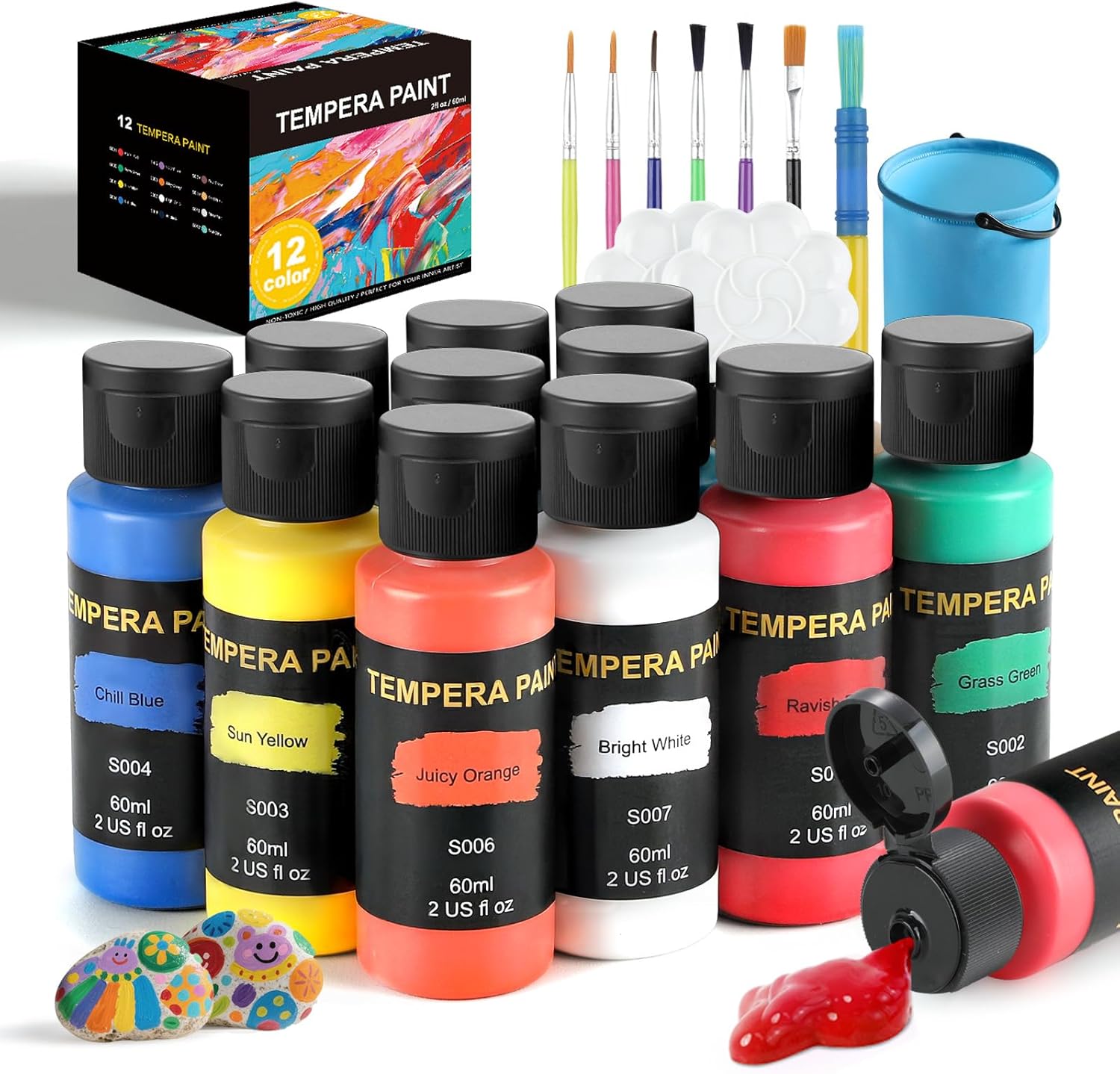
TMOL’s 12-color set includes 12 bottles, six brushes, two palettes and a foldable bucket. The bottles are transparent and labeled to help children learn color names, with flip-top caps to reduce drying and spills.
The listing describes the paint as certified non-toxic and washable from skin, clothes and surfaces with soap and water, and positions finger painting for ages 6 and up.
Best suited for: Families who want everything to start, including a water bucket.
Key features:
- 12 bottles of washable tempera
- 6 brushes, 2 palettes, foldable bucket
- Labeled transparent bottles
Pros:
- Tools included
- Color-learning labels
- Flip caps limit spills
Cons and limitations:
- Listing suggests 6+ for finger painting
- Safety standard not named specifically
Buying consideration: A good gift set for ages 4 to 8; supervise younger kids.
7. ARTME Washable Paint for Kids, 14 Colors — Best for color range for preschoolers

ARTME offers 14 colors in 2 oz bottles plus three brushes. The listing states a skin-safe formula conforming to ASTM D-4236, non-toxic and acid-free, and water based for easy cleanup.
Like several honest listings, it notes that paint may stain porous materials like untreated fabric or wood.
Best suited for: Preschoolers and early-elementary kids who want more colors.
Key features:
- 14 x 2 oz bottles
- 3 brushes
- ASTM D-4236, non-toxic, acid-free
Pros:
- Wide color range
- Tempera works for finger or brush
- Mid price tier
Cons and limitations:
- Only three brushes
- Can stain untreated wood
Buying consideration: Use on paper and cardboard rather than wooden toys if washability matters.
Buying Guide: How to Choose Safe Paint for Kids
Read the specific safety claim
Look for ASTM D-4236 conformance at minimum. The AP Seal is a stronger signal. A vague “safe” with no standard named is the weakest claim.
Match texture to age
Thick finger paints for toddlers, smooth tempera for preschoolers, acrylic only for older supervised kids.
Check washability details
Look for honest exceptions in the listing. If it says “may stain porous materials,” believe it.
Consider allergens
If allergies matter, choose products that list excluded ingredients rather than guessing.
Look at packaging
Flip caps and squeeze bottles reduce spills. Small pots and caps can be choking hazards for under-3s.
Buy the right volume
Classrooms need 16 oz bottles; a toddler at home needs small pots that get used before they dry out.
How to Set Up a Safe Painting Session
- Clear the space. Remove food and drinks from the painting table so paint cups are never confused with snack cups.
- Dress for mess. An apron or old shirt with sleeves pushed up. Even washable paint is easier to remove from skin than from a favorite sweater.
- Pour small amounts. A teaspoon of each color on a palette is plenty. It limits waste and makes spills minor.
- Keep caps and small parts away. For under-3s, caps and tiny pots go on a high shelf during painting.
- Ventilate if you are using acrylic. Open a window for older kids using acrylic, and never use sprays indoors.
- Wash hands and brushes together. Make it part of the routine: brushes rinsed, hands washed with soap, table wiped.
Store all kids paint in one labeled bin, and keep adult materials such as solvents, oil paints and spray sealers in a separate, closed cupboard. That one habit prevents most mix-ups.
Safe Projects to Start With
Once you have the right paint, choose projects that suit it. Washable tempera works well for simple subjects like our easy ladybug painting for kids. For outdoor projects on stone, older kids can move to acrylic with supervision; see our guide to painted rock critters.
Common Mistakes to Avoid
- Assuming non-toxic means edible. Supervise and stop mouthing behavior.
- Using adult artist paint in kids kits. Some pigments carry warnings for good reason.
- Letting kids help with sealers or sprays. Adults only, outdoors.
- Ignoring stain warnings. Washable paint can still mark untreated wood or certain fabrics.
- Mixing powder paint around kids. Pre-mixed liquid avoids inhaling fine powder.
- Skipping handwashing. Wash hands after every session, even with skin-safe paint.
FAQs
What does ASTM D-4236 mean on kids paint?
It means the product has been reviewed by a toxicologist for chronic health hazards and is labeled accordingly. It is a labeling standard, not a guarantee that the product has no hazards at all.
Is the AP Seal better than “non-toxic”?
The AP Seal from the Art and Creative Materials Institute indicates evaluation by a toxicologist and that the product contains nothing in amounts toxic to people under normal use. Many schools treat it as a stronger signal than a generic non-toxic claim.
Is washable paint safe for babies?
Finger paints formulated for skin contact are designed for young children, but always supervise. Babies put things in their mouths, and non-toxic does not mean edible.
Is acrylic paint safe for kids?
Non-toxic acrylic craft paint is commonly used by older children with supervision. It is not washable once dry and is best avoided for toddlers.
Which paint is safest for toddlers?
Thick washable finger paint or washable tempera labeled non-toxic, ideally with ASTM D-4236 conformance or the AP Seal.
What should I do if my child eats paint?
Rinse the mouth, check the label and call Poison Control at 1-800-222-1222 in the US for guidance.
Final Recommendation
For classrooms and allergy-conscious homes, Colorations Simply Washable Tempera has the most complete safety documentation in this list. For toddlers, ABEIER and Jar Melo offer washable finger paints in generous quantities, while Honeysticks is the premium pick for the very first painting sessions. Crayola remains the budget starter, and TMOL or ARTME suit preschoolers who want more colors and tools. Whatever you buy, read the specific safety claim, supervise young children, and keep adult art materials in a separate cupboard.