Quick answer: Easy summer painting ideas for beginners include a beach sunset, a simple ocean wave, watermelon slices, a lemon pattern, sunflowers, a palm tree silhouette, a pool water ripple study, and an ice cream cone. Use bright, saturated colors, big shapes, and a small canvas or watercolor paper. If you paint outdoors, work in the shade and mist acrylic palettes often, since heat makes paint dry fast.
Summer subjects are bold by nature: blazing sunsets, turquoise water, red watermelon, yellow sunflowers. That boldness helps beginners, because strong color and simple shapes create impact without fine detail. The challenge is not finding ideas; it is keeping bright colors clean and managing paint that dries too quickly in warm weather.
This guide offers 15 easy summer painting ideas for beginners, organized by setting: beach and ocean, fruit and food, garden, and outdoor painting. You will also get a detailed ocean wave walkthrough, practical heat-management tips for painting outside, and a list of common color mistakes. For an overview of beginner tools and techniques that apply to any season, our painting for beginners guide is a helpful starting point.
Summer Colors and How to Keep Them Bright
Summer paintings rely on saturated color, and saturation drops fast with careless mixing. Keep these principles in mind:
- Mix bright colors from neighbors, not opposites. For a vivid orange, mix a warm yellow and a warm red. For turquoise, mix a green-leaning blue with a little yellow-green and white.
- Clean brushes between warm and cool colors. A trace of blue on a brush can dull a yellow.
- Use white carefully. White lightens but also cools and softens color. For bright light areas, try lightening with yellow before reaching for white.
- Add darks with complements sparingly. A tiny touch of the opposite color deepens shadows; too much turns them muddy.
| Summer color | Easy mix |
|---|---|
| Turquoise water | Phthalo or cerulean blue + a touch of yellow + white |
| Sunset orange | Warm yellow + warm red |
| Coral | Red + yellow + white |
| Sand | White + yellow ochre + a tiny touch of red or brown |
| Watermelon red | Crimson or magenta + a touch of warm red |
Beach and Ocean Ideas
1. Beach Sunset With Reflections
Paint a gradient sky from yellow at the horizon through orange and pink to purple at the top. Below the horizon, repeat the colors in horizontal strokes but slightly darker, as water reflects a little less light. Add a sun half-sunk into the horizon.
2. Simple Ocean Wave
A single curling wave shows off blending and highlights. Full steps follow below.
3. Aerial Beach View
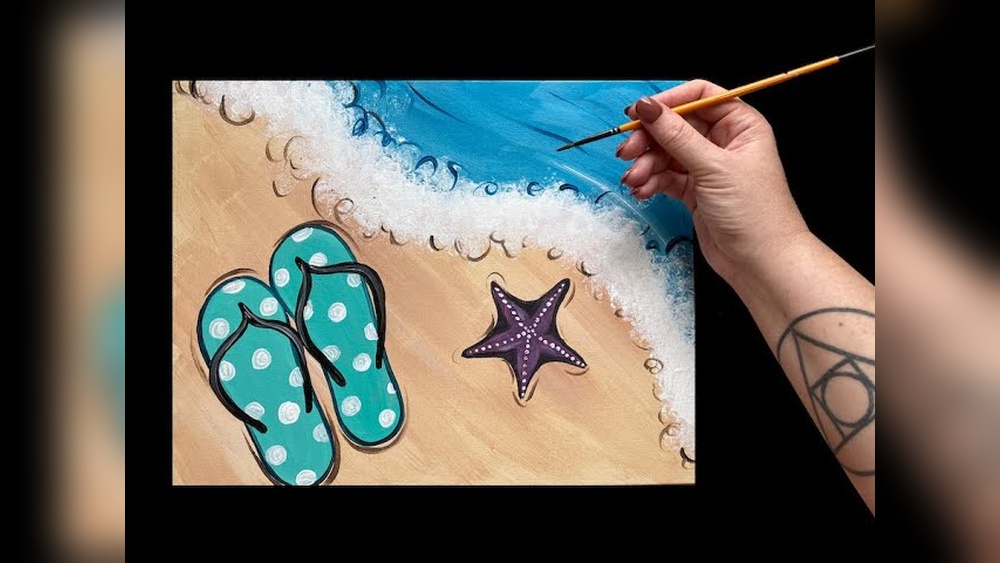
Divide the canvas diagonally into sand and water, with a wavy band of white foam where they meet. Add tiny colorful umbrellas and towels as dots and rectangles. It looks complex but uses only flat shapes.
4. Palm Tree Silhouette
Over a sunset, paint a slender curved trunk and leaves made of long arching strokes with short downward flicks along each. Silhouettes hide detail, which keeps them easy.
5. Seashells on Sand
Paint a sand-colored background and add a scallop shell, a spiral shell, and a starfish. Use ridged lines and soft shadows to suggest form.
6. Pool Water Ripples
Paint a turquoise background, then add irregular, wavy, connected lines of light blue and white across the surface, like a net. This abstract-looking study captures sunlit water and is surprisingly calming to paint.
Fruit and Food Ideas
7. Watermelon Slices
Paint triangle wedges with a green rind, a pale green-white stripe, and red flesh. Add black or brown teardrop seeds. Repeating slices make a fun pattern.
8. Lemon Pattern
Paint whole lemons and halves scattered across a blue or white background, with green leaves tucked between them. Pattern paintings are a great way to practice the same shape repeatedly.
9. Ice Cream Cone
A triangle cone with crosshatch lines and two or three round scoops in pastel colors. Add a drip or two and sprinkles for fun.
10. Popsicles
Rounded rectangles in bright colors with wooden sticks and a bite missing from one corner. Arrange three in a row on a solid background.
Garden and Outdoor Ideas
11. Sunflowers
Paint a dark brown circle, then add pointed yellow petals around it in two layers. Use a darker yellow-orange for the back layer and a lighter yellow for the front. Dot the center with lighter brown and yellow for texture.
12. Hydrangeas
Use a sponge or round brush to dab clusters of blue, purple, and pink in a rounded shape. Add a few four-petal flower shapes on top for definition.
13. Firefly Night
Paint a deep blue-green twilight sky with dark grass silhouettes. Add small dots of yellow-green, then glaze a soft, lighter halo around each dot for a glowing effect.
14. Hot Air Balloon Over Fields
A colorful striped balloon against a blue sky with patchwork green and yellow fields below.
15. Camping Tent Under Stars
A triangle tent glowing warm yellow from inside, dark pine trees, and a star-filled sky. Painting the glow lighter in the center of the tent creates the illusion of light.
Step-by-Step: Simple Ocean Wave
This project suits an 8×10 or 9×12 inch canvas with acrylics and takes about an hour.
Materials
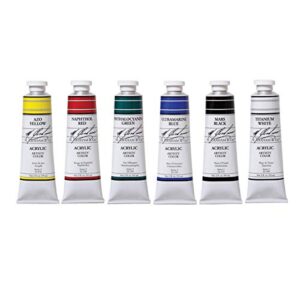
- Acrylic paint: white, phthalo or ultramarine blue, a turquoise or teal, yellow
- Brushes: 1 inch flat, size 6 round, and an old stiff brush for spray
- Palette, water, paper towels
Steps
- Paint the sky. Fill the top third with a light blue gradient, lighter near the horizon. Let it dry.
- Paint the far ocean. Just below the horizon, paint a band of deeper blue. Keep the horizon line perfectly level; use a strip of tape if needed.
- Shape the wave. Lightly sketch a curve rising from the right side and curling over toward the left, like a large letter C on its side.
- Paint the wave body. Fill the inside of the curve with dark blue at the base, transitioning to turquoise and then a lighter, slightly yellow-green near the top where sunlight shines through the thin water.
- Add foam on the crest. With a round brush and white, paint the curling lip of the wave. Use broken, irregular dabs rather than a solid line.
- Paint the foreground water. Below the wave, add turquoise and blue with horizontal strokes, and sweep white foam lines across it.
- Add spray. Dip an old stiff brush or toothbrush in thinned white and flick it near the crest for spray.
- Add highlights and shadows. Put a little pure white on the brightest foam and a darker blue under the curl where it shadows the water.
Tips for Painting Outdoors in Summer
Painting outside (often called plein air painting) is a summer pleasure, but heat and sun create problems you will not face indoors.
- Find shade for you and your surface. Direct sun on a white canvas causes glare and makes you paint colors too dark.
- Mist your palette. Acrylic can dry on the palette within minutes in hot, dry air. A spray bottle and a stay-wet palette help.
- Consider a slow-drying medium. Acrylic retarders or open-time formulas extend working time.
- Watercolor dries fast too. Work in smaller sections and have water ready to rewet edges.
- Keep it small. 6×8 or 8×10 inch panels let you finish before light changes dramatically.
- Protect yourself. Hat, sunscreen, water, and bug spray applied away from your palette.
Prefer guided, numbered projects you can do at a kitchen table? Our step-by-step painting ideas for adults work well on hot days when staying indoors is more comfortable.
Easy Watercolor Painting Ideas for Beginners in Summer
- Loose lemon slices: Yellow circles with white spokes left unpainted.
- Beach horizon: Three bands for sky, sea, and sand, painted wet-in-wet.
- Watermelon wedges: Easy shapes with satisfying color.
- Flip-flops and sunglasses: Simple objects on a white page.
Easy Canvas Painting Ideas for Beginners Step by Step: Choosing Your First Summer Project
If you are not sure where to begin, match the project to the skill you most want to build:
| Want to learn | Start with | Why it helps |
|---|---|---|
| Blending | Beach sunset with reflections | Large gradients with forgiving edges |
| Highlights and form | Ocean wave or cherries | Shows how light defines shape |
| Repetition and control | Lemon pattern or watermelon slices | Same shape painted many times |
| Glow effects | Firefly night or tent under stars | Contrast between light and dark |
| Texture | Sunflowers or hydrangeas | Dabbing and layered petals |
Easy Oil Painting Ideas for Beginners in Summer
Oils stay workable for hours, which suits blending big summer skies and water. Try these on small panels:
- Sunset over a calm lake: Blend the sky in one session and pull its colors down into the water with horizontal strokes.
- A bowl of cherries: Small round forms with strong highlights teach how light wraps around a shape.
- Sailboat on the horizon: A simple triangle sail against a blue gradient with a few white wave marks.
- Golden wheat field: Warm ochres and yellows below a blue sky, with a few dark accents for depth.
In hot weather, oil paint stays wet longer than acrylic, but finished paintings still need to dry somewhere protected from dust and insects. Allow several days before handling.
Summer Painting With Kids
Long summer days are ideal for painting with children. A few ideas keep the mess outdoors and the fun high:
- Sidewalk water painting: Give kids a bucket of water and big brushes to “paint” pavement. It evaporates, so the canvas resets itself.
- Nature printing: Brush washable paint onto leaves and press them onto paper.
- Ice painting: Freeze washable watercolor in ice cube trays with craft sticks and let kids paint as the cubes melt in the sun.
- Rock painting: Collect smooth rocks on beach or creek trips and paint them at a picnic table.
Use washable, non-toxic paints for younger kids and keep sessions short in the heat.
Keep a Summer Sketchbook
A small watercolor sketchbook is one of the easiest ways to build skills over the season. Try one small painting a day, five minutes to half an hour, of anything around you: a glass of lemonade, a flower in the garden, the view from a porch, a beach towel. Small daily studies sharpen observation faster than occasional big projects, and the finished book becomes a visual diary of your summer.
- Pick a pocket size such as 5×8 inches so it travels easily.
- Use a travel palette with 8 to 12 colors and a water brush to avoid carrying jars.
- Date every page so you can track progress.
Common Summer Painting Mistakes
| Mistake | Result | Fix |
|---|---|---|
| Mixing opposite colors for brights | Dull, gray color | Mix neighboring hues for vivid results |
| Too much white in sunsets | Chalky, pastel look | Lighten with yellow first |
| Tilted horizon | Water looks like it is sliding | Use tape or a ruler for a level line |
| Solid white foam lines | Stiff, cartoonish waves | Use broken, irregular dabs |
| Painting in direct sun | Colors end up too dark | Work in shade |
FAQs
What are easy summer painting ideas for beginners?
Beach sunsets, ocean waves, palm silhouettes, watermelon slices, lemon patterns, sunflowers, and pool water ripples are all great beginner summer projects.
How do I keep acrylic paint from drying too fast in summer?
Work in the shade, mist your palette with water, use a stay-wet palette, and consider adding a retarder or using slow-drying acrylics.
How do you paint a simple ocean wave?
Paint a level horizon, sketch a curling wave shape, fill it with dark blue at the base fading to lighter turquoise at the top, then add broken white foam and flicked spray.
What colors make turquoise?
Mix a green-leaning blue, such as phthalo or cerulean, with a small amount of yellow and white. Adjust with more blue or yellow until you get the shade you want.
What size canvas is best for summer beginner paintings?
An 8×10 or 9×12 inch canvas works well indoors. For outdoor painting, smaller panels like 6×8 inches help you finish before the light changes.
Can I paint summer scenes with watercolor as a beginner?
Yes. Lemon slices, beach horizons, watermelon wedges, and simple objects are ideal first watercolor projects. Work in small sections in hot weather.
Next Step
Start with the beach sunset to practice blending, then try the ocean wave to practice highlights and foam. Each one teaches skills you will use across many subjects. To build those core skills further, including brush control and choosing beginner supplies, visit our essential guide for new painters.