

PaintingProGuide is reader-supported. When you buy through links on this page we may earn an affiliate commission at no extra cost to you.
Painting for beginners gets complicated quickly when it should not. Before your first brushstroke you are asked to choose between four or five media, dozens of brushes and hundreds of colors, and every tutorial seems to assume you already know the basics. The good news: learning to paint follows a predictable path. Choose one medium, learn to see values and mix colors, paint small subjects often, and add complexity only when the basics feel easy.
This guide helps you pick a medium, explains what to learn first, gives ten practical tips, lays out a 30-day starter plan and points you to beginner projects across our site. At the end we review seven beginner painting books on Amazon, covering acrylic, watercolor and multi-media courses.
Quick answer: Most beginners should start with acrylic because it is forgiving, fast-drying and cleans up with water. Choose watercolor if you want something portable and low-mess. For a complete beginner, Painting for the Absolute and Utter Beginner explains fundamentals in plain language; acrylic beginners should consider Acrylics for the Absolute Beginner, and watercolor beginners The Complete 30-Day Watercolor Course for Beginners.
Step 1: Choose Your First Medium
| Medium | Why beginners like it | Main challenge | Cleanup |
|---|---|---|---|
| Acrylic | Forgiving, paint over mistakes, works on many surfaces | Dries fast, making blending tricky | Water while wet |
| Watercolor | Portable, inexpensive, beautiful transparency | Hard to correct; water control takes practice | Water |
| Gouache | Opaque and matte, rewettable, good for illustration | Can look chalky if overworked | Water |
| Oil | Slow drying allows rich blending | Solvents, ventilation, long drying times | Solvent or oil-based cleaner |
| Digital | Unlimited undo, no supplies to buy after setup | Requires a tablet and software | None |
Choose the medium that fits your space and temperament. If you want to experiment freely and fix mistakes, choose acrylic. If you want to paint at the kitchen table and travel light, choose watercolor. If you love blending and have ventilation, oil is rewarding. If you already own an iPad or drawing tablet, digital is a low-cost start; our beginner guides to painting digital characters, painting digital animals, digital lettering and animating in Procreate are good first projects.
Step 2: Learn What Matters Most First
Seeing values
Value is the lightness or darkness of a color. Squint at your subject; the details vanish and the big light and dark shapes remain. Paint those shapes first. A painting with correct values looks right even if the colors are unusual.
Mixing color
Learn to mix secondaries from primaries, lighten with white (or water in watercolor) and dull colors with their complement. A color chart from three primaries teaches more than any paint set.
Brush control
Practice straight lines, curves, dots and even fills. Let the brush shape make the mark: a flat brush makes a rectangle, a round makes a teardrop.
Simple composition
Place your main subject off-center, keep the horizon away from the middle, and give the painting one clear focal point.
Step 3: Gather a Minimal Kit
- Paint: a small set in your chosen medium plus extra white (or a good pan set for watercolor).
- Brushes: a flat, a round, a small detail round and a liner.
- Surface: canvas panels for acrylic and oil, 100 percent cotton or student watercolor paper for watercolor.
- A palette, two water jars and rags.
Step 4: Set Up a Space You Will Actually Use
The biggest predictor of progress is how often you paint, and that depends on how easy it is to start. A permanent corner, even a small one, beats a perfect studio you have to assemble each time. Choose a spot near a window or under a daylight-balanced lamp, cover the table with a wipeable cloth, and keep supplies in one box or caddy within arm’s reach. If you can sit down and start within two minutes, you will paint far more often.
Think about mess and ventilation for your medium. Watercolor and acrylic are fine at a kitchen table with a cover. Oil needs ventilation and a place for wet paintings to dry undisturbed for days. Digital needs only a charger and a comfortable chair.
How to Practice So You Improve Faster
- Set a short, regular slot. Thirty minutes three times a week is better than a four-hour session once a month.
- Have one goal per session. “Soft edges on the clouds” is more useful than “paint a nice picture.”
- Repeat subjects. Paint the same apple or tree three times in a week. Repetition shows what you are learning.
- Review weekly. Line up the week’s paintings and note one thing that improved and one to work on next.
- Learn from one teacher at a time. Mixing advice from many sources at once is confusing. Finish one book or course before starting another.
10 Practical Tips for Beginner Painters
- Paint small and often. Ten 5×7 paintings teach more than one large canvas.
- Use bigger brushes than feels comfortable. They force simpler shapes.
- Limit your palette. Three primaries plus white builds mixing skill and harmony.
- Squint constantly. It reveals values and hides distracting detail.
- Work big to small. Block in, then refine, then detail.
- Keep clean water. Dirty water muddies colors.
- Step back. View your painting from across the room every 15 minutes.
- Copy to learn. Copying tutorials and master paintings for practice builds skill quickly.
- Stop before you overwork. Most ruined paintings were nearly finished ten minutes earlier.
- Keep everything. Date your paintings. Looking back after a month is the best motivation.
A 30-Day Starter Plan
| Week | Focus | Example exercises |
|---|---|---|
| 1 | Materials and mixing | Color chart, value scale, brush mark sheet |
| 2 | Simple forms | Single fruit, a cup, a stone; one light source |
| 3 | Nature subjects | Sky gradient, simple tree, flowers |
| 4 | Full small scenes | Mountain landscape, seascape, a cute animal |
Beginner Projects to Try Next
Once you have finished the 30-day plan, choose subjects that excite you:
- Our step-by-step painting ideas for adult beginners and broader easy painting ideas for beginners are good next steps for any medium.
- Flower lovers can start with our beginner flower painting ideas.
- Watercolor beginners will find gentle projects in our easy watercolor ideas for beginners.
- Seasonal subjects keep practice fresh all year: try our spring painting ideas, summer painting ideas and winter painting ideas.
- Animal fans can start with our cute animal painting ideas for beginners, and landscape fans with our mountain painting ideas.
- If you chose oil, our beginner tutorials on painting water in oil and painting a rose in oil are ideal first subjects.
Our Top Picks at a Glance
- Painting for the Absolute and Utter Beginner — Best plain-language introduction
- Acrylics for the Absolute Beginner — Best first acrylic book
- The Complete 30-Day Watercolor Course for Beginners — Best structured watercolor course
- How to Paint: A Complete Beginner’s Guide to Watercolors, Acrylics, and Oils — Best for comparing media
- Learn to Paint in Acrylics with 50 Small Paintings — Best for practice volume
- Happy Flower Painting for Beginners — Best for flower subjects
- Compendium of Acrylic Painting Techniques — Best budget reference
| Product | Best For | Key Spec | Key Strength | Price Tier |
|---|---|---|---|---|
| Painting for the Absolute and Utter Beginner | Total beginners | Plain-language fundamentals | Lowest price tier | $ |
| Acrylics for the Absolute Beginner | Acrylic starters | Beginner acrylic course | Gentle pacing | $$ |
| 30-Day Watercolor Course | Watercolor starters | Daily lessons over 30 days | Built-in structure | $$ |
| How to Paint: Beginner’s Guide | Undecided beginners | 38 projects across 3 media | Compare media | $$ |
| 50 Small Paintings | Practice volume | 50 small acrylic projects | Many quick wins | $$ |
| Happy Flower Painting | Flowers | 20 blooms | Cheerful subjects | $$ |
| Compendium of Acrylic Techniques | Reference | Technique compendium | Look-up guide | $ |
How We Chose
We chose these books from Amazon listings checked in October 2026, prioritizing titles explicitly aimed at beginners, a mix of media, clear structure (courses, project counts or references), and how widely each title is reviewed by Amazon buyers. Book listings contain limited detail, so we describe each title from its listing information only.
- Beginner level.
- Medium coverage.
- Structure: course, projects or reference.
- Price tier.
Best Painting Books for Beginners Reviewed
1. Painting for the Absolute and Utter Beginner — Best for a plain-language introduction

Claire Watson Garcia’s title promises exactly what nervous beginners want: painting explained for the absolute and utter beginner. It sat in the lowest price tier in our listing check.
A fundamentals-first book is the right choice if you feel you have “no talent”; it treats painting as a set of learnable skills.
Best suited for: People who have never painted and want encouragement and basics.
Key features:
- Absolute beginner level
- Fundamentals focus
- Paperback
Pros:
- Lowest price tier
- Reassuring approach
- Good before choosing a medium
Cons and limitations:
- Less project volume
- Not medium-specialized
Buying consideration: Read it alongside the 30-day plan above.
2. Acrylics for the Absolute Beginner — Best for a first acrylic book

Charles Evans writes acrylic instruction for people starting from scratch. If you have already chosen acrylic, a dedicated beginner book is the fastest route to confident results.
It pairs naturally with the color chart and value exercises in week one.
Best suited for: New acrylic painters.
Key features:
- Acrylic-specific
- Absolute beginner level
- Paperback
Pros:
- Focused instruction
- Mid price tier
- Gentle progression
Cons and limitations:
- Acrylic only
- Basic for returning painters
Buying consideration: Follow its supply list to avoid overbuying.
3. The Complete 30-Day Watercolor Course for Beginners — Best for a structured watercolor course

Nolan Ashcroft’s course offers simple daily lessons over 30 days, with the title highlighting washes, wet-on-wet and color control. A daily format builds the habit that watercolor especially needs.
Thirty short lessons fit neatly into a month-long learning commitment.
Best suited for: Watercolor beginners who like a schedule.
Key features:
- 30 daily lessons
- Washes, wet-on-wet, color control
- Paperback
Pros:
- Built-in structure
- Covers core watercolor skills
- Mid price tier
Cons and limitations:
- Watercolor only
- Daily pace may not suit everyone
Buying consideration: If you miss a day, repeat the previous lesson rather than skipping ahead.
4. How to Paint: A Complete Beginner’s Guide to Watercolors, Acrylics, and Oils — Best for comparing media

Ian Sidaway and Angela Gair cover three media with 38 step-by-step projects according to the title. If you cannot decide on a medium, trying the same principles in each helps you choose.
It also suits beginners who want to understand painting broadly before specializing.
Best suited for: Beginners still choosing a medium.
Key features:
- 38 step-by-step projects
- Watercolor, acrylic, oil
- Comprehensive guidance
Pros:
- Broad scope
- Helps choose a medium
- Mid price tier
Cons and limitations:
- Requires supplies for multiple media if you try all
- Less depth in each
Buying consideration: Try one project in each medium before buying a full set of anything.
5. Learn to Paint in Acrylics with 50 Small Paintings — Best for practice volume
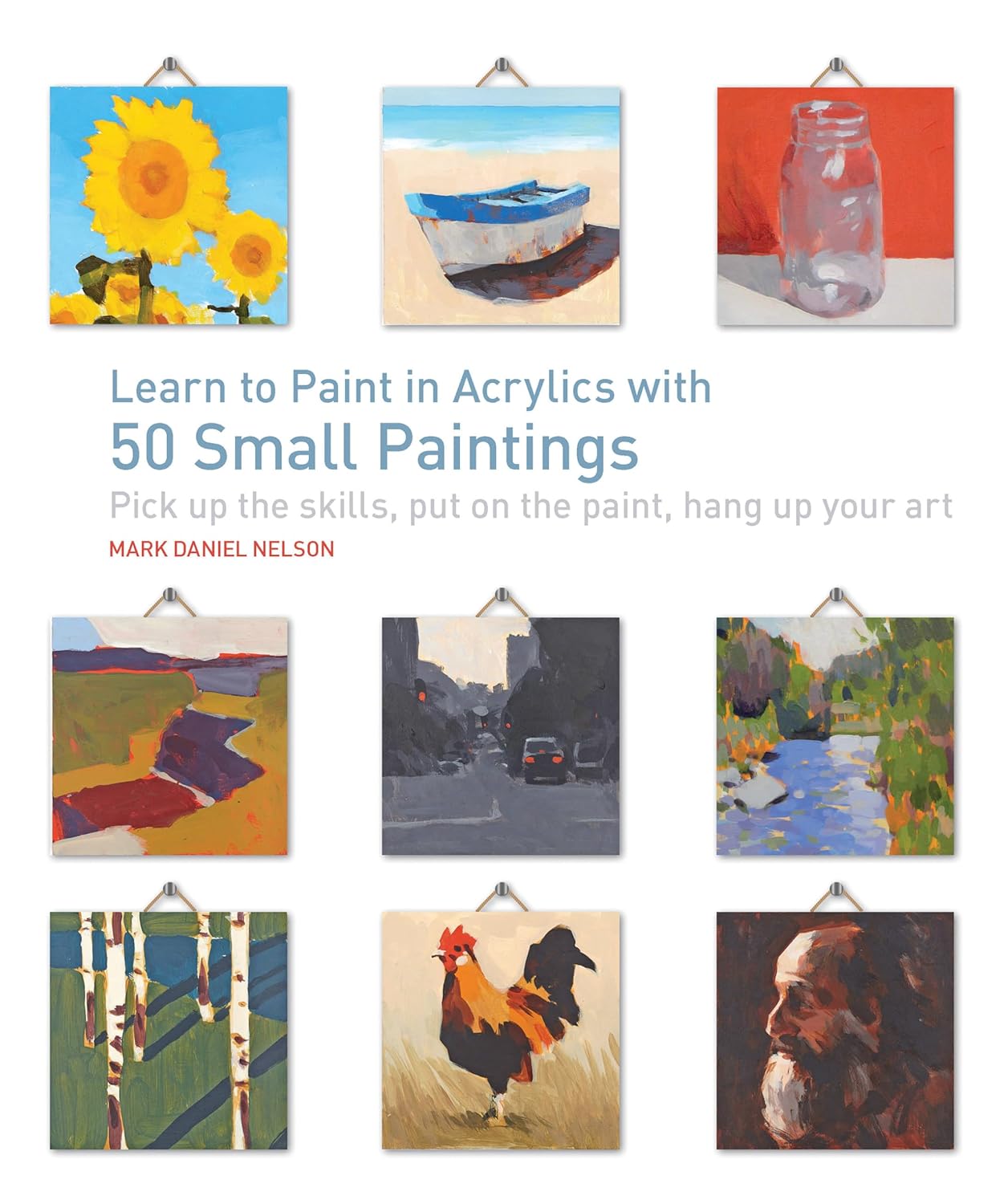
Mark Daniel Nelson’s 50 small paintings are designed to build skills one manageable project at a time. Volume is how beginners improve, and small projects make volume possible.
It suits the “paint small and often” tip perfectly.
Best suited for: Acrylic beginners who want many short projects.
Key features:
- 50 small paintings
- Skills-first sequence
- Paperback
Pros:
- High practice volume
- Finishable sessions
- Mid price tier
Cons and limitations:
- Small scale
- Acrylic only
Buying consideration: Work through in order and date each finished piece.
6. Happy Flower Painting for Beginners — Best for flower subjects

Bethany Joy Adams offers sweet and simple instructions for 20 blooms. Flowers are one of the most motivating beginner subjects because results look cheerful even when imperfect.
Flower shapes also teach brush control naturally: petals are often single strokes.
Best suited for: Beginners who love flowers.
Key features:
- 20 flower projects
- Simple instructions
- Paperback
Pros:
- Motivating subjects
- Brush-control practice
- Mid price tier
Cons and limitations:
- Single subject
- Check medium in the preview
Buying consideration: Combine with our flower painting ideas for even more practice.
7. Compendium of Acrylic Painting Techniques — Best for a budget reference

Gill Barron’s compendium is a reference of acrylic techniques at a low price tier. Beginners often hit unfamiliar terms in tutorials; a compendium explains them.
Keep it on the shelf as you move from beginner projects to your own ideas.
Best suited for: Acrylic beginners wanting a technique dictionary.
Key features:
- Acrylic technique reference
- Paperback
Pros:
- Low price tier
- Long-term use
- Broad coverage
Cons and limitations:
- Not a course
- Acrylic only
Buying consideration: Look up each technique before using it in a project.
Buying Guide: Choosing Your First Painting Book
Match your medium
Dedicated books go deeper. Multi-media books help if you are undecided.
Course or projects
Courses (like 30-day programs) give structure; project books give variety.
Beginner language
Look for “absolute beginner” or similar in the title if you have never painted.
Subjects you love
Motivation matters. Flowers, landscapes and animals all have beginner books.
One project book plus one reference
This combination covers most beginner needs.
Preview before buying
Step photos and clear layouts make learning easier.
Common Mistakes to Avoid
- Buying every medium. Pick one and stay with it for a few months.
- Starting with a large canvas. Small is faster and less intimidating.
- Chasing detail too early. Big shapes first.
- Comparing yourself to experts online. Compare yourself to last month.
- Skipping exercises. Color charts and value scales feel boring but speed progress.
- Quitting after a bad painting. Every painter has them. Paint the next one.
FAQs
What is the easiest type of painting for beginners?
Acrylic is generally the easiest because it is forgiving and fast-drying. Watercolor is portable and inexpensive but harder to correct.
How do I start painting with no experience?
Choose one medium, buy a minimal kit, practice color mixing and values, then paint small simple subjects several times a week.
What should a beginner paint first?
A color chart, a value scale, then simple subjects like a single fruit, a sky gradient or a flower.
How long does it take to get good at painting?
It varies, but regular practice brings visible improvement within weeks. Painting small pieces several times a week speeds progress.
Do I need expensive supplies to start painting?
No. Student-grade paints, a few synthetic brushes and inexpensive surfaces are enough to learn.
Is it okay to copy paintings when learning?
Yes, for practice. Copying tutorials and master works teaches technique. Credit the original if you share copies, and do not sell them as your own designs.
Final Recommendation
Pick one medium, most likely acrylic, and commit to the 30-day starter plan. If you want a gentle, plain-language foundation, start with Painting for the Absolute and Utter Beginner. Acrylic painters should add Acrylics for the Absolute Beginner or Learn to Paint in Acrylics with 50 Small Paintings, watercolor painters The Complete 30-Day Watercolor Course, and anyone undecided How to Paint, which covers three media. Then use the beginner projects linked above to keep practicing with subjects you love.




4 Comments