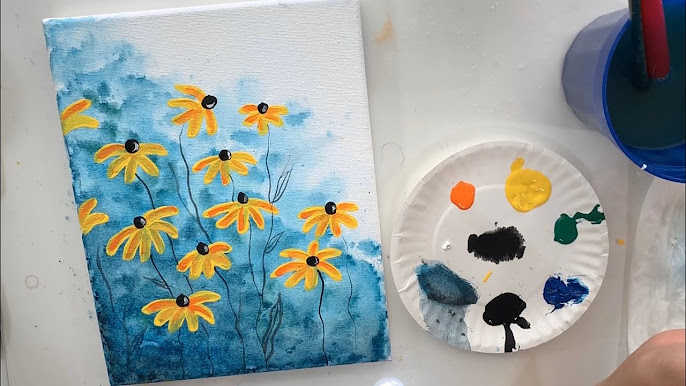
Quick answer: Good beginner painting ideas include color-gradient skies, simple still lifes (a mug, a lemon, a pear), single flowers, layered landscapes, geometric tape abstracts, cactus and succulent studies, and moonlit silhouettes. Choose ideas that match your medium: acrylic suits bold canvas projects, watercolor suits loose florals and skies, and gouache suits flat, graphic illustrations. Pick projects you can finish in under two hours so you build skills through many completed paintings.
The hardest part of starting to paint is often deciding what to paint. A blank canvas plus endless options can stall you before the first stroke. The fix is to choose from ideas that are proven to work for new painters and that teach a skill along the way.
This list collects more than 40 beginner painting ideas, organized by medium and surface, with notes on what each teaches and how long it takes. We also cover how to choose the right idea for your level, a step-by-step example, and a plan for building skills week by week. For supplies, color mixing and technique fundamentals, our starter guide to painting for beginners is the best companion to this list.
How to Choose the Right Beginner Painting Idea
Not every “easy” idea is easy for every person. Use these filters before you start.
- Match the medium. Acrylic handles layering and covering mistakes. Watercolor rewards loose, light-to-dark work. Gouache is ideal for flat, matte shapes. An idea that suits one medium can be frustrating in another.
- Pick one skill per painting. Blending, brush control, value, texture or color mixing. Trying to learn all five at once leads to overwhelm.
- Keep it finishable. 30 to 120 minutes is ideal. Finishing builds momentum.
- Use a reference. Paint from a real object, a photo you took, or a simple tutorial. Painting from imagination is harder at first.
- Size it right. 8×10 to 11×14 inches for canvas, or 5×7 to 9×12 inches for paper.
Acrylic Ideas for Beginners
Acrylic is forgiving: it dries quickly, layers well, and lets you paint over errors. These acrylic painting ideas lean on those strengths.
| Idea | Skill it teaches | Time |
|---|---|---|
| Ombre sky gradient | Wet blending | 30 min |
| Moon over a lake | Contrast and reflections | 60 min |
| Cactus in a terracotta pot | Simple shapes and shading | 60 min |
| Lemon on a cloth | Light, shadow and form | 75 min |
| Birch trees | Taping and scraping texture | 60 min |
| Starry night sky | Splatter technique | 45 min |
| Rainbow arches | Clean edges and color harmony | 45 min |
| Lavender field | Perspective and repeated strokes | 75 min |
For birch trees, tape vertical strips onto a painted background, paint the strips white, remove the tape, then drag a credit card edge with black paint sideways to create bark marks. It is one of the most satisfying beginner techniques because results look complex while the method is simple.
Canvas Painting Ideas for Beginners
Stretched canvas has a springy surface and visible weave, which suits bold strokes and texture. These ideas take advantage of that.
- Abstract palette knife flowers: press the flat of the knife down and lift to make petal shapes.
- Silhouette city skyline at sunset: a gradient sky and black rectangles of varying heights.
- Single bold leaf (monstera or palm): a large shape filling the canvas, with simple vein lines.
- Northern lights over pines: green and purple streaks over a dark sky.
- Waves crashing on rocks: dry-brushed white foam over blue-green water.
- Sunflower close-up: petals radiating from a textured brown center.
Large Canvas Ideas for Beginners
Going big (24×36 inches or larger) can feel intimidating, but some ideas actually work better at scale because they rely on broad strokes rather than detail.
- Color-field abstract: two or three large blocks of color with soft edges.
- Textured neutral abstract: white, beige and gray applied with a large knife or putty knife.
- Minimalist horizon: a simple sky and sea split with one thin line.
- Giant brushstroke art: a few sweeping strokes with a wide house-painting brush.
Use a 2- to 3-inch flat brush and buy paint in larger bottles. On a big surface, small brushes lead to streaks and take far too long.
Watercolor Painting Ideas for Beginners
Watercolor works from light to dark, uses the paper’s white as highlights, and loves loose, organic shapes.
- Wet-on-wet galaxy: drop blues and purples onto wet paper, then splatter white gouache stars.
- Loose roses: spiral shapes with dark centers and lighter outer petals.
- Simple mountains: graded washes in layers, letting each dry.
- Leaf studies: one leaf per square, practicing single-stroke shapes.
- Rainy window: soft blurred shapes with sharp droplets on top.
- Citrus slices: circles with segmented sections and white gaps left unpainted.
Our guide to easy watercolor projects for beginners expands on these with more ideas and technique notes.
Gouache Painting Ideas for Beginners
Gouache is opaque and dries matte, which makes it perfect for illustration-style work with flat color shapes.
- Mushrooms in grass: simple rounded caps and stems with flat color.
- Retro sunset stripes: horizontal bands with a half circle sun.
- Houseplant in a pot: flat leaf shapes with one shade of darker green for depth.
- Tiny landscapes: 2×3-inch thumbnails of hills, sky and trees.
- Patterned pottery: a vase shape with simple stripes or dots.
Traditional gouache can reactivate with water, so avoid scrubbing when adding layers on top.
Ceramic Painting Ideas for Beginners
Painting on ceramics uses either underglazes (for kiln firing) or acrylic enamel and porcelain paints designed for home baking. Follow the paint manufacturer’s instructions carefully, especially for anything that will touch food.
- Polka-dot mug: dots made with the end of a brush handle or a dotting tool.
- Simple botanical plate: a few leaves or a sprig of lavender.
- Stripes and bands: use a banding wheel or steady hand to paint horizontal stripes.
- Initial or monogram: stenciled letters with a decorative border.
Glass Painting Ideas for Beginners
Glass paints come in transparent, frosted and opaque varieties. Clean the glass with rubbing alcohol first so paint adheres.
- Stained-glass-style window panel: outline shapes with liquid leading, then fill with transparent color.
- Wine glass stems: dots and swirls on the stem only, away from lips.
- Mason jar lanterns: frosted paint with simple star cutouts using tape.
- Mirror border: leaves or vines around the edge.
Airbrush Ideas for Beginners
Airbrushing has its own learning curve. Start with exercises that build control before trying images.
- Dot and line drills: control air and paint flow.
- Gradient backgrounds: smooth fades from one color to another.
- Stencil silhouettes: spray over a cut stencil for crisp shapes.
- Simple spheres: shading a circle to look three-dimensional.
Painting Ideas for Beginners Step by Step: A Lemon Still Life
A single lemon teaches light, shadow, form and color temperature in one small painting. Use acrylic on an 8×10-inch canvas panel.
- Set up. Place a lemon on a plain cloth near a window or lamp so light comes from one side.
- Sketch. Lightly draw the oval shape and the shadow it casts.
- Background. Paint a soft gray-blue background. Cool backgrounds make warm yellows glow.
- Base color. Fill the lemon with a mid-tone yellow.
- Shadow side. Mix yellow with a tiny bit of purple or burnt sienna and paint the side away from the light. Avoid black, which turns yellow greenish.
- Light side. Add a lighter yellow, mixed with white, on the side facing the light.
- Cast shadow. Paint a darker version of the cloth color beneath the lemon, darkest right where it touches.
- Highlight. Add one small dot of near-white where the light hits strongest.
Once you can paint a convincing lemon, you can paint an apple, a pear, an egg or a mug using the same logic. For more structured projects like this, see our list of step-by-step painting ideas for adult beginners.
Ideas to Paint for Beginners Who Want Quick Wins
Some days you only have 20 minutes. These micro-projects are designed for short sessions and still teach something useful.
- Color swatch grid: paint a 5×5 grid mixing each of your colors with every other one. It doubles as a reference chart you will use for years.
- Value strip: paint a strip of nine boxes from pure white to your darkest dark using one color plus white. This trains your eye for light and shadow.
- Three-minute clouds: on a blue background, paint a cloud in three minutes, then another, then another. Speed forces you to simplify.
- Brushstroke sampler: fill a page with every mark each brush can make: flat, edge, tip, dry brush, stipple.
- One-color still life: paint an apple using only one color plus white to focus purely on form.
None of these will hang in a frame, but they build the control that makes framed paintings possible. Many experienced painters still use exercises like these as warm-ups before longer sessions.
How to Make Beginner Ideas Your Own
Following a tutorial exactly is a good start, but small changes quickly turn a copied idea into a personal painting. Try changing the time of day in a landscape, swapping the palette from warm to cool, moving the horizon line, or replacing a generic subject with one from your own life: your mug instead of any mug, the tree outside your window instead of a stock tree.
Another approach is to paint the same idea in two mediums. A moon over a lake in acrylic looks crisp and graphic; the same scene in watercolor looks soft and atmospheric. Comparing the two teaches you more about each medium than any amount of reading. Keep notes on the back of each painting about what you changed and what you would try next time.
A Four-Week Beginner Painting Plan
| Week | Focus | Suggested ideas |
|---|---|---|
| 1 | Blending and brush control | Ombre sky, moon over a lake, silhouette skyline |
| 2 | Value and form | Lemon still life, cactus in a pot, simple spheres |
| 3 | Texture and technique | Birch trees, palette knife flowers, starry sky splatter |
| 4 | Combine skills | Lavender field at sunset, waves on rocks, northern lights over pines |
Two or three short sessions a week is plenty. Keep every painting, dated, so you can see improvement over time.
Track your progress by photographing each painting and keeping the photos in one album. Scrolling back after a month is one of the most motivating things a beginner can do, because improvement that feels invisible week to week becomes obvious over several weeks.
Common Mistakes When Choosing Beginner Ideas
- Starting with portraits or pets. Faces and fur require drawing accuracy and subtle color. Save them for later.
- Picking ideas with too many elements. One subject is better than a busy scene.
- Ignoring the medium. Detailed, crisp designs are hard in watercolor; soft washes are hard in gouache.
- Going too big or too small. Very small canvases cramp your strokes; very large ones drain time and paint.
- Not repeating ideas. Painting the same subject twice is one of the fastest ways to improve.
FAQs
What are good painting ideas for beginners?
Sky gradients, simple still lifes, single flowers, layered landscapes, silhouettes, cacti and geometric abstracts are excellent choices because they teach core skills without requiring detailed drawing.
What should I paint first as a beginner?
Start with a color gradient or simple sunset to learn blending, then move to a single object still life to learn light and shadow.
Are acrylic ideas for beginners different from watercolor ideas?
Yes. Acrylic suits layered, opaque designs and bold canvas projects. Watercolor suits loose, light-to-dark subjects such as florals, skies and leaves, where the paper’s white provides highlights.
What are easy gouache painting ideas for beginners?
Mushrooms, houseplants, retro sunsets, small landscapes and patterned pottery work well because gouache excels at flat, opaque color shapes.
Can beginners paint on large canvases?
Yes, with the right ideas. Color-field abstracts, textured neutrals and minimal horizons work well at large sizes. Use wide brushes and larger paint containers.
How often should a beginner paint?
Two or three short sessions a week is a sustainable pace. Consistent practice matters more than long, occasional sessions.
Next Step
The best beginner painting ideas are ones you can finish, that suit your medium, and that teach one clear skill. Work through a few acrylic, watercolor or gouache projects from this list, repeat your favorites, and gradually combine techniques into more complex scenes.
To strengthen the foundations behind every idea here, visit our essential tips for getting started with painting, which covers supplies, brushes, color mixing and good practice habits.