
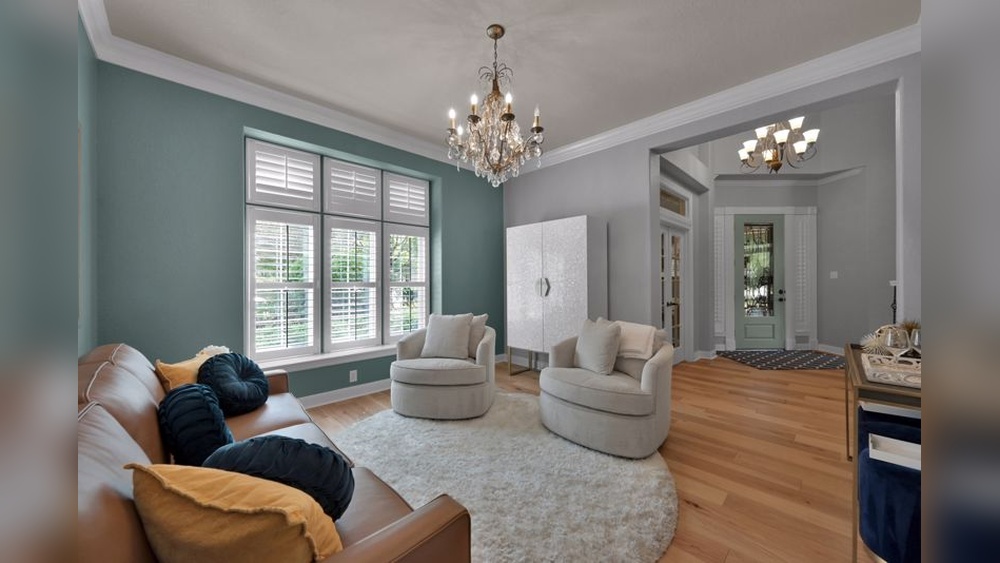
Quick answer: The best painting ideas for a living room accent wall are a single deep color behind the sofa or fireplace, a color-blocked arch or rectangle that frames furniture or art, geometric tape designs, a two-tone wall split at chair-rail height, a soft limewash or color-wash texture, and a hand-painted mural or abstract. Choose the wall your eye lands on when you enter, pick a color two or more shades deeper than the other walls, and plan where your art will hang before you paint.
An accent wall works when it gives the room a focal point that feels deliberate. It fails when it looks like someone ran out of paint. The difference usually comes down to three choices: which wall, which idea, and how the wall relates to the art and furniture in front of it.
Below are twelve painting ideas for a living room accent wall, each with the skill level, time and tools it needs, followed by advice on color, layout and pairing the wall with canvas art. If you already have a statement piece in mind, it helps to read our guide to the best paintings for a living room wall first, since the art should influence the wall, not the other way around.
How to Choose Your Accent Wall
The right wall is usually obvious once you stand in the doorway and notice where your eye goes first.
- The wall behind the sofa is the most common choice and the easiest to frame with art.
- The fireplace wall is a natural focal point already; deepening its color makes it stronger.
- The TV wall benefits from a dark, matte color, which reduces the black-rectangle effect of a screen that is switched off.
- A wall with architectural interest, such as a recess, a sloped ceiling or built-in shelving, rewards an accent color.
Avoid walls broken up by several doors or windows. With little uninterrupted surface, the accent color looks choppy instead of bold.
12 Painting Ideas for a Living Room Accent Wall
1. A single saturated color
The classic approach: one deep color on one wall. Navy, forest green, terracotta, charcoal and aubergine are popular because they recede visually and make lighter art and furniture pop. Skill: beginner. Time: one day with two coats.
2. Color-drenched wall and ceiling corner
Extend the accent color onto the trim, or wrap it a foot onto the ceiling for a cocooning effect. It works especially well in reading corners. Skill: beginner to intermediate, since clean ceiling lines need careful cutting in.
3. Painted arch
Paint a tall arch behind a console table, mirror or reading chair. Mark the center line, tie a pencil to a string pinned at the top center of the rectangle, and swing it to draw the curve. Fill with a brush along the curve and a small roller for the field. Skill: intermediate. Time: half a day.
4. Color-blocked rectangle behind the sofa
Paint a rectangle a little wider than the sofa and roughly two-thirds of the wall height. It visually anchors the seating area and acts as a built-in frame for one large canvas or a pair of prints. Skill: beginner with tape.
5. Two-tone split wall
Paint the lower third or half darker than the top, with a crisp line at about 36 to 42 inches, similar to chair-rail height. A darker bottom hides scuffs and makes ceilings feel taller. Skill: beginner.
6. Geometric tape design
Use painter’s tape to mark triangles, chevrons or intersecting lines, then fill sections in two to four colors. Keep the palette tight, ideally a light, a mid and a dark of related hues, so it reads as art rather than noise. Skill: intermediate. Time: one to two days.
7. Vertical or horizontal stripes
Wide stripes (8 to 12 inches) in two close shades of the same color look sophisticated. Vertical stripes add height; horizontal stripes add width. Skill: intermediate, because the measurements have to be exact.
8. Limewash or color-wash texture
Limewash and color-wash techniques create soft, cloudy movement. Brushed on in overlapping X or crosshatch strokes, they give a hand-finished look that suits rustic, Mediterranean and modern minimal rooms. Note that true limewash needs a mineral-based or primed surface; check product directions. Skill: intermediate.
9. Ombre fade
Blend from a dark color at the bottom to a lighter one at the top, using a third mixed color in the middle and a damp brush to soften the transitions. It looks dramatic behind minimal furniture. Skill: intermediate to advanced, since blending must happen while paint is wet.
10. Large abstract mural
Organic blobs, sweeping curves or overlapping shapes in three or four colors. Sketch the design at small scale on paper, grid it, and transfer it to the wall in pencil. Skill: intermediate. It doubles as artwork, so keep nearby walls simple.
11. Landscape or mountain silhouette
Layered mountain ranges in progressively lighter tones toward the top. Tape or freehand the ridgelines, paint the darkest range at the bottom first, and work upward. Skill: beginner to intermediate.
12. Gallery-frame outlines
Paint thin rectangular “frames” or panels in a slightly deeper tone than the wall, then hang art inside some of them. It mimics paneled walls at a fraction of the cost. Skill: intermediate.
Comparison: Which Idea Fits Your Room?
| Idea | Skill level | Time | Best for | Works with art? |
|---|---|---|---|---|
| Single saturated color | Beginner | 1 day | Any room | Excellent; makes art stand out |
| Painted arch | Intermediate | Half day | Entry or reading nook | Frames one piece or mirror |
| Color-blocked rectangle | Beginner | Half day | Behind sofa | Excellent; acts as a mat |
| Two-tone split | Beginner | 1 day | High-traffic rooms | Good; hang art above the line |
| Geometric design | Intermediate | 1 to 2 days | Modern spaces | Limited; the wall is the art |
| Limewash | Intermediate | 1 to 2 days | Textured, calm rooms | Very good; soft backdrop |
| Abstract mural | Intermediate | 2+ days | Minimal furniture | Limited; skip extra art |
Best Paint Colors for a Living Room Accent Wall
The best paint colors for a living room accent wall depend on light direction and what will hang on the wall.
- North-facing rooms get cool, even light. Warm deep colors such as terracotta, ochre and warm greens keep them from feeling cold.
- South-facing rooms get strong warm light, so cooler deep colors such as navy, slate and teal hold up well.
- East and west rooms change through the day. Test samples in morning and evening light before deciding.
Paint sample swatches at least 2 by 2 feet, on more than one part of the wall, and look at them over two days. Small chips are unreliable because color looks more intense over a large area.
Choosing a finish
Matte or flat finishes give accent walls a rich, velvety depth and do not create glare around framed art. Eggshell is more washable for homes with children or pets. Higher sheens show every roller mark on large, dark walls, so avoid them unless the design calls for contrast.
Pairing an Accent Wall With Canvas Art
An accent wall and wall art should cooperate. Some practical guidelines:
- Contrast in value. Light or bright art reads best on a dark wall; dark, moody art reads best on a lighter wall.
- Repeat one color. Pick an accent color that appears somewhere in your main painting, even in a small area.
- Size the art to the furniture. A common guideline is art that spans roughly two-thirds the width of the sofa below it.
- Hang at eye level. The center of the artwork around 57 to 60 inches from the floor is a widely used standard, adjusted lower when hanging above a sofa (often 8 to 10 inches above the backrest).
- Do not compete. Busy murals and geometric walls rarely need additional art. Single-color, color-blocked and limewash walls are the best partners for large canvases.
Best canvas art for a living room accent wall
Large abstract canvases, minimalist landscapes and oversized botanical prints are all popular choices against bold walls because they read clearly from across the room. If you are choosing between a single large canvas for the living room and a grouping of smaller pieces, our roundup of living room wall paintings and canvas art compares styles and sizes for different seating layouts.
Step-by-Step: Painting a Color-Blocked Rectangle
- Measure. Make the rectangle 6 to 12 inches wider than the sofa on each side and stop it somewhere between two-thirds and three-quarters of the wall height.
- Mark with a level. Draw light pencil lines with a long level or laser level.
- Tape outside the line. Burnish the edge with a putty knife.
- Seal the tape edge. Brush a thin coat of the existing wall color over the tape edge first. Any bleed will be the base color, so it is invisible.
- Paint two coats of the accent color with a small roller, cutting in along the tape with a brush.
- Remove tape while the second coat is still slightly wet, pulling at a 45 degree angle.
Large Canvas for a Living Room: Sizing Against the Wall
Once the accent wall is finished, the most common regret is art that looks too small for it. A bold wall magnifies empty space, so err on the side of larger. These are rough starting points, not rules:
| Furniture below | Typical width | Art width to consider |
|---|---|---|
| Loveseat | About 60 inches | About 36 to 45 inches, or a pair of smaller pieces |
| Three-seat sofa | About 84 inches | About 48 to 60 inches, or a triptych |
| Sectional (long side) | 100 inches or more | A large canvas plus flanking pieces, or a wide gallery grouping |
| Fireplace mantel | Varies | Roughly the width of the firebox opening or slightly wider |
Before buying, cut kraft paper to the dimensions you are considering and tape it to the painted wall. Live with it for a day. It is the cheapest way to confirm scale and height.
Common Accent Wall Mistakes
- Picking the wrong wall. An accent on a wall nobody faces is wasted effort.
- Choosing a color too close to the others. If it is only one shade deeper, it can look like a mismatch rather than a choice.
- Ignoring undertones. A green with a gray undertone can clash with warm wood floors. Sample next to flooring and fabrics.
- Too many accent walls. One per room keeps the focal point clear.
- Skipping primer on dark colors. A gray-tinted primer helps deep colors reach full depth in fewer coats.
- Overloading the wall. A bold wall plus a busy mural plus a dense gallery wall becomes chaotic.
FAQs
Which wall should be the accent wall in a living room?
Usually the first wall you see when entering, or the wall behind the main seating, fireplace or TV. Choose a wall with large uninterrupted space rather than one broken up by doors and windows.
What are the best paint colors for a living room accent wall?
Deep, slightly muted colors such as navy, forest green, terracotta, charcoal and warm ochre are popular. Choose based on light direction and test large samples in morning and evening light.
Should an accent wall be lighter or darker than the other walls?
Most accent walls are darker, because deep colors recede and create depth. A lighter accent can work when the other walls are dark, but it is less common.
What size canvas should go on a living room accent wall?
A common guideline is art about two-thirds the width of the furniture below it. For a standard three-seat sofa, that often means a large canvas around 40 to 60 inches wide or a grouping that covers a similar area.
Can I paint an accent wall without tape?
Yes, if the accent covers a full wall and meets inside corners. A steady angled brush can cut a clean corner line. Shapes, stripes and color blocks are much easier with tape.
Are accent walls still in style?
Accent walls remain common, though the approach has shifted from random bright walls toward deliberate focal points: color-blocked shapes, arches, limewash textures and deep, moody colors that frame art and furniture.
Final Thoughts
The strongest living room accent walls are planned around what will sit in front of them. Pick the focal wall, choose an idea that matches your skill and time, sample the color in real light, and decide where the art goes before you start taping. Once the paint has cured, finish the look with a piece that suits the scale and color of the wall; our guide to picking statement art for your living room walks through sizes, styles and pairings.



One Comment