

PaintingProGuide is reader-supported. When you buy through links on this page we may earn an affiliate commission at no extra cost to you.
Acrylic is the most forgiving paint for beginners. It cleans up with water, dries in minutes so you can paint over mistakes, needs no solvents and works on canvas, paper, wood and almost anything else. The best way into acrylic painting for beginners is a short list of supplies, a handful of exercises that teach how the paint behaves, and a series of small, finishable paintings. A good beginner book provides that structure better than random videos, because it builds skills in order.
This guide covers the minimum supplies you need, five exercises to do before your first “real” painting, a four-week plan, and seven beginner acrylic books on Amazon, ranked by how well they suit different learners: complete novices, landscape lovers, people who want lots of small projects, and those who prefer a visual technique reference.
Quick answer: Start with a small set of student-grade acrylics (white, black, a warm and cool version of each primary and a brown), three synthetic brushes (a 1-inch flat, a medium flat and a small round), canvas panels or heavy acrylic paper, and a palette. For guidance, Acrylics for the Absolute Beginner by Charles Evans is the best first book for complete newcomers. If you learn best by doing many quick projects, Learn to Paint in Acrylics with 50 Small Paintings by Mark Daniel Nelson is the strongest alternative.
What You Actually Need to Start
| Item | Beginner recommendation | Why |
|---|---|---|
| Paint | Student-grade set or 6–8 tubes: Titanium White, Mars or Ivory Black, a lemon and a warm yellow, a warm and cool red, Ultramarine and Phthalo Blue, Burnt Umber | Mixes almost every color |
| Brushes | Synthetic: 1-inch flat, #8 flat, #4 round, plus a liner for details | Synthetics hold up to acrylic |
| Surface | Canvas panels (8×10, 9×12) or 290 gsm+ acrylic paper | Cheap and flat |
| Palette | Disposable palette paper or a stay-wet palette | Easy cleanup; slows drying |
| Extras | Two water jars, paper towels, spray bottle, palette knife | Clean color and workable paint |
How Acrylic Behaves: Five Things Beginners Should Know
It dries darker
Many acrylics look slightly lighter when wet and darken as they dry, especially student-grade paints. Mix a touch lighter than you want, or test a swatch and let it dry before committing.
It dries fast
Thin layers can be dry to the touch in minutes. That is an advantage for layering and fixing mistakes, but blending needs to happen quickly or with help from a slow-drying medium.
Water thins it, but too much weakens it
A little water makes paint flow; a lot breaks down the binder so the paint becomes chalky and less durable. For thin glazes, use an acrylic medium instead.
Opaque and transparent colors behave differently
Some pigments cover in one coat; others are see-through and better for glazing. Check your tubes and notice which colors hide what is underneath.
Dried acrylic is permanent
Once dry it will not rewet, so clean brushes promptly and keep a separate jar for rinsing. Wear old clothes; acrylic does not wash out after drying.
Five Exercises Before Your First Painting
- Value scale. Paint a strip of five boxes from white to black, mixing grays evenly. It trains your eye for light and dark.
- Color mixing chart. Mix each primary with each other primary, then with white. You will learn which combinations stay clean and which go muddy.
- Gradient sky. Blend blue to white across a panel quickly before it dries. It teaches speed and blending.
- Brush mark sampler. Make every mark each brush can: thick, thin, dry brush, stipple, scumble.
- Simple sphere. Paint a ball lit from one side with a cast shadow. This is the basis of making anything look three-dimensional.
A Four-Week Beginner Plan
- Week 1: Exercises above; one simple sunset silhouette.
- Week 2: Two still lifes (fruit, a mug) with one light source.
- Week 3: Two small landscapes: sky, distant hills, foreground.
- Week 4: A painting of your choice combining what you learned, plus repainting your week-one piece to see progress.
If you need subject ideas along the way, our lists of easy acrylic painting ideas for quick results and tips on how to find easy acrylic painting ideas will keep you moving, and our composition tips for beginners help each painting look planned rather than accidental.
Our Top Picks at a Glance
- Acrylics for the Absolute Beginner (Charles Evans) — Best first book for complete newcomers
- Learn to Paint in Acrylics with 50 Small Paintings (Mark Daniel Nelson) — Best for learning through many small projects
- Lee Hammond’s Big Book of Acrylic Painting — Best for painting a wide range of favorite subjects
- Acrylic Painting Step by Step (Tom Swimm) — Best low-cost introduction
- Acrylic Landscapes for Beginners (Sarah Johnston) — Best for landscape-focused beginners
- Compendium of Acrylic Painting Techniques (Gill Barron) — Best technique reference
- The Complete Acrylic Painting Guide for Beginners (Leonard Koe) — Best all-in-one guide covering supplies
| Product | Best For | Key Spec | Key Strength | Price Tier |
|---|---|---|---|---|
| Acrylics for the Absolute Beginner | Complete novices | Paperback; Charles Evans | Starts from zero | $$ |
| 50 Small Paintings | Learning by doing | Paperback; Mark Daniel Nelson | Many short, finishable projects | $$ |
| Lee Hammond’s Big Book | Varied subjects | Paperback; Lee Hammond | Fast, easy techniques | $ |
| Acrylic Painting Step by Step | Budget start | Paperback; Tom Swimm | Basics plus special techniques | $ |
| Acrylic Landscapes for Beginners | Landscape lovers | Paperback; Sarah Johnston | Scenic step-by-step projects | $ |
| Compendium of Acrylic Techniques | Technique lookup | Paperback; Gill Barron | Broad technique reference | $ |
| Complete Acrylic Painting Guide | Supplies and techniques | Paperback; Leonard Koe | All-in-one coverage | $$$ |
How We Chose
The beginner advice above reflects standard ways acrylic painting is taught. The books were selected from Amazon listing details checked in October 2026, based on how well each title’s stated approach fits a type of beginner, and on how widely each is reviewed by Amazon buyers. We have not worked through these books ourselves; descriptions are based on titles, subtitles and author information.
- Starting point — does the book assume no prior experience?
- Project structure — step-by-step projects beat theory for most beginners.
- Subject range — general books versus landscape-focused ones.
- Reference value — books you will still open after the first month.
Best Acrylic Painting Books for Beginners Reviewed
1. Acrylics for the Absolute Beginner by Charles Evans — Best for complete newcomers

Charles Evans’ book is aimed, as the title says, at the absolute beginner. Books in this format typically start with materials and basic techniques before moving into simple, complete paintings, so you are never asked to do something you have not been shown.
For someone who has never held a paintbrush, that step-by-step progression removes most of the anxiety of starting.
It sits at an accessible price tier.
Best suited for: People who have never painted and want a gentle, structured start.
Key features:
- Paperback
- Written for absolute beginners
- Author: Charles Evans
- Step-by-step approach
Pros:
- Assumes no experience
- Builds skills in order
- Accessible tier
Cons and limitations:
- May feel slow for those with some experience
- Limited listing detail on contents
- General rather than subject-specific
Buying consideration: Paint each project twice: once following along, once from memory with your own colors.
2. Learn to Paint in Acrylics with 50 Small Paintings by Mark Daniel Nelson — Best for learning through many projects
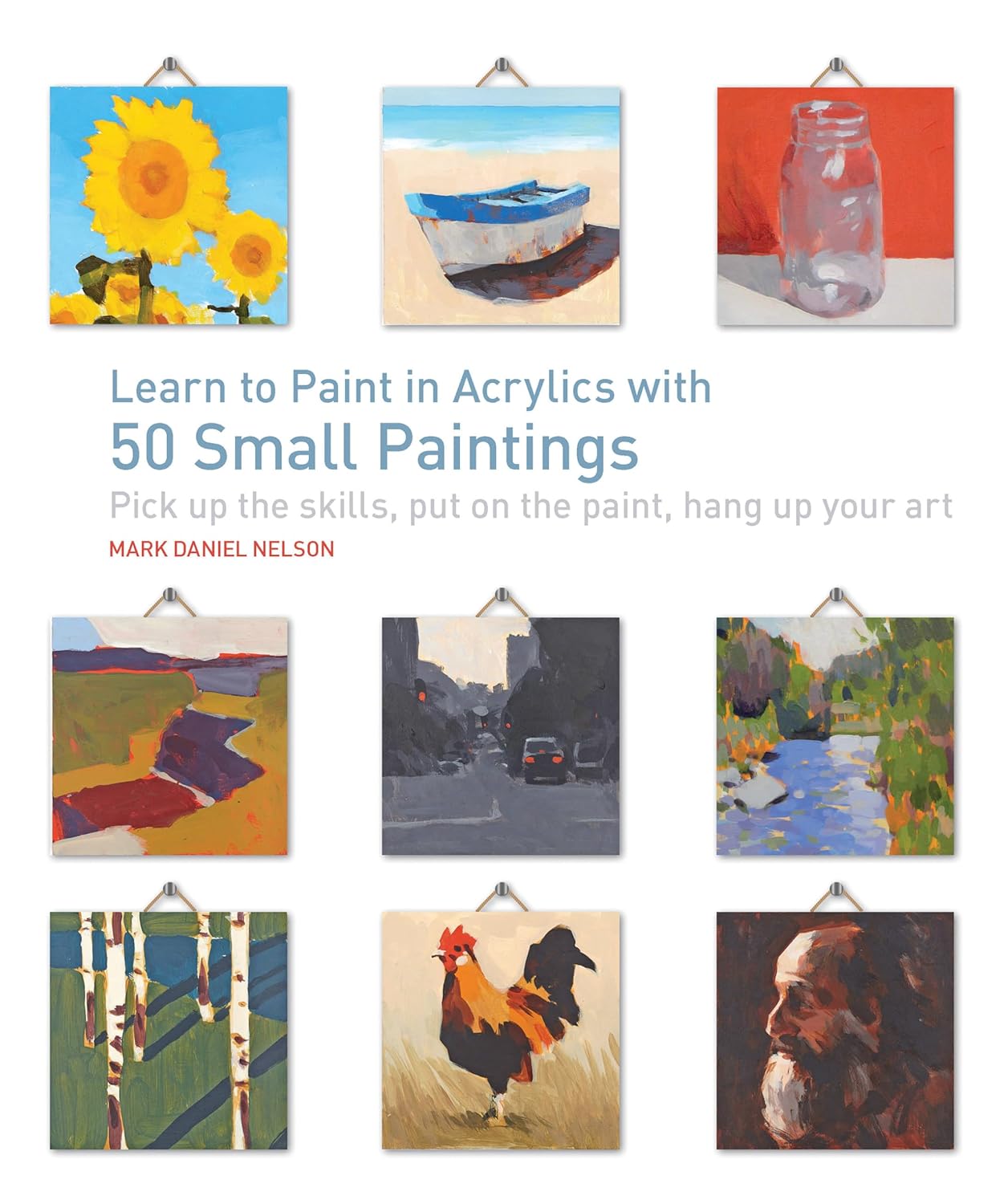
Mark Daniel Nelson’s book is built around 50 small paintings, and the subtitle (pick up the skills, put on the paint, hang up your art) captures the idea: frequent, finished results. Small paintings are the fastest way to improve because you complete more of them.
Each small project typically isolates one skill, which keeps sessions short and focused.
It is a strong choice for busy beginners with 30 to 60 minutes at a time.
Best suited for: Beginners who learn by doing and want quick wins.
Key features:
- Paperback
- 50 small painting projects
- Author: Mark Daniel Nelson
- Skill-building structure
Pros:
- Many finishable projects
- Short sessions
- Builds confidence quickly
Cons and limitations:
- Small formats only
- Less theory
- Mid tier
Buying consideration: Use 5 x 7 or 6 x 6 inch panels for these projects to keep material costs low.
3. Lee Hammond’s Big Book of Acrylic Painting — Best for painting favorite subjects

Lee Hammond’s Big Book is subtitled Fast, easy techniques for painting your favorite subjects. A subject-led approach appeals to beginners who already know what they want to paint, whether animals, flowers, landscapes or people.
Lee Hammond is a long-established art instruction author, and a big-book format usually covers many subjects in one volume.
It is good value for the breadth.
Best suited for: Beginners who want to jump into specific subjects quickly.
Key features:
- Paperback
- Many subjects
- Fast, easy techniques
- Author: Lee Hammond
Pros:
- Broad subject coverage
- Practical techniques
- Low-to-mid tier
Cons and limitations:
- Less depth per subject
- Fewer fundamentals exercises
- Style may not suit everyone
Buying consideration: Pick one subject and paint it three times before moving to the next.
4. Acrylic Painting Step by Step by Tom Swimm — Best for a low-cost introduction

Tom Swimm’s title promises the basics plus a range of special techniques for creating your own paintings in acrylic. Step-by-step books in this format are concise and visual, which suits beginners who prefer pictures to long explanations.
It is the lowest-priced book here, making it an easy first purchase.
Use it alongside a project-heavy book if you want more practice paintings.
Best suited for: Budget-conscious beginners wanting a concise visual guide.
Key features:
- Paperback
- Basics and special techniques
- Author: Tom Swimm
- Step-by-step format
Pros:
- Lowest tier
- Visual and concise
- Covers special techniques
Cons and limitations:
- Shorter than larger guides
- Fewer projects
- Limited listing detail
Buying consideration: Try each special technique on a sample board before using it in a painting.
5. Acrylic Landscapes for Beginners by Sarah Johnston — Best for landscape-focused beginners

Sarah Johnston’s book focuses on landscapes, with step-by-step projects such as scenic drives, misty forests and snowy mountains according to the subtitle. Landscapes are a natural first subject for many beginners because they forgive small inaccuracies.
Focused subject books build specific skills (skies, trees, water) quickly.
It is accessible in price.
Best suited for: Beginners who mainly want to paint landscapes.
Key features:
- Paperback
- Landscape step-by-step projects
- Author: Sarah Johnston
- Beginner level
Pros:
- Clear subject focus
- Atmospheric subjects
- Accessible tier
Cons and limitations:
- Landscapes only
- Less general technique
- Limited listing detail
Buying consideration: Paint the same scene at different times of day to practice color temperature.
6. Compendium of Acrylic Painting Techniques by Gill Barron — Best for a technique reference

Gill Barron’s compendium is a technique reference: a book you open when you want to know how to scumble, glaze, sponge or create texture. Reference books like this stay useful long after the first month.
It pairs well with any project-based book.
Low-to-mid tier.
Best suited for: Beginners who like to look things up and experiment.
Key features:
- Paperback
- Technique compendium
- Author: Gill Barron
- Reference format
Pros:
- Long-term usefulness
- Broad technique coverage
- Good companion book
Cons and limitations:
- Not a guided course
- Can overwhelm total beginners
- Limited listing detail
Buying consideration: Keep it near your painting area and try one new technique per week.
7. The Complete Acrylic Painting Guide for Beginners by Leonard Koe — Best for supplies and techniques in one guide

Leonard Koe’s guide promises a step-by-step path to essential techniques and choosing the right supplies, which addresses the first real hurdle for beginners: knowing what to buy.
It is the highest-priced book in this list, so compare it against the others before buying.
Best for readers who want a single comprehensive book.
Best suited for: Beginners who want supply advice and technique in one volume.
Key features:
- Paperback
- Supplies plus techniques
- Author: Leonard Koe
- Step-by-step format
Pros:
- All-in-one approach
- Supply guidance
- Beginner-focused
Cons and limitations:
- Highest tier here
- Limited listing detail on contents
- Newer title with less track record
Buying consideration: Check the table of contents preview on the product page before buying.
Buying Guide: How to Choose a Beginner Acrylic Book
Match the book to how you learn
Project-based books suit learners who want results; reference books suit experimenters; subject books suit those with a clear goal.
Look for step-by-step photos
Seeing each stage of a painting helps you understand order of work, the most common beginner gap.
Check supply lists
Books that list specific colors and brushes make it easier to follow along.
Prefer small projects at first
Small paintings are cheaper, faster and less intimidating.
Combine with practice ideas
Books give structure; idea lists keep you painting between chapters.
Set up a small, dedicated space
You will paint more often if setup takes two minutes rather than twenty. A tray holding your paints, brushes, water jars and palette paper, plus a corner of a table you can leave covered, removes most of the friction. Good, even light from a window or a daylight bulb helps you judge color.
Do not overbuy
One project book and one reference book are plenty for the first few months.
More Help for Beginners
Read our tips for absolute beginners in acrylic, then browse simple acrylic painting ideas and simple and fun ideas for complete beginners for your next projects.
Common Mistakes to Avoid
- Buying too many colors. A limited palette teaches mixing.
- Using cheap natural-hair brushes. Choose synthetics for acrylic.
- Letting paint dry on brushes. Rinse often and keep brushes wet while working.
- Painting too large too soon. Start with 8×10 or smaller.
- Overworking wet areas. Acrylic gets tacky fast; let it dry and paint over.
- Skipping values. Most dull paintings lack strong lights and darks.
FAQs
Is acrylic painting good for beginners?
Yes. Acrylic is affordable, water-based, fast-drying and forgiving, so mistakes can be painted over quickly.
What should a beginner paint first in acrylic?
Simple subjects with clear shapes: sunsets, silhouettes, a single fruit, or a simple landscape with sky, hills and foreground.
How many colors does a beginner need?
Six to eight is enough: white, black, two yellows, two reds, two blues and a brown. You can mix almost anything from these.
Do I need expensive paint to learn?
No. Student-grade acrylics are fine for learning. Upgrade white and your most-used colors later.
How do I stop acrylic drying too fast?
Put out small amounts, mist your palette, use a stay-wet palette or add a slow-drying medium.
Are books better than videos for learning acrylic?
Both help. Books give structure and step-by-step stages you can study at your own pace; videos show brush movement. Many beginners use both.
Final Recommendation
Start with a small palette, three synthetic brushes and canvas panels, do the five exercises, then follow a book. Complete newcomers should choose Acrylics for the Absolute Beginner; learners who like to dive straight in will thrive with 50 Small Paintings. Pick Lee Hammond’s Big Book for varied subjects, Acrylic Painting Step by Step on a tight budget, Acrylic Landscapes for Beginners for scenery, and keep the Compendium of Acrylic Painting Techniques as a reference. The Complete Acrylic Painting Guide suits readers who want supplies and techniques in one book.





One Comment