PaintingProGuide is reader-supported. When you buy through links on this page we may earn an affiliate commission at no extra cost to you.
Tape is one of the most useful and least glamorous tools in a painter’s kit. It holds watercolor paper flat, creates the clean white borders on a finished study, masks razor-sharp stripes in hard-edge abstract paintings, and protects areas you want to keep untouched. The best masking tape for painting holds firmly while you work, resists paint creeping underneath, and peels away without tearing paper or lifting the layer below.
Those goals pull in different directions, which is why artists keep more than one kind. This guide focuses on painting art and crafts: paper, canvas, panels, wood and craft surfaces.
Quick answer: For watercolor and paper, use low-tack JusArt Artist Tape (1/2 inch, 200 ft), made for watercolor paper. For crisp lines on canvas or panels, FrogTape Multi-Surface with PAINTBLOCK is designed to seal edges against bleed. ScotchBlue Original (2 inch) is the versatile all-rounder for wider masking, and the Amazon Basics beige masking tape is the budget choice for crafts, labeling and holding sketches, not delicate paper.
Types of Tape Painters Use
| Tape type | Adhesion | Best for in art | Watch out for |
|---|---|---|---|
| Artist tape | Low tack | Watercolor paper borders, drawings, delicate paper | May lift on rough or damp surfaces |
| Painter’s tape (blue) | Medium, clean removal | Masking on canvas, panels, wood; wider areas | Can still tear soft paper if left long |
| Edge-sealing painter’s tape | Medium, with edge barrier | Crisp hard-edge lines on canvas and panels | Higher cost per roll |
| General masking tape (beige) | Higher tack | Crafts, labeling, temporary holds | Tears paper; can leave residue over time |
The rule of thumb: the more delicate the surface, the lower the tack you want.
Our Top Picks at a Glance
- JusArt Artist Tape for Watercolor Paper — Best for watercolor paper and drawings
- FrogTape Multi-Surface Painter’s Tape with PAINTBLOCK — Best for crisp hard-edge lines on canvas and panels
- ScotchBlue Original Multi-Surface Painter’s Tape, 2 in. — Best for wider masking on most art surfaces
- SmaringRobot Premium Painter’s Tape, 4 Rolls — Best for multiple narrow rolls for crafts and kids
- Amazon Basics Multi-Surface Masking Tape, Beige — Best for budget crafts and labeling
- Fyguard Blue Painter’s Tape, 2 in., 5 Rolls — Best for large murals and big-canvas masking
| Product | Best For | Key Spec | Key Strength | Price Tier |
|---|---|---|---|---|
| JusArt Artist Tape for Watercolor Paper | Watercolor paper and drawings | 1/2 in. wide, 200 ft long | Designed for watercolor paper, low-tack style | $ |
| FrogTape Multi-Surface Painter’s Tape with PAINTBLOCK | Crisp hard-edge lines on canvas and panels | 0.94 in. x 60 yds | PAINTBLOCK edge technology against bleed | $ |
| ScotchBlue Original Multi-Surface Painter’s Tape, 2 in. | Wider masking on most art surfaces | 1.88 in. x 60 yds | Clean removal on many surfaces | $ |
| SmaringRobot Premium Painter’s Tape, 4 Rolls | Multiple narrow rolls for crafts and kids | 4 rolls, 0.94 in. x 22 yd each (88 yd total) | No-residue, easy-removal claims | $ |
| Amazon Basics Multi-Surface Masking Tape, Beige | Budget crafts and labeling | 1.41 in. x 60 yds, beige | Low cost general masking tape | $ |
| Fyguard Blue Painter’s Tape, 2 in., 5 Rolls | Large murals and big-canvas masking | 5 rolls, 2 in. wide | Bulk wide rolls for big projects | $$ |
How We Chose
We compared these tapes using their Amazon listing details and specifications checked in October 2026, without testing them ourselves. We looked at width, length, adhesion level, stated removal behavior, surface compatibility and suitability for paper, canvas and craft painting, and favored tapes that are widely reviewed by Amazon buyers.
Our criteria:
- Clean removal without residue or tearing.
- Edge sharpness: designs that help prevent paint bleed.
- Width options for borders, stripes and wider masking.
- Roll length and value.
- Surface fit: paper, canvas, panels and craft surfaces.
Best Masking Tape for Painting Reviewed
1. JusArt Artist Tape for Watercolor Paper — Best for watercolor paper and drawings
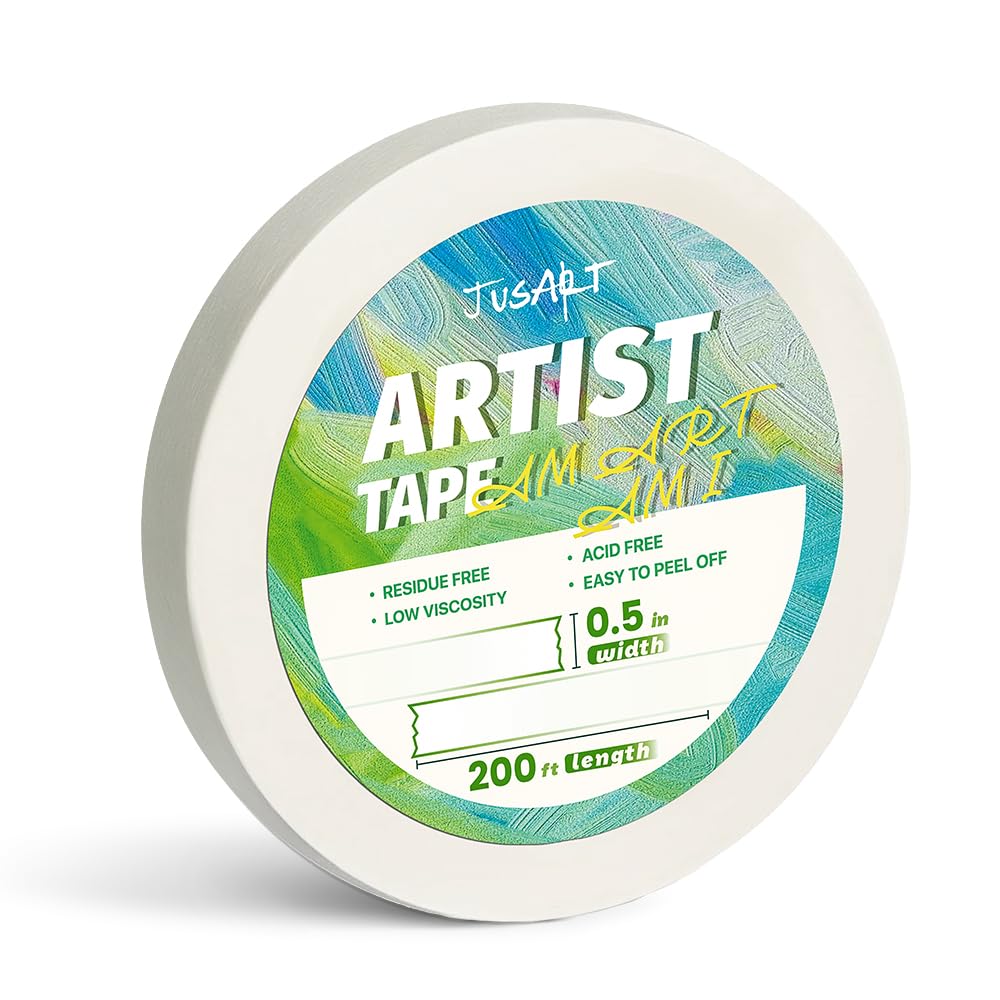
JusArt’s tape is made for watercolor paper, which immediately sets it apart from tapes designed for walls. Artist tapes like this are intended to hold paper flat during painting and peel off cleanly afterward, leaving the crisp white border many watercolorists like to frame with.
A 1/2-inch width gives a neat, narrow border, and 200 feet is a long roll that lasts through many paintings.
Best suited for: Watercolor painters, ink and wash, drawing on quality paper and taping sheets to boards.
Key features:
- 1/2 inch width
- 200 ft roll
- Made for watercolor paper
- Narrow, clean borders
Pros:
- Purpose-made for delicate paper
- Long roll
- Narrow width suits small studies
Cons and limitations:
- Narrow width limits wide masking
- Low-tack tapes may lift on very wet edges
Buying consideration: Peel slowly at a low angle, pulling the tape back over itself and away from the painting. Fast, upward peeling is what tears paper.
2. FrogTape Multi-Surface Painter’s Tape with PAINTBLOCK — Best for crisp hard-edge lines on canvas and panels

FrogTape’s selling point is PAINTBLOCK, an edge treatment designed to seal the tape edge so paint does not seep underneath. For hard-edge abstract painting, geometric designs and striped canvases, that is exactly the problem you need solved.
At just under one inch wide and 60 yards long, it suits stripes and geometric masking on canvas and panels.
Best suited for: Hard-edge abstract painters, geometric designs, stripes on canvas and crafts on wood.
Key features:
- 0.94 inch width
- 60 yards
- PAINTBLOCK edge technology
- Multi-surface
Pros:
- Built for sharp lines
- Good width for stripes
- Widely available
Cons and limitations:
- Higher price tier per yard than generic tape
- Not intended for delicate watercolor paper
Buying consideration: Burnish the edge firmly with a fingernail or palette knife, and seal it with a thin coat of the underlying color or clear medium before painting the new color. Any bleed then matches the base.
3. ScotchBlue Original Multi-Surface Painter’s Tape, 2 in. — Best for wider masking on most art surfaces

ScotchBlue Original is the familiar blue painter’s tape. The listing describes a multi-surface tape that protects surfaces and removes easily, for indoor and outdoor use. At about 2 inches wide it covers larger areas quickly: masking a canvas edge, protecting a section of a mural, or covering parts of a panel during spray or sponge work.
Its medium adhesion and clean removal make it a solid general-purpose tape for canvas, panels and wood.
Best suited for: Masking large areas, canvas edges, mural sections and spray stencil work.
Key features:
- 1.88 in. x 60 yds
- Multi-surface
- Indoor and outdoor
- Clean removal
Pros:
- Versatile general-purpose tape
- Wide enough for big masks
- Trusted brand
Cons and limitations:
- Can tear soft paper if left on long
- No special edge-sealing feature
Buying consideration: Remove painter’s tape while the paint is still slightly soft or just dry. Pulling it off fully cured, thick acrylic can lift a ragged edge.
4. SmaringRobot Premium Painter’s Tape, 4 Rolls — Best for multiple narrow rolls for crafts and kids

This four-pack of blue painter’s tape gives just under one-inch-wide rolls, 22 yards each, for 88 yards total. The listing mentions DIY crafts and arts, labeling and decoration, and describes no residue and easy removal.
Several smaller rolls are handy in a classroom or family art space, where tape gets passed around and lost. The width suits tape-resist kids’ art and stripes on small canvases.
Best suited for: Classrooms, kids’ tape-resist art, craft tables and small canvases.
Key features:
- 4 rolls
- 0.94 in. x 22 yd each
- No-residue claim
- Multi-purpose
Pros:
- Multiple rolls for sharing
- Narrow width for stripes and shapes
- Low price tier
Cons and limitations:
- Shorter rolls than single 60 yd rolls
- No edge-sealing technology
Buying consideration: For kids’ tape-resist art, use thick paper or cardstock and have them peel the tape slowly once the paint is dry.
5. Amazon Basics Multi-Surface Masking Tape, Beige — Best for budget crafts and labeling

Classic beige masking tape has higher tack than painter’s tape and is designed for general use. Amazon Basics markets this roll for labeling and multi-surface use at 1.41 inches wide and 60 yards long.
In the studio, it is useful for labeling paint jars and palettes, holding reference photos to an easel, taping canvas wrapping and craft projects. Avoid it on watercolor paper and delicate surfaces, where stronger adhesive can tear fibers.
Best suited for: Labels, holding references, packaging, kids’ crafts on sturdy surfaces.
Key features:
- 1.41 in. x 60 yds
- Beige general masking tape
- Multi-surface
- Writable for labels
Pros:
- Lowest price tier
- Good for labeling and holds
- Wide enough for general use
Cons and limitations:
- Higher tack can tear paper
- Not designed for crisp paint lines
Buying consideration: Keep this roll for everything except painting masks. Using one tape for labels and another for masking avoids accidental damage.
6. Fyguard Blue Painter’s Tape, 2 in., 5 Rolls — Best for large murals and big-canvas masking

For large art projects, such as murals, multi-panel canvases or a classroom’s worth of tape art, a multi-roll pack of 2-inch tape is practical. Fyguard’s five-pack provides wide blue painter’s tape intended for clean masking.
Wide tape is also useful for protecting the sides of gallery-wrapped canvases while painting the front.
Best suited for: Murals, large canvases, workshops and classes.
Key features:
- 5 rolls
- 2 in. width
- Blue painter’s tape
- Bulk pack
Pros:
- Wide coverage
- Bulk supply
- Good for protecting canvas sides
Cons and limitations:
- Higher up-front price tier
- Too wide for fine stripes
Buying consideration: Tear or cut tape lengths before you start painting. Stopping mid-mural to unroll tape with painted hands transfers paint everywhere.
Tape by Medium: What Works Where
Watercolor. Tape paper to a board on all four sides with low-tack artist tape before wetting. The tape limits buckling and gives a white border. Do not paint wet washes right up against the tape and leave them pooling there; water can creep under the edge and lift fibers when the tape comes off.
Acrylic. Acrylic dries quickly, which makes it ideal for tape masking. Paint thin layers, let each dry to the touch, and remove tape before the paint fully cures. Edge-sealing with matte medium is the most reliable way to get crisp lines on textured canvas.
Oil. Oil paint stays wet for days, so tape lines need care. Mask over a fully dry underlayer, lay paint against the tape, and peel shortly after applying the color while it is still wet, pulling away from the fresh edge. Leaving tape in wet oil for days can drag paint when removed.
Gouache and ink. Use artist tape on paper. Gouache can reactivate with water, so avoid brushing wet paint repeatedly over a taped edge.
Spray and sponge work. Wide painter’s tape and paper sheets protect large areas. Burnish well, since spray mist finds any gap.
How to Get Crisp Lines with Tape
- Make sure the surface is dry. Tape applied over damp or tacky paint can lift it.
- Lay tape in a single motion. Stretching tape as you apply it causes it to pull back and wrinkle.
- Burnish the edge. Press firmly along the edge you will paint against.
- Seal the edge. Brush a thin layer of the base color, or a clear acrylic medium, along the tape edge and let it dry. Any bleed will be invisible.
- Paint away from the tape. Brush from the tape toward the open area, not into the edge.
- Remove at the right time. Pull slowly at a low angle once the paint is touch-dry.
Masking Ideas for Painters
- Watercolor borders: tape all four edges of a sheet for a clean, frame-ready white margin.
- Hard-edge abstracts: mask stripes and triangles on canvas with edge-sealing tape.
- Geometric landscapes: tape a grid of triangles over a canvas, paint each section, then peel for a mosaic effect.
- Horizon lines: tape a straight horizon to keep sky and sea cleanly separated.
- Tape-resist cards: tape initials or shapes onto cardstock, paint over, then peel.
- Gallery-wrap edges: protect canvas sides while painting the front, or tape off to paint them a solid color.
Buying Guide: How to Choose Masking Tape for Painting
Match tack to surface
Low-tack artist tape for paper, medium-tack painter’s tape for canvas and panels, general masking tape for crafts and labels.
Choose width by job
Half-inch tape gives neat paper borders and thin stripes. One-inch tape suits most canvas stripes. Two-inch tape masks large areas and canvas sides.
Consider edge sealing
If crisp lines matter, edge-sealing tapes are designed to reduce bleed. Combine with burnishing and edge sealing for best results.
Think about removal time
Most tapes are designed for clean removal within a certain window. Remove artwork tape as soon as the paint is touch-dry.
Watch for surface texture
Tape seals better on smooth surfaces. Heavily textured canvas allows more bleed, so seal edges with medium.
Buy enough
Long rolls and multipacks save money if you mask often or teach groups.
More Tape and Masking Techniques
For project inspiration, our guide to painting ideas with tape and masking covers tape-resist art, geometric canvases and more. Tape is also handy for craft surfaces: use it to mask clean bands when painting pottery at home, or to keep a roof line crisp on a painted birdhouse.
Common Mistakes to Avoid
- Using beige masking tape on watercolor paper. It can tear the surface when removed.
- Not burnishing the edge. Paint seeps under loose tape.
- Painting thick paint against tape. Thick layers form a skin that tears when tape is removed.
- Leaving tape on for days. Adhesive can bond more strongly over time.
- Peeling straight up. Pull back at a low angle instead.
- Taping over damp paint. It lifts the paint when removed.
FAQs
What is the best tape for watercolor paper?
Low-tack artist tape made for watercolor paper, such as the JusArt artist tape, is best. It holds paper flat and removes cleanly without tearing when peeled slowly at a low angle.
Is painter’s tape the same as masking tape?
Not quite. Painter’s tape is designed for clean removal and sharper paint lines. General masking tape usually has stronger adhesive and can leave residue or tear delicate surfaces.
How do I stop paint bleeding under tape on canvas?
Burnish the tape edge firmly, then brush a thin layer of the underlying color or clear acrylic medium along the edge and let it dry before applying the new color.
When should I remove tape from a painting?
Remove it once the paint is touch-dry but before it fully cures, peeling slowly at a low angle. Removing too early can smear; too late can lift ragged edges.
Can I use painter’s tape on watercolor paper?
You can, but it may tear softer papers if left on long or removed quickly. Artist tape is a safer choice for delicate paper.
Which tape width is best for art?
Half-inch tape suits paper borders and thin lines, around one inch suits most canvas stripes, and two inches suits large masked areas and canvas edges.
Final Recommendation
Keep two or three tapes on hand. Use JusArt Artist Tape for watercolor and drawings, FrogTape for crisp lines on canvas and panels, and ScotchBlue for wider masking. Add SmaringRobot’s multi-roll pack for kids and classrooms, Fyguard’s wide rolls for murals, and the Amazon Basics beige roll for labels and crafts.