
PaintingProGuide is reader-supported. When you buy through links on this page we may earn an affiliate commission at no extra cost to you.
A beginner does not need fifty brushes to start oil painting. What matters is having the four core shapes, flat, round, filbert and a fine liner, in a few sensible sizes, with bristles that survive oil paint and solvent cleaning. The best oil painting brush sets for beginners deliver exactly that at a modest price, ideally with a roll or case that protects the tips, so new painters can learn how each shape behaves before spending money on premium single brushes.
This guide compares six sets from the Amazon listings we checked, explains which shapes to learn first, and covers the care habits that keep inexpensive brushes working far longer.
Quick answer: For most beginners, the Nicpro 30-Piece Brush Set is the best balance: eight flats, six rounds, six filberts, angles, fans, daggers, a cat tongue, a liner and a spatula in a roll case. If you want even more sizes per shape, the Nicpro 36-Piece Set adds a full range of angles and fine detail brushes. On a tight budget, the Benicci 12-Piece Set covers the essential shapes in the lowest price tier.
Our Top Picks at a Glance
- Nicpro 30pcs Paint Brush Set — Best overall beginner set
- Nicpro 36pcs Paint Brush Set — Best for complete size coverage
- Benicci 12-Piece Brush Set — Best budget essentials
- Fuumuui 25pcs Professional 9-Shape Set — Best for exploring specialty shapes
- Fuumuui 26pcs Synthetic Nylon Set — Best soft synthetic set for blending
- Norberg & Linden XXL Oil Paint Set — Best brushes-plus-paint starter kit
| Product | Best For | Key Spec | Key Strength | Price Tier |
|---|---|---|---|---|
| Nicpro 30 | All-round beginners | 8 flat, 6 round, 6 filbert, angles, fans, daggers, cat tongue, liner | Balanced shape mix | $$ |
| Nicpro 36 | Size coverage | 6 each flat, round, filbert, angle; 5 fan; 5 detail | Full size ladders | $$ |
| Benicci 12 | Budget starts | Flat, round, fan, filbert | Essential shapes only | $ |
| Fuumuui 25 | Specialty shapes | 9 shapes incl. cat tongue, rigger, dagger, knife | Canvas roll | $$ |
| Fuumuui 26 | Soft blending | Synthetic nylon; pointed, liner, filbert, dagger | Soft bristle | $$ |
| Norberg & Linden XXL | Complete starter | 24 oil paints, 25 brushes, palette, canvas | Paint included | $$ |
How We Chose
We have not painted with these sets. The picks are based on the Amazon listing details and specifications checked in October 2026, how well each set’s shapes, sizes and bristles fit a beginner learning oil painting, and how widely each product is reviewed by Amazon buyers. We left out a kids’ gift set in the results that is pitched at watercolor and acrylic.
- Core shapes: flats, rounds, filberts and at least one liner or detail brush.
- Size range: small, medium and large in each core shape.
- Oil durability: secure, double-crimped ferrules and bristles that hold up to solvent or oil cleaning.
- Storage: a roll or case that protects tips.
- Value: enough useful brushes without filler.
Which Brushes Beginners Actually Need for Oil
Most beginner oil paintings can be made with five brushes: a large flat or filbert for blocking in, a medium filbert for shapes, a small filbert or flat for edges, a small round for details and a liner for thin lines. Larger sets are useful because they let you try different sizes, but it is worth learning those five first. Our guide to what brushes you need for oil painting goes into each shape in more detail.
- Flat: long bristles with a square end. Broad strokes, crisp edges and blocking in.
- Filbert: a flat with a rounded tip. Softer edges and blending; the most versatile oil brush.
- Round: pointed tip. Lines, details and small shapes.
- Liner or rigger: very long, thin hairs. Branches, grass, rigging and signatures.
- Fan: softening and texture such as foliage.
- Angle: precise edges and corners.
- Mop: a soft, large brush for blending and glazing; not in every set.
Two specialty brushes beginners often ask about are covered in our tutorials: how to use a mop brush with oil paint for soft blending and glazes, and how to use a rigger brush in oil painting for fine lines.
Synthetic or natural bristle?
Traditional oil brushes use hog bristle, which is stiff and moves thick paint. Most affordable beginner sets use synthetic nylon, which is softer, easier to clean and works across oil and acrylic. For a beginner, synthetic is a perfectly good start; many painters add a few hog bristle brushes later for heavy, textured work.
Best Oil Painting Brush Sets for Beginners Reviewed
1. Nicpro 30pcs Paint Brush Set for Acrylic, Oil, Watercolor and Gouache — Best for an all-round beginner set

Nicpro’s 30-piece set lists exactly what is inside: eight flats (#2 to #14), six rounds (#0 to #14), six filberts (#2 to #14), three angles, three fans, two daggers, one cat tongue, one liner and a paint spatula, packed in a nylon cloth roll. Bristles are nylon, ferrules double-crimped aluminum, and handles birch.
That mix is ideal for learning: enough flats and filberts in graduated sizes to practice blocking in and blending, a #0 round and liner for details, and a few specialty shapes to experiment with. The roll is described as resistant to oil and water.
Best suited for: New oil painters who want one set that covers every core shape and a few specialty ones.
Key features:
- 30 pieces
- 8 flats, 6 rounds, 6 filberts
- 3 angles, 3 fans, 2 daggers, cat tongue, liner, spatula
- Nylon bristles, double-crimped ferrules
- Oil- and water-resistant roll
Pros:
- Balanced shape and size mix
- Clearly listed sizes
- Protective roll
- Mid price tier
Cons and limitations:
- Nylon is softer than hog for thick impasto
- More brushes than an absolute beginner needs at first
Buying consideration: Start with the #12 flat, #8 and #4 filberts, #2 round and the liner. Add other shapes once you are comfortable.
2. Nicpro 36pcs Paint Brush Set, Professional Paintbrushes — Best for complete size coverage

The 36-piece Nicpro set includes six each of flat, round, filbert and angle brushes in sizes 2 to 12, five fans (1 to 9), five detail brushes (#0, 2/0 and 3/0 rounds, a #0 flat and a #0 liner), one large flat (12) and a palette knife, according to the listing. Nylon bristles sit in chrome-plated aluminum double-crimped ferrules, with a nylon cloth roll case.
Matching size ladders across four shapes make it easy to understand how size changes a stroke, and the five detail brushes are useful for small paintings.
Best suited for: Beginners who want every size and plenty of detail brushes.
Key features:
- 36 pieces
- 6 each flat, round, filbert, angle (2-12)
- 5 fans, 5 detail brushes
- Large flat and palette knife
- Nylon roll case
Pros:
- Full size ladders
- Five fine detail brushes
- Palette knife included
- Mid price tier
Cons and limitations:
- No dagger or cat tongue
- Many brushes may feel overwhelming at first
Buying consideration: Label your favorite sizes with a dot of tape; it speeds up choosing the right brush mid-painting.
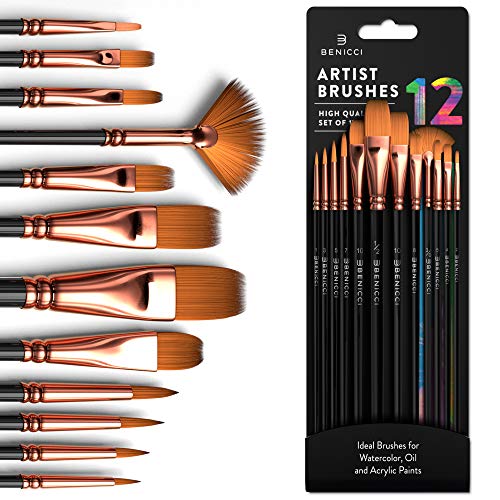
3. Benicci Professional Artist Paint Brush Set of 12 — Best for budget essentials

Benicci calls this a “Goldilocks” set: 12 brushes covering flat, round, fan and filbert shapes, with high-grade nylon bristles that keep their shape and do not shed, and ergonomic wooden handles. The set name lists acrylic and oil use.
It is the lowest-cost set here, and twelve brushes in four core shapes are enough to complete beginner paintings.
Best suited for: Absolute beginners on a budget, or anyone testing oil painting before committing.
Key features:
- 12 brushes
- Flat, round, fan, filbert
- Nylon bristles
- Ergonomic wooden handles
Pros:
- Lowest price tier
- Only useful shapes
- Shedding-resistant per listing
Cons and limitations:
- No liner or dedicated detail brush
- No roll or case mentioned
- Fewer size options
Buying consideration: Add a single liner brush if you plan to paint branches, grass or fine lines.
4. Fuumuui 25pcs Paint Brush Set, Professional 9 Shapes — Best for exploring specialty shapes

Fuumuui’s 25-piece set includes 24 brushes in nine shapes, large wide flat, flat, filbert, fan, dagger, cat tongue, round, angle and rigger, plus a palette knife and a waterproof canvas roll with separate compartments. Handles are sustainably sourced birch.
Beginners who are curious about what each brush shape does will find a full tour here, including the rigger and cat tongue shapes that cheaper sets skip.
Best suited for: Beginners who want to experiment with every brush shape.
Key features:
- 24 brushes, 9 shapes
- Palette knife
- Waterproof canvas roll
- Synthetic bristles
- Birch handles
Pros:
- Widest shape variety
- Includes rigger and cat tongue
- Roll keeps brushes organized
Cons and limitations:
- Listing does not give every size
- General claims about pigment capacity
Buying consideration: Make a shape sampler: one page with a few strokes from each brush, labeled. It is the fastest way to learn what each does.
5. Fuumuui 26pcs Professional Paint Brush Set, Synthetic Nylon — Best for soft blending

This Fuumuui set uses soft synthetic nylon with hand-crafted double-crimped copper ferrules and ergonomic birch handles. Shapes include large wide flat, pointed, liner, flat, brights, slant, dagger and filbert, among others.
Soft bristles make smooth blending easier for beginners, especially for skies, skin and still life objects.
Best suited for: Beginners who want soft brushes for smooth blending in oil or acrylic.
Key features:
- 26 brushes
- Soft synthetic nylon
- Double-crimped copper ferrules
- Many shapes including liner and pointed
Pros:
- Soft bristles blend smoothly
- Secure ferrules
- Mid price tier
Cons and limitations:
- Too soft for heavy textured paint
- Sizes not itemized in the listing
Buying consideration: Pair it with one or two stiff brushes for blocking in thick passages.
6. Norberg & Linden XXL Oil Paint Set — Best for a brushes-plus-paint starter kit

Norberg & Linden’s kit includes 24 oil paint tubes (12 ml each), 25 brushes in assorted sizes and styles (bristle, nylon and foam), a metal palette and one stretched 8 x 10 inch canvas panel, according to the listing. The colors include primaries, earth tones, blues, greens and skin-tone shades.
For someone starting from nothing, a kit avoids buying brushes and paint separately. The mix of bristle, nylon and foam brushes gives a taste of each type.
Best suited for: Complete beginners who need paint and brushes in one purchase.
Key features:
- 24 oil paints, 12 ml each
- 25 brushes: bristle, nylon and foam
- Metal palette
- 8 x 10 canvas panel
Pros:
- Everything needed to start
- Mix of bristle types
- Mid price tier
Cons and limitations:
- 12 ml tubes run out quickly, especially white
- Foam brushes have limited use in oil
- Kit-quality paint
Buying consideration: Buy a larger tube of titanium white separately; beginners use far more white than any other color.
Buying Guide: How to Choose an Oil Painting Brush Set as a Beginner
Check for the four core shapes
Flat, round, filbert and liner. Sets missing filberts or a fine liner leave gaps beginners notice quickly.
Look at size ranges
Small, medium and large in each shape. A set of all tiny brushes encourages fussy painting.
Prefer secure ferrules
Double-crimped ferrules hold bristles through repeated oil and solvent cleaning.
Choose storage
A roll or case prevents bent tips. Sets like Nicpro and Fuumuui include rolls.
Decide on synthetic or hog
Synthetic is easier for beginners; add a few hog brushes later for texture.
Consider a kit if starting from scratch
Brushes-plus-paint kits like Norberg & Linden simplify the first purchase.
Three Beginner Exercises to Learn Your Brushes
1. The stroke sampler
On a canvas panel or oil paper, make a row of strokes with each brush: a long pull, a short dab, a twist, a stroke with the edge and one with the flat. Label each row. In twenty minutes you will know which brush makes which mark, which saves endless guessing later.
2. The value ladder
With one medium filbert, paint a strip of five squares from white to near-black using only white and one dark color. This teaches paint loading, how much pressure gives even coverage, and how to wipe a brush between mixtures without muddying the next step.
3. The three-brush still life
Set up a simple object, like an apple or mug, and paint it using only a large flat, a medium filbert and a small round. Block in with the flat, model with the filbert and add highlights with the round. Limiting yourself shows how much a few brushes can do and builds the habit of working from large to small.
Making Cheap Brushes Last
- Wipe excess paint on a rag before rinsing.
- Rinse in odorless mineral spirits or a safflower or linseed oil bath.
- Wash with mild soap and warm water, working lather into the bristles near the ferrule.
- Rinse, reshape the tip with your fingers and lay flat or store tip-up to dry.
- Never leave brushes standing in solvent on their tips.
- Keep one or two old brushes for mixing paint so your good ones stay sharp.
Detail brushes take extra care. Our guides on using a liner brush for detail work and painting dots with a round brush show how to get clean results from small brushes.
Common Mistakes to Avoid
- Starting with tiny brushes: big brushes first keep paintings bold and simple.
- Using watercolor brushes for oil: very soft brushes cannot move oil paint well.
- Letting paint dry in the ferrule: it splays bristles permanently.
- Mixing paint with good brushes: use a palette knife or old brush instead.
- Storing brushes tip-down in a jar: bent tips are nearly impossible to fix.
- Buying a huge set and using two brushes: practice with every core shape.
FAQs
What brushes should a beginner buy for oil painting?
Start with flats, filberts and rounds in small, medium and large sizes plus a liner. A set like the Nicpro 30-Piece covers all of these.
Can I use acrylic brushes for oil painting?
Yes. Synthetic brushes sold for acrylic generally work in oil too. Clean them thoroughly after each session, as oil paint dries slowly but stubbornly.
Are synthetic brushes good for oil painting?
Yes, especially for beginners. They are easier to clean and blend smoothly. Hog bristle brushes are better for thick, textured paint and can be added later.
How many brushes do I need to start oil painting?
Five to eight brushes is enough for most beginner paintings. Larger sets give you more sizes to explore.
What is the most useful oil painting brush?
The filbert. It makes both broad strokes and soft edges, which is why many oil painters use it more than any other shape.
How do I clean oil brushes as a beginner?
Wipe off paint, rinse in mineral spirits or oil, then wash with mild soap and warm water. Reshape the tips and let them dry flat or tip-up.
Final Recommendation
The Nicpro 30-Piece Set is the best all-round oil brush set for beginners, with every core shape in graduated sizes, a few specialty brushes and a protective roll. The Nicpro 36-Piece Set is the choice if you want full size ladders and extra detail brushes, while the Benicci 12-Piece Set covers the essentials on a tight budget.
Curious beginners can explore every brush shape with the Fuumuui 25-Piece Set, and the Fuumuui 26-Piece Synthetic Set suits those who want soft blending. If you are starting with no supplies at all, the Norberg & Linden XXL Kit bundles brushes with paint, a palette and a canvas.





One Comment