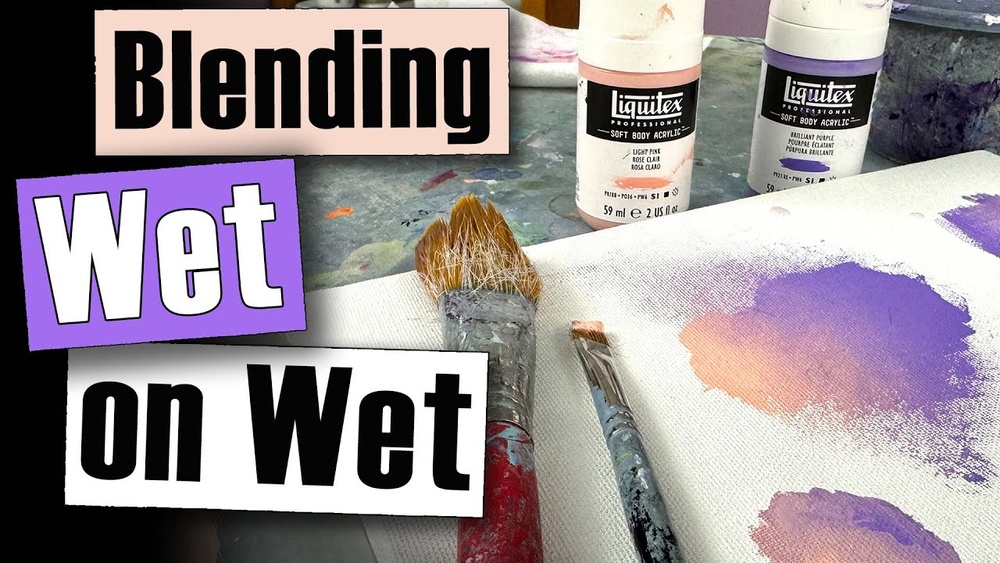
Quick answer: To wet blend acrylics on canvas, slow the drying first: mist the canvas lightly, add a retarder or slow-drying medium to your paint, and work in sections no bigger than about a hand span. Lay down both colors side by side generously, mix a middle value between them, then stroke across the join with a soft, slightly damp brush in light, overlapping X or crisscross strokes, wiping the brush often. Stop while the paint is still wet; going back into tacky paint causes streaks.
Smooth transitions are the hardest thing to get out of acrylic paint. A sunset that fades from gold to violet, a soft shadow on a cheek, or a misty background all need paint that stays workable long enough to merge. Acrylic, which can skin over in a few minutes, seems built to resist that.
The fix is a combination of preparation, timing, and brush handling. This guide explains how to wet blend acrylics on canvas step by step, which mediums extend working time, how to rescue streaky blends, and alternative blending methods when wet blending is not practical.
Why Acrylics Are Tricky to Blend
Acrylic paint is pigment suspended in a water-based acrylic polymer emulsion. As water evaporates, the polymer particles pack together and fuse into a film. Once that happens, the paint no longer moves. Three factors speed that process on canvas:
- Absorbent ground. Gesso pulls water out of the paint, so the first layer dries faster than later ones.
- Thin application. Thin paint has less water to lose and sets almost immediately.
- Room conditions. Dry air, heat, fans, and air conditioning all shorten open time dramatically.
Successful wet blending means slowing those factors down just enough to give you a few minutes of workable paint. If you are new to the medium overall, our guide on painting with acrylics on canvas covers surface preparation, layering, and mixing before you tackle blending.
What You Need
Paint and mediums
- Heavy body or soft body acrylics. Heavier paint holds more water and stays workable a little longer. Fluid acrylics blend easily but dry fast in thin films.
- Retarder. An additive that slows drying. Many brands recommend no more than about 15 percent by volume; too much can leave paint weak or tacky.
- Slow-drying or blending medium. Similar to retarder but with more binder, so you can add more without weakening the film.
- Slow-drying acrylic lines. Some manufacturers make acrylics formulated to stay open much longer than standard paint, which many portrait and landscape painters find easier for blending.
Brushes
- A soft synthetic filbert (size 8 to 12) for laying in and blending
- A wide, soft flat or mop brush for softening large areas
- A fan brush for feathering sky and foliage transitions
- A clean, dry brush reserved only for the final softening pass
Other tools
- Fine mist spray bottle filled with clean water
- Stay-wet palette, or a damp paper towel under parchment paper
- Paper towels or a lint-free rag for wiping the brush
Prepare the Canvas for Blending
The surface makes a surprising difference. A rough, heavily textured canvas catches paint in the weave and breaks up gradients. For soft blends:
- Apply one or two extra coats of gesso and sand lightly between them with fine sandpaper. A smoother surface lets paint glide.
- Tone the canvas with a thin, dried layer of acrylic. A sealed, toned surface absorbs less water than raw gesso, so your blending layer stays wet longer.
- Right before painting, mist the area lightly. It should look dewy, not wet enough to run.
How to Wet Blend Acrylics on Canvas: Step by Step
We will use a simple two-color sky gradient as the example, moving from a warm yellow near the horizon to a soft blue above. The same sequence works for any transition.
- Mix all colors before you start. Prepare the yellow, the blue, and a middle color. For yellow to blue, a direct mix gives green, which looks wrong in a sky; instead, use a warm off-white or pale peach as a bridge. Add retarder or blending medium to each pile.
- Mist the canvas section. Work only in a band you can finish in five minutes or so.
- Lay in the top color. Brush the blue across the top third in horizontal strokes, slightly thicker than you normally would. More paint means more working time.
- Lay in the bottom color. Brush the yellow across the bottom third.
- Add the bridge. Paint the middle color in the gap, overlapping slightly into both neighbors.
- Blend the first join. With a clean, barely damp filbert, use short crisscross (X-shaped) strokes along the line between blue and the bridge color. Work across the full width, then wipe the brush.
- Blend the second join. Repeat between the bridge and the yellow, wiping your brush between passes so you do not carry blue into the yellow.
- Soften. Switch to the dry, soft mop or flat brush. Lightly sweep horizontally across the entire gradient with almost no pressure. This removes visible strokes.
- Stop. When the paint starts to drag or the brush leaves lifted ridges, it is setting. Leave it to dry fully. You can always refine with another layer.
Wet Blending Techniques to Practice
Crisscross blending
Short, overlapping X strokes are the workhorse method. They distribute paint in multiple directions, so the transition loses its edges. Use for skies, backgrounds, and broad forms.
Feathering
Drag the tips of a soft or fan brush lightly from one color into the other, then the other way. It creates a soft, slightly textured transition suited to clouds, fur, and foliage.
Two-brush method
Keep one brush for each color plus a clean one for blending. You avoid rinsing mid-blend, which adds water and dilutes the paint unexpectedly.
Wet-in-wet drops
Touch a second color into a still-wet first color and let them mingle with minimal brushing. This gives loose, atmospheric effects in clouds and abstract work.
Value bridges
When blending colors far apart in value, add one or two intermediate mixes. Each smaller step is easier to blend smoothly than one large jump.
Other Ways to Blend Acrylics When Paint Dries Too Fast
Wet blending is not the only route to smooth transitions. When the room is hot or the area is large, these methods can be easier:
| Method | How it works | Best for |
|---|---|---|
| Layered or dry blending | Apply thin, semi-transparent layers over dry paint, each slightly shifting the color | Portraits, still life, controlled gradients |
| Glazing | Mix a little color into glazing medium and apply over a dry layer | Deepening shadows, unifying color |
| Scumbling | Scrub a thin, opaque layer over dry paint with a dry brush, letting the underlayer peek through | Atmospheric haze, soft skies |
| Stippling or optical blending | Dab small marks of two colors that merge visually at a distance | Foliage, textured surfaces |
| Airbrush or sponge | Apply paint in fine dots or soft sponge marks | Large gradients, backgrounds |
Many painters combine methods: a rough wet blend first, followed by one or two glazes to smooth any remaining bands.
How to Use Acrylic Medium on Canvas for Blending
Mediums change not just drying time but how paint moves. A few practical guidelines:
- Add mediums on the palette, not directly on the canvas, so the mix is consistent.
- Glazing medium increases transparency and often extends open time a little.
- Flow improver helps paint level smoothly, useful for flat color fields and soft gradients.
- Avoid thinning acrylic heavily with water alone for blending. Too much water weakens the binder, makes color chalky, and reduces adhesion.
- Remember that layers with retarder dry slower and should cure fully before varnishing. Our guide to sealing acrylic paint on canvas explains how long to wait.
Troubleshooting Streaky or Patchy Blends
| Problem | Cause | Fix |
|---|---|---|
| Visible brush streaks | Paint too thin, or brushing into tacky paint | Use more paint and medium; let it dry and glaze over |
| Muddy middle zone | Mixing complementary colors (yellow and violet, blue and orange) | Use a neutral or light bridge color; wipe brush more often |
| Lifting or peeling paint | Overworking a layer that has started to set | Stop; let it dry fully and repaint the area |
| Hard band between colors | Gap in values too large; not enough overlap | Add an intermediate mix; blend wider |
| Chalky, pale gradient | Too much water | Use medium instead of water to extend paint |
| Paint stays sticky for hours | Too much retarder | Use less next time; allow extra drying before layering |
Blending Tips for Common Subjects
Skies and sunsets
Work from the lightest area near the horizon upward, or from the top down, but stay consistent. Horizontal strokes suit calm skies; slightly curved strokes suggest a dome. Paint the whole sky in one session if you can, since restarting halfway often leaves a visible seam.
Skin tones
Skin needs small, controlled transitions rather than broad sweeps. Mix three values (light, middle, shadow) of the same skin color before starting, and blend each join with a small filbert. Warm reds around cheeks, nose, and ears can be dropped into wet paint and softened gently. Dry layering with thin glazes is often easier than full wet blending for faces.
Water and reflections
Blend vertically first to set the reflected colors, then pull a few light horizontal strokes across with a clean, dry flat brush. The horizontal pass suggests the water’s surface without destroying the reflection.
Round forms
Follow the shape with your strokes. Curved, overlapping strokes around a sphere or apple describe the form better than straight crisscrosses, and they keep the turning edge soft.
Practice Exercises
- Value strip: Blend black to white across a 2 x 8 inch strip. Repeat until you see no bands.
- Two-color sky: Blend blue to peach on an 8 x 10 canvas panel. Time yourself to learn how long your paint stays open.
- Sphere: Paint a ball with a light side, a core shadow, and reflected light. This teaches blending around a form.
- Sunset: Try three or four colors, from deep violet to orange to yellow, using bridge mixes.
Once these feel comfortable, apply them to small paintings. Our list of easy acrylic painting ideas for beginners includes several subjects, like sunsets and night skies, that are built almost entirely on smooth blends.
Common Mistakes
- Working in direct sunlight or under a fan
- Blending too large an area at once
- Overloading the brush with water between strokes
- Going back into paint after it starts to set, hoping to fix a streak
- Skipping the bridge color between distant hues
- Using stiff hog bristle brushes for soft blends; they leave marks
FAQs
How do you blend acrylic paint on canvas without it drying?
Mist the canvas lightly, add retarder or a slow-drying medium to your paint, use a stay-wet palette, and work in small sections. Applying slightly thicker paint than usual also keeps it workable longer.
Can I use water to blend acrylic paint?
A lightly damp brush helps, but adding a lot of water thins the binder and leads to chalky, weak paint. Mediums designed to extend drying time are a better choice for blending.
What is the best brush for blending acrylics?
Soft synthetic brushes work best, especially filberts for blending and mop or wide flat brushes for softening. Stiff bristle brushes tend to leave visible marks in smooth gradients.
Why do my acrylic blends look streaky?
Streaks usually come from paint that is too thin or from brushing paint that has already begun to set. Use more paint and a blending medium, work faster in smaller areas, and if streaks remain, let the layer dry and smooth it with a glaze.
Is wet blending or layering better for acrylics?
Neither is universally better. Wet blending is faster and suits skies and backgrounds. Layering with glazes gives more control for portraits and realistic detail. Many painters start with a wet blend and refine with layers.
Does the type of canvas affect blending?
Yes. Smoother, fine-weave surfaces with extra sanded gesso make blending easier, while rough or very absorbent canvas pulls water out quickly and catches paint in the weave.
Final Thoughts
Smooth acrylic blends come from controlling drying time and keeping your strokes light. Mist, use medium, work small, and know when to stop. Blending is one piece of a broader skill set, so for help with layering, composition, and finishing a whole painting, explore our in-depth guide to acrylic canvas painting techniques and materials.