

PaintingProGuide is reader-supported. When you buy through links on this page we may earn an affiliate commission at no extra cost to you.
Landscape painting has its own logic about canvas. The format is usually horizontal, because horizons, valleys, coastlines and skies stretch sideways. The size tends to be generous, because a broad view benefits from room to breathe. And the surface texture matters, because a medium-grain canvas helps with the dry-brush passages that describe grass, foliage, rock and cloud edges. The best canvas for landscapes is therefore usually a well-primed cotton or linen canvas in a horizontal format, from small 8×10 or 9×12 studies painted on location up to large stretched canvases like 24×36 for finished studio work. The proportions you choose shape the composition as much as the subject does.
Quick answer: For large studio landscapes, the KINGART 24×36 stretched canvas 2-pack is our top pick: 100 percent cotton, triple gesso primed with a medium grain, back-stapled on pine bars for clean edges. For a three-pack at the same size with an extra cross bar for stability, the ESRICH 24×36 3-pack is the value choice. For kids and beginners learning landscape painting, the Anseal 12-pack of pre-drawn 5×7 landscape canvases gives outlined scenes to paint.
A note on our product data for this query: many Amazon results for “canvas landscape” are printed landscape wall art, not blank canvas for painting. We excluded those and kept only the three blank or paint-ready canvases that fit. To make this guide genuinely useful, we spend more time on choosing formats, sizes and surfaces for landscape painting, which applies to any canvas brand.
Choosing a Format for Landscape Painting
Standard horizontal ratios
Common canvas sizes such as 9×12, 12×16, 16×20, 18×24 and 24×36 have proportions between 3:4 and 2:3. Used horizontally, they suit most landscapes: a wide sky above a horizon placed around one third from the top or bottom.
Panoramic formats
Long, narrow formats like 12×24, 10×30 or 20×40 emphasize breadth and suit coastlines, mountain ranges, prairies and city skylines. They also make striking wall pieces.
Square formats
Squares like 12×12 or 24×24 are less traditional for landscape but work well for close-up scenes, a single tree, a pond or a dramatic sky, where you want a calm, centered composition.
Vertical landscapes
Tall formats suit waterfalls, forests, cliffs and paths leading into the distance.
Multi-panel landscapes
Diptychs and triptychs split a wide view across two or three canvases, which can be easier to paint and hang than one very large canvas.
Choosing a Size
Small studies: 6×8 to 9×12
Plein air painters often work small so they can finish before the light changes. Small canvases or panels also make good color studies for larger paintings.
Medium: 11×14 to 18×24
A comfortable studio size for most landscape painters. Large enough for detail in the foreground and atmosphere in the distance.
Large: 24×36 and up
Big canvases suit expansive skies and dramatic scenes and make strong statement pieces. They need larger brushes, more paint and an easel that can hold them.
Our Top Picks at a Glance
- KINGART Stretched Canvas, 24×36, 2-Pack — Best large canvas for studio landscapes
- ESRICH Stretched Canvas, 24×36, 3-Pack — Best value large landscape canvases
- Anseal 12-Pack Pre-Drawn Landscape Canvas, 5×7 — Best for kids and beginners
| Product | Best For | Key Spec | Key Strength | Price Tier |
|---|---|---|---|---|
| KINGART 24×36 2-Pack | Finished studio landscapes | 100% cotton, triple gesso, medium grain, pine bars, back-stapled, 5/8″ | Clean edges, quality priming | $$ |
| ESRICH 24×36 3-Pack | Value large canvases | Cotton, acid-free gesso, 8 oz primed, pine frame with cross bar, 5/8″ | Extra cross bar | $$$ |
| Anseal Pre-Drawn 12-Pack | Kids, beginners | 12 x 5×7 pre-printed landscape outlines, stretched | Guided designs | $$ |
How We Chose
We chose these canvases from the Amazon listing details and specifications checked in October 2026, by how well each product’s format, size, priming and construction suit landscape painting, and by how widely each product is reviewed by Amazon buyers. We have not painted on these canvases. We excluded printed wall art, which is not a painting surface.
- Blank or paint-ready surface, not prints.
- Size and format suited to landscapes.
- Priming quality for acrylic and oil.
- Frame construction: pine bars, cross braces, stapling.
Best Canvas for Landscapes Reviewed
1. KINGART Stretched Canvas, 24×36, 2-Pack — Best for finished studio landscapes

KINGART’s two-pack includes 24×36 stretched canvases in 100 percent cotton, triple gesso primed and acid-free, with a medium grain that the listing says gives smooth, even paint coverage. The canvas is tightly stretched on pine wood bars and back-stapled, with a 5/8 inch profile. It is sold for acrylic, oil, pouring and mixed media.
At 24×36 inches in landscape orientation, you have room for a deep sky, a clear middle ground and a detailed foreground. A medium grain helps dry-brush strokes catch on the weave, which is useful for foliage and grass textures.
Back-stapling keeps the sides clean, so you can paint the edges or frame the canvas without visible staples.
Best suited for: Landscape painters producing large finished pieces in acrylic or oil.
Key features:
- 2 canvases, 24×36
- 100% cotton, medium grain
- Triple gesso primed, acid-free
- Pine bars, back-stapled
- 5/8″ profile
Pros:
- Large format for expansive scenes
- Clean back-stapled edges
- Triple primed
Cons and limitations:
- Standard profile usually needs a frame
- Only two canvases
Buying consideration: Tone the canvas with a thin wash of a warm or cool neutral before painting the sky.
2. ESRICH Stretched Canvas, 24×36, 3-Pack — Best for value large canvases

ESRICH’s three-pack includes 24×36 cotton canvases pre-coated with acid-free acrylic gesso at a stated 8 oz primed weight. The canvas is nailed firmly to a 5/8 inch pinewood frame, with an extra cross bar for steadiness, according to the listing. Uses listed include oil, watercolor, acrylic, tempera and gouache.
A cross bar matters at this size. Large stretched canvases without one can twist or bow, especially as paint layers add weight. Three canvases let you paint a series, such as the same view in different seasons.
The priming count is not specified as triple, so add a coat of gesso if you want a smoother surface.
Best suited for: Landscape painters who want several large canvases at a lower cost per canvas.
Key features:
- 3 canvases, 24×36
- Cotton, acid-free gesso
- 8 oz primed weight
- Pinewood frame with cross bar
- 5/8″ profile
Pros:
- Cross bar for stability
- Three canvases
- Lower cost per canvas
Cons and limitations:
- Number of gesso coats not stated
- Standard profile
Buying consideration: Paint a seasonal series on the three canvases to compare light and color.
3. Anseal 12-Pack Pre-Drawn Landscape Canvas, 5×7 — Best for kids and beginners
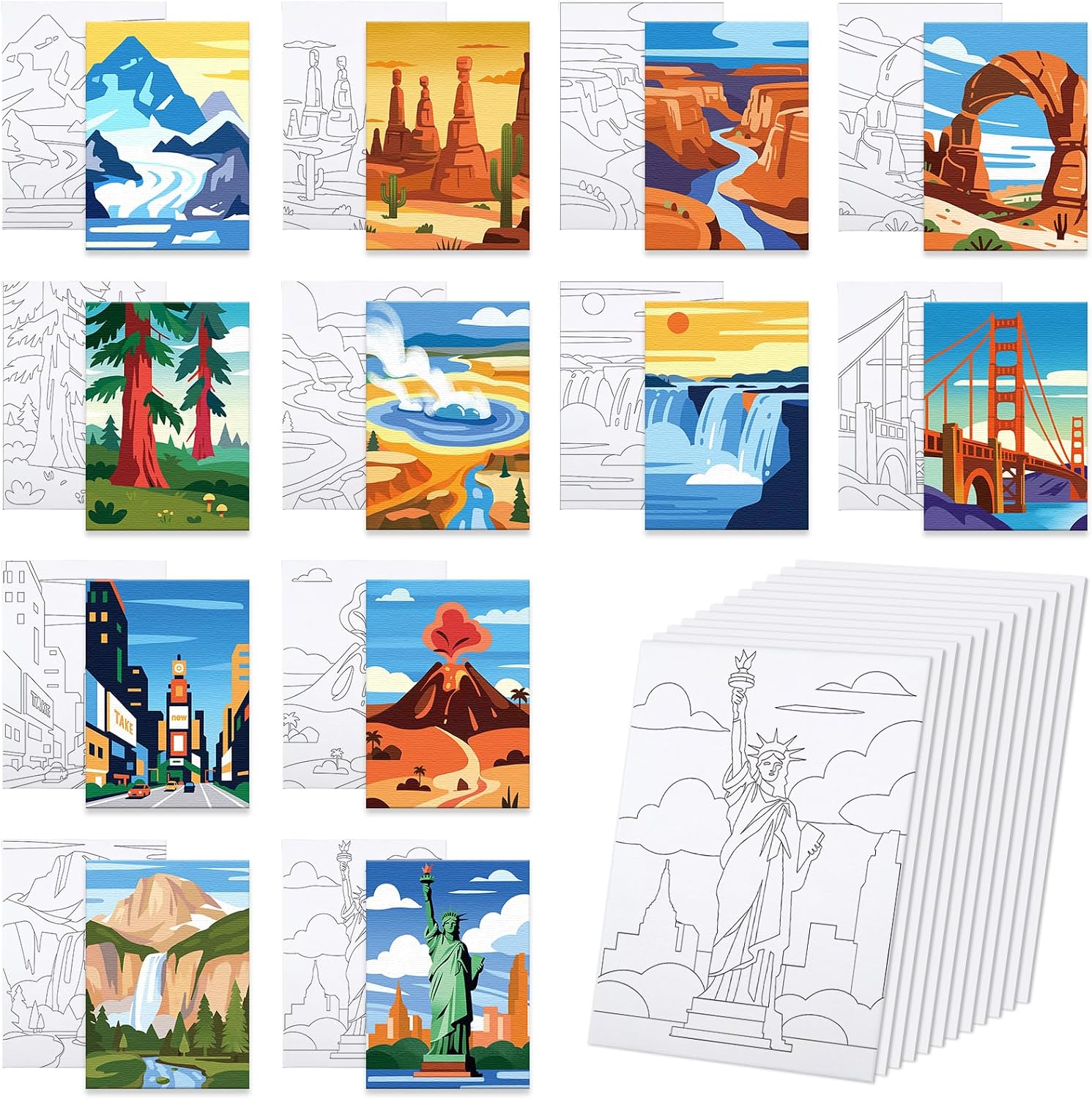
Anseal’s pack contains 12 small canvases, about 5×7 inches, each pre-printed with a different landscape outline. The listing says the canvas is nailed to a frame so it does not loosen or curl, and it is aimed at children, students and beginners, including party favors.
Outlines remove the hardest part for young painters, drawing the scene, so they can focus on color and brushwork. It is a gentle introduction to landscape elements like skies, hills, water and trees.
Best suited for: Children, beginners and party activities.
Key features:
- 12 pre-drawn canvases
- About 5×7″
- 12 landscape designs
- Stretched on frame
Pros:
- Guided designs
- Variety of scenes
- Good for groups
Cons and limitations:
- Small size
- Not for original compositions
Buying consideration: Encourage kids to change the colors from the obvious, such as a pink sky or purple mountains, to explore mood.
Surface Choices for Landscape Painters
Medium-grain cotton
The most common landscape surface. The weave helps with textured strokes and scumbling, which is useful for foliage, grass and rocks.
Fine-grain or smoothed canvas
For detailed, realistic landscapes with fine branches and distant detail, extra gesso coats sanded smooth reduce texture.
Linen
Linen has a livelier, more irregular weave and is more stable at large sizes, though it costs more.
Panels for plein air
Rigid canvas panels or boards are lighter and easier to carry and protect outdoors than stretched canvas, and they do not catch wind. Most plein air painters use panels.
Toned grounds
Many landscape painters tone the canvas before starting, often with a warm ochre or burnt sienna wash that peeks through cool greens and blues, or a gray that makes it easier to judge sky values.
Matching Format to Landscape Subject
| Subject | Suggested Format | Why It Works |
|---|---|---|
| Rolling hills and farmland | Horizontal 3:4 or 2:3 (16×20, 24×36) | Room for layered hills receding to the horizon |
| Coastlines and beaches | Panoramic (12×24, 20×40) | Emphasizes the long line of the shore |
| Mountain ranges | Panoramic or wide horizontal | Shows the breadth of peaks |
| Dramatic skies and sunsets | Horizontal with low horizon | Gives two-thirds of the canvas to the sky |
| Waterfalls and cliffs | Vertical (16×20 portrait, 18×24) | Follows the downward movement |
| Forest interiors and paths | Vertical or square | Leads the eye into the distance |
| Single tree or pond | Square (12×12, 24×24) | Calm, centered compositions |
Landscape Canvas by Medium
Oil
Oil landscapes are often built in layers over days or weeks, from a thin underpainting to thicker passages in the foreground. Acrylic-primed cotton or linen works well. Many oil painters prefer a slightly absorbent surface for the first layer and add a toned ground.
Acrylic
Acrylic dries fast, which suits painting skies and distant planes quickly, but makes soft blending harder. A smoother surface and a retarder or slow-drying medium help with gradients. Medium-grain canvas helps with dry-brushed foliage.
Mixed media and texture
Some landscape painters add modeling paste for rocks or bark texture. Rigid panels or well-braced stretched canvas are better for heavy texture, which can crack on flexible supports.
Preparing a Large Landscape Canvas
A 24×36 canvas is a big commitment, so a little preparation pays off. Check that the stretcher is square and the canvas is evenly taut. Add a coat of gesso if you want a smoother surface or more even absorbency. Tone the surface with a thin, transparent wash and let it dry. Then sketch the main shapes with thinned paint or charcoal, using a grid if you are working from a small study. Keep a large flat or filbert ready for the sky, because covering a big sky with small brushes leads to streaks and fatigue.
Composing a Landscape on Canvas
- Decide the format and orientation before you draw.
- Place the horizon off-center, roughly a third from the top or bottom.
- Establish a focal point and lead the eye with paths, rivers or fences.
- Block in sky, distance, middle ground and foreground as large value shapes.
- Paint from back to front: sky, distant hills, middle ground, foreground.
- Keep distant elements cooler, lighter and less detailed to create depth.
- Add the sharpest detail and strongest contrast at the focal point.
Painting Atmosphere and Depth on Canvas
What makes a landscape feel deep is aerial perspective: objects become lighter, cooler, bluer and less detailed as they recede. On canvas, that means mixing a little of the sky color into distant hills, softening their edges, and reserving the warmest colors, strongest darks and crispest edges for the foreground. Texture follows the same rule. Thin, smooth paint reads as distance; thicker, broken strokes that catch the canvas weave read as nearby grass, rocks and leaves. A medium-grain canvas makes it easier to vary texture this way, which is one reason it remains the most popular surface for landscape painters.
Supplies That Pair With a Large Landscape Canvas
- Large flat or filbert brushes (size 12 and up, or 1 to 2 inch flats) for skies and big shapes.
- A palette knife for mixing generous amounts of sky and ground colors and for texture.
- A sturdy easel rated for a 36 inch canvas.
- A large palette or stay-wet palette so you can mix big batches of each color.
- A spray bottle for acrylic to keep paint workable on large areas.
Buying Guide: How to Choose Canvas for Landscapes
Format and orientation
Choose horizontal for most scenes, panoramic for broad vistas, vertical for falls and forests. Match the canvas proportion to your reference photo or sketch so you do not have to crop or stretch the composition.
Size
Small panels for studies and plein air; medium for most studio work; large for statement pieces. Before committing to a big canvas, paint the scene small first. Consider where the finished painting will hang; a 24×36 suits a sofa wall, while an 11×14 suits a hallway.
Grain
Medium grain helps texture; smooth surfaces suit fine detail. Highly realistic landscape painters often add and sand extra gesso layers.
Frame strength
Large canvases need sturdy pine bars and cross braces to prevent twisting. Check the listing for a center brace on anything 24×36 or larger.
Profile and edges
Back-stapled canvases give clean sides; standard 5/8 inch profiles typically go in frames, while deeper profiles can hang unframed.
Easel compatibility
A 24×36 canvas needs an easel rated for its height and weight; many light tripods top out around 36 inches.
Related Canvas Guides
Scale up a sketch accurately with our guide to gridding a canvas, explore multi-canvas wall art sets for panoramic landscapes, and learn how to fix a ripped canvas if a large canvas gets damaged.
Common Mistakes to Avoid
- Buying printed landscape wall art by mistake when looking for blank canvas.
- Placing the horizon exactly in the middle of the canvas.
- Painting a large canvas with small brushes.
- Using unbraced large canvases that twist over time.
- Making distant hills as detailed and saturated as the foreground.
- Taking stretched canvas outdoors on a windy day.
- Choosing a canvas proportion that does not match your reference, then cramming or stretching the scene to fit.
- Skipping a value sketch and discovering composition problems halfway through a large canvas.
FAQs
What size canvas is best for landscape painting?
Medium sizes such as 16×20 or 18×24 suit most studio landscapes; small 8×10 to 9×12 panels suit plein air.
Should landscape canvas be horizontal?
Usually, since most landscapes are wide, but vertical and square formats work for specific scenes.
Is linen or cotton better for landscapes?
Cotton is affordable and widely used; linen offers a livelier texture and more stability at large sizes.
What canvas texture is best for landscapes?
Medium grain is a good all-round choice for textured strokes; smooth surfaces suit fine detail.
Do I need to tone a canvas for landscapes?
It is optional but helpful for judging values and unifying color.
What is a good panoramic canvas size?
Sizes like 12×24 or 20×40 give a wide, panoramic proportion.
Final Recommendation
For large studio landscapes, the KINGART 24×36 two-pack offers triple-primed cotton with clean, back-stapled edges. The ESRICH 24×36 three-pack adds a cross bar and costs less per canvas, which makes it a good choice for a series. For children and beginners, the Anseal pre-drawn landscape canvases are an easy way to learn color and brushwork. For plein air studies and other formats, use the guidance above to choose panels or stretched canvas in the right proportion.




