PaintingProGuide is reader-supported. When you buy through links on this page we may earn an affiliate commission at no extra cost to you.
Paint markers behave more like pens than brushes. The fiber tip needs to glide, and every bump in the weave interrupts the line. That changes what you should look for in a canvas. The best canvas for paint markers is a smooth, heavily primed canvas board on a rigid core: smooth so fine tips do not skip or fray, heavily primed so the water-based acrylic ink sits on top rather than soaking in, and rigid so the surface does not bounce when you press the tip down.
Quick answer: The Artkey 8×10 Canvas Boards (10 oz, triple primed) are our top pick for paint markers thanks to heavy priming and a firm board. The FIXSMITH 8×10 12-pack is a close second with a 4 mm MDF core, and the ARTISTRO 36-color dual-tip acrylic markers are a good marker set to pair with any of them.
Canvas boards rather than stretched canvas dominate this list on purpose. A stretched canvas flexes under the pressure of a marker tip, which makes long straight lines wobble, and the weave on many stretched canvases is coarser than on smooth panels. For lettering, mandalas, doodle art and illustration on canvas, a flat panel is easier to control.
Our Top Picks at a Glance
- Artkey 8×10 Canvas Boards, 12 Pack — Best overall surface for paint markers
- FIXSMITH 8×10 Canvas Boards, 12 Pack — Best rigid MDF core for pressure and detail
- KEFF 8×10 Canvas Boards, 12 Pack — Best triple-primed value pack
- Simetufy 8×10 Canvas Boards, 12 Pack — Best for classroom marker projects
- KEFF 24-Pack Canvas Boards, 4 Sizes — Best for trying several sizes
- ESRICH 8×10 Canvas Boards, 5 Pack — Best small pack to test markers on canvas
- ARTISTRO 36 Dual-Tip Acrylic Paint Markers — Best marker set to pair with canvas
| Product | Best For | Key Spec | Key Strength | Price Tier |
|---|---|---|---|---|
| Artkey 8×10 Boards | Overall marker work | 12 pack, 10 oz primed, triple gesso, cotton | Heavy priming, smooth glide | $ |
| FIXSMITH 8×10 Boards | Detail and lettering | 12 pack, triple primed, 4 mm MDF core | Very rigid | $ |
| KEFF 8×10 Boards | Everyday marker art | 12 pack, triple primed, MDF core | Warp resistant | $ |
| Simetufy 8×10 Boards | Classes and kids | 12 pack, acid-free cotton, MDF core | Holds paint without absorbing | $ |
| KEFF 24-Pack | Mixed sizes | 6 each of 5×7, 8×10, 9×12, 11×14 | Size variety | $$ |
| ESRICH 8×10 Boards | Testing | 5 pack, smooth cotton, board core | Small commitment | $ |
| ARTISTRO Markers | Drawing on canvas | 36 colors, 1 mm fine tip plus 1-5 mm dot tip | Ready to use, no pumping | $ |
How We Chose
We did not draw on these boards ourselves. Our picks are based on the Amazon listing details and specifications checked in October 2026, how well each surface’s smoothness, priming and rigidity fit marker work, and how widely each product is reviewed by Amazon buyers. We favored listings that state priming coats or weight and the core material, because those two details most affect how a marker behaves.
What mattered most:
- Smoothness: fine tips catch on coarse weave; smooth or triple-primed surfaces let lines run cleanly.
- Priming weight: more gesso means less absorption, so marker ink stays bright and lines stay crisp.
- Rigid core: MDF and heavy board cores stop the surface flexing under tip pressure.
- Size: 8×10 is a comfortable size for marker art and fits standard frames.
- Pack count: marker artists often work in series and classes need many boards.
Best Canvas for Paint Markers Reviewed
1. Artkey 8×10 Canvas Boards, 12 Pack — Best for overall paint marker work

Artkey lists 10 oz primed, 100% cotton canvas boards with acrylic titanium gesso, triple primed, hand stretched and glued over acid-free heavy boards that the maker describes as smooth, firm and flat. Each of those details helps marker work. Triple priming fills more of the weave, so the tip glides instead of bumping along every thread.
Titanium gesso gives a bright white base, which makes transparent and semi-opaque marker colors look cleaner. The firm board keeps the surface still under pressure, important for lettering and long lines. The listing also suggests the panels for tabletop easels and shelf display, which suits small marker pieces.
Best suited for: Marker artists doing lettering, mandalas, illustration and detailed doodle art on canvas.
Key features:
- 8×10 inch, 12 pack
- 10 oz primed 100% cotton
- Triple primed with titanium gesso
- Acid-free heavy board backing
Pros:
- Heavily primed, smoother glide
- Bright white ground
- Firm and flat
- Good pack size
Cons and limitations:
- Still a woven surface, not paper-smooth
- Single size
Buying consideration: For ultra-fine pens, brush on one more thin coat of gesso and sand with fine paper once dry for an even smoother finish.
2. FIXSMITH 8×10 Canvas Boards, 12 Pack — Best for detail and lettering

FIXSMITH states a 4 mm panel thickness with triple primed acid-free gesso over a medium density fibreboard core, with 100% cotton canvas hand stretched and glued on top. The cotton is described as not rinsed with alkaline chemicals.
The 4 mm MDF core is the most specific rigidity detail in this list. When you lean on a marker for a solid fill or use a ruler for straight lettering, the panel will not bow or bounce.
Best suited for: Lettering artists and illustrators who press firmly or work with rulers and stencils.
Key features:
- 8×10 inch, 12 pack
- Triple primed acid-free gesso
- 4 mm thick, MDF core
- 100% cotton surface
Pros:
- Very rigid core
- Triple primed
- Frame-friendly size
- Good for school projects and parties
Cons and limitations:
- Heavier than paper-core boards
- Gesso weight not stated
Buying consideration: If you use stencils, tape them down; rigid panels make that easy and stop smudged edges.
3. KEFF 8×10 Canvas Boards, 12 Pack — Best for everyday marker art
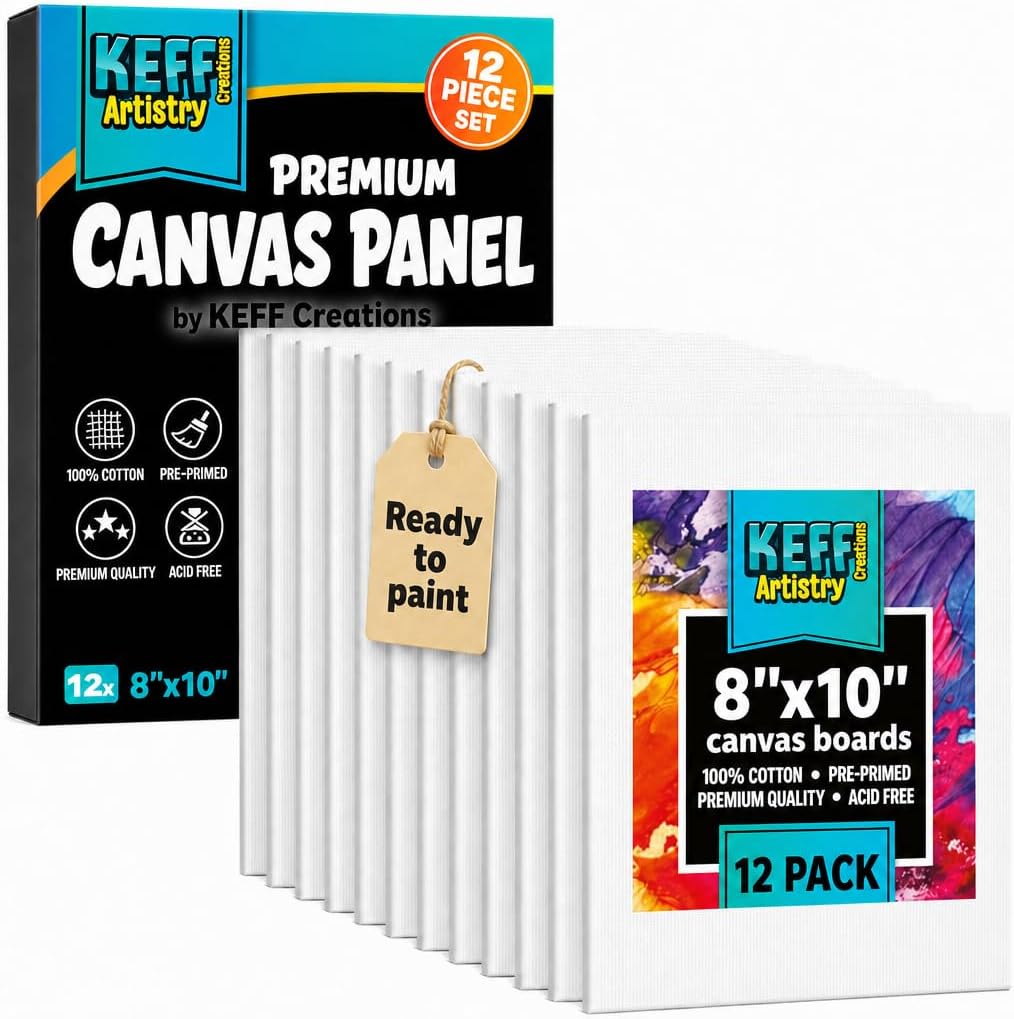
KEFF lists 100% cotton canvas boards triple-primed with acid-free acrylic gesso over a strong MDF core that stays rigid and flat, even under heavy applications. The combination of triple priming and MDF gives most of what marker work needs.
This is a dependable everyday option if you go through boards quickly or want a consistent surface for a series.
Best suited for: Hobby marker artists and teens making doodle art, quotes and illustrations.
Key features:
- 8×10 inch, 12 pack
- 100% cotton, triple primed
- Acid-free acrylic gesso
- Warp-resistant MDF core
Pros:
- Triple primed
- Rigid MDF
- Good everyday value
Cons and limitations:
- Gesso weight not stated
- Single size
Buying consideration: Let each marker color dry before layering another on top to avoid lifting the first layer.
4. Simetufy 8×10 Canvas Boards, 12 Pack — Best for classroom marker projects

Simetufy describes its boards as 100% cotton, acid-free, with a surface texture that holds paint without absorbing it, over an MDF core rather than recycled paper. The listing targets artists of all ages, beginners and classes.
Marker projects are popular in classrooms because they avoid water cups and brushes. A 12 pack of rigid boards suits a small class or a family project.
Best suited for: Teachers, families and beginners using paint markers on canvas.
Key features:
- 8×10 inch, 12 pack
- Acid-free cotton
- MDF core
- Pre-primed
Pros:
- Rigid for young hands
- Holds paint without soaking in
- Lightweight but sturdy
Cons and limitations:
- Priming coats not stated
- Surface texture may be slightly coarser than triple-primed boards
Buying consideration: For young artists, pair these with markers that have a fine and a broad tip so they can outline and fill.
5. KEFF 24-Pack Canvas Boards, 4 Sizes — Best for trying several sizes

This KEFF set gives you six boards each in 5×7, 8×10, 9×12 and 11×14, all 100% cotton and triple primed. Marker artists often find that small sizes suit quotes and quick designs, while larger boards suit mandalas and illustrations with lots of detail.
Having all four sizes on hand lets you match the board to the idea without another order.
Best suited for: Marker artists who make a mix of small gifts and larger display pieces.
Key features:
- 24 boards in 4 sizes
- 100% cotton
- Triple primed
- Multi-media use
Pros:
- Size variety
- Triple primed
- Good gift-making stock
Cons and limitations:
- Core material not detailed
- Fewer boards of any one size
Buying consideration: Use the 5×7 boards to test new marker brands before using them on larger work.
6. ESRICH 8×10 Canvas Boards, 5 Pack — Best for testing markers on canvas

ESRICH lists a smooth pure cotton surface, acid-free primer and a sturdy board core. Five panels make a low-cost test if you have only used markers on paper or wood and want to see how they behave on canvas.
The smooth surface description is promising for marker work, although priming coats are not stated.
Best suited for: Anyone trying paint markers on canvas for the first time.
Key features:
- 8×10 inch, 5 pack
- Smooth pure cotton
- Acid-free primer
- Sturdy board core
Pros:
- Small, low-risk pack
- Smooth surface
- Rigid core
Cons and limitations:
- Only five boards
- Priming detail limited
Buying consideration: Test every color in a corner first; some marker colors look different on canvas than on paper.
7. ARTISTRO 36 Dual-Tip Acrylic Paint Markers — Best for drawing on canvas

ARTISTRO pairs a 1 mm fine tip for outlines and lettering with a 1-5 mm dot tip for bold dots and fills on each marker. The listing describes water-based acrylic paint in pre-activated cotton tips that are ready to use with no pumping, across 36 colors, and lists canvas among suitable surfaces.
Dual tips make the set practical on canvas: outline with the fine end, fill with the dot end. The maker notes results vary by surface, which is another reason to prefer smooth, heavily primed boards.
Best suited for: Anyone who needs markers to go with their canvas, from beginners to doodle and dot artists.
Key features:
- 36 colors
- 1 mm fine tip and 1-5 mm dot tip
- Water-based acrylic paint
- Pre-activated, no pumping
Pros:
- Wide color range
- Two tip types per marker
- Ready to use
- Multi-surface
Cons and limitations:
- Fine tips can fray on coarse canvas
- Coverage may need two coats on some colors
Buying consideration: Store markers horizontally so the paint stays evenly distributed between both tips.
Buying Guide: How to Choose Canvas for Paint Markers
Smooth beats textured
The single biggest factor is surface texture. A coarse weave makes fine tips skip and fray and turns smooth lines into dotted ones. Look for triple-primed or heavily primed boards, or smooth the surface yourself with extra gesso and fine sandpaper.
Rigid support for control
Markers need pressure. A rigid MDF or heavy board core keeps the surface flat, which helps with lettering, straight lines and stencils. Stretched canvas works if you support it from behind with a book or board, but panels are easier.
Priming and absorbency
Underprimed canvas soaks up marker paint, dulling color and spreading lines. Heavier gesso keeps the ink on top. If a board seems thirsty, add a coat of gesso.
Marker type and tip size
Water-based acrylic markers are the usual choice for canvas. Fine tips under 1 mm are for detail; chisel or dot tips cover large areas. Extra-fine tips are the most sensitive to rough texture.
Background painting first
Many marker artists paint a background with acrylics, let it dry completely, and draw on top. Paint the background thinly so it does not add texture that fights the markers.
Sealing the finished piece
Marker art on canvas can be sealed with a varnish compatible with acrylic. Test first on a scrap: some sprays and brushed varnishes can reactivate or smear marker ink. Light misting coats are safer than one heavy coat.
Paint Marker Techniques That Suit Canvas
Outline then fill. Draw the outline with a fine tip, let it dry for a few minutes, then fill with a broad or dot tip. Filling first and outlining after tends to drag wet color into the line.
Build opacity in layers. Light colors over dark backgrounds rarely cover in one pass. Two thin passes, with drying time between, give more even coverage than one heavy, wet pass that pools in the weave.
Dot art and mandalas. Dot tips and the back end of a brush handle both make clean dots on smooth boards. Work from the center outward and keep the board flat so dots stay round.
Lettering on a painted background. Paint the background with thin acrylic, let it cure overnight, and pencil a light guideline. Graphite can show through light marker colors, so keep pencil marks faint or use a chalk pencil you can wipe away.
Blending. Water-based acrylic markers can be blended while wet by layering a second color over the edge of the first and dabbing gently with a damp brush. Practice on the back of a board first.
Fixing mistakes. While wet, many acrylic marker lines can be lifted with a damp cotton swab. Once dry, paint over the error with background color and redraw.
Plan Your Layout
Marker artwork, especially lettering and mandalas, benefits from careful planning. This guide to gridding a canvas helps you place text and symmetric designs accurately. If you plan a set of marker pieces to hang together, see how to design a multi-canvas wall art set.
Common Mistakes to Avoid
- Drawing fine lines on coarse, lightly primed canvas and fighting a skipping tip.
- Pressing too hard, which pushes the tip in and floods the line.
- Drawing on a background that is not fully dry.
- Layering marker colors before the first layer has dried.
- Spraying varnish heavily on marker work without testing for smearing.
- Shaking and pumping pre-activated markers that do not need it.
FAQs
Can you use paint markers on canvas?
Yes. Water-based acrylic paint markers work well on primed canvas. Smooth, heavily primed boards give the cleanest lines.
Do I need to prime canvas before using paint markers?
Pre-primed boards are ready to use. An extra coat of gesso, sanded smooth, helps if you want very fine lines.
Is canvas board or stretched canvas better for paint markers?
Canvas board. It is rigid and usually smoother, so markers stay controlled. Stretched canvas flexes under pressure.
How do I stop paint marker lines from bleeding on canvas?
Use a well-primed surface, make sure any painted background is fully dry, and avoid overloading the tip with paint.
Can I seal paint marker art on canvas?
Yes, with a varnish compatible with acrylic. Test on a sample first and apply light coats, as some varnishes can smear marker ink.
What size canvas is best for paint marker art?
8×10 is a comfortable size for most designs. Smaller boards suit quotes and gifts; 11×14 and up suit detailed mandalas and illustrations.
Final Recommendation
For the cleanest marker lines, choose the Artkey 8×10 boards with their heavy triple priming, or the FIXSMITH boards if you want the most rigid core for lettering. The KEFF and Simetufy 12-packs are solid everyday and classroom options, the KEFF 24-pack covers several sizes, and the ESRICH five-pack is a cheap trial. If you need markers too, the ARTISTRO dual-tip set covers outlining and filling in one tool.