PaintingProGuide is reader-supported. When you buy through links on this page we may earn an affiliate commission at no extra cost to you.
Canvas has tooth: a woven texture that grabs paint from a brush but chews through marker tips and breaks up thin lines. That is why the best paint markers for canvas are opaque, water-based acrylic markers with tips sturdy enough to ride over the weave and ink flow generous enough to fill it. Fine fiber tips designed for paper often skip on canvas; soft brush tips and controlled-flow systems tend to cope better, especially on primed canvas boards with a tighter surface.
This guide compares five acrylic paint marker sets on Amazon that list canvas among their surfaces. You will also find advice on choosing the right canvas for markers, combining markers with brushed acrylic, and sealing finished marker paintings without smearing them.
Quick answer: The JusArt 30-color brush-tip set is the best paint marker for canvas overall: its soft brush tip makes 1–8 mm lines by changing the angle, and an automatic ink-control system feeds ink evenly without pumping, which helps on textured weave. For the biggest palette with strong coverage on dark grounds, the WINSONS 120-color set (60 dual-ended brush pens) is the step up. If you mainly add outlines, lettering and dots over painted canvas, the ARTISTRO 36 fine-and-dot set is the budget choice.
Our Top Picks at a Glance
- JusArt 30 Colors Brush Tip Markers with Automatic Ink Control — Best overall for canvas
- WINSONS 120 Colors Dual-Tip Brush Paint Pens — Best large palette with high opacity
- ZWIOT 60 Colors Brush Markers with Ink Control — Best value brush set with case
- ARTISTRO 36 Dual-Tip Markers (Fine + Dot) — Best for details over painted canvas
- KEVIN&SASA CRAFTS 24 Colors Dual Tip — Best budget starter set
| Product | Best For | Key Spec | Key Strength | Price Tier |
|---|---|---|---|---|
| JusArt 30 Brush | Painting directly on canvas | 1–8 mm brush tip; auto ink control | Even flow without flooding | $$ |
| WINSONS 120 | Large, colorful canvas pieces | 60 pens, 120 colors; brush tips | High opacity on dark surfaces | $$ |
| ZWIOT 60 | Students and hobbyists | 60 brush markers; 2.6 ml ink each | Large ink capacity, carry case | $ |
| ARTISTRO 36 | Outlines, dots, lettering | 1 mm fine + 1–5 mm dot | Pre-activated, no pumping | $ |
| KEVIN&SASA 24 | Trying markers on canvas | Round nib + brush nib | Lowest tier | $ |
How We Chose
Our picks are based on Amazon listing details and specifications checked in October 2026, how well each set’s tip design, ink system and opacity claims suit textured canvas, and how widely each is reviewed by Amazon buyers. We have not used these markers on canvas ourselves. Surface and sealing advice reflects common practice with acrylic paint markers.
- Canvas listed as a surface — every set here names canvas in its listing.
- Tip type — brush tips and robust nibs handle weave better than ultra-fine tips.
- Ink delivery — automatic ink control or pre-activated tips avoid skipping and flooding.
- Opacity — markers must cover painted backgrounds and dark grounds.
- Color range — enough colors to avoid layering every shade.
Which Canvas Works Best With Paint Markers?
| Surface | Marker performance | Tip |
|---|---|---|
| Canvas board / panel | Smoothest and most rigid; lines stay crisp | Best starting surface for marker art |
| Stretched canvas, fine weave | Good, with some texture in fills | Press lightly and build layers |
| Stretched canvas, coarse weave | Skipping and tip wear; lines break up | Add gesso or acrylic base coats first |
| Painted acrylic background | Very good once fully dry | Ideal for outlining and details over brushwork |
If your canvas feels rough, brush on one or two extra coats of gesso and lightly sand between them. A smoother ground makes any marker perform better and saves its tip.
Best Paint Markers for Canvas Reviewed
1. JusArt 30 Colors Brush Tip Markers with Automatic Ink Control — Best for painting directly on canvas

JusArt’s set has two features that matter on canvas. First, the soft brush tip lets ink flow without pressing and creates lines from 1 to 8 mm depending on the angle, so one marker can outline and fill. Second, an automatic ink-control system with multi-layer dividers in the grip is designed to keep flow even, without flooding or clogging.
Canvas weave tends to drink ink unevenly, so steady delivery helps produce solid fills. The listing describes the water-based ink as vivid and opaque enough to cover mistakes, and resistant to water and fading once dry.
It is certified to ASTM D4236 and EN71 and names canvas among suitable surfaces, alongside paper, stone, wood and ceramic.
Best suited for: Artists making marker-led paintings on canvas boards and stretched canvas.
Key features:
- 30 colors with soft brush tips
- 1–8 mm line range by angle
- Automatic ink-control system
- ASTM D4236 and EN71; waterproof when dry
Pros:
- Brush tip copes with canvas texture
- Even ink flow for fills
- Opaque enough to correct mistakes
Cons and limitations:
- No separate fine tip for very small details
- Mid price tier
- Brush tips wear on coarse weave
Buying consideration: Work fills in short, overlapping strokes in one direction; let them dry before adding a second layer for solid color.
2. WINSONS 120 Colors Dual-Tip Brush Paint Pens — Best for big, colorful canvases
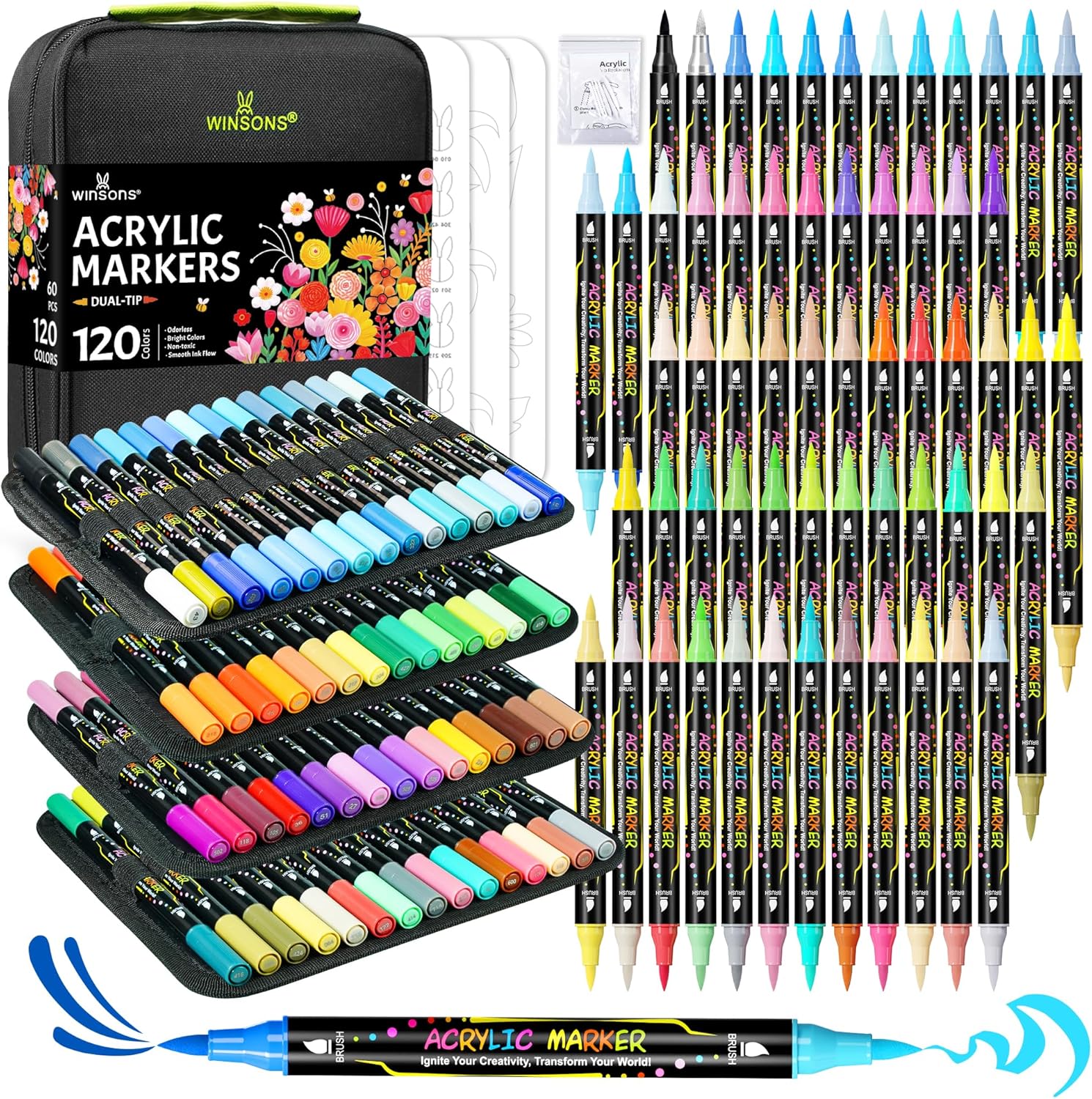
WINSONS uses a dual-tone design: 60 pens, each with a different color at each end, for a total of 120 colors. Both ends have brush tips that the listing says mimic a paintbrush, moving from fine detail to bold strokes.
The listing emphasizes high-opacity ink that maintains vibrancy on dark surfaces, which is useful if you paint black or dark-toned canvases. Once dry, the pigment is described as waterproof and fade-resistant, and the set comes in a portable case.
With 120 colors, you can shade and highlight by picking a lighter or darker marker rather than layering.
Best suited for: Illustrative painters, pop-art and graffiti-style canvases, and anyone working on dark grounds.
Key features:
- 60 dual-ended pens, 120 colors
- Soft brush tips on both ends
- High-opacity, waterproof ink
- Portable storage case
Pros:
- Huge color range
- Strong coverage on dark canvas
- Brush feel for painterly marks
Cons and limitations:
- Highest tier in this guide
- Two colors per pen means checking both caps
- No fine or dot tips
Buying consideration: Swatch both ends of every pen on a scrap canvas board and label the chart; dual-ended sets are easy to mix up.
3. ZWIOT 60 Colors Brush Markers with Ink Control — Best for value brush markers with a case

ZWIOT’s 60 brush markers each hold 2.6 ml of ink, which the listing presents as high capacity for extended use. The flexible tip draws 1–5 mm lines by changing pressure and angle, and an automatic ink-control system aims for steady flow. The listing advises shaking before first use and storing markers horizontally.
Ink is described as quick-drying, no-bleed, high coverage, odorless and waterproof once dry. A tough carrying case makes the set practical for classes and travel.
Sixty colors at a low tier is strong value for canvas experimentation.
Best suited for: Students, classrooms and hobbyists who want many brush markers for less.
Key features:
- 60 colors, brush tips
- 2.6 ml ink per marker
- Automatic ink-control system
- Waterproof, fade-resistant when dry
Pros:
- Large ink capacity
- Low tier for 60 colors
- Carry case included
Cons and limitations:
- Canvas is not named in the visible surface list
- Brush tip range smaller than JusArt
- Needs horizontal storage
Buying consideration: Because canvas is not explicitly listed, test on a primed canvas board first. Most water-based acrylic markers work best on primed, smooth surfaces.
4. ARTISTRO 36 Dual-Tip Markers (Fine + Dot) — Best for outlines and details over painted canvas

ARTISTRO pairs a 1 mm fine tip for lines, writing and outlining with a 1–5 mm dot tip for bold dots and patterns. The pre-activated cotton tips are ready to use without pumping; the listing suggests a gentle shake. Canvas is named among suitable surfaces, with a note that results vary by surface.
Fine tips are hard to use for large fills on raw canvas, but they are excellent for crisp outlines, lettering and dot patterns over a dry acrylic painting, the most common way artists combine brushes and markers.
The ink is water-based acrylic conforming to ASTM D4236.
Best suited for: Mixed-technique painters who brush the background and use markers for detail.
Key features:
- 36 colors, fine + dot tips
- 1 mm fine tip; 1–5 mm dot tip
- Pre-activated cotton tips
- ASTM D4236; odorless
Pros:
- Crisp detail over painted surfaces
- Dot tip for patterns
- Lowest tier for 36 colors
Cons and limitations:
- Fine tip skips on coarse canvas
- Not ideal for large fills
- Cotton tips wear on rough weave
Buying consideration: Let the painted background dry completely, ideally overnight, before outlining; damp acrylic clogs fine tips.
5. KEVIN&SASA CRAFTS 24 Colors Dual Tip Markers — Best for a budget starter set

This set gives each of its 24 markers a round nib and a brush nib, and the listing names canvas, paper, wood, metal, plastic and fabric among surfaces. The barrels have a glitter laser pattern with clear nib identification.
At the lowest tier in this guide, it is a sensible way to try marker art on canvas before investing in a larger set.
Expect basic performance: plan on two coats for solid color and use canvas boards rather than coarse stretched canvas.
Best suited for: Beginners, kids and casual crafters trying marker art on canvas boards.
Key features:
- 24 colors
- Round nib + brush nib
- Canvas listed among surfaces
- Easy-to-identify nib markings
Pros:
- Lowest tier
- Two tip types
- Good introduction to markers
Cons and limitations:
- Limited performance details in the listing
- May need multiple coats
- Fewer colors
Buying consideration: Start with small canvas boards; the smoother surface gives budget markers the best chance.
Combining Paint Markers and Brushed Acrylic
Many artists get the best canvas results by using markers and brushes together rather than markers alone.
- Block in with a brush. Paint the background and large shapes with acrylic paint, which covers canvas texture quickly.
- Let it dry fully. Marker ink applied over damp paint lifts and clogs tips.
- Draw with markers. Add outlines, patterns, lettering and small details where markers excel.
- Correct with paint. Fix mistakes by painting over with acrylic, then redraw.
- Seal the finished piece. See below.
Canvas Styles That Suit Paint Markers
Markers are not a substitute for every brush technique, but some styles are actually easier with them:
Pop art and bold illustration
Flat areas of saturated color with heavy black outlines play to a marker’s strengths. Brush the large color fields, then pull clean outlines and halftone dots with markers.
Line art and continuous-line portraits
A single confident line across a pale painted canvas looks striking on a wall. A medium brush tip held at a consistent angle gives an even weight across the weave.
Patterns, doodles and zentangle
Repeating motifs, mandalas and intricate fills are slow with a brush but fast with fine and dot tips, especially over a smooth canvas board.
Hand lettering and quote canvases
Brush-tip markers produce thick-and-thin strokes similar to brush lettering. Pencil guidelines first, letter with the marker, and erase gently once the ink is completely dry.
Highlights on finished acrylic paintings
A white or light-colored marker adds sparkle to eyes, water and metal far more precisely than a tiny brush.
Sealing Marker Art on Canvas
Water-based acrylic marker ink is generally waterproof once dry, but brushing on a water-based varnish can occasionally drag or soften some inks. A safe approach is to apply one or two very light coats of spray varnish first to lock the marker layer in place, let them dry, then brush on a final varnish if you want more protection. Always test on a scrap canvas first.
Buying Guide: How to Choose Paint Markers for Canvas
Choose acrylic paint markers
Water-based acrylic markers are opaque, permanent once dry and compatible with acrylic paint and varnish. Alcohol markers sink into canvas and can bleed.
Brush tips for fills, fine tips for detail
Brush tips ride over canvas weave and fill areas quickly. Fine tips are best reserved for details over smoother painted areas.
Look for controlled ink flow
Automatic ink-control systems and pre-activated tips reduce skipping and flooding, which are both common on canvas.
Check opacity claims
If you paint on black or dark canvas, choose sets described as high opacity, such as WINSONS.
Consider ink capacity
Canvas absorbs more ink than paper. Larger ink capacity, like ZWIOT’s 2.6 ml, means fewer markers running dry mid-project.
Plan for tip wear
Prime and sand rough canvases. Rotate brush tips as you work to wear them evenly.
Canvas Projects and Fixes
For accurate marker drawings, learn how to grid a canvas for painting first. Paint markers are perfect for linking designs across a multi-canvas wall art set, and if an older piece is damaged, see how to fix a ripped canvas painting.
Common Mistakes to Avoid
- Using fine tips on coarse canvas. They skip and fray.
- Drawing over damp paint. Ink lifts and tips clog.
- Pressing hard to force ink. It floods and damages tips.
- Storing markers upright. Store horizontally unless the listing says otherwise.
- Brushing varnish straight over markers. Lock the ink with light spray coats first.
- Skipping a test swatch. Marker colors can look different on canvas than on caps.
FAQs
Do paint markers work on canvas?
Yes. Water-based acrylic paint markers work well on canvas, especially on primed canvas boards or over a dry painted background. Brush tips handle the texture better than very fine tips.
Are paint markers permanent on canvas?
Acrylic paint markers are generally waterproof and permanent once dry. Sealing with varnish adds protection against UV, dust and scuffs.
Can I use paint markers over acrylic paint?
Yes, and it is one of the best ways to use them. Let the acrylic dry fully first, then add details and outlines with markers.
Should I prime canvas before using paint markers?
Pre-primed canvas is fine. If it feels rough, add another coat or two of gesso and sand lightly for smoother marker lines.
How do I seal paint marker art on canvas?
Spray one or two light coats of varnish first to lock in the ink, then brush on more varnish if desired. Test on a scrap canvas before treating the final piece.
What tip size is best for canvas?
Brush tips in the 1–8 mm range are the most versatile on canvas. Fine 1 mm tips are best for details over smooth painted areas.
Final Recommendation
For drawing and painting directly on canvas, choose the JusArt 30 brush-tip set for its wide line range and steady ink control. If you work large or on dark grounds, the WINSONS 120 is worth the higher tier. The ZWIOT 60 is the value brush set with a case, the ARTISTRO 36 is the detail tool for use over painted canvas, and the KEVIN&SASA 24 is an inexpensive way to try marker art on canvas boards.