
PaintingProGuide is reader-supported. When you buy through links on this page we may earn an affiliate commission at no extra cost to you.
Cold wax medium turns ordinary oil paint into something closer to sculpted butter. Mixed with paint, it stiffens the color, cuts the gloss to a soft matte, and lets you build translucent layers that can be scraped, incised, stamped and buffed. Unlike encaustic, it needs no heat, which is why so many abstract and landscape painters use it as their entry into wax-based work.
There are really two families of products sold as “cold wax.” One is a soft, paste-like medium designed primarily for mixing into oil paint, typified by Gamblin Cold Wax Medium. The other is a wax and damar resin paste, like Jacquard’s Dorland’s Wax Medium, that doubles as a protective finishing coat and is popular for sealing watercolor, gouache and collage. This guide compares six options currently on Amazon.com and explains which one fits the way you paint.
Quick answer: Gamblin Cold Wax Medium is the best cold wax medium for oil painting: a soft, matte paste made for mixing into oils and building textured layers; the 16 oz jar is the better value once you know you like the technique, and the 4 oz jar is the low-risk trial. For a wax-and-damar medium that also works as a protective topcoat, choose Jacquard Dorland’s Wax Medium.
Our Top Picks at a Glance
- Gamblin Cold Wax Medium, 16 oz — Best overall for oil painters
- Gamblin Cold Wax Medium, 4 oz — Best low-cost trial size
- Jacquard Dorland’s Wax Medium, 4 oz with Palette Knife — Best wax-and-damar medium and finishing coat
- Jacquard Dorland’s Wax, 1 Gallon — Best bulk option for studios and classes
- Conelist 4 oz Cold Wax Medium with Palette Knife — Best budget starter with a knife
- Conelist Cold Wax Medium, 2 × 4 oz — Best budget multi-pack
| Product | Best For | Key Spec | Key Strength | Price Tier |
|---|---|---|---|---|
| Gamblin Cold Wax, 16 oz | Regular cold wax painting | 16 oz, matte finish | Designed for mixing with oil paint | $$ |
| Gamblin Cold Wax, 4 oz | First experiments | 4 oz, matte, tintable | Adjusts sheen, flexibility and body | $ |
| Dorland’s Wax Medium + Knife | Mixed media and sealing | 4 oz wax and damar + palette knife | Medium and protective coat | $$ |
| Dorland’s Wax, 1 Gallon | Studios and teachers | 1 gallon wax and damar resin | Varnish, sealant and medium | $$$ |
| Conelist 4 oz + Knife | Budget starter | 4 oz (118 g) wax and dammar | No heating needed, knife included | $ |
| Conelist 2 × 4 oz | Budget volume | Two 4 oz jars | Low cost per ounce | $$ |
How We Chose
We did not paint with these mediums for this article. Our picks are based on the Amazon listing details and specifications checked in October 2026, well-established facts about how cold wax techniques work, how well each medium’s formulation and size match common uses, and how widely each product is reviewed by Amazon buyers.
- Intended use: mixing into oil paint versus sealing and finishing.
- Formulation clarity: what the listing says the medium contains.
- Finish: matte straight from the jar, with the ability to buff to a sheen.
- Size and value: trial jars versus studio quantities.
- Brand track record: established artist-material makers versus newer budget brands.
Best Cold Wax Medium Picks Reviewed
1. Gamblin Cold Wax Medium, 16 oz — Best for regular cold wax painting
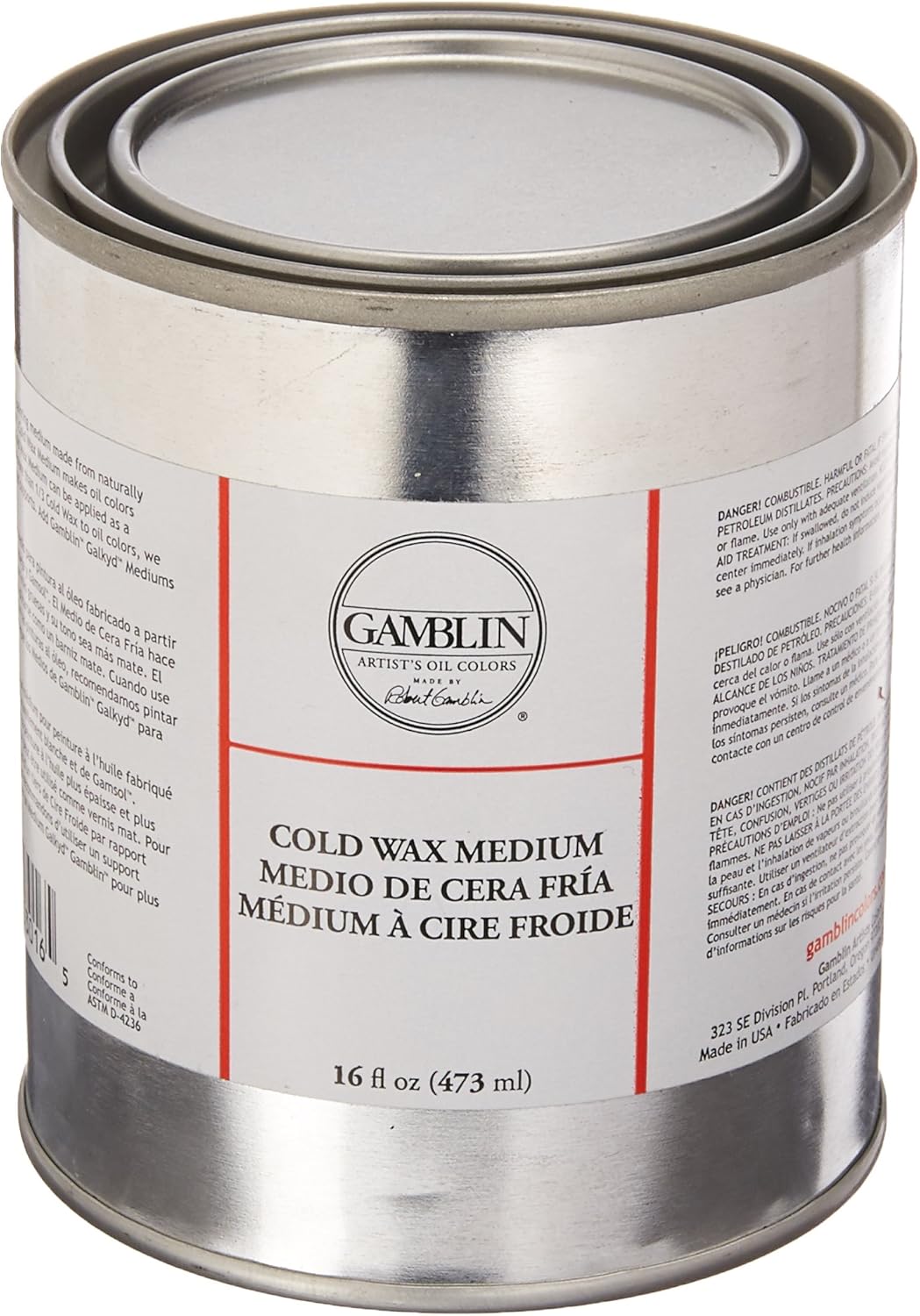
Gamblin Cold Wax Medium is the reference product for cold wax oil painting in the US, and many cold wax workshops and books assume you are using it. Gamblin describes it as a blend of beeswax, alkyd resin and odorless mineral spirits, formulated to be mixed with oil colors. The listing confirms a flat, matte finish and a 16 oz jar.
Mixed with oil paint, it thickens and matte-s the color and allows the layered, scraped, textured surfaces cold wax painters are known for. The 16 oz size is the better value for anyone who has tried the technique and plans to keep working with it, since cold wax paintings often use a high proportion of medium.
Best suited for: oil painters committed to cold wax abstraction, landscapes and textured mixed-media work.
Key features:
- 16 oz jar
- Matte finish
- Designed for mixing with oil paint
- Formulated by an established artist-oil maker
Pros:
- Industry-standard cold wax medium
- Large jar lowers cost per ounce
- Consistent soft paste texture
Cons and limitations:
- Higher price tier
- Contains mineral spirits, so ventilate your workspace
Buying consideration: Cold wax paintings work best on rigid supports such as wood panels or heavy paper mounted to board, because thick wax layers are not designed to flex like stretched canvas.
2. Gamblin Cold Wax Medium, 4 oz — Best for first experiments

The same Gamblin formula in a 4 oz jar is the sensible way to try cold wax before committing. The listing notes a matte finish and describes it as tintable, with uses including oil painting, alkyd brush consistency adjustment, and modifying sheen and flexibility.
Four ounces is enough for a handful of small panels or a series of test pieces, which is exactly what most painters should do first: try different ratios of paint to wax and different tools before working larger.
Best suited for: oil painters curious about cold wax, and anyone who wants to add a matte, buttery body to their regular oil paint.
Key features:
- 4 oz jar
- Matte, tintable
- Adjusts sheen, flexibility and brush consistency
Pros:
- Low-risk trial
- Same trusted formula as the larger jar
- Useful even outside cold wax painting for matte effects
Cons and limitations:
- Runs out quickly in thick, textural work
- Higher cost per ounce than the 16 oz
Buying consideration: Start with small 6 x 6 or 8 x 8 inch panels so 4 oz lasts long enough to learn the technique.
3. Jacquard Dorland’s Wax Medium, 4 oz, with Palette Knife — Best for mixed media and sealing

Dorland’s Wax Medium is a long-standing cold wax product from Jacquard, and this Moshify bundle pairs a 4 oz jar with a palette knife. According to the listing, it can be mixed with oil paints, powdered pigments, colored sands, dyes and other compatible fine art materials.
What sets Dorland’s apart is its double role. The listing describes it as a watercolor sealer that protects against water and humidity, allowing paintings to be displayed without glass, and notes that the translucent wax adds richness and vibrancy of tone in oil painting.
Best suited for: mixed-media artists, watercolor and gouache painters who want a protective finish, and oil painters exploring wax.
Key features:
- 4 oz Dorland’s Wax Medium
- Palette knife included
- Mixes with oils, pigments, sands and dyes
- Can seal watercolor against water and humidity
Pros:
- Works as both medium and finish
- Popular for glassless framing of works on paper
- Knife included for mixing and application
Cons and limitations:
- Bundle seller rather than Jacquard directly
- Smaller jar for large projects
Buying consideration: Test on a scrap first when sealing watercolor; any wax coating changes the look of paper slightly.
4. Jacquard Dorland’s Wax, 1 Gallon — Best for studios and teachers

For classrooms, workshops and prolific painters, Jacquard sells Dorland’s Wax by the gallon. The listing describes it as made from pure wax and damar resin, a versatile cold wax medium and a protective topcoat used for sealing and finishing oil paintings, collage, watercolor and gouache.
The listing notes a durable waterproof finish that adds depth to color, a finish that can be left rough for a matte effect or buffed with a rag after drying for a uniform high gloss, and that it will not yellow over time. It calls itself sealant, varnish and medium in one.
Best suited for: teachers running cold wax workshops, studios and artists who use wax as their standard finishing coat.
Key features:
- 1 gallon of wax and damar resin
- Medium, sealant and varnish in one
- Matte or buffed high-gloss finish
- Listed as non-yellowing
- Item weight 5.12 lb
Pros:
- Lowest cost per ounce at volume
- Multipurpose
- Buffs to a range of sheens
Cons and limitations:
- Highest price tier by far
- Too much for a casual hobbyist
Buying consideration: Decant into smaller jars for daily use so the main container stays sealed and does not dry out.
5. Conelist 4 oz Cold Wax Medium with Palette Knife — Best for a budget starter

Conelist’s cold wax kit includes a 4 oz (118 g) jar and a palette knife. The listing describes the medium as made of pure wax and dammar resin, intended to improve pigment texture and color saturation and create layered effects in oil and acrylic paintings.
It requires no heating, and the listing notes a melting point above 68°C, so it can be applied straight from the jar with the included knife. It is also described as a waterproof protective coat that resists moisture and dust.
Best suited for: budget-minded beginners who want to try cold wax effects and need a knife.
Key features:
- 4 oz (118 g) jar
- Wax and dammar resin
- Palette knife included
- No heating needed
- Described as waterproof protective coat
Pros:
- Low price tier
- Includes a tool
- Medium and finishing coat in one
Cons and limitations:
- Newer brand with less track record
- Listing mentions acrylic use; wax over or in acrylic needs testing for adhesion
Buying consideration: If you plan to combine wax with acrylic, keep wax as a final top layer and test adhesion first; acrylic should not be painted over wax.
6. Conelist Oil Painting Waterproof Wax, 2 × 4 oz — Best for budget volume

The two-pack gives eight ounces of the same Conelist wax and dammar formula at a low cost per ounce. The listing repeats the same uses: enhancing texture and depth in oil and acrylic paintings, a waterproof and dustproof protective surface, and techniques including thick application, polishing and scraping.
Two jars mean you can keep one sealed while working from the other, which helps prevent the medium from drying out.
Best suited for: hobbyists working on several small paintings and anyone wanting a spare jar.
Key features:
- Two 4 oz jars
- Wax and dammar resin
- No heating needed
- For thick coating, polishing and scraping
Pros:
- Low cost per ounce
- Spare jar stays fresh
- Versatile
Cons and limitations:
- No knife included
- Less established than Gamblin or Jacquard
Buying consideration: Buy a flexible palette knife or a set of plastic scrapers; cold wax is applied more with tools than with brushes.
Gamblin vs Dorland’s: Which Type of Cold Wax Do You Need?
Choose Gamblin if your main goal is cold wax oil painting: mixing medium into oil paint, building translucent layers on panels, and scraping back to reveal under-layers. It is formulated for that workflow and widely used in cold wax instruction.
Choose Dorland’s if you want a medium that also functions as a protective finishing coat, especially for watercolor, gouache, collage and mixed media, or if you like to buff wax to a range of sheens. Many artists keep both: Gamblin for painting, Dorland’s for finishing.
Budget brands like Conelist can be fine for experimentation, but established brands have longer track records and more published guidance on use.
Buying Guide: How to Choose a Cold Wax Medium
Know what you will mix it with
Cold wax is designed primarily for oil paint and oil-compatible materials such as dry pigments, oil sticks and some powders. Do not paint acrylic over wax; acrylic will not adhere to it.
Choose a rigid support
Thick cold wax layers can crack on flexible surfaces. Wood panels, cradled boards and heavy oil-primed papers mounted to board are the usual supports.
Plan your ratio
Many painters start with roughly equal parts cold wax and oil paint, then adjust. More wax gives a more translucent, matte, workable paste; more paint gives richer color. Follow the manufacturer’s guidance on maximum proportions.
Size for your output
Cold wax paintings use a lot of medium. If you work bigger than 12 inches or paint often, the larger jar quickly pays for itself.
Tools matter
Palette knives, rubber brayers, plastic scrapers, old credit cards and silicone shapers are the main tools. A kit with a knife is a convenient start.
Ventilation and drying
Some cold wax mediums contain solvent, so ventilate while working. Cold wax paintings feel dry to the touch fairly soon but take longer to cure fully, depending on thickness.
Basic Cold Wax Technique
- Prepare the panel: seal or prime a wood panel so oil and wax do not soak into raw wood.
- Mix: on a glass or palette paper surface, combine cold wax and oil paint with a palette knife until smooth.
- Apply thin layers: spread with a knife, squeegee or brayer. Thin layers dry faster and allow more layering.
- Build and remove: add layers, then scrape, incise or dissolve with solvent to reveal earlier colors.
- Add texture: stamp, press in tissue or sprinkle dry pigment and sand into soft layers.
- Finish: once fully dry, buff with a soft cloth for a satin sheen, or leave it matte.
Our full tutorial on how to use cold wax medium in oil painting goes deeper into layering, mark-making and troubleshooting. If you want to compare wax with other ways to change paint body, our guide on which medium to use with acrylic paint shows how acrylic mediums differ, and our walkthrough on varnishing an oil painting correctly explains when a traditional varnish is the better finish.
Common Mistakes to Avoid
- Using flexible stretched canvas for thick cold wax work.
- Painting acrylic over a waxed surface.
- Applying layers too thick, which slows drying and can wrinkle.
- Skipping ventilation with solvent-containing mediums.
- Buffing before layers have firmed up.
- Leaving jars open, which dries the medium out.
- Displaying cold wax paintings in hot spots such as sunny windows or near heaters, which can soften wax.
FAQs
What is the best cold wax medium?
Gamblin Cold Wax Medium is the standard for oil painting. Jacquard Dorland’s Wax Medium is a strong choice if you also want a protective finishing coat.
Can you use cold wax with acrylic paint?
Cold wax is designed for oil paint. Acrylic should not be painted over wax. Some products list acrylic compatibility, but wax is best used as a top layer over dry acrylic, if at all.
What surface is best for cold wax painting?
Rigid supports like sealed wood panels or heavy paper mounted to board. Flexible canvas can crack under thick layers.
How long does cold wax take to dry?
Thin layers firm up relatively quickly, while full curing can take much longer depending on thickness, paint and environment.
Do cold wax paintings need varnish?
Usually not. Most artists buff the cured surface for a soft sheen. Dorland’s can also be used as a finishing coat.
Is cold wax the same as encaustic?
No. Encaustic uses molten wax and heat. Cold wax is a soft paste used at room temperature and mixed with oil paint.
Final Recommendation
For cold wax oil painting, buy Gamblin Cold Wax Medium: the 4 oz jar to experiment and the 16 oz jar once you are hooked. Choose Jacquard Dorland’s if you want a medium that doubles as a protective finish for watercolor, gouache and collage, and the gallon size if you teach or paint at volume. Conelist is a budget way to try wax effects, ideally the kit with a palette knife. For finishing other types of paintings, see our guide to varnishing an acrylic painting.




