

PaintingProGuide is reader-supported. When you buy through links on this page we may earn an affiliate commission at no extra cost to you.
Oil painting has a reputation for being complicated: solvents, mediums, rules about fat over lean, paintings that take days to dry. The reality is that a beginner needs surprisingly little to start, and most of what makes oils intimidating comes from buying the wrong supplies or too many of them. The best oil painting supplies for beginners are a decent student-grade paint set with a strong white, a few bristle and synthetic brushes, a palette knife, primed surfaces, and a safe way to clean up.
This guide lays out a simple beginner kit, then reviews six products that cover it: three oil paint sets at different levels, an all-in-one kit, a brush set and a palette knife set. We also explain mediums and solvents in plain language, the one rule that prevents cracking, and a first-week plan to get comfortable with the medium.
Quick answer: For paint, the Winsor & Newton Winton Basic Set (10 x 21 ml) is the best beginner choice: a trusted student line with lightfast, intermixable colors in larger tubes. For a budget all-in-one start, the Norberg & Linden XXL set includes 24 paints, 25 brushes, a metal palette and a canvas panel. Round out any kit with CONDA palette knives and the Nicpro 30-piece brush set.
Our Top Picks at a Glance
- Winsor & Newton Winton Oil Color Basic Set, 10 x 21 ml — Best oil paint set for beginners
- Norberg & Linden XXL Oil Paint Set — Best all-in-one beginner kit
- Magicfly Oil Paint Set, 40 x 18 ml — Best large palette with extra white
- Ohuhu Oil Paint Set, 24 x 12 ml — Best budget set for trying oils
- Nicpro 30-Piece Paint Brush Set — Best brush set for oil beginners
- CONDA 5-Piece Palette Knife Set — Best palette knives for mixing and texture
| Product | Best For | Key Spec | Key Strength | Price Tier |
|---|---|---|---|---|
| Winsor & Newton Winton 10 | Core paint set | 10 colors x 21 ml | Lightfast, intermixable | $$ |
| Norberg & Linden XXL | All-in-one start | 24 x 12 ml, 25 brushes, palette, canvas | Everything to start | $$ |
| Magicfly 40 Colors | Color range | 40 x 18 ml incl. 2 extra whites | ASTM D4236 | $$ |
| Ohuhu 24 Colors | Trying oils cheaply | 24 x 12 ml | ASTM D4236 & EN71-3 | $$ |
| Nicpro 30 Brushes | Brush variety | 30 brushes in 8 shapes + roll | Specialty shapes | $$ |
| CONDA Knives | Mixing and texture | 5 stainless steel knives | Wood handles | $ |
How We Chose
We did not paint with these supplies. Picks are based on Amazon listing details and specifications checked in October 2026, how well each product fits a beginner’s oil painting kit, and how widely each product is reviewed by Amazon buyers. The Ohuhu set appeared twice at very different prices during our check, so compare the current price before buying.
- Paint quality: recognized student lines or sets with clear safety labeling.
- Tube size: enough paint to practice, especially white.
- Completeness: brushes, knives and surfaces to start painting quickly.
- Versatility: tools useful as skills grow.
- Value: sensible spending for a first kit.
The Beginner Oil Painting Checklist
| Item | What to Get | Why |
|---|---|---|
| Paint | A student set plus a large titanium white | White is used in nearly every mix |
| Brushes | Flats and filberts (bristle or synthetic), one small round | Covers blocking in, blending and detail |
| Palette knife | One medium trowel or straight knife | Mixing without wasting brushes |
| Surfaces | Primed canvas panels or oil painting paper | Oil must not soak into raw surfaces |
| Palette | Glass, wood, metal or disposable palette paper | Smooth mixing surface |
| Medium | Linseed oil or a ready-made painting medium | Adjusts flow and drying |
| Cleanup | Odorless mineral spirits or a solvent-free method, rags, soap | Brush care and safety |
| Easel | Optional at first; tabletop works | Comfortable posture and viewing angle |
For a full walk-through of setting up, see our guide on how to start oil painting for beginners.
Best Oil Painting Supplies for Beginners Reviewed
1. Winsor & Newton Winton Oil Color Basic Set, 10 x 21 ml — Best for a trusted beginner paint set

Winton is Winsor & Newton’s long-running student oil line. This basic set contains 10 colors in 21 ml tubes, nearly twice the size of the 12 ml tubes in many budget sets. The listing describes individually formulated colors offering high quality at a moderate price, lightfast, permanent and intermixable with other brands.
Ten well-chosen colors teach mixing better than 40 convenience shades, and because Winton is sold widely in open stock, you can replace individual colors, especially white, as you use them.
Best suited for: Beginners who want reliable paint they can keep using as skills grow.
Key features:
- 10 colors x 21 ml
- Lightfast and permanent
- Intermixable with other brands
- Open-stock replacements available
- Matte finish listed
Pros:
- Trusted student line
- Larger tubes
- Easy to restock
Cons and limitations:
- Fewer colors than budget sets
- No brushes or surfaces
- Higher cost per set than budget brands
Buying consideration: Buy an extra large tube of titanium white with the set; it runs out long before the others.
2. Norberg & Linden XXL Oil Paint Set — Best for an all-in-one start

Norberg & Linden’s XXL set includes 24 oil paint tubes of 12 ml in assorted colors, including primaries, earth tones, blues, greens and skin tones, plus 25 brushes in bristle, nylon and foam, a metal mixing palette and an 8×10 stretched canvas panel.
It is a quick way to start without separate shopping trips. The brush assortment covers broad coverage, blending and detail, and the inclusion of skin tones is helpful for first portrait attempts.
Best suited for: Absolute beginners and gift buyers who want everything in one box.
Key features:
- 24 oil paints x 12 ml
- 25 brushes (bristle, nylon, foam)
- Metal palette
- 8×10 stretched canvas panel
Pros:
- Complete kit
- Lots of brushes
- Skin tones included
Cons and limitations:
- Small tubes
- Only one canvas
- Foam brushes have limited use in oils
Buying consideration: Buy a pack of canvas panels; one surface is not enough to practice.
3. Magicfly Oil Paint Set, 40 Colors x 18 ml — Best for a large palette with extra white
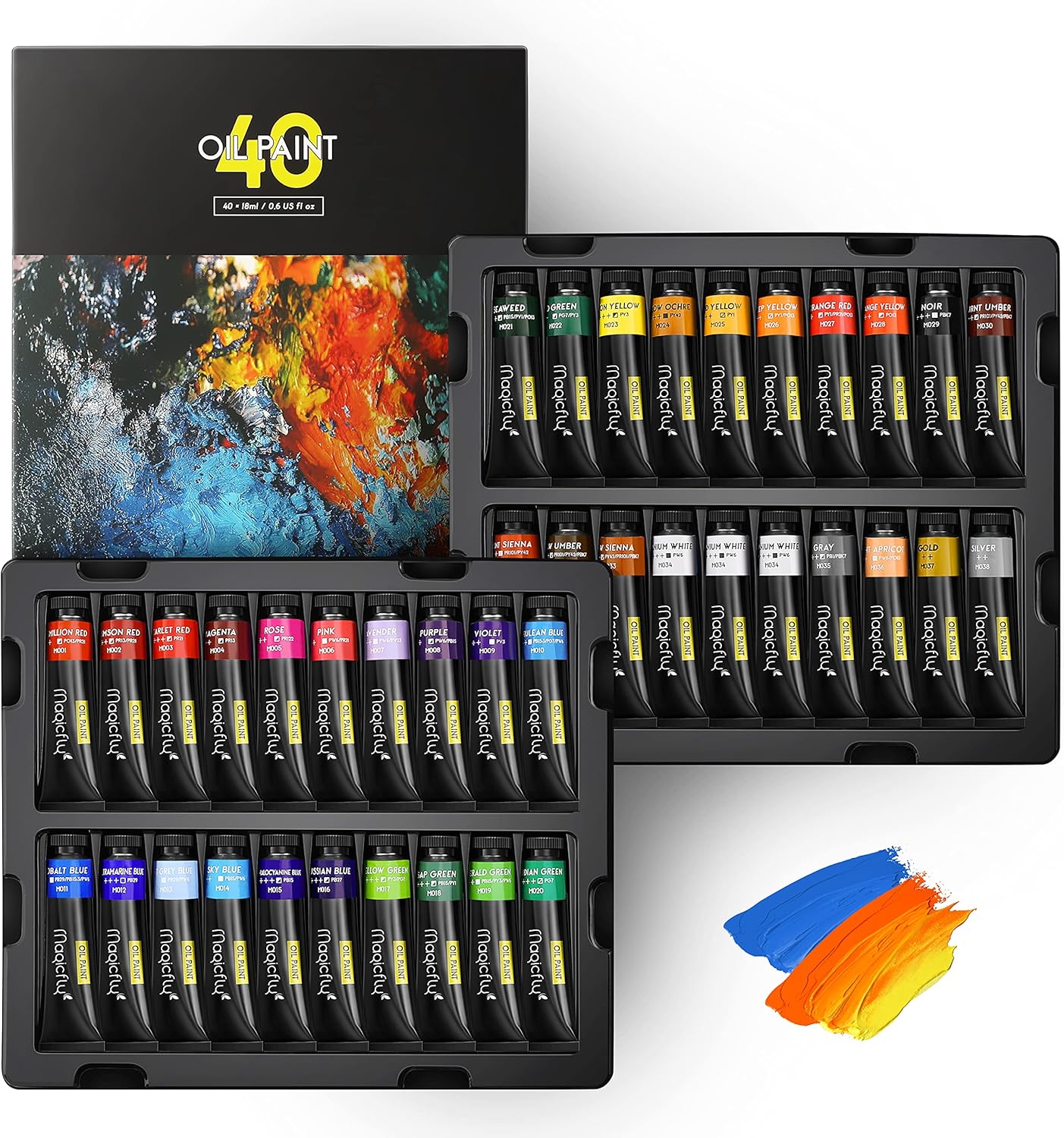
Magicfly’s set includes 40 colors in 18 ml tubes, including metallic gold and silver, and adds two extra white tubes, a thoughtful touch for oil painters. The listing says it conforms to ASTM D4236 and describes thick, creamy paint with excellent coverage that mixes easily.
Forty colors give lots of convenience shades for landscapes and florals. Beginners benefit from practicing with a limited palette at first, but this set leaves room to explore.
Best suited for: Beginners who want many colors and plenty of white.
Key features:
- 40 colors x 18 ml
- 2 extra white tubes
- Metallic gold and silver
- ASTM D4236
- Thick, creamy consistency
Pros:
- Extra white included
- Larger tubes than many budget sets
- Broad palette
Cons and limitations:
- Many convenience colors can discourage mixing
- No brushes
- Metallics have limited use
Buying consideration: Pick six or seven colors from the set for your first paintings, and add others gradually.
4. Ohuhu Oil Paint Set, 24 Colors x 12 ml — Best for trying oils on a budget
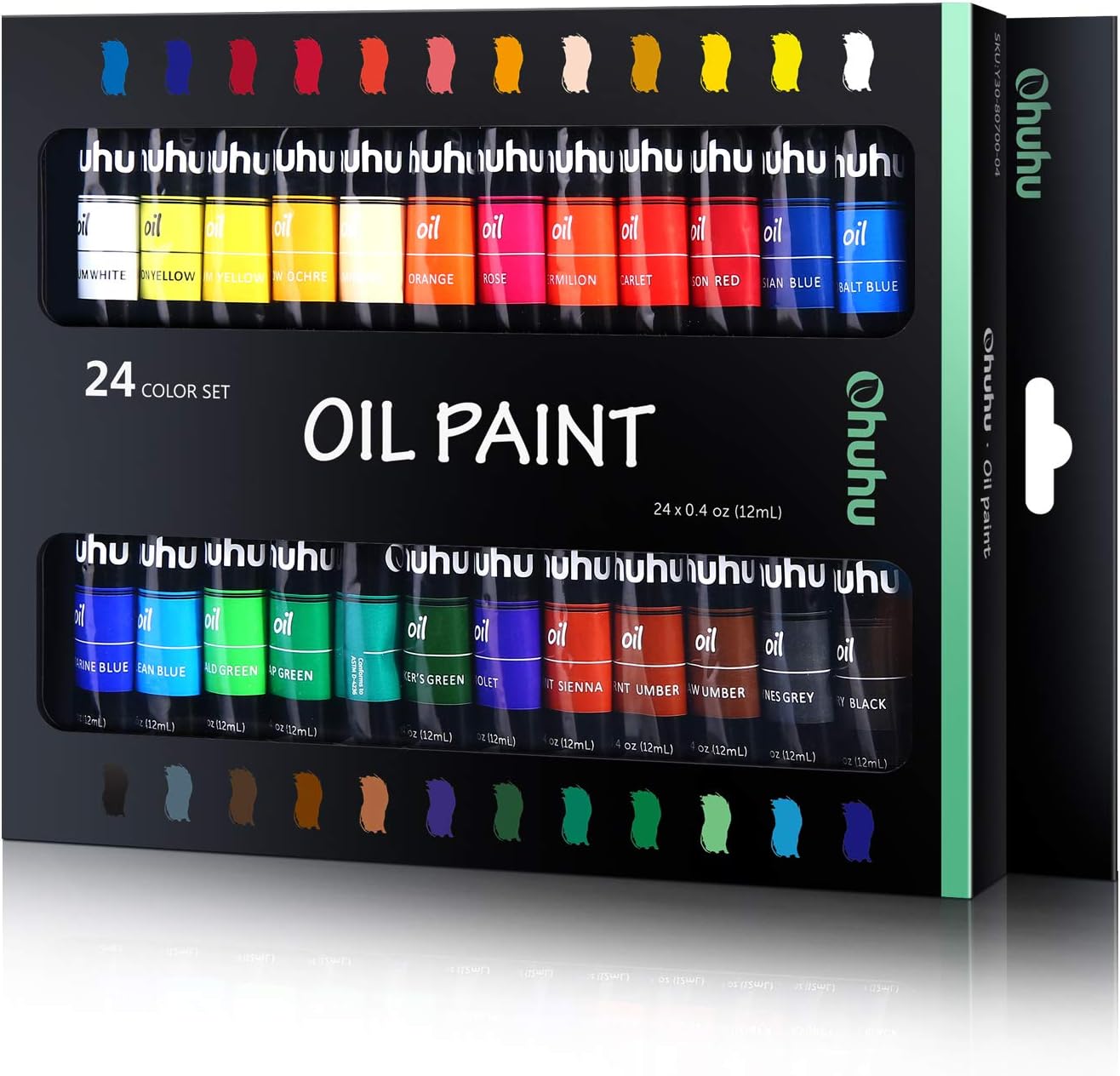
Ohuhu’s 24-color set names a sensible palette that includes titanium white, lemon and medium yellow, yellow ochre, vermilion, crimson, Prussian, cobalt, ultramarine and cerulean blues, sap green, viridian, burnt sienna, burnt umber, raw umber, Payne’s grey and ivory black. It conforms to ASTM D4236 and EN71-3.
At the lower listing price we saw, it is an inexpensive way to discover whether you enjoy oils. The listing’s claim that the paint dries quickly should be read with caution; oil paint generally dries over days.
Best suited for: Curious beginners testing oil painting before investing more.
Key features:
- 24 colors x 12 ml
- Traditional color names
- ASTM D4236 and EN71-3
- Gloss finish
Pros:
- Low cost at the lower listing price
- Useful earth tones
- Safety labeling
Cons and limitations:
- Small tubes
- Listing price varied widely
- Student-grade pigment
Buying consideration: Check the current price; this listing appeared at very different prices during our check.
5. Nicpro 30-Piece Paint Brush Set with Canvas Roll — Best for brush variety

Nicpro’s 30 brushes include 8 flats, 6 rounds, 6 filberts, 3 angles, 3 fans, 2 daggers, a cat’s tongue and a liner, with nylon bristles, double-crimped aluminum ferrules and birch handles, stored in a nylon canvas roll. The listing names oil among compatible media.
Synthetic brushes are easy to clean with the oil-then-soap method and handle thinner oil layers well. For heavy impasto, add one or two hog bristle flats later.
Best suited for: Beginners who want one brush set to cover every shape.
Key features:
- 30 brushes in 8 shapes
- Nylon bristles
- Double-crimped ferrules
- Birch handles
- Canvas roll
Pros:
- Huge shape range
- Protective roll
- Works across media
Cons and limitations:
- No hog bristle for heavy texture
- More shapes than needed at first
- Mid price tier
Buying consideration: Keep your oil brushes separate from acrylic brushes to avoid contaminating either medium.
6. CONDA 5-Piece Palette Knife Set (Red) — Best for mixing and texture

CONDA’s set includes one each of 5 standard knife styles in stainless steel with wood handles, individually packaged. The listing says blades range from a couple of inches long to only slightly longer than a thumbnail and resist wear and corrosion.
In oil painting, a knife is the best way to mix piles of color cleanly on the palette, and it opens up texture techniques like impasto and scraping.
Best suited for: Every oil beginner, for mixing and later for knife painting.
Key features:
- 5 stainless steel knives
- Standard shapes
- Wood handles
- Individually packaged
Pros:
- Very low cost
- Mixing and painting uses
- Durable steel
Cons and limitations:
- Small knives are too flexible for heavy mixing
- Wood handles need drying
- No straight mixing knife
Buying consideration: Use the largest knife for mixing and wipe it clean between colors to keep mixes fresh.
Mediums, Solvents and Safety in Plain Language
You can paint with oils straight from the tube. Mediums, usually based on linseed oil, change how paint flows, how glossy it dries and how long it takes to dry. Solvents, such as odorless mineral spirits, thin paint for early layers and help clean brushes. Many beginners use far more solvent than they need.
- Ventilate: work with a window open or fan running whenever solvents are present.
- Use less: a small jar of solvent with a lid is enough; let sludge settle and reuse the clear liquid.
- Consider solvent-free cleanup: wipe brushes, work them in a little vegetable or safflower oil, then wash with soap and water.
- Handle rags carefully: oily rags can self-heat; lay them flat to dry outdoors or store them in a sealed metal container with water.
- Keep food away: no eating or drinking while painting; wash hands afterward.
Fat Over Lean
The most important oil rule is fat over lean: each layer should contain the same or more oil than the one beneath it. Early layers can be thinned with a little solvent (“lean”); later layers use paint straight from the tube or with added oil medium (“fat”). This keeps upper layers flexible as lower layers dry, which prevents cracking. Working thin to thick follows the same idea.
Buying Guide: How to Choose Oil Painting Supplies for Beginners
Start with student-grade paint
Student lines are affordable and good enough to learn on. Upgrade your most-used colors to artist grade later.
Choose a limited palette
A warm and cool of each primary, an earth tone or two, and white is enough to mix almost anything. Extra colors are optional.
Buy more white
White is used in most mixtures. Choose a large tube from the start.
Pick versatile brushes
Flats and filberts do most of the work in oil. Add a small round for detail and a fan for texture.
Use primed surfaces
Canvas panels and oil paper are inexpensive. Avoid raw paper or unprimed canvas.
Plan safe cleanup
Decide whether to use odorless mineral spirits or a solvent-free method before you start, and set up ventilation.
A First-Week Plan for Oil Beginners
- Day 1: mix a value scale from black to white and a few tints of each color.
- Day 2: paint simple shapes, a sphere, cube and cylinder, in one color plus white.
- Day 3: paint a single piece of fruit from life with a limited palette.
- Day 4: practice blending a sky gradient on a canvas panel.
- Day 5: paint a small landscape, working thin to thick.
- Day 6: try palette knife texture on a scrap panel.
- Day 7: start a small finished painting and let it dry for several days.
Need subjects? Our step-by-step guides to painting a seashell in oil and painting fog in oil are approachable early projects that teach soft edges and value control.
Common Mistakes to Avoid
- Buying too many colors: mixing teaches more than premixed tubes.
- Using too much solvent: it weakens paint and fills the room with fumes.
- Painting thick first: work thin to thick to avoid cracking.
- Using unprimed surfaces: oil soaks in and damages paper and canvas.
- Expecting fast drying: oil takes days; plan drying space.
- Mixing oil and acrylic brushes: keep separate sets.
FAQs
What supplies do I need to start oil painting?
A student oil paint set with a large white, a few flats and filberts, a palette knife, primed canvas panels, a palette, a medium such as linseed oil, and a cleanup method.
What is the best oil paint brand for beginners?
Established student lines such as Winsor & Newton Winton are popular because they are consistent, affordable and easy to restock.
Do I need solvents to oil paint?
Not necessarily. You can paint from the tube, use oil-based mediums and clean brushes with oil and soap. If you use solvents, choose odorless mineral spirits and ventilate.
How long does oil paint take to dry?
Thin layers are often touch-dry in a few days, while thick layers can take weeks. Drying depends on pigment, thickness and conditions.
Can I use acrylic brushes for oil painting?
Synthetic brushes work for both, but keep separate sets for each medium so residues do not mix.
What surface should beginners use for oil painting?
Primed canvas panels or oil painting paper are affordable and ready to use. Stretched canvas works well for finished pieces.
Final Recommendation
For a beginner’s core paint, the Winsor & Newton Winton basic set offers dependable color in larger tubes. Choose Norberg & Linden’s XXL set if you want everything in one box, Magicfly if you prefer a big palette with extra white, and Ohuhu to try oils cheaply. Add the Nicpro brush set and CONDA palette knives, a pack of canvas panels and a safe cleanup routine, and you have everything you need to start.




