
PaintingProGuide is reader-supported. When you buy through links on this page we may earn an affiliate commission at no extra cost to you.
Metallic paint behaves differently from ordinary color. Its shine comes from tiny flakes of mica or metal pigment suspended in the binder, and those flakes lie down in the direction of your brushstroke. Brush back and forth and the flakes catch the light at different angles, which shows up as streaks, stripes and patchy shine. The best paint brushes for metallic paint are therefore soft, smooth synthetic brushes that lay paint in long, even strokes in a single direction, sized to the surface: fine rounds and liners for gilded details on canvas and crafts, small flats and slanted fitch brushes for edges and accents on frames and furniture, and 1 to 2 inch flats for larger metallic surfaces.
Quick answer: For metallic accents on paintings, ornaments and crafts, the Benicci 12-piece nylon brush set is our top pick: soft flats, filberts, rounds and a fan that hold their shape and are listed as non-shedding. For crisp gold edges on frames, molding and furniture, the GACDR slant lining fitch set gives two each of 0.5, 0.75 and 1 inch angled brushes. For metallic paint on larger flat areas, the 1 and 2 inch flats in the Pro Grade 5-piece set are an inexpensive option.
Why Metallic Paint Shows Brush Marks
Flake alignment
Metallic and pearlescent pigments are flat, reflective particles. When they all point the same way, the surface looks like smooth metal. When strokes cross, flakes point in different directions and you see stripes. The fix is to finish each area with strokes in one direction.
Paint thickness
Thick metallic coats can dry with ridges and uneven sheen. Two or three thin coats look more like real metal than one heavy coat.
Brush texture
Stiff or splayed bristles leave grooves that metallic paint highlights. Soft synthetic filaments with a clean edge lay paint down more smoothly.
Base color
Metallics are often semi-transparent. A base coat in a related color, such as warm brown or ochre under gold and gray under silver, gives a richer look with fewer coats.
Metallic paint versus gold leaf
Gold leaf is a thin sheet applied over adhesive size and burnished; it uses soft gilder’s brushes. Metallic paint is brushed on like any acrylic. This guide covers metallic paint.
Our Top Picks at a Glance
- Benicci 12-Piece Professional Brush Set — Best overall brushes for metallic accents
- GACDR Slant Lining Fitch Trim Brushes, 6 Pack — Best for metallic edges on frames and furniture
- Nicpro 30-Piece Paint Brush Set — Best large set for metallic painting on canvas
- Artstorys 20-Piece Paint Brushes — Best fine rounds for gilded details
- Pro Grade 5-Piece Brush Set — Best for larger metallic surfaces
- AROIC 10-Piece Paint Brush Set — Best budget set for crafts
- Bates 6-Pack Chip Brushes — Best disposable brushes for base coats
| Product | Best For | Key Spec | Key Strength | Price Tier |
|---|---|---|---|---|
| Benicci 12-Piece | Accents on paintings, crafts | Flat, round, fan, filbert; nylon | Soft, shedding-resistant | $ |
| GACDR Fitch 6-Pack | Edges and lining | 2 each 0.5″, 0.75″, 1″ slanted, synthetic | Sharp edge control | $ |
| Nicpro 30-Piece | Metallic painting on canvas | 8 flats, 6 rounds, 6 filberts + more; nylon | Many sizes | $$ |
| Artstorys 20-Piece | Fine details | 20 brushes, 10 sizes to 2/0, nylon | Fine points | $ |
| Pro Grade 5-Piece | Larger surfaces | 1″ and 2″ flats + angles, SRT filament | Wide, smooth flats | $ |
| AROIC 10-Piece | Budget crafts | 10 sizes, nylon | Low cost | $ |
| Bates Chip 6-Pack | Base coats, primers | 2 each 1″, 2″, 3″ chip brushes, synthetic | Disposable | $ |
How We Chose
We picked these from the Amazon listing details and specifications checked in October 2026, based on how well each brush’s filament, shape and size suit applying metallic paint smoothly, and how widely each product is reviewed by Amazon buyers. We have not tested these brushes with metallic paints. Claims about shedding and smoothness are as stated by the makers.
- Soft synthetic filaments that leave fewer grooves.
- Clean edges on flats and fitches for lining.
- Fine points for gilded details.
- Width range from detail to 2 inch flats.
- Shedding resistance, since stray hairs show in metallic finishes.
Best Paint Brushes for Metallic Paint Reviewed
1. Benicci 12-Piece Professional Brush Set — Best for metallic accents on paintings and crafts

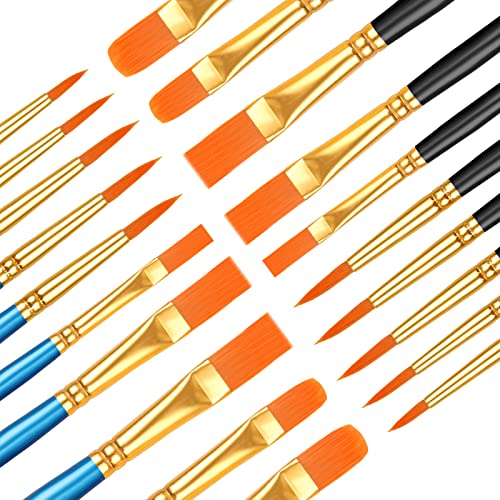
Benicci’s set includes flat, round, fan and filbert brushes with high-grade nylon bristles that the listing says keep their shape, do not shed and hold paint evenly, plus ergonomic wooden handles. It is sold for acrylic, watercolor and mixed media, and also mentions fabric, wood and board.
Soft nylon flats and filberts let metallic acrylic flow into smooth, even passes, which is how you avoid the stripes that crossing strokes create. Rounds handle gold accents on leaves, stars and lettering, and the fan can lay a soft metallic shimmer over a dry background.
Because metallic paint is often used in final accents, a brush that sheds is a real problem. A listed non-shedding claim is worth having.
Best suited for: Painters adding gold, silver and copper accents to canvas, ornaments and crafts.
Key features:
- 12 brushes
- Flat, round, fan and filbert
- Nylon bristles
- Ergonomic wooden handles
Pros:
- Soft, smooth application
- Shedding resistance stated
- Useful shapes for accents
Cons and limitations:
- No very fine liner
- Not for large furniture surfaces
Buying consideration: Finish each metallic area with light strokes all in one direction.
2. GACDR Slant Lining Fitch Trim Brushes, 6 Pack — Best for metallic edges on frames and furniture
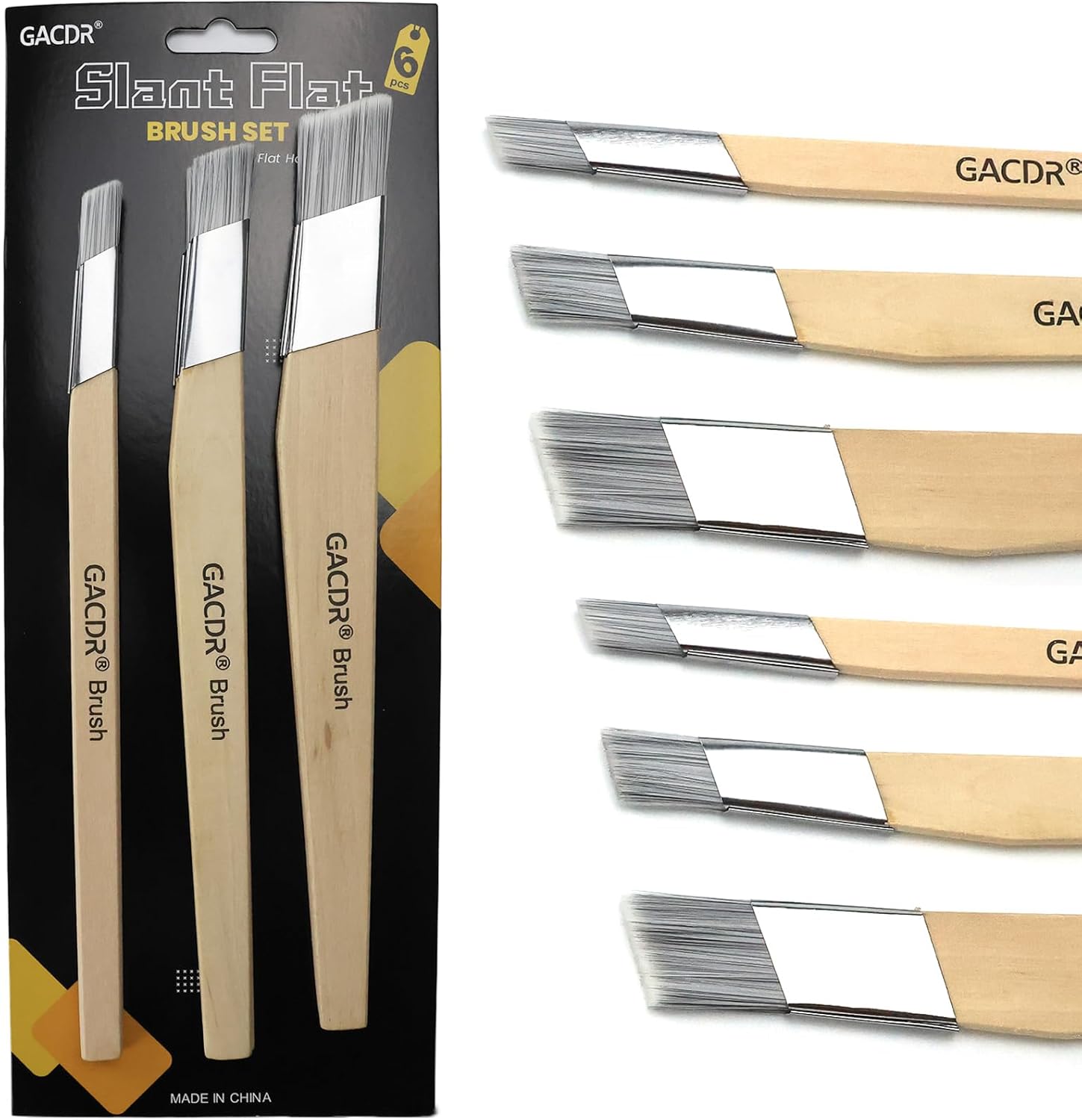
GACDR’s set contains two each of 0.5, 0.75 and 1 inch slanted lining fitch brushes with firm, micro-tipped, high-density synthetic bristles and wooden handles. The listing describes them for razor-sharp lines, trim, edging and cutting in.
Gold or silver edges on picture frames, furniture legs, molding details and drawer fronts are a common metallic project. A slanted fitch lets you ride the edge of a molding and lay a narrow, even metallic line.
Two of each size lets you keep one brush in gold and one in silver.
Best suited for: Furniture and frame painters adding metallic edges and lines.
Key features:
- 6 brushes: 2 each of 0.5″, 0.75″, 1″
- Slanted fitch heads
- High-density synthetic
- Wooden handles
Pros:
- Precise edges
- Small widths for trim
- Two of each size
Cons and limitations:
- Firm bristles may be less ideal for broad smooth coats
Buying consideration: Load lightly and pull a single stroke along the edge; avoid dabbing.
3. Nicpro 30-Piece Paint Brush Set — Best for metallic painting on canvas

Nicpro’s set includes eight flats, six rounds and six filberts among its 30 nylon brushes, with double-crimped aluminum ferrules, birch handles and a water-resistant canvas roll.
Abstract and decorative painters who use metallic paint across whole areas of a canvas need a range of flat sizes. Larger flats lay smooth metallic fields; smaller rounds and filberts handle accents.
Best suited for: Painters using metallic acrylics as a main color on canvas.
Key features:
- 30 brushes
- Flats, rounds and filberts
- Nylon
- Double-crimped ferrules
- Canvas roll
Pros:
- Many sizes
- Durable construction listed
- Organized storage
Cons and limitations:
- Mid price tier
Buying consideration: Dedicate a few brushes to metallics only; flakes can linger in bristles.
4. Artstorys 20-Piece Paint Brushes — Best for fine gilded details

Artstorys includes two packs of 10 sizes (from 2/0 up to larger rounds), 17.5 to 19.5 cm long, with UV-coated wooden handles and nickel ferrules. The listing names watercolor, oil, gouache, rocks and canvas among uses.
Gold highlights on eyes, jewelry, stars and lettering need fine rounds. Two of each size lets you keep separate brushes for metallic and non-metallic paints.
Best suited for: Painters adding small metallic details.
Key features:
- 20 brushes, 10 sizes
- Nylon
- Nickel ferrules
- UV-coated handles
Pros:
- Fine points
- Low price tier
Cons and limitations:
- Small sizes only
Buying consideration: Stir metallic paint well; flakes settle quickly.
5. Pro Grade 5-Piece Brush Set — Best for larger metallic surfaces

Pro Grade’s set includes 1 and 2 inch flats plus 1.5, 2 and 2.5 inch angled brushes with SRT filaments and adhesive-bonded bristles. The listing says the flats give broad, smooth coverage on furniture, shelving and doors.
For metallic paint on a cabinet, a mirror frame or a piece of furniture, the 2 inch flat lays smooth passes, and the angles reach corners.
Best suited for: DIYers using metallic paint on furniture and home decor.
Key features:
- 5 brushes
- 1″ and 2″ flats
- Angles and angle stubby
- SRT filament
Pros:
- Wide flats
- Low price tier
Cons and limitations:
- Less refined than artist brushes
Buying consideration: Apply thin coats and let each dry before the next.
6. AROIC 10-Piece Paint Brush Set — Best for budget crafts

AROIC’s 10-piece set covers 10 sizes with nylon bristles, nickel ferrules and solid wood handles, and the listing says it gives smooth, streak-free strokes.
For metallic craft projects such as ornaments and pumpkins, an inexpensive set you can dedicate to metallics is practical.
Best suited for: Crafters using metallic paint occasionally.
Key features:
- 10 brushes
- 10 sizes
- Nylon
Pros:
- Low cost
- Range of sizes
Cons and limitations:
- Basic quality
Buying consideration: Label these brushes for metallic use only.
7. Bates 6-Pack Chip Brushes — Best for base coats and primers

Bates’ chip brush set includes two each of 1, 2 and 3 inch brushes with soft synthetic bristles and wooden handles, for paints, stains and finishes.
Chip brushes are not ideal for the final metallic coat, but they are perfect for the base coat underneath and for primers.
Best suited for: Base coats under metallic finishes.
Key features:
- 6 chip brushes
- 1″, 2″ and 3″
- Synthetic bristles
Pros:
- Very low cost
- Several widths
Cons and limitations:
- Leave more texture than artist brushes
Buying consideration: Sand lightly after the base coat for a smoother metallic finish.
How to Get a Smooth Metallic Finish
- Prepare a smooth surface; sand furniture and use well-primed canvas.
- Apply a base coat in a color that complements the metallic.
- Stir the metallic paint thoroughly; do not shake if the label advises against it.
- Load the brush moderately and lay paint in long strokes in one direction.
- Do not go back over areas that have started to dry.
- Apply a second thin coat after the first dries.
- Seal with a clear topcoat if the piece will be handled; test first, since some sealers dull metallic sheen.
Choosing a Metallic Paint
Brushes are only half the story; metallic paints vary a lot. Craft metallic acrylics in small bottles are inexpensive and fine for ornaments and accents, though many need two or three coats. Artist-grade metallic and interference acrylics have finer pigment and smoother flow on canvas. Metallic waxes and gilding pastes are rubbed on with a finger or soft cloth and buffed, which avoids brush marks entirely on raised details. Liquid leaf and solvent-based metallic finishes can give a bright, mirror-like effect but need ventilation and solvent cleanup, so keep separate, inexpensive brushes for them.
Base Colors That Make Metallics Look Richer
- Gold: a warm red-brown, ochre or yellow base adds depth and covers gaps.
- Silver: a mid-gray or black base gives a pewter look; white makes it brighter.
- Copper and bronze: a burnt sienna or dark brown base enhances warmth.
- Rose gold: a soft pink or terracotta base supports the color.
Metallic Paint Projects
- Gold accents on canvas: moons, stars, leaf veins and abstract lines.
- Gilded frames: metallic edges on wooden picture frames.
- Furniture accents: drawer pulls, legs and trim.
- Holiday crafts: ornaments, pumpkins and pinecones.
- Lettering: metallic letters on signs and cards.
Cleaning Brushes After Metallic Paint
Metallic flakes are heavier than ordinary pigment and tend to settle deep in the heel of a brush, near the ferrule. Rinse brushes thoroughly in water, then work a little brush soap into the bristles and squeeze from the ferrule toward the tip until no glitter remains in the lather. Rinse again, reshape the tip and dry the brush flat or tip-down. If you skip this, the next color you paint can pick up a faint shimmer, which is why many painters keep separate brushes for metallics. For solvent-based metallics, use the cleaner recommended on the label before washing with soap.
Buying Guide: How to Choose Brushes for Metallic Paint
Soft synthetic filaments
Soft nylon or taklon leaves fewer grooves for metallic flakes to highlight than stiff bristle does.
Shape for the job
Fine rounds for details, fitches and small flats for edges, wide flats for larger areas.
Clean edges
Brushes with crisp edges help with metallic lines and trim, where a wobble is very visible.
Shedding resistance
A stray hair in a shiny finish is obvious; choose brushes with crimped ferrules.
Dedicated brushes
Metallic flakes can linger in bristles; keep separate brushes for metallics, marked with a dab of gold paint on the handle.
Budget for base coats
Use cheaper brushes for primer and base coats, and reserve your softest brushes for the final metallic layer where every stroke shows.
Related Brush Guides
Smooth metallic finishes depend on brushes in good condition. See how to keep brushes from shedding, how to dry brushes correctly and how to work with large brushes on broad metallic areas.
Common Mistakes to Avoid
- Brushing back and forth, which creates stripes.
- Applying one thick coat instead of thin coats.
- Skipping a base coat under transparent metallics.
- Using a splayed, worn brush.
- Not stirring the paint, so flakes are unevenly distributed.
- Using the same brush for metallic and regular colors without a thorough wash, which leaves sparkle in later work.
- Sealing with a product that dulls the shine without testing on a sample first.
FAQs
How do I avoid brush strokes with metallic paint?
Use a soft brush, thin coats and finish each area with strokes in one direction.
What brush is best for gold paint?
Soft synthetic rounds for details and small flats or fitches for edges.
Should I use a base coat under metallic paint?
Yes, a complementary base color improves coverage and richness.
Can I use a foam brush for metallic paint?
Foam brushes can give smooth results on flat surfaces but are less precise for detail.
Does metallic paint need a sealer?
For handled items, a clear sealer helps; test first, as some dull the shine.
How do I paint gold edges on a frame?
Use a slanted fitch or small flat, load lightly and pull steady strokes along the edge.
Final Recommendation
For metallic accents on paintings and crafts, choose the Benicci 12-piece set. For gold edges on frames and furniture, the GACDR fitch set gives precise control. Painters using metallics across a canvas will appreciate the Nicpro 30-piece range, and Artstorys rounds handle fine details. Use Pro Grade flats for larger surfaces, AROIC for budget crafts and Bates chip brushes for base coats.




